A trade union for actors and actresses

WHILE DRINKING IN the first-floor bar of the Duke of York’s Theatre (‘DOY’) in London’s St Martin’s Lane, I noticed an interesting small commemoration plaque. But before discussing that, first a few words about the theatre.

The DOY was opened in 1892 with the name ‘The Trafalgar Square Theatre’. Later, it was given its present name in honour of the Duke of York, who later became King George V. It was designed by the leading theatre and music hall architect Walter Emden (1847-1913). Amongst the many plays performed in this beautiful fin-de-siecle theatre where JM Barrie’s play, the precursor of his book, “Peter Pan, or The Boy Who Wouldn’t Grow Up” which was premiered in late 1904. The theatre was bought by the Ambassador Theatre Group (ATG) in 1992. Since its opening, many successful plays have been performed in it. The play we watched in mid-November 2022 was “The Doctor” by Robert Icke. It was a lively and engaging play that was crammed a bit too full of dilemmas that trouble us today.

The plaque, which I noticed whilst waiting to enter the auditorium was put on the wall of the bar to celebrate that on the 1st of December 1929, a mass meeting of actors and actresses was held in the theatre. Those assembled resolved to form the ‘British Actors Equity Association’. Above this plaque, there is a framed document with many signatures below the words:
“We the undersigned, hereby pledge ourselves that we will not enter into any engagements with Theatre Managers on conditions which would deny our right to refuse to work with non-members of Equity.”


Amongst the signatures on this undated document, I was able to read those of Flora Robson, Hermine Baddeley, Violet and Irene Vanburgh, Marie Burke, Reginald Backs, Robert Donat, Sybil Thorndyke, Leslie Henson, Godfrey Searle, and many others.


This document marked the birth of the actors’ union known as Equity. As the document suggested, and like many other British trade unions, Equity adopted the closed-shop policy. When this was made illegal by Margaret Thatcher’s government in the 1980s, joining the union required evidence of having experience of a sufficient amount of paid professional work.

I must admit that I am not sure whether seeing the memorial to the foundation of Equity was not more exciting for me than watching the play I had come to see.

Body Politics at the Barbican Gallery

AT THE TICKET desk of the Barbican Gallery we were hesitantly asked if we knew about the exhibition of Carolee Schneemann (1939-2019) because it contains some sexually explicit exhibits. We said we knew roughly what we were heading for.

The exhibition is laid out on two floors and visitors are given a suggested route that allows one to see the gradual development of Schneemann’s work from abstract and semi-abstract painting through to highly adventurous installations and happenings (to use a word that assumed a special meaning in the 1960s).

The artist’s earlier works are on the upper floor. Dissatisfied with the relative flatness of painting on canvas, she began adding a third dimension to her paintings. Soon she was producing collections of objects in boxes, rather like the kind of things produced by Joseph Cornell. Unlike Cornell, who filled his boxes and frames with intact objects, Schneemann filled hers with damaged objects, such as rusty musical boxes and fragments of broken glass.

Much of Schneemann’s work became involved with the human body and sexual experiences, as depicted from the female point of view. In many of her creations, she used her own body as a prop. For example, there is a film recording of a ‘happening’ during which she painted glue on her naked body and then applied scraps of paper to herself, creating a human collage. Many of her other works either defy description or if described might disturb the squeamish or prudish reader.

Later in her career, she moved from depicting the body and sexual matters to political comment and protest. Most of these often powerful works are in the form of videos and installations.

I much preferred the earlier works on the upper floor. They were created as timeless artworks that could be looked at whenever. The more adventurous and innovative works on the lower floor are mostly almost static records of events that would have been seen to full and maximum effect when they took place in real life so many years ago. That said, this exhibition was both exciting and interesting.

Glorious detail in a gothic revival church

I HAD PASSED it often, but never entered it until recently when I attended a concert within it. I am talking about a church on Holland Road in West London not far from Shepherds Bush, St John the Baptist. This Anglican church is an exceptional example of gothic revival style. Designed by James Brooks (1825-1901) with John Standen Adkins (an assistant of Brooks), it was constructed between 1872 and 1910.

Although the façade facing Holland Road is not exceptional, the church’s interior is highly breathtakingly decorative. Unlike mediaeval churches, which took centuries to complete, St John the Baptist was constructed in much less time. Yet, its decorative details, which imitate what is best in many older churches, rival those found within the old ones. The workmanship and fine details in St John’s remind one of the best productions of craftsmen, who flourished many centuries earlier. However, unlike the earlier churches, which inspired the designers of St John’s, the interior of the church on Holland Road looks too good to be true. Completed in a relatively short period, the variety that adds to the charm of gothic churches built in earlier times and more slowly is lacking in St John’s and other fine examples of late Victorian gothic revival buildings. What we see at St John’s is the realisation of the architects’ concept of an ideal ‘mediaeval’ church. What was achieved at St John’s is probably something like the results early creators of (mediaeval) churches hoped to create, but never lived long enough to see fully realised.

The attention to detail in the better gothic revival churches, such as St John’s, is marvellous. The result is an ensemble of decorative features rich in meticulously executed intricate details. While I was listening to the concert in St John’s, my eyes took in the details of the church, and I began thinking it was amazing that the elaborate attention to fiddly ornate minutiae was carried out only a few years before architectural trends turned through 180 degrees from excessively decorative to the greater simplicity of much 20th century architecture.

A railway station far below the surface at Hampstead

HAMPSTEAD UNDERGROUND STATION, which was designed by Leslie W Green (1875-1908), was opened for passengers in June 1907. Green was responsible for the use of blood red, glazed terracotta tiling on many of London’s Underground stations. The station facades and interiors which he designed, including those at Hampstead, feature many aspects of the British Art Nouveau style. Examples of this style can be seen on Hampstead’s facade, interior tiling, and the ticket office counters.

While I was researching my latest book, “Golders Green & Hampstead Garden Suburb: Visions of Arcadia” (available from Amazon), I came across an interesting diagram in a book by FC Howkins (published in 1923). It shows how the Northern Line tracks rise gradually from several feet below sea level at Embankment (formerly Charing Cross) station to 192 feet above sea level at Hampstead station. However, Hampstead station’s ticket office is about 360 feet above sea level, which is 168 feet above the tracks and platforms (Wikipedia stated that the platforms are 192 feet below the surface). High speed lifts convey passengers between the platform entrances and the ticket office. Originally, these were slow lifts which were entered though brown sliding wooden doors with Art Nouveau inspired cut-outs for ventilation purposes. These old lifts still existed when I was at school in the 1960s, but the newer high-speed lifts with metal concertina doors were the main method of moving between the surface and the trains. Currently, newer lifts have replaced those which were in use between the 1960s (or maybe earlier) and 2014.

If you have a long wait before your train arrives at Hampstead, it is worth wandering to the end of the platform, where you will find the station’s original name, ‘Heath Street’, still on the wall. Today, I disembarked at Warren Street, and noticed that its old name ‘Euston Road’, is still clearly visible at the end of the southbound platform next to its exit.

By 1907, the Northern Line had been extended northward to Golders Green, whose station was opened for passenger use in 1907. It is a long journey between Hampstead and Golders Green stations. An intermediate station near the Bull and Bush pub (on North End Road) was planned. Although the platforms were constructed, they have never been used by passengers, and there is only a small hut on the surface (on Hampstead Way), which contains the entrance to shafts leading down them. Opposition by the founders of Hampstead Garden Suburb and later its residents ensured that the planned ‘North End’ station was never completed.

The Art Nouveau ticket counters at Hampstead station are no longer in use, but they have been beautifully preserved. In each of them, there are information panels detailing the aspects of the station’s history. Other decorative features have been maintained but much of the space in the ticket hall is occupied by the automatic ticket-checking entrance and exit portals. Perched at the top of the High Street, at the point where it meets Heath Street, Hampstead station is an important meeting point and a hard to miss landmark.

Two in one at South Kensington

SOUTH KENSINGTON STATION has two street entrances connected by an arcade with a glazed roof. Its subsurface ticket office and foyer gives access to three of London’s Underground Lines: Circle, District, and Piccadilly. But this has not always been the case. People standing outside the southern entrance to the arcade will notice that to its right there is a building faced with the blood red glazed terracotta tiles typical of many London Underground stations. Above the façade are the words “South Kensington Station”, but there is no public entrance to this building.

The arcade used to be the entrance to the station at which passengers could embark and disembark from trains operating on the District and Circle lines, which were part of the Metropolitan Railway. This station was opened in 1868. In 1906, a station on the Great Northern, Piccadilly and Brompton Railway (now the Piccadilly line) was opened at South Kensington. Its platforms are far deeper beneath the surface than those of the District and Circle lines. Lifts inside the building with the red façade carried passengers to and from the Piccadilly line platforms. This building was then the entrance to the Piccadilly Line station, which was separate from that (with the arcade) which led to the shallower subsurface Circle and District platforms.

In the early years of the 1970s, the lifts to the Piccadilly Line were replaced by escalators. Access to these was made from the concourse that serves the District and Circle line platforms, and then the entrance via the building with the blood red façade was taken out of use. So, what had been two stations became one.

You can read much more about South Kensington in my book “Beyond Marylebone and Mayfair: Exploring West London” (see: https://www.amazon.co.uk/BEYOND-MARYLEBONE-MAYFAIR-EXPLORING-LONDON/dp/B0B7CR679W/)

A mansion in Marylebone

A HIGHLY DECORATIVE BLOCK of flats stands on the southeast corner of the intersection of Wimpole and New Cavendish Streets. Bearing the date 1892, one of its large bricks was laid by Mary Mason Lithgow.

Mary was the mother of the person who commissioned the building, the lawyer and property developer Samuel Lithgow (1860-1937). Samuel was born in Marylebone and after qualifying as a solicitor, he practised at 42 Wimpole Street. Politically inclined, he represented the West St Pancras ward of the London County Council between 1910 and 1913. A philanthropist, he founded the Stanhope Institute for Men in 1891. In addition, he was a governor of the North West London Polytechnic (founded 1896).

Wimpole House was designed by Charles Worley (1853-1906) in the so-called Belgian Renaissance Style. It is a very florid addition to an area filled with buildings displaying a wide variety of decorative flourishes

A chance meeting in north London

During the late 1990s, our then young daughter had a baby-sitter called Bridie. Although Bridie was already well into her eighties when we first met her, she was a remarkably sprightly lady. Born in a rural part of the west of Ireland, she came to England in her late teens. On arrival in England, she and her husband were cared for by the Salvation Army in exchange for taking a pledge never to drink alcohol again. Bridie never reneged on this promise.  To earn a living in London, where she settled, she became a domestic servant. Hearing that I had been brought up in northwest London’s Golders Green, she told me the following story.

War memorial clocktower in Golders Green

Sometime before WW2, Bridie was employed as a maid in a Jewish household in Golders Green. She looked after the family’s children and carried out many household duties. Even though it was not a particularly wealthy family, Bridie recalled that she wore uniforms when on duty. There was one outfit that she wore in daytime and in the evening, she changed into another. As she did with our daughter, Bridie became fond of the family’s two young sons.

Many years later, when Bridie had become a grandmother and our daughter’s baby-sitter, she used to spend her spare time travelling around London by bus (making use of her old age free bus pass).  One day, she was waiting for a bus at the stop closest to Golders Green’s Sainsbury’s (on the site of the Ionic cinema), when a well-dressed late middle-aged man in the queue said to her:

“Goodness! Is it you, Bridie? We have not seen each other for so many years.”

After a moment, Bridie realised that she was being addressed by one of the two boys, whom she had looked after in the house in Golders Green before the War. Just then, a bus arrived, and as her former charge was about to embark, he shouted:

“This is my bus. Are you taking it, Bridie?”

Bridie misheard what he had said, and by the time she realised, the bus had pulled away, leaving her at the bus stop. She told me that if she had known he was taking that bus, she would have joined him. As far as I know, she has never seen him again.

A slave owner in central London

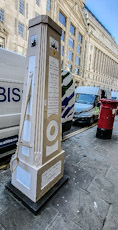
THE TALL GREY GRANITE drinking fountain that stands on the southeast corner of London’s Lincoln’s Inn Fields is no longer in use. The inscription carved on its base reads:

“In memory of Philip Twells. Barrister at law of Lincolns Inn and sometime Member of Parliament for the City of London. 8 May A.D. 1880”

Born the son of a banker John Twells (1776-1866), Philip (1808-1880) attended Oxford University and then was called to the bar at Lincoln’s Inn in 1834. His father was a partner in the private bank of Spooner Attwood & Co. In 1863, that bank was taken over by Barclay, Bevan & Tritton & Co, a precursor of the modern Barclays Bank. It was then that Philip became a partner in the enlarged banking concern. He was MP for the City of London from 1874 to 1880.

A website (www.layersoflondon.org/map/records/philip-twells-mp-banker-and-slave-owner-of-stoke-newington-church-street) recorded that Philip Twells owned 252 slaves in Jamaica, and added:

“The Slavery Abolition Act of 1833 had made the ownership of slaves illegal within the British Empire although servitude was replaced by ‘apprenticeship’ for at least five years. The 1837 Slave Compensation Act provided compensation to owners for the loss of their business assets.”

Another website (http://wwwdepts-live.ucl.ac.uk/lbs/person/view/46210) noted that Philip Twells was:

“Awarded part of the compensation for the Islington estate in St Mary Jamaica with his brother Rev. John Twells …”

The slave-owner compensation awarded to Philip was £4207, which is worth well in excess of £300,000 in today’s money. On his death, Pholip left a substantial fortune to his wife.

The fountain commemorating Twells in Lincoln’s Inn Fields was a gift of his widow, and was erected in 1882. Sadly, this memorial to a former owner of slaves can no longer refresh the passer-by. However, during weekdays, food and drinks can be obtained at a café in the middle of Lincolns Inn Fields. And while you are in the area, do not miss seeing the magnificent Sir John Soane’s Museum on the north side of the Fields.

Art Deco in Victoria

I HAVE WALKED past London’s Victoria Coach Station many times without looking at it particularly carefully. Yesterday, the 28th of September 2022, I was early for a meeting at the Embassy of Albania, which is not far from Victoria Station. So, I walked slowly, stopping to look at the Coach Station. I had never noticed before that it is a fine example of Art Deco architecture.

The Coach Station, which opened for use in March 1932, was designed by Wallis, Gilbert, and Partners.

I suppose that my interest in Art Deco buildings was initiated by visits to Bombay (Mumbai), where there are many splendid examples of this style of architecture. Gradually, I am discovering that London also has a rich collection of Art Deco buildings. The Coach Station is a fine and well-maintained example.