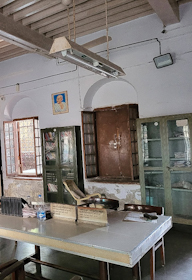
AN OLD BUILDING stands near the Bhadra Fort in the heart of old Ahmedabad. This is the Himabhai Institute. Its origin dates back to 1849 when Alexander Kinloch Forbes, an administrator in the British East India Company, set up the Gujarati Vernacular Society which aimed at carrying out social reforms, enriching the Gujarati language and its literature, and to promote ‘useful knowledge’.
The Society set up a library in the building now known as the Himabhai Institute. A leading light in establishing the library was the Gujarati poet Dalpatram, a friend of Forbes and his teacher of the Gujarati language.
Dalpatram, whose full name was Dalpatram Dahyabhai Travadi, lived from 1820 to 1898. According to Wikipedia, he: “… led social reform movements in Ahmedabad, and wrote articles against superstitions, caste restrictions and child marriage. He dealt with the problem of widow remarriage at length in his poem, Vencharitra … In 1885, Dalpatram was made a Companion of the Most Eminent Order of the Indian Empire.”
The library, named after the philanthropist Himabhai (Vakhatchand) who lived from 1785 to 1858, is one of Gujarat’s oldest. It contained a valuable collection of books and manuscripts. Today, unfortunately, the place is in a sad condition. The number of people using it has declined considerably. This is to some extent due to the Internet having become a major source of information, and as a consequence people depend less on books than they used to. The Institute has a peaceful rear garden and on the first floor there is a hall that can be used for meetings and other functions.
A preserved historical building, the now melancholic Himabhai Institute was known as the “Native Library” in the nineteenth century.
IN AUGUST 2003, we spent a day in Aliwal North (now called ‘Maletswai’). This small town on the northern border of South Africa’s Eastern Cape Province is not on many tourists’ itineraries. We went there for a special reason. It was originally named after the Battle of Aliwal (1846), a British victory during the First Anglo-Sikh War.
The town was laid out in 1849. When this happened, the Jewish mercantile firm, Mosenthals, opened a branch in the newly established town. After a few months, they sent a young man, Heinrich (later ‘Henry’) Bergmann (1831-1866), to manage the new store and to help sell land in the embryonic township. Very rapidly, Bergmann became one of the most prosperous people in Aliwal North. He owned much land and managed a bank in the town. Soon, he was so successful that he took over the town’s other two banks. For reasons that are not altogether clear, but they might have had something to do with a financial problem, Bergmann shot himself. Having committed suicide, neither the small Jewish cemetery nor the Christian one was prepared to bury him. In the end, his friends the De Wet family, who farmed in the district, buried him in their private family cemetery, and that is where we saw his gravestone when we visited Aliwal North in 2003.
Henry Bergmann was my mother’s grand uncle.
Arriving in what was then the Cape Colony in 1849, he was the first member of my family to migrate from Germany to southern Africa. He was also amongst the small number of Jewish people who came to that part of the world in the first half of the nineteenth century. The majority of Jewish migrants to what is now South Africa began arriving after the late 1860s, as I have described in my book “Exodus to Africa”.
We visited Aliwal North in 2003 as part of my research into the life of Henry Bergmann. Apart from meeting members of the De Wet family, descendants of those who buried Bergmann, who showed me family histories containing details of my ancestor’s life and fields that were once owned by him, we spent some time with Mrs Joubert, the librarian of Aliwal North’s public library. She was extremely helpful and took a great interest in my research.
Aliwal’s library was selling a few books that were no longer needed. My wife bought a few novels, one of which was “Mr Mirakel” by E Phillips Oppenheim (1866-1946). The book we bought contains the words: “First printed … 1943”. It is a first edition. Inside the book, there are labels inserted by the library. They are printed both in English and Afrikaans. There are also four imprints of an inked rubber stamp. Each one reads: “Aliwal North. Public Library. Cape of Good Hope.”
Just before 1910, when the Unification of South Africa occurred, what had been known as the Cape Colony became known as ‘The Cape of Good Hope Province; (‘often shortened to ‘the Cape Province’). In 1994, this vast territory was divided into the Northern Cape, Western Cape, and Eastern Cape provinces. Given that the book can only have been acquired in or after 1943, the words ‘Cape of Good Hope’ on the stamp intrigued me. Although they do refer to a geographic entity, they have never, as far as I can see, referred to an administrative area, and did not do so on or after 1943 when the book was published.
Had we not been sorting out our books recently, we would not have come across the book from Aliwal North. Seeing it and its library labels and stamps brought back memories of our visit to Aliwal North 22 years ago.
VISITORS TO LONDON (and residents of the city) should not miss visiting Kenwood House, which is in north London between Hampstead and Highgate. Not only does it contain a magnificent collection of Old Master paintings that can be compared favourably with what can be seen in Britain’s finest public art galleries, but it also has a beautiful library.
In my book about Hampstead, “Beneath a Wide Sky: Hampstead and its Environs”, I wrote:
“The first house to stand on the site of the present one was built in brick by John Bill (1576-1630), printer to King James I. He bought the Kenwood Estate (which was known as ‘Caen Wood’) in 1616. After several changes in ownership, the Estate was bought in about 1747 by a former Prime Minister and King George III’s close associate, John Stuart, third Earl of Bute (1713-1792). In 1754, Bute sold the property to the lawyer and law-reformer William Murray (1705-1793), who became the First Earl of Mansfield, and was Lord Chief Justice of the King’s Bench from 1756 to 1788. In 1778, he was a supporter of the Roman Catholic Relief Bill that led to the violent protests described above. During the First Earl’s stay in the House, he employed the architect Robert Adam (1728-1792) to make improvements.”
The library was one of the improvements that Robert Adam created at Kenwood. The library or Great Room was constructed between 1764 and 1774. It was intended both as a reception room and a library, which might explain why so little of this large room’s wall space is occupied by bookshelves. Most of the wall space is occupied by mirrors and windows. Lord Mansfield would have been used to host guests, hold dinners, and for music performances.
The library’s architecture is based on that of Roman public bath houses. John Summerson (1904-1992), the architectural historian, wrote of its design in his “The Iveagh Bequest, Kenwood : a short account of its history and architecture” (published 1988):
“This is one of the finest Adam rooms in existence … The shape of the room, with its curved ceiling leading into two apsidal ends, on the chords of which are pairs of columns, is one which Adam used for several of his most stately interiors. Apart from the plan, a great innovation for England was the flat arched ceiling which Adam frankly describes as ‘extremely beautiful …”
Although the library is the finest of Adam’s creations at Kenwood, there are others that deserve to be admired. These include the orangery, the entrance hall with its magnificent stucco ceiling, and the library’s anteroom. In this piece I have concentrated on the interior of Kenwood House, but a visit to this wonderful place should be accompanied by a stroll in the place’s superb, landscaped gardens.
JUST IN CASE you do not know about it, there is a wonderful independent cinema in West London’s Acton. Called ActOne, it is housed in what was once Acton’s public library. Built between 1898 and 1900, it was one of a series of public libraries financed by the philanthropist Passmore Edwards. Incidentally, the Bush Theatre in Shepherds Bush is also housed in a former Passmore Edwards library.
ActOne has two screens, both with comfortable seating and good sound systems. The public spaces in the library include a bar and a large room with shelves filled with books about cinema. All in all, ActOne is a lovely place to enjoy films.
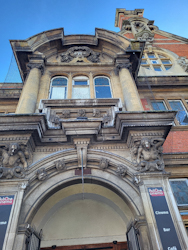
THE DAVID LEAN cinema, where we watched a superb film called “Coming to America” (made in 1988), is within a complex known as the Croydon Clocktower. In the heart of Croydon, this cultural centre is housed in what was originally constructed as the district’s Town Hall.
The Town Hall is a magnificent – exuberant – example of Victorian brickwork. It was constructed to the designs of a local architect, Charles Henman, and inaugurated by the Prince of Wales in 1896. There is a large statue of his mother, Queen Victoria, outside the façade on Katherine Street.
Until the 1980s, the enormous edifice was used for local government purposes. In the late 1980s, and early 1990s, the interior was renovated. Areas that were no longer needed for council business were repurposed as a public library, a café, a museum, and the David Lean cinema. A large room, which retains its original interior décor, the Braithwaite Hall, continues to be used for concerts, theatrical shows, and other public functions. It looked to me that the inside of the building had been hollowed out to create a spacious central atrium with a glass roof, which can be overlooked from galleries surrounding it on each floor. The result is pleasing to the eye. From the outside of the building, you would not expect to see this kind of atrium. The Town Hall complex is now known as the Croydon Clocktower, the name referring to the building’s high brick clock tower.
The film we watched in the small David Lean cinema was wacky but wonderful – a complete contrast to an incredibly slow-moving Taiwanese film, “Days”, which we watched a few days later.
MERSEA ISLAND IS south of Colchester in the mouth of the Blackwater River, which flows through the south of Essex. Connected to the mainland by a cuseway, which gets submerged twice a day when it is high tide, Mersea Island feels like it is many hundreds of miles away from London, even though it is about 60 miles from Trafalgar Square and only a few miles from Chelmsford and Colchester. The island has two settlements: West Mersea and the much smaller East Mersea.
Although there are some working people on the island, many of its residents are retired. We did spot a few (less than five) people, who did not look as if their heritage was white British, but the island cannot be described as having a multi-ethnic population. The island is an outpost of the Anglo-Saxon heartland. It seems to be a friendly community. People with whom we spoke were very amicable. Having said this, a surprise greeted us when, out of curiosity, we stepped inside West Mersea public library, which is run by Essex County Council.
The library is a modern structure with a simple but pleasant, spacious reading room. Immediately after entering, we spotted a bookshelf with a notice above it. This had the words “Author of the Month”. The author whose books were prominently displayed on the shelves were by Vaseem Khan. He was born in east London in 1973, and studied at the London School of Economics. Then, he worked for ten years in India. His experience of India led him to begin writing detective novels set in India. My wife, Lopa, has read and enjoyed many of his books.
I am not sure why we were so surprised to see Vaseem Khan’s books given pride of place in the library in West Mersea. Maybe, it was because our experience of the island is that its population is far from being cosmopolitan. Lopa spoke to the librarian, saying how pleased she was that Vaseem Khan had been highlighted, and then began mentioning other British Indian authors such as Abir Mukherjee and Imran Mahmood. The librarian had read books by all these authors and spoke knowledgeably about them. She had chosen Vaseem Khan to be the author of the month because she had met him at a literary festival, and then invited him to speak in her library. We left the library having been highly impressed by what she had discussed with us.
One thing we forgot to ask her was how often Vaseem’s books were borrowed in comparison with other fiction writers’ volumes on the shelves. I would liked to have discovered whether her display of Vaseem’s books attracted much attention from the local, seemingly Anglo-centric, users of the library.
THE TOWN OF Redruth in Cornwall was once the centre of a flourishing mining industry. Now, although it contains a few attractive buildings that remind the visitor of its heyday, it has a slightly forlorn feeling. Amongst the many places in Cornwall that attract the visitors, Redruth is not highly rated. However, it has an attraction that is well worth visiting. Located at the western edge of the old town, it is called ‘Kresen Kernow’.
Kresen Kernow is the Cornish for ‘Cornwall Centre’. Recently opened (in 2019), it houses the historical archives of Cornwall, a library, and a café. What makes it so very special is its architecture and the ‘recycling’ of a former industrial building. This used to be the on the site of the Devenish Brewery, which had been the Cornish Brewery Company Ltd until 1934. In 1991, the brewery was sold to new operators and renamed the ‘Redruth Brewery’. This closed in 2004, and the edifice fell into decay, and was damaged by fire both in 2011 and 2013.
During the early 2000s, Cornwall Council began to consider having a new archive centre and local studies library. After much deliberation, the former Redruth Brewery was chosen as the site for a new home for Cornwall’s archives. In 2015, the derelict brewhouse was purchased by the council, and after the site was cleared and decontaminated, construction commenced. The building was chosen because despite the damage it had suffered, its shell was recognised as being of great beauty. Making use of much of what was left of the original brewhouse, the architects of the Purcell Practice designed a new building. Pictures of the project before and after it was completed can be seen on their website (www.purcelluk.com/projects/kresen-kernow/).
Completed in 2019, the result is a beautiful blend of modern design and the remains of the original structure. With clean lines and plenty of natural illumination, the building consists of a harmonious combination of interconnecting spaces. On the ground floor, there is a spacious reception area in which there are exhibition display cases and an area for temporary exhibitions. There is also a café. Apart from public spaces, there are several for use of the staff of the archives. The first floor has a library and rooms where people can carry out research on archival material.
Behind the refurbished building, there is a courtyard in which there are sculptures of ‘ordinary’ people. They resemble a group of people who have suddenly frozen during conversations. They were created in 2015 by two artists from Glasgow: Craig Little and Blake Whitehead.
I hope that the presence of Kresen Kernow and the gradual recognition of the beautiful 19th century and earlier buildings in the town will help elevate Redruth to the ranks of places worth visiting in Cornwall.
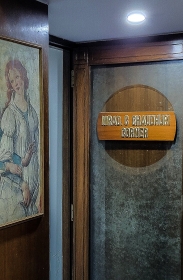
THE CALCUTTA CLUB (in Kolkata) was founded in 1907. Unlike other ‘elite’ clubs in existence at that time, it admitted members regardless of their ethnic background. The Club has a library consisting of several rooms arranged in a line, each one connecting to the next. At the far end of the library, there is a locked door bearing the label:
“Nirad C Chaudhuri Corner”.
Nirad Chaudhuri was one of 20th century India’s great writers. Born in 1897 at Kishoreganj – a place that is now in Bangladesh, but was then in British East Bengal – he died in Oxford (UK), having passed his 101st birthday. He was an original thinker whose views have not been shared by everyone. He wrote about India and its history in an incisive way that was not fettered by the conventional ideas of his contemporaries. In the 1970s, he shifted from India to England, and settled in Oxford. A few years ago, we met and were befriended by his son Prithvi – now a physically and intellectually active octogenarian. When we are staying at the Tollygunge Club (in south Kolkata), we often meet him after breakfast to chat and enjoy cups of coffee.
During one of our morning meetings, he told us how his father’s books and other possessions were shipped to India after his demise. He mentioned that some of these things are now stored in a room at the library of the Calcutta Club in what has been called the ‘Nirad Chaudhuri Corner’. As we expressed interest in seeing this, he said that he would ring the relevant Calcutta Club committee member to arrange for us to view his father’s collection. Although the Club feel they were given the items, Prithvi said that he had simply lent them. The matter is currently being contested in court. He told us that although there is much to see at the Calcutta Club, some of his father’s collection – notably his collection of books written in French – have been stored elsewhere.
The following day, we visited the Club’s library, where a librarian showed us to, and then unlocked, the Nirad Chaudhuri Corner. Apart from books that belonged to Nirad, there are paintings and other objects. One of these is the Royal Proclamation that was written when he was awarded the honour of the Commander of the British Empire (‘CBE’) in 1992. There are also several objets d’art including decorative ceramics (plates and cups), an ancient Egyptian sculpture, some wine glasses, a bottle of vintage port, a set of the first UK metric currency coins to have been issued, and many other things. The paintings include a well-executed hand-painted copy of a picture by Monet – a famous French impressionist. Prithvi told us that when his father bought the painting, he paid a great deal of money for it. Some of the family disapproved, but as Prithvi rightly said, it was his own money.
After examining the Corner, we walked back through the library. On the way, I spotted a small, framed manuscript. It was labelled “Original Signature of Mr Satyajit Ray Membership No. R211”. For those who do not know, Satyajit Ray (1921-1992), born in Bengal, was one of India’s most famous film directors.
Thanks to Prithvi, we were able to see a fascinating collection of possessions once owned by a great Indian writer. Almost hidden in the Calcutta Club’s library, I doubt that many of its members have seen it or are even aware of its existence.
OUR FRIEND MIKAEL is an accomplished creative quilter (maker of quilts). Some of her artistic quilting is on display alongside works by other quilters in London’s Swiss Cottage Library until the 26th of July 2023. I must admit that when I learned that we were going to see an exhibition of quilts, my heart sank a bit. However, I am glad we went. I had no idea how creative and imaginative quilt makers can be. Well displayed in Swiss Cottage Library, there is a collection of extremely artistic contemporary quilts, which are well worth seeing. Far from simply being scraps of material stitched together, the quilters have used their imaginations and skills to create artworks which are not only beautiful but superbly innovative.
Until I entered Swiss Cottage Library today, I cannot recall having been inside it since about 1965 when I left the nearby Hall School, aged 13. I have passed its distinctive exterior often but never bothered to go inside. I was at the school between 1960 and 1965, and I remember visiting the then new library after it opened in November 1964. It was designed in the Modernist style by Basil Spence (1907-1976), who was born in Bombay. He based his library on the design of several that he had visited in Scandinavia. All that I can recall of the new library was that its shelves contained a far better range of books than our local library in Golders Green. Being a pupil in the area, I was able to borrow books from the Swiss Cottage Library, which I used to visit often because I found it to be so wonderful.
Although I can remember the superb collection of books that existed in 1964-1965, I could not recall the appearance of the library’s interior. It was only today when we visited the quilting show that I appreciated what a superb job had been done by Basil Spence and his team. Even though it was designed in the early 1960s, the style of the well-lit spacious interior has not dated at all. The interior of the library is far more intelligently conceived than most new British buildings created in the last few years. It is uplifting to wander around the various peaceful spaces within the library. If it were nearer home, it would be a place where I would want to go regularly to read and write.
I am grateful that Mikael invited us to see the quilting exhibition not only because it contained aesthetically pleasing works of art but also because I got to go back inside the library. Although I was not particularly interested in architecture when I was 11, my fascination with it began to grow a few years later. There was even a brief period in my life when I toyed with the idea of becoming an architect. Even though I did not pursue that profession, my love of good architecture – both modern and historical – has persisted. I believe that now, in my retirement, my appreciation of great buildings (such as Swiss Cottage Library) is greater than it has ever been. Even if you miss the quilting exhibition, it is worth making a detour to see Spence’s wonderful creation – both inside and outside.
The Madras Gymkhana Club library was not devoid of interest. To enter it, one has to climb over a tall step. This is designed to protect the library when rainfall causes flooding of the Club’s grounds which are on low lying land close to the Adyar River estuary.
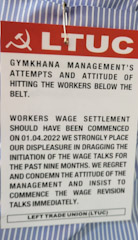
Another interesting feature was pinned to the shirt of one of the library staff. It was a rectangular plastic badge with a hammer and sickle on both of its sides. One side had words in Tamil, and the other in English. These words explain to the reader that there was a grievance between the staff and their employers, The Club. The problem about which the employees were protesting concerned pay. Seeing these badges of protest reminded me of a visit to Nizam’s restaurant in Kolkata a few years ago. There, the waiters were wearing similar badges, some in Bengali, some in Hindi, and others in English.
As for the library, it seemed well stocked with books and journals. Several old books were being sold, and there were three that I could not resist!






 yamey
yamey 