A beneficient ruler of a kingdom now part of Gujarat

THE AINA MAHAL (‘Palace of Mirrors) in Bhuj (Kutch, Gujarat) was constructed in about 1750, and badly damaged during the terrible earthquake of 2001. Luckily, some of the palace survived, and several rooms containing an intriguing variety of objects can be visited by the public. Above these, there is another floor, which is not accessible to the public. A prominent member of the royal family of Kutch, with whom we have become friendly, kindly showed us around these rooms, which include the old Durbar Hall where the ruler, the Maharao, used to hold audiences. After 1868, when a new palace, the gothic revival style Pragmahal, was built, the rulers of Kutch used its larger durbar.

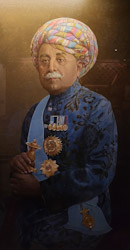
The old durbar Hall in the Aina Mahal contains fine painted portraits of some of the previous Maharaos. One of these depicts Maharao Desarji II, who ruled from 1819 to 1860. Amongst his many achievements he encouraged the study of mathematics, geography, and astronomy. He developed schools and hospitals. And he also put an end to slave trading in Kutch. In addition, he put an end to the practice of sati (‘self’-immolation of widows during their husbands’ cremations).

His son Pragmalji II, who ruled from 1860 to 1875, not only had the Pragmahal place built but also encouraged education. It was during his reign that the Alfred School was built. It was named in honour of Queen Victoria’s son Prince Alfred, who visited India in 1869/70.

My wife’ great great grandfather, Laxmidas Ravji Sapat, was the 11th headmaster of the Alfred High School between 1888 and 1892. This was during the reign of Maharao Khengarji III, who ruled Kutch from 1876 to 1942. He loved wildlife and took an interest in education. Amongst the many things he did was establishing the Museum of Kutch and the Jubilee Hospital – both in Bhuj. He also helped Laxmidas Ravji Sapat.

After being headmaster of the Alfred School, Laxmidas and his son-in-law went to London to study law, Mr Thacker, at Middle Temple. Going to London to study was expensive. As both Laxmidas and his son-in-law, Mr Thacker (my wife’s great grandfather) were bright, their community, the Kutchi Bhatias, clubbed together to help finance the education of these two promising men. Additional money was donated by the Maharao (Khengarji III), who, as already mentioned, was keen on promoting education.

I am grateful that we were privileged to have been shown around a part of the Aina Mahal not open to the public. Apart from seeing something new and having a member of the royal family to explain things, we managed to see portraits of his ancestors, each of which was accompanied by labels that summarised their achievements.

Red coloured meat dish from Rajasthan

LAL MAS IS a traditional meat dish that originated in Rajasthan. Its name means ‘red meat’ and its colour comes from the use of mild, fragrant, fresh red chillies. The best sort to use are those grown at Mathania in Rajasthan, but if these are not available, Kashmiri chillies can be used but they are less satisfactory. Originally, lal mas used to be prepared to feed hunters after a day of hunting. The meat being game.

We have been staying at the Sharad Baug Palace homestay in Bhuj (Kutch, Gujarat), which is owned and run by members of the Royal family of Kutch. Several members of the family are great cooks. The food they have been preparing for our evening meals has been superbly tasty.

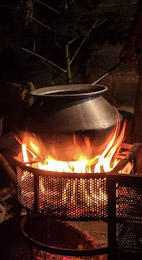
Last night, one of the family gave us a very special treat. While we watched, he prepared lal mas on a pot heated on a wood fired brazier in the garden. The smoke from the burning wood enhances the flavour of the dish.

Even if I knew the exact recipe for lal mas, it would be pointless giving it to you. This is because to achieve a good result, the person cooking it must be constantly tasting the sauce and adding ingredients as required, as well as checking the degree of tenderness of the meat. This is something that cannot be described in writing.

That said, this is, roughly speaking, how he prepared the lal mas. First, good quality cold-pressed mustard oil was heated to a high temperature. Then, he added whole spices including the Mathania chillies. Next, chopped onions, followed by pureed onions and pureed Mathania chillies. Following this, the goat meat was added. Later, chopped tomatoes followed by ginger and fresh green chillies – both minced. After a while at various stages, other ingredients including ground cumin, turmeric, coriander powder, fenugreek leaves (added at the end), hot red chilli powder, salt, and water were added to the stew. Throughout the cooking process, which took almost two hours, the stew has to be stirred often, and water added as required so as to maintain the sauce’s thick consistency and to prevent the spice mixture from burning.

I can say, without exaggeration, that the resulting dish was one of, if not, the very best Indian meat dishes I have ever eaten. It was fragrant, tasty, and not too piquant. It was without fault.

We are very grateful that our host took the time and care to produce this miracle of culinary art for us.

Piles of stones and prayers by those seeking to build a home

THE PUARESHWAR MAHADEV Shiv temple is about 24 miles west of Bhuj. Built about 1200 years ago, it is possibly the oldest surviving Hindu temple in the Kutch region of Gujarat. Partially restored, this attractive small mandir is still in use but has lost most of its roof.

At Puareshwar

As we approached the temple, I noticed that near it, there were numerous small piles of stones. Each of the precarious looking piles consisted of several rock’s or fragments of masonry piled carefully, one on top of another. I asked our driver, who had suggested we visit this temple on our way to Narayan Sarovar, about these small piles. He said that they were constructed by people, praying to obtain or build a home of their own.

After visiting, Narayan Sarovar, its lake and mandir, we stopped to see the mandir at Koteshwar, which is on a spit of land near India’s border with Pakistan. Outside this temple, there were many piles of stones just like we had seen at Puareshwar.

Although I have visited many Hindu temples in India during 30 years of travelling to the country, it was only yesterday, the 27th of November 2023, that I first became aware of these small stone offerings. According to one online article I found (https://medium.com/six-word-photo-story-challenge/prayer-stone-stacks-a-belief-b7fc0edc5d9a), stones are piled outside temples all over India by people hoping to build their own homes. I will now look out for them whenever I visit a mandir.

Painting behind glass in the Palace of Mirrors

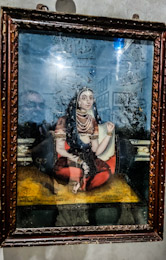
PARTLY DAMAGED BY the great earthquake that struck Kutch (Kachchh) in 2001, what remains of the Aina Mahal in Bhuj contains a fascinating museum. Constructed in about 1750 for Rao Lakhpatji, ruler of Kutch, the palace is named because of the many mirrors (‘aina’) contained within it. Miraculously many of these fragile items survived the earthquake. The same is true for a set of reverse glass paintings.

A reverse glass painting

First developed in Europe, it was introduced to China by an Italian artist Giuseppe Castiglione (1688-1766). During the 18th and 19th centuries, Kutch traders brought them back from China as gifts for the rulers of Kutch. The traders commissioned them from Chinese artists, having first explained what subject matter was to be depicted. Later, glass painting became popular in both Kutch and Saurashtra, where it began to be done.

The technique of reverse glass painting is difficult. Paint is applied to the side of the glass away from the viewer. The artist must begin by painting what will be at the front of the picture. For example, if painting a portrait, the eyebrows, eyelashes, moustache, hair, and beard must be painted first. Then, the rest of the face needs to be created, and then the background. Adding to this difficulty is that the artist is painting on glass as thin as paper.

The reverse glass paintings and the ageing mirrors are but a few of the amazing exhibits on display in the Aina Mahal. We have visited the place several times, each time noticing things we had not seen before.

Feeding the faithful at a Hindu temple in Kutch (Gujarat)

THE DHRABUDI TRMPLE complex is near the sea about 5 miles east of the town of Mandvi (Kutch, Gujarat). It is located ated next a small Freshwater lake, where pilgrims can bathe. Our driver told us that baby boys are brought to be blessed at the temple when they reach their first birth anniversary. When we visited, we saw a group of people doing a puja in the open air. They were respecting the first death anniversary of one of their relatives.

While wandering around the temple compound, we saw a group of Rabari women seated in the shade, under a large banyan tree. The Rabari are nomadic cattle and camel herders, as well as shepherds. In India, they aremost frequently found in Gujarat, Punjab, and Rajasthan.

Worshippers come from far and wide to do pujas at the mandir. The temple offers free meals to pilgrims. These are served in a large dining hall. One wall of this is lined with numerous portraits of people who have died. We were told that diners pick up a thali and other eating utensils before lining up to be served food.

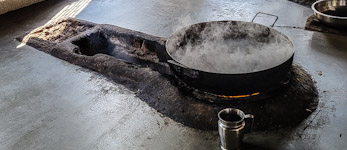
Pit containing glowing charcoal for cooking

The kitchen, which is next door to the dining hall is vast. It was spotlessly clean. I saw a few gas rings, but what really fascinated me was the other method by which food is heated up. I saw three or four pits sunk into the floor. Each one is shaped like a large spoon. Glowing charcoal is heaped in the bowl of the ‘spoon’, and can ve spread along the stem. Pots are placed above the charcoal. The arrangement reminded me of the Turkish ocakbaşı. I imagine that the cooking speed can be adjusted by varying the amounts of glowing charcoal beneath each of the enormous cooking pots.

We did not stay to join the pilgrims having lunch. Although the temple cooks kindly invited us, we had lunch awaiting us at my wife’s cousin’s home.

I always enjoy visiting place of worship. What made Dhrabudi special for me was being shown its wonderful kitchen.

LOOKING FOR A HEADMASTER IN BHUJ: FURTHER EXPLORATION OF FAMILY HISTORY

AT THE END OF January 2023, I wrote:


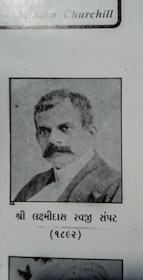
“My wife’s mother’s great grandfather was one Laxmidas Ravji Sapat (aka Sampat), who was born in the mid-19th century, or a bit earlier. Along with Gokaldas Parekh, Laxmidas was one of the first teachers in the Alfred High School in Bhuj (founded by Rao of Cutch, Pragmalji II in 1870). It is likely that he was its headmaster for a time. I have yet to see it, but his portrait hangs in the school. One of my wife’s relatives, also a descendant of Laxmidas, arranged to have it restored a few years ago.
In 1890, Laxmidas left the school. Later, along with his son-in-law, Cullyanji Murarji Thacker, he went to London (UK) to become a barrister. He studied for the Bar at Middle Temple and was called to the Bar on the 27th of June 1900, along with his son-in-law, Mr Thacker, who was my wife’s mother’s grandfather.” (https://adam-yamey-writes.com/2023/02/02/running-in-the-family/)

Laxmidas Ravji Sapat

Today, the 25th of November 2023, we visited the Alfred School in Bhuj in search of the portrait of Laxmidas Ravji Sapat. We were shown a board on which the headmasters of the school were listed. On it we discovered that Laxmidas had been headmaster between 1888 and 1892. He was the school’s eleventh headmaster. It appears that he left the school two years later than I had been told.

As for the portrait of Laxmidas, the officials at the school had no knowledge. They suggested we try the museum next door. Part of this now owns the school’s original building, which was restored after the 2001 earthquake that destroyed much of Bhuj. Despite being part of the museum, the old school building stands disused and being renovated.

At the Bhuj Museum, we asked about the portrait. We were told that it is not in the museum. So where is it? In a few days time we will return to the school to visit its current headmaster. Maybe, he might know where it is. Until then, watch this space!

The house in the desert and a fighter for the independence of India

A NARROW ROAD LEADS away from the town of Mandvi (in Kachchh, a part of Gujarat) into an arid sandy area close to the seacoast. Scrubby bushes populate most of this flat terrain. After a few miles, a red building can be seen on the horizon. As you approach it, you can see that it resembles no other in the surrounding area, or, for that manner, in any other part of India. However, if you are a Londoner, it would seem familiar, although quite incongruous.

Replica of India House near Mandvi, Kachchh

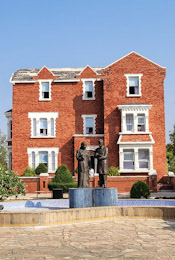
The house in the desert is an accurate replica of a typical Victorian house, such as can be found in North London. In fact, it is a full-size copy of number 65 Cromwell Avenue in London’s Highgate area. The reproduction near Mandvi was built as part of a complex to commemorate Shyamji Krishnavarma (1857-1930), who was born in the centre of Mandvi.

Krishnavarma, who became a barrister and worked in various Princely States, moved to London, where he lived until about 1907. He moved to Paris, and then to Geneva, where he and his wife lived until they died.

In London, Krishnavarma lived opposite Highgate Woods. He invested wisely, and became interested in the works of English men, who had their doubts about Britain’s domination of India. He became an opponent of British rule in the Indian subcontinent. At first, his interest was mainly intellectual. However, in 1905, following the partition of Bengal, he became an activist.

One of his several activities was to purchase number 65 Cromwell Avenue. He had it adapted to become a ‘home away from home’ for Indians studying in London – they frequently had to endure the racist attitudes of English people. He named the building ‘India House’ (which should not be confused with the present Indian High Commission in London).

Apart from providing Indian food, some accommodation, and some leisure facilities, India House also hosted meetings that discussed the injustice of British rule in India. Soon, India House attracted the attention of the British police. This was because India House was becoming a nucleus or hotbed of anti-British activism. For example, some of the people who frequented the House experimented with bomb making and smuggling firearms to freedom fighters in India.

Krishnavarma left London in 1907, when he feared that he might be arrested. India House continued to be active until mid-1909 when one of its visitors assassinated an important colonial official.

Krishnavarma wrote in his will that after he was cremated, his ashes should be returned to India only after it had become independent of the British.

In the early part of this cemetery, the Chief Minister of Gujarat, then Narendra Modi, decided to bring Krishnavarma’s ashes to India – to Mandvi. Some years later, a complex to commemorate Krishnavarma was built outside Mandvi. Part if this is the replica of Highate’s former India House. The ashes of Krishnavarma and his wife are stored in urns on display in a building next to the replica.

If this story interests you and you want to know much more about India House, its replica, Krishnavarma and his fellow freedom fighters, including the currently influential VD Savarkar, you should read my, dare I say it, very informative book. I have produced two versions of it. One, the latest edition is “Indian Freedom Fighters in London 1905-1910), and is available here: https://www.amazon.co.uk/gp/aw/d/0244270716/ . The other “Ideas, Bombs, and Bullets”, which can only be delivered to addresses in India in available here: https://store.pothi.com/book/adam-yamey-ideas-bombs-and-bullets/.

By road and by rail through rural Gujarat

WE HAD DECIDED TO travel to Mandvi (in Kutch, a part of Gujarat) by taking a train to Gandidham, then going by road the 98 kilometres between there and Mandvi.

The Indore to Gandidham Express arrived 30 minutes late on Ahmedabad Junction’s platform 4. Getting on to our carriage was a veritable scrum. The problem was that people, including us, wanted to board before those alighting at Ahmedabad had reached the carriage entrance. Someone behind us shouted “Hurry up and get inside.” When a passenger who was trying to leave the train replied “We want to get off”, the irritating lout behind us shouted “You should have started getting out quicker.” We struggled along the carriage and found our window seats eventually.

We had reserved seats numbers 73 and 76. A man was sitting in seat 76. When we said it was one of ours, he said that he was occupying his alloted seat, namely seat 77. It took some considerable persuasion before he understood that seat 77 did not have the number ‘76’ above it. This incident reminded me when I used to travel by train in Italy during the 1960s.

Whenever we travelled by intercity trains in Italy long ago, my parents always reserved seats – always in the first class carriages – in advance. Invariably, our reserved seats would be occupied by passengers who should not have been in them. It was o lying after the train conductor had been summoned that the people yielded our seats to us. Moments later, these obstinate people would engage in friendly conversation with us.

Returning to the Indore to Gandidham Express, before it started, vendors selling fruit and bottled water roamed along the platform looking for customers. Meanwhile, a hot tea seller moved along the interior of the train. He and others remained on board during the journey, as did a couple of snack vendors.

Once we got going, the train sped along. There was only one intermediate station where we stopped briefly during the 4 and a 1/2 hour journey. As we traversed the flat plains of Gujarat, we saw many neatly cultivated fields and numerous industrial units of varying sizes. In the area where eastern Kutch begins, we passed vast expanses of land being used as salt pans. Every now and then, we saw conical mounds of grayish white harvested salt.

Many trains passed us, travelling in the opposite direction. Almost all of them were freight trains. The line along which were moving leads to and from the busy port of Kandla on the south coast of Kutch. What little we saw of Gandidham and its outskirts was unattractive.

The air temperature at Gandidham station was well over 30 degrees Celsius and there was little shade. To exit the station, we had to use an escalator. Once again it was a scrum trying board it. Some passengers were too frightened to step on it which made using it even more difficult.

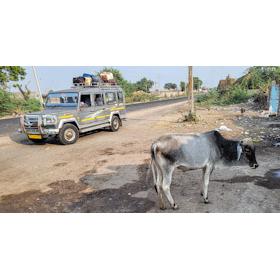
Our host in Mandvi had kindly booked us seats in a shared taxi to travel from Gandidham to Mandvi. This vehicle was like a jeep. It had a front row of seats – sofa like – and behind that there was another similar seating arrangement. Behind that, there was a far less comfortable seating space that accommodated any number of people that could be squeezed in. We were booked into the seating behind the front seats and in front of the rear ‘compartment’.

Although the middle seating had been booked for my wife and me, Lopa invited one of the three passengers who had squeezed in the front seat next to the driver to join us. He turned out to be a friendly chap. He and his friends were returning home from several days of a religious pilgrimage. Our new companion was a trader in rice, sugar, etc. He bought commodities and sold them for export. During our journey, he received a telephone call. He told us that soon after getting home, he had to go to Bombay for some urgent work. He and his business partner would have to drive for 11 hours through the night to reach Bombay from near Mandvi.

Our driver decided not use the 4 lane highway between Gandidham and Mandvi because of heavy traffic. Instead – and it made the journey far more interesting – he took us along a “short cut”, using country roads, some of them minor. This added fascination because we passed through rustic villages. At one of these, we were stopped by an elderly lady standing beside the road. She wanted to go to Mandvi, and was invited on board.

At another place, we stopped and the driver picked up a bundle tied in cloth, which he delivered to someone in another village we passed through later. After about an hour, to my great relief because my mouth was parched, we stopped for about 20 minutes at a stall where snacks and cold drinks were available.

At one point early during our journey, someone in the rear compartment asked our new companion to dial a certain number on his phone. Some conversation in Gujarati ensued. It turned out that there were some labourers travelling in the rear compartment. As they had not yet been paid by their employer, they claimed that they did not have the 300 Rupees needed to pay for the ride. Our friendly sugar trader allowed the employer to electronically transfer the required amount to his account. Our neighbour then suggested that he could electronically transfer that fare money to the driver’s account. However, the driver wanted to be paid in cash, which the trader kindly agreed to do.

Most of the way, the driver used one hand to steer, and the other to hold his mobile phone to his ear. Despite this hazardous practice, there were no scary moments along the way. We arrived at our destination safely, but somewhat cramped.

When we sat inside our host’s air-conditioned large saloon car to drive to his house, it felt as if we had moved from a stone seat into a feather bed. Never before has a modern saloon car felt so comfortable.

Despite moments of discomfort, our rail and road trip was enjoyably interesting. By the end of the journey we felt as if we had been truly travelling – a feeling that air travel often fails to provide.

Kutch from kingdom to district

MY WIFE’S COUSIN lives in a part of the Indian state of Gujarat called Kutch (‘Kachchh’). He and his wife have a lovely farmhouse near the port city of Mandvi, where you can watch huge wooden dhows being constructed along the riverbank. Although Kutch is now a part of the state of Gujarat, it has not always been. The people of Kutch (‘Kutchis’) speak a language quite distinct from Gujarati. The Kutchi language has closer similarity to Sindhi than to any other Indian language (Kutch is bordered to its north by Sindhi speaking people*). It is a spoken language, but not written. Even though Kutchi people can speak and write in Gujarati, they will proudly inform you that they are Kutchis and definitely not Gujaratis. During our several visits to Kutch, my wife’s cousin’s driver, who can speak good Gujarati, insists on speaking to my wife in Kutchi, which she cannot speak as well as Gujarati.

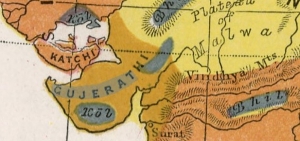
Many people with whom I have discussed my travels, look puzzled when I say that we have been to Kutch. Just in case you are wondering, it is the furthest west part of India. Most of the north of the region is bordered by Pakistan, from which it is separated by the arid Rann of Kutch. To the south and separated from it by the Gulf of Kutch (a part of the Arabian Sea) is the peninsula of Saurashtra – now also a part of Gujarat.

Until 1947, Kutch was a kingdom founded by unifying three separate kingdoms, ruled by branches of the Jadeja family, in the 16th century. In 1819, having suffered a military defeat (at The Battle of Bhuj in March 1819), the Kingdom of Kutch accepted the sovereignty of the British East India Company. Under the watchful eyes of the British, members of the Jadeja family continued to rule Kutch – it became one of India’s many ‘Princely States’. On the 16th of August 1947, one day after India became independent, Kutch voluntarily acceded to the new Indian state.

Kutch became a state of India. In November 1956, as a result of the State Reorganisation Act (1956), Kutch ceased to be a state in its own right, but became a part of the then huge Bombay State. The latter was effectively a bilingual region, most people were either speakers of Marathi or of Gujarati. The Marathis and the Gujaratis began to clash. In 1956, the Mahagujarat Movement began campaigning for a state for Gujaratis, which was separated from that for Marathis. The movement was spearheaded by Indulal Yagnik (1892-1972). His nephew, who lives in Bangalore is a family friend, whom we meet whenever we are in the city. As the Gujaratis clamoured for their own state, so did the Marathis, Blood was shed, and much property was damaged. On the 1st of May 1960, the old Bombay state was divided along linguistic grounds. The states of Maharashtra and Gujarat were formed. The latter includes the Gujarati speaking district of Saurashtra as well as the northern part of the former Bombay State, and also Kutch. And that is how it remains today.

Since 2017, we have made several enjoyable visits to Kutch, from which my wife’s maternal ancestors hail, and enjoyed many fascinating experiences there. Some of these can be found in my new book – a collection of true stories about life in India seen through my eyes. The book (also Kindle) is available from Amazon websites including https://www.amazon.co.uk/HITLER-LOCK-OTHER-TALES-INDIA/dp/B0CFM5JNX5/

*When Lord Napier conquered Sindh *which neighbours Kutch) in 1843, he is reputed to have sent a single word message to London in Latin “Peccavi”, which means ‘I have sinned’.

A temple in Mandvi: architectural revival or survival?

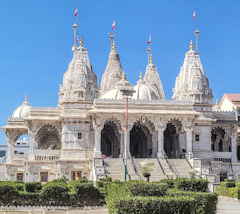
THE SWAMINARAYAN TEMPLE in Mandvi (Kutch, Gujarat) was constructed between 1991 and 1999 to replace a smaller Mandir on the site. Without going into the details of its very fine architectural and decorative features, this edifice was financed by local Kutchi followers of Swaminarayan. The Rajasthani Marble that forms the temple’s structure was hand carved by workmen, all of whom were followers of Swaminarayan. The stones that make up the building were carved in Rajasthan, transported to Mandvi where they were put together to make the edifice. This is similar to how the great temple in London’s Neasden was constructed.

Swaminarayan Mandir in Mandvi

The temple at Mandvi looks very similar to ancient Hindu temples I have seen elsewhere in India. As you look around it, you can see how the very old temples looked when they had just been built many centuries ago. Apart from the fact that Mandvi’s Swaminarayan Mandir looks recently built, a layman like myself, would find it difficult to age the building.

In 19th century England, many new churches were built in the gothic style. Like the newish temple at Mandvi, may of them faithfully reproduce the churches built in mediaeval times. The only thing that differentiates the 19th century Gothic Revival churches from their mediaeval predecessors is that they look too new to be as old as them.

In a book about Gothic Revival written by the art historian Kenneth Clark (1903-1983), he suggests that in England the use of gothic style in architecture never actually died out, and this suggested to me the Gothic Revival was really gothic survival. As far as I can gather, the same is the case for Hindu mandir architecture. If this is really the case, new temples such as Mandvi’s Swaminarayan Mandir is not the revival of the use of an ancient style of architecture, but an example of its survival. Put another way, the new temple at Mandvi is a reincarnation of its predecessor.