LAST NIGHT I ENJOYED a pint of Moretti beer in a pizzeria on Mersea Island (Essex). The beer company was formed in 1859 in a town in northeast Italy: Udine. The company logo is a man wearing a hat and holding a glass tankard of beer.
In the 1960s, a young lady from Udine, Adriana, came to London to teach Italian at the LSE, where my father was a professor of economics. My parents, who loved Italy and Italians, used to invite Adriana to our home. Soon, she became a family friend.
After her return to Italy, we used to visit Adriana and her hospitable parents in Udine. In Udine and all over the region of Friuli-Venezia Giulia, in which the city is located, there were advertising hoardings for Birra Moretti. The images of the hatted beer drinker were as ubiquitous as were images of Tito in Yugoslavia or of Lenin in the USSR.
As I drank my pint of Moretti in West Mersea, happy memories of Adriana, her family, and trips made to Udine came back to me.
By the way, the Waterfront Pizza in West Mersea, where I drank the Moretti, is a superb place to enjoy an evening. Not only are the pizzas high quality, but also the ambience and management of the place is excellent. Although we were eating on an island next to the coast of Essex, it felt as if we were hundreds of miles away on the shores of the Mediterranean.
DURING THE LATE 1950s and much of the 1960s, my mother created artworks in the sculpture workshops of St Martins School of Art, which was then located on Charing Cross Road near to Foyles bookshop. My mother was a keen follower of the recipes of Elizabeth David (1913-1992), who introduced Mediterranean food to British kitchens. Near to St Martins in Old Compton Street, there were many food shops that supplied the ingredients that were required to follow Ms David’s recipes accurately. There used to be a French greengrocer between Charing Cross Road and Greek Street. This was one of the only places where ‘exotic’ salads such as mâché (lamb’s lettuce) could be purchased. Further west along Old Compton Street, there was a Belgian butcher, Benoit Bulcke, which cut meat in the French style, which my mother preferred. She claimed that English butchers were not ‘up to scratch’. Both these shops have long since disappeared. Another Soho establishment, which we used to visit regularly, was Trattoria da Otello in Dean Street. We went there so often that we were treated like old friends. Now, sadly, that wonderful restaurant is no more.
Three Old Compton Street shops frequented by my mother are still in business. They are the Algerian Coffee Stores, whose appearance has barely changed since the early 1960s when I first remember entering it; and a supplier of Italian foods: I Camisa & Son. Lina Stores, which my mother also used to visit still exists, but its branch on Brewer Street (and other newer branches) seems to have become more like restaurants than Italian delicatessens.
During school holidays, I used to accompany my mother on trips from Golders Green, where we resided, to the West End. On most of these excursions, food shopping in Soho was on our itinerary. So, as a youngster I got to know these various food shops quite well. As an innocent child, I associated Soho with food shopping rather than its other more colourful activities.
Every visit to Soho involved a stop at Bar Italia on Frith Street. There, I would be treated with a cappuccino while my mother drank an espresso. From when I first knew it in the early 1960s (or possibly the late 1950s), the overall appearance of Bar Italia has barely changed. As a friend remarked on a recent visit, the cracked Formica counter opposite the bar is typical of how cafés would have been fitted out back in the 1950s.
Bar Italia is almost three years older than me. It was founded in late 1949 by Lou and Caterina Polledri. Lou was born in the Italian city of Piacenza. According to the Bar’s website, some of the above-mentioned Formica was put in place in 1949, when the establishment was for its time ‘state-of-the-art’. The floor is that which was laid down by members of the Polledri family in 1949.
When it opened, Soho had a large Italian community, which much appreciated the Bar Italia as a home-away-from-home. At the far end of the small establishment, there is a television that broadcasts Italian TV, mostly sporting events. Each time I visit the place, the screen sems to have been replaced by a larger one. However, I cannot recall whether there was a television in place when I visited as a child. What I do remember is that next door to Bar Italia, there used to be a Greek restaurant called Jimmy’s, which, for some reason, my mother never took us there.
Once a local for the Italian community, Bar Italia has become somewhat of a Soho landmark and tourist attraction. In addition to coffee and alcoholic drinks that would be available in any local bar in Italy, Bar Italia now also serves hot meals. It also sells Portuguese ‘natas’, which are not typical fare in bars in Italy. Apart from this change, the prices of its excellent coffee have shot up to levels higher than most London cafés charge. Whereas one can expect to pay from on average £2.80 to “£3.20” for an espresso, Bar Italia is now charging over £4.20. I mention this, but do not begrudge them because by patronising Bar Italia we are helping to preserve a delightful historical London landmark.
NOW watch this lovely little video about the place:
TODAY THE TEMPERATURE in Athens (Greece) will exceed 35 degrees Celsius, and in Rome it is predicted to reach 42 degrees in two days’ time. Two years ago, a temperature of 48 degrees was recorded in Sicily. So, it seems that so-called Global Warming is happening with vigour. Meanwhile, this Sunday (16th of July 2023) in London, we enjoyed a breezy morning with temperatures not greater than a pleasant 21.
While walking along Portobello Road this Sunday, we spotted a beautifully cared for open-topped Ford Zodiac. These vehicles were manufactured between 1950 and 1972. I remember seeing them in my childhood and teenage years. In those days, I was not much interested in cars, but now when I see one that used to be common in my earlier years, I find them worthy of examination. I took several photographs of the Zodiac and then headed for the bus stop from which we were returning home.
Despite the external temperature being 21 degrees or less, it was far warmer inside the bus although its windows being open. The higher temperatures that we have been experiencing here in London and are now affecting places near the Mediterranean are commonly believed to be at least partly due to emissions produced by fossil fuels, such as petrol. As we moved homewards, a thought struck me. The beautiful Ford Zodiac, which we had just seen, is aesthetically pleasing and a souvenir of one of the great eras of automobile engineering, but it is also an ‘ancestor’ of Global Warming. Beautiful as it is, it too burns fossil fuel and makes its own contribution to what is believed to be causing dangerously high air temperatures in many parts of the world.
MY MOTHER WOULD ONLY drive Fiat cars. Because they were made in Italy, a country with many hills and mountains, she believed that they must have been built with powerful engines. So, we owned first a Fiat 600, then an 1100, and lastly a 1200. These memories were stimulated by seeing a Fiat 600 on the heart of Panjim in Goa.
Fiat began licencing car making factories outside Italy long ago. In 1964, the Premier Company began manufacturing an Indian version of the Fiat 1100, which was marketed as the ‘Fiat 1100 Delight’, which was renamed the ‘Premier Padmini’ from 1974. These cars looked almost identical to our old family Fiat 1100. Padmini means ‘she who sits on the lotus’.
The Padmini remained a popular purchase until the mid-1980s when the more modern Suzuki Maruthi came on to the market. Decline in Padmini sales was accelerated by liberalisation of the Indian economy in the 1990s, which allowed other foreign car manufacturers to enter the Indian Market. By the late 1990s, the Padmini was manufactured no more.
The owner of the Fiat 600, which we spotted in central Panjim, told us that his vehicle had been imported from abroad by a relative some years ago. Although it looked in immaculate condition, we noticed that after it had been driven a few yards, it had stopped and its owner was tinkering about in the car’s rear engine compartment.
Original Fiat 600s are rarely seen in the UK. After more than 50 trips to India, this 600 in Goa is the first I have seen in the subcontinent.
THE BIENNALE IN Venice was first held in 1895. The original international bi-annual art exhibition was contained in public gardens at the Eastern end of the city of Venice in the Castello district.
Initially, there was a Central Pavilion, opened in 1894. Later, various participating countries built national pavilions, the first being Belgium in 1907. The latest is the Australian pavilion, built only a few years ago.
The national pavilions reflect both the politics and architectural styles prevailing at the time they were built. Therefore, they are at least as interesting as the artworks that take up temporary residence within them at each exhibition.
I will discuss two of the pavilions in this short essay, and hope to write about some of the others at a later date.
The Russian pavilion bears the date 1914 and several double-headed eagles. It was constructed before the 1917 Revolution, and has some traditional Russian architectural features.
Next to the Belgian pavilion, stands the Spanish one. First constructed in 1933, its facade was replaced by a modern brick one in 1952.
Both the Spanish and the Russian pavilions appear to be empty, but for quite different reasons. For the 2022 Biennale, the artist Ignasi Aballi (born 1958 in Barcelona) has left the pavilion empty but shifted its internal walls in an attempt to correct a discrepancy between its original architectural plan and what ended up being constructed. The result is an empty pavilion with a strange internal layout. It was at first disconcerting to discover a pavilion empty of artworks, but soon it became pleasurable to see the strange vistas and connections between neighbouring rooms.
The Russian pavilion, unlike the Spanish, is closed. But it is also devoid of exhibits. Russia was not invited to the Biennale this year. The reason for this was Mr Putin’s unwise decision to invade his neibour, Ukraine.
IN WARWICK, I chanced upon a fascinating book in a charity shop. It is Part 2 of “Stanley Gibbons Priced Catalogue of Stamps of Foreign Countries 1912”. When it was published, it could be purchased for as little as half a crown (2/6, which is 12.5 pence). I paid a lot more for it, but not an excessive amount.
I felt compelled to buy it because of its date and my interest in Albania. For, on the 28th of November 1912, the independence of Albania was proclaimed in the seaside town of Vlorë. Albania’s independence was formally recognised when the Treaty of London was signed in July 1913. The catalogue I bought in Warwick was published some time in 1912 and most likely before independence was proclaimed. As far as the publishers and the compilers were concerned, what is now Albania was still part of the Ottoman Empire.
The index of the catalogue contains an entry for “Albania (Italian P.O.)”. This needs some explanation. Throughout the Ottoman Empire, there were postal services operated by foreign (i.e., not Ottoman) countries. A website (www.levantineheritage.com/foreign-post-offices.html) reveals:
“In the 18th century, foreign countries maintained courier services through their official missions in the Empire, to permit transportation of mail between those countries and Constantinople [sic] the Empire capital. Nine countries had negotiated Capitulations or treaties with the Ottomans, which granted various extraterritorial rights in exchange for trade opportunities. Such agreements permitted Russia (1720 & 1783), Austria (1739), France (1812), Great Britain (1832) and Greece (1834), as well as Germany, Italy, Poland, and Romania, to maintain post offices in the Ottoman Empire. Some of these developed into public mail services, used to transmit mail to Europe. The Ottoman Empire itself did not maintain a regular public mail service until 1840, when a service was established between Constantinople and other major cities in the country and this was slow to develop and expand. The gap in this capacity was very much filled with the various foreign post offices which continued functioning right till the beginning of WWI in 1914 …”
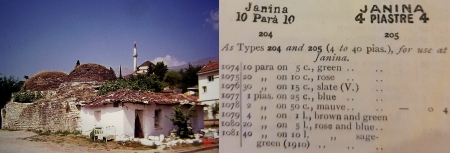
Left: Ioannina in the 1970s. Right: examples of over-printing texts
Hence, the entry in the catalogue’s table of contents. I turned to the page listed and found the section on Albania. The Italian Post Offices in the Turkish (Ottoman) Empire issued stamps, to quote the catalogue, which:
“…surcharged or over-printed for use in Italian post offices abroad.”
These stamps were the regular issues but, to quote the catalogue:
“… distinguished by the removal of some details of the design, over-printed with Type…”
Different Italian stamps were overprinted with names of places and a Type number. For example, Italian stamps were over-printed with: “ALBANIA. 10 Para 10. 201” (where ‘10 Para’ is a monetary denomination and ‘201’ is the Type number), or “Durazzo. 4 PIASTRE 4. 205”, or “Valona, or other place names. 10 Para 10. 208”. Durazzo and Valona being the Italian for the Albanian names Durres and Vlore.
Within the Albanian section of the catalogue there is also an illustration of the over-printing “JANINA. 4 Piastre 4. 205”. Janina is the name of a town now in Greece, Ioannina (Ιωάννινα). In 1912, this town was not in what was then Greece, but in the Pashalik of Janina, part of the Turkish Empire. In February 1913, following the battle of Bizani in the First Balkan War, the town was absorbed into Greece. Many Albanians still consider that by rights Ioannina should be a part of a Greater Albania. The large Albanian population in the town was forcibly reduced by population exchanges in the early 1920s and also the pre-WW2 Greek government’s policy of strongly encouraging people of Albanian ethnicity to regard themselves as Greeks. When I visited Ioannina in the 1970s, there were the remains of Turkish buildings but many of them were in a sad condition. I do not know whether they have been restored since then.
My purchase in Warwick has proved to be of interest. It records the state of postage stamps on the eve of great changes that were about to happen in the Balkan peninsular as well as illustrating aspects of European colonialism, both political and economic.
THE ITALIAN WRITER and patriot, Ugo Foscolo (1778-1827) was born on Zakynthos when it was part of the Venetian Republic. He became a political activist in what is now Italy and came to London in 1816. In London, he was regarded as a literary celebrity, but this did not always keep him out of trouble. For example, in about 1813 he faced Mr Graham, the editor of the “Literary Museum” in a duel at Primrose Hill. The dispute that led to this was about his ‘Three Graces’. These three ladies were sisters working in Foscolo’s home near Regents Park. Two of them turned out to be prostitutes, and one of them ran off with his former translator. This led to a duel, whether in Regent’s Park or Primrose Hill is not clear; fortunately, no blood was shed.
Foscolo’s monument in Chiswick
Foscolo lived another few years until 1817, when he died in Turnham Green in west London. He was buried in the lovely churchyard next to the Chiswick church of St Nicholas, where the artist William Hogarth was also interred. The cemetery contains Foscolo’s elegant, well-maintained grave, which is surrounded by a cast-iron railing.
However, Foscolo’s remains are no longer in the old cemetery at Chiswick.
In June 1871, ten years after the Unification of Italy, Foscolo’s remains were dug up and transported to Florence (Firenze). There, they were reburied but within the church of Santa Croce. This is all recorded by words carved on the monument in the Old Chiswick Cemetery.
DURING A SHORT VISIT to Chelmsford in Essex, we noticed an old hotel The Saracens Head. Situated in the centre of the city – yes, Chelmsford is a city; it has a fine cathedral – it bears a commemorative plaque which states that the inventor of radio Guglielmo Marconi (1874-1937), founder of the Wireless Telegraph Company, stayed at the hotel between 1912 and 1928, when he made visits to his New Street factory in Chelmsford. Marconi made the city a place that was to change the world. It is hard to imagine how our world would be today without radio signals.
I wondered why he had chosen Chelmsford to site his factory. The only explanation I can find is that Marconi needed electricity for his factory and that Chelmsford had a good supply of it. In any case, his factory provided work for many (up to 6000) people in the city.
As for The Saracens Head hotel, I have not yet stayed there, which might be a good thing as it receives many poor reviews on Tripadvisor.
Prior to establishing his factory in Chelmsford, he lived in a terraced house near London’s Westbourne Grove, at number 71. He lived there between 1896 and 1897. That was 2 years after he had made the world’s first demonstration of radio transmission. He arrived in London from Italy in 1896 because few in his native land could see much of a future in what he had demonstrated.
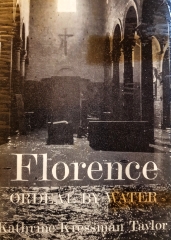
I HAVE JUST finished reading a book about an incident that made a great impression on me and my close family many years ago. The slender volume, “Florence. Ordeal by Water” was written by Kathrine Kressman Taylor (1903-1996), who was an eye-witness to the event that troubled our family so much. The book was first published in 1967.
During my childhood, my parents, who were keen on the art of the Italian renaissance and Italy in general, took my sister and me to the city of Florence every year (until about 1969), except 1967. Visiting churches, museums, and art galleries was not exactly my ‘cup of tea’ when I was a child, especially when I knew that my best friend was enjoying what sounded to me like a far more exciting holiday than mine. Now with the benefit of hindsight, I realise that the experiences that my parents gave me were actually far more valuable than anything I could have gained from annual holidays at a seaside resort in North Wales, where my friend went every summer.
I mentioned that in 1967, we did not make our annual visit to the city on the River Arno, Florence (Firenze). This was because the city was severely affected by a flood in November 1966. This inundation was caused by heavy storms and ill-advised opening of a dam on the River Arno upstream from Florence. The water caused much damage. I remember that when my parents heard that it had happened, they appeared to be as devastated as if a close, much-loved friend or relative had died suddenly. They decided that visiting the stricken city in 1967 was inadvisable, so we returned in 1968. What we found in 1968 was distressing. The flood water, which had become mixed up with central heating fuel oil, had stained the walls of the city’s buildings, leaving a tide line at the often-high levels that it had reached. These marks remained for several years. In low-lying parts of the city, the water had reached the upper floors of buildings. In addition to damaging the buildings, the water also destroyed many irreplaceable works of art. Dad was particularly upset about the heavy damage suffered by a crucifix painted in about 1265 by Cimabue, which hung in the Church of Santa Croce. He used to mention this often. I felt that this affected him more than the damage to the rest of the city.
Miraculously, the surging waters of the Arno in spate and laden with tree trunks and other heavy debris did not significantly damage any of the many lovely bridges that cross the river. This is unlike what happened at the end of WW2 when the retreating Germans destroyed all the bridges except the Ponte Vecchio.
Kathrine Kressman Taylor, whose book I have just read, was living in a palazzo in Florence when the great flood hit the city. Her book is a diary of what she and the Florentines experienced when the waters of the Arno almost destroyed the city, and the aftermath. It is a compelling account of the tragedy, filled with vignettes and anecdotes that illustrate the true horror of what happened. What shines out in her account was that despite overwhelming odds, the Florentines refused to be defeated by the events that rendered many homeless and caused an even greater number to lose all their worldly possessions and their livelihoods. As soon as the oil-filled, filthy waters began to subside, the citizens of Florence as well as foreigners who had become trapped there began to work on restoring the city.
Reading Kressman Taylor’s account has given me a much clearer idea of the extent of the disaster than I had as a youngster just after it had happened.
By the way, I must mention how I ‘stumbled’ across this marvellous book about Florence. A friend had given me a copy of the recently republished novella, “Address Unknown”, by Kressman Taylor. First published in 1938, this book subtly drew her readers’ attention to the plight of Jewish people in Nazi Germany. Having read and enjoyed it, I looked to see what else the author had written. When I saw that she had written about the flood that had upset us so much in 1966, I had to read it, and I am pleased that I did.





 yamey
yamey 