Animal rights

Driving in India may seem somewhat chaotic to visitors from northern Europe including the UK. It might seem less so to visitors from the southern parts of Europe or from Egypt. However, there is some order in the apparent mayhem that can often be observed on Indian roads.

One unwritten rule is that it is advisable to give way to something bigger than you. If you are driving a car, it is best to yield to a lorry or a bus. If a cow or bullock or even an elephant wanders into your path, it is best to avoid it. If you collide with a large beast, your vehicle might suffer greater injury than the beast. Best to give the creature the right of way.

If you should happen to be an autorickshaw (‘tuk tuk’) driver, you are likely to have superbly fast reflexes, the courage of a lion, and nerves of steel. Drivers of these vehicles take risks on the road that sometimes seem suicidal, but overehelmingly they know what they are doing.

One autorickshaw driver in Bangalore once told me that he had been a truck driver before taking up his present occupation. He said that to drive an autorickshaw it was necessary to employ all of the senses. He said that his whole body had to be fully aware of what is going on around him.

However, even the skilfully adventurous autorickshaw drivers will give way to, or avoid cattle in the street. This is not because they hold the cow to be sacred nor because they are believers in animal rights, but because they have a sensible regard for self-preservation.

Seen girl bring ring

Arranged marriages where parents choose the bride and groom are still very common in India. Often the girl and boy hardly know each other, or may have never met, before the wedding ceremony.

In India when a marriage is not ‘arranged’ except by Cupid’s arrow, it is called a ‘love marriage ‘. My wife and I had a love marriage. When our daughter was very young she must have learned about arranged marriages from someone or at school because one day she said to us, assuming that we had had an arranged marriage :

“When I grow up, I am going to marry whoever I like unlike you.” We told her that we had chosen each other.

I am not qualified to discuss the relative merits of love and arranged marriages but both of them can be quite successful. To westerners, arranged marriages might seem strange. The reverse is true for many Indians, for whom the idea of love marriages often seem alien.

Once, I was talking to some young men in a bookshop in Bangalore. When I told them that my wife is Indian, one of them asked me if we had had a love marriage. I said we did have one. They asked me how I felt about love marriage. I told them that I can recommend it.

My in-laws, both Indians, married in India in the late 1940s. In those days, the majority of marriages were arranged. My in-laws were very unusual for that era because they had a love marriage. My father in law and his bride came from different communities. At first, the marriage could not occur because the bride’s family did not want their daughter to marry out of her community. After some time, they softened their views and a very successful married life began.

My wife and I come from different continents, but no objection to us marrying came from any quarter.

Recently, we were chatting with an elderly Indian gentleman, whose story illustrates how little say the participants in an arranged marriage might have. He told us that he had married in the late 1940s. He said that he did not meet his bride until the day he got married. He was working away from his home town when he received a telegram from his mother. It contained the words:

“SEEN GIRL BRING RING”

Bare your feet

In India, I prefer to wear sandals because in so many places it is necessary to remove footwear, and putting on and off sandals is so much easier than doing the same for lace up shoes.

Just in case you are wondering why there is the requirement to bare one’s feet, the reason is to prevent bringing dirt from outside into the place being entered. It is also a mark of respect when entering a religious place such as a mosque, church, temple, or gurdwara.

In some homes, footwear is left by the entrance. This is also the case for some homes that I have visited in the UK. When I went to a junior school in London’s Belsize Park, The Hall School, we left the shoes we had arrived in at the entrance and then replaced them by another pair reserved for use within the school.

When we visited Gulbarga (in North Karnataka, India) recently, we visited what purported to be an Arabic restaurant, Al Makki by name. Its floor was covered with carpets, and guests had to sit on cushions that surrounded very low tables. The owner took one look at my wife and me, and took pity on us. He provided us with a normal height table and chairs. The food was delicious. We ate a mutton “handi”, which is a pilaff flavoured with dried fruit, fried onions, nuts, and mild spices. By now, if you are still reading this, you might well be thinking that I have strayed from my topic. But, you are mistaken. We were not allowed to enter Al Makki until we had removed our footwear.

To conclude, my advice to people visiting India is: wear footwear that is easy to remove and replace.

Overload

“Incredible India” is a tourist promotion slogan. And, it is totally justifiable.

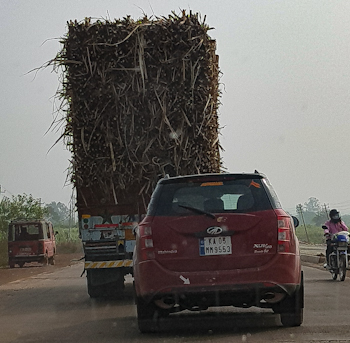
The truck in my picture is not unique. We saw many similarly loaded trucks on a short journey through northern Karnataka, and on many other road trips.

India is not simply incredible because of sights such as overloaded trucks, the wealth of colour, bustle, fantastic food, and the Taj Mahal. It is incredible because of its unending variety and generally very friendly people. Rich in history, the country has a very vibrant present.

Please note that I write this not as a promoter of tourism, but as a lover of a great country that survives despite itself.

On the Indian road

One of the multitude of things that attracts me to India is that often one can see something which remains unchanged over many thousands of years alongside something that has only come into existence very recently.

There is no better place to experience this than on the open road. Bullock carts share the highway with the latest models of automobiles.

In market places, goods are weighed on scales if a design that would not have seemed unfamiliar to people many hundreds of years ago, but the merchant prepares a computerised bill.

You can talk to a scientist who is making ‘cutting edge’ discoveries. During a short conversation, this person will switch with great ease between modern and ancient concepts without any problems.

For me, one of the great joys of India is the seemless coexistence of the past and present in everyday life.

Hindu burials

Death is a morbid but fascinating topic, as is disposal of the dead. Many people living outside India, including myself, believe that the corpses of Hindus are only cremated. At least, I believed this until about 15 years ago, when I visited a Hindu burial ground in Bangalore.

In a Hindu Burial Ground in Bangalore

I have visited two Hindu cemeteries in Bangalore, one of them being next door to a major electric crematorium in the city centre. When I have asked about Hindu burials, I have been told that some sects of Hindus favour burial rather than cremation.

Recently, I read an article about Hindu burials (in Calcutta) by A Acharya and S Sanyal in the “Mint” newspaper (Bangalore), dated 24 Nov 2018. Here is a brief digest of the points contained within it.

1. Certain groups of Hindus are traditionally immersed or buried.

2. These groups include:

A. Saddhus or ascetics who perform their own mortuary rites when they become saddhus, and are considered to be dead to the social world, living ghosts one might say.

B. Some young children, especially those who have not yet developed visible teeth. Also, some parents prefer to bury their dead offspring, rather than watching them being cremated.

C. Lepers. It used to be feared that a leper’s body might release an infectious vapour during cremation.

D. Some members of the following communities prefer to bury their dead to avoid the dominating behaviour of the Hinduism of the Brahmins: dalits, Vaishnav, Hela, and Kaburpanthi.

3. Sometimes, burial is cheaper than cremation. In Calcutta, burial can cost half of the charge of cremation.

4. Burial of Marwaris and Vaishnavites is more costly than for others because these two groups bury their dead with lots of salt, which they believe speeds disolving the flesh off the bones.

This newspaper piece has helped me to understand the existence of cemeteries where Hindus are buried. I assume that at least some of what has been written about Calcutta also applies to Bangalore.

On a parting note, I used to believe that the traditional method of corpse disposal amongst the Parsis was to feed their dead to the vultures. A Parsi friend of ours died in Bangalore, which has Towers of Silence for the corpses of Parsis, was buried in a Parsi cemetery in Bangalore. I have visited that cemetery, which is located in the district if Malleswaram and is for Parsis only.

All of this goes to show that making generalisations about India is inadvisable. So, before you assert that Hindus do not eat beef, hold your tongue! Some sects of Hindus have eaten beef since time immemorial. If the present government in India bans the consumption of beef, it will not be only Christians and Muslims who will be affected, but also several million Hindus.

In the club

The Bangalore United Services Club was established in its present pleasant premises in 1868 by members of the British military, the United Services. It was an officers’ club. With a very few exceptions (some members of Indian royal families), the Club only admitted Europeans (i.e. white people).  One of its best-known members was Winston Churchill, who did not like Bangalore and left the city leaving an unpaid bill at the Club. After WW1, some Indian military officers were admitted as members, but other Indians were excluded. After 1946, the Club was renamed “The Bangalore Club”, and civilians, both ‘white’ and Indian could become members. My late father-in-law became one of the first Indian members in the early 1950s.

CLUB 1

Today, the Bangalore Club is regarded as being one of the top (elite) social clubs in India. To become a member, applications must be made, and a hefty amount of money must be deposited with the Club. Then, the prospective member is put on a waiting list. The average waiting time is currently about a quarter of a century. This slow method of entry can be bypassed if you are the child or the spouse of an existing member. It so happens that I married a member of the Club. I was eligible to become a ‘spouse member’.

Simply being married to a member is not enough to get you into the Club. The spouse candidate needs first to apply, and then to find six sponsors, who are already members of the Club, and then to attend an interview. The interviews are only held a few times a year. Missing the interview might wreck the candidate’s chances of ever becoming a member. So, the candidate, who might be living anywhere in the world, must drop everything and attend when he or she is summoned.

I was lucky. My father-in-law (‘Daddy’), a well-respected and much-loved member of the Club, arranged that I would be called for interview on a date, when he was certain that I would be in India. However, he did not tell us about the interview before we left London. Had I known, I would have packed my only smart suit, but I did not. As soon as we arrived in Bangalore, Daddy told us about the interview, and we told him that we had not brought my suit. Undismayed, he rang around his friends in the neighbourhood, and he and I drove from house to house, trying to find a suit for me to borrow. Eventually, some kind person lent me his incredibly smart double-breasted jacket suit, which fitted me well. Unfortunately, I had to return it after the interview.

For a few days before my interview, Daddy and I visited several venerable members of the Club to get their signatures for my sponsorship. At each of their homes, I was received kindly, offered drinks and snacks while my potential sponsors became acquainted with me. At last, I was ready for the interview.

On the day of the interview, I woke up with an attack of influenza. My temperature was high, but the interview could not be missed. I was dosed up with paracetamol. Just before we left the flat, with me in my smart suit, Daddy sprayed me with some Eau de Cologne, saying it was best that I should smell pleasant when I met the interviewing committee.

I arrived with Daddy at the Club, where we joined about ten other candidates. Each candidate was chaperoned by a member, who would introduce him or her to the interviewers. Daddy was my chaperone. The interview procedure involved introducing me to each of several Club Committee members. Each Committee member asked me questions. Daddy was clearly worried about what I might say in response. So, as soon as I was about to answer any of the questioners, Daddy would interrupt me, saying something like:

“You remember me. I have been a member since 1954. How is your father? He joined at the same time as me, you know.”

I do not recall having answered any of the questions. Being Daddy’s son-in-law was enough to persuade them that I would be an acceptable member of the Club.

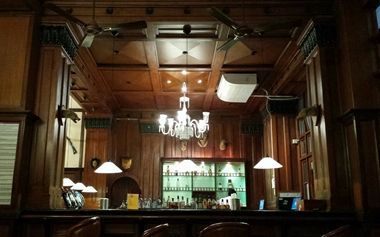
As we walked away from the interviewing room, Daddy congratulated me for becoming a member of the esteemed club. He led me to the Men’s Bar (for men only), where we downed draught Kingfisher beer. Oddly, my influenza symptoms were beginning to subside by then.
CLUB 2

Sadly, Daddy is no longer around. Today, the Men’s Bar is no longer for men alone. Its name changed in about 2017, by which time both men and women were permitted to use its facilities. Daddy would, I believe, have approved of the liberation of the former Men’s Bar.


Finally, let me emphasise that I do not agree with Groucho Marx, who said:

“Please accept my resignation. I don’t want to belong to any club that will accept people like me as a member”