A postman and his spear

Happy New Year!

NEXT TO THE POST OFFICE on the corner of Bangalore’s Museum and State Bank of India Roads, there is a recently opened Museum of Communication. Housed in an old-fashioned Bangalorean bungalow, it is effectively a museum of the Indian postal services. This well laid out museum contains a variety of exhibits ranging from postage stamps to large pieces of mechanised equipment. I will describe a few of the many exhibits that interested me.

There is a photograph of the world’s highest post office (somewhere in the Himalayas). There is an enormous piece of equipment, which occupies the whole of a room. It was used for transmission of money orders. Several panels described the history of the Indian freedom struggle and that of the Indian Post.

Outside on the museum’s shady verandah, there is a collection of old letter boxes. They include boxes of various shapes, sizes, and colours. One of them bears the Portuguese words “CAIXA POSTAL”. Once upon a time, it must have been used in one of Portugal’s Indian colonies, but there was no information about its original location.

Outside the museum, and still in use, there is a hexagonal pillar box, very similar to one placed at the Bowring Institute in the late 1880s. Unlike the one at Bowring, which bears the British Indian postal insignia, the box near the museum has been modified to make it look like a post-Independence Indian Post pillar box.

Next to the entrance to the museum, also on the verandah, there is aalifesize model of an Indian postman of yesteryear. Wearing a green and white uniform (including a turban) with some red trim, he has a sack slung over his left shoulder. His right hand is stretche out in front of him. In it he holds a wooden shaft tipped with a sharp metal spear tip. Four small bells are attached to the base of this tip. A lantern hangs from his right wrist.

In the past, the postman mafe his way from village to village along paths through the jungle. The spear tip and its staff were used to ward off wild animals. The lantern was used to light his way, and the bells were rung to alert villagers to his arrival.

Visiting the museum was an interesting experience. Seeing the hardships that postmen used to face should make us pleased that we can now communicate using fax, email, and other modern inventions.

A fine old coffee house with waiters in turbans

WHEN I FIRST VISITED Bangalore in 1994, there was a coffee house on MG Road close to the now derelict Srungar Shopping Complex. This venerable ‘hole in the wall’ was a branch of the Indian Coffee House (‘ICH’) chain. In both appearance and atmosphere it reminded me of some of the older coffee houses I had seen in Yugoslavia when it was still a country.

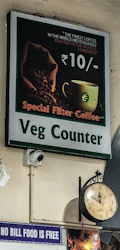
Customers sat at old wooden tables on wooden benches with upright hard backrests. Old Coffee Board posters hung on the walls. The waiters were dresses in grubby white jackets and trousers held up by an extremely wide red and gold belt with huge buckles that bore the logo of the ICB. These gentlemen wore white turbans with red and gold ribbons on their heads. On addition to rather average quality South Indian filter coffee, a variety of snacks and cold drinks were also available.

During the British occupation of India, admission to most coffee houses was restricted to European clients. In the late 1890s, the idea of establishing an ICH chain of coffee houses for Indian customers began to be considered. In 1936, the India Coffee Board opened the first ICH in Bombay’s Churchgate area By the 1940s, there were at least 50 branches all over what was then British India.

In the mid 1950s, the ICHs were closed by the Coffee Board. The Communist leader AK Gopalan (1904-1977) and the Coffee Board workers managed to get the Coffee Board to hand over the ICH outlets to them, and they formed a series of Indian Coffee Workers’ Co-operatives. The cooperative on Bangalore was formed in August 1957. There are now several branches in the city.

The MG Road branch, which opened in 1959, closed in 2009, at about the sane time as the nearby Srungar Complex began becoming closed for redevelopment, which has not yet happened.

The branch reopened in the Brigade Gardens complex on Church Street. Apart from being accommodated in a room which is rather nondescript compared to its former home, not much has changed as a result of the move to a new location. The furniture is that which was in the older site. Likewise, the old posters have been transferred. And the waiters are still attired in their stained white uniforms with belt, buckle, and turbans. The ‘atmosphere’ of the old ICH on MG Road has been recreated or maybe continued in the coffee house’s new premises. The quality of the coffee served has neither improved nor deteriorated. The ICH remains as popular as ever, and for me it is always a pleasure to enter this old-fashioned place in a city that is addicted to change.

From paper come plants

A TALL MINARET OVERLOOKS Ebrahim Saheb Street in Bangalore’s busy Commercial Street bazaar district. Not far from the lofty structure stands the premises of a printing firm called Sundaram. It is here at this efficient enterprise that I have often had visiting (business) cards printed.

Recently, I went to Sundaram’s to collect my latest batch of cards. While I was waiting to have them packed, I noticed a man in the shop, folding what looked like A3 sized sheets of plain white paper. He folded them in half lengthwise. I asked him what he was doing, and he replied:
“Seed papers”
I must have looked puzzled because the owner of the business added:
“You put them in the ground and plants will come. You leave them in the ground after plants have come. The papers have seeds in them.”
He told me that these seed papers were made in Coimbatore, a town south of Bangalore. Then, he went to the rear of his shop and brought me a few offcuts of the seed paper.

The paper is quite thick and rather stiff. It has a slightly rough surface. When you examine it you can see well spaced, small darkish thickenings. These spots are the seeds, which have been incorporated into the biodegradable paper.

Not being a gardener, I had not come across seed paper before. It has been around for many centuries. Until 1941, it used to be handmade in small batches, but after that year it began to be made on an industrial scale.

The paper can incorporate a variety of seeds from flowers to edible plants. I suppose that the advantages of seed papers include appropriate spacing of seeds and protection from consumption by birds etc.

When I entered Sundaram’s to pick up my cards, little did I expect to learn about seed paper, or to discover horticultural material being processed in a printing shop. It is surprises such as these that make visiting India so much fun.

Holy Communion and covid19

ST MARKS CATHEDRAL in Bangalore was constructed between 1808 and 1812. It is an elegant late Baroque church standing in its own spacious grounds. We visited it on Christmas Day 2022. There was a service in progress. The congregation was too large to be fully accommodated within the building. Many people were sitting outside the church, some of them under a canopy. The service was conveyed to those outside the building using loudspeakers and a giant television screen.

While the cleric began reciting the words associated with taking communion, he spoke of receiving the body of Christ. As he said that, I noticed a woman in the congregation opening a small container and taking a small flat white object from it, and then slipping it into her mouth.

A man nearby asked if we wished to take communion, and then pointed to a table covered with small round plastic containers with lids. Each of these contains a communion wafer fragment and some “communion nectar”, which I imagine represents the blood of Christ.

At St Mark’s, it appears that Holy Communion is self-administered, rather than being handed out by a cleric, as is the case in most churches where I have witnessed Holy Communion. I wondered whether these little pots of Holy Communion ‘ingredients’ are an attempt to reduce the risk of transmitting disease in these times when the covid19 virus is so prevalent.

An unusual letter box in Bangalore

A FRIEND IN BANGALORE, Mr Aggarwal, alerted me to the existence of an historic pillar box (letter box) in the city’s Bowring Institute. This private club has been located in its current position on St Marks Road since 1888, when it’s elegant clubhouse was constructed.

In front of the main entrance to the clubhouse, there is a hexagonal pillar box, which is still in use. This six-sided box is topped with six sloping triangular panels which meet at the highest point of the letter box.

The box bears a crest or emblem on the side where the slot for posting letters is located. This consists of a lion and a unicorn facing each other. Their forecast rest on a circle contains a cross. The circle is surmounted by a crown with two crosses. There is also a small crown with a cros on the lion’s head.

Below the crest, there is a diamond shaped lozenge containing the letters R, N, C, I (or possibly O). What these letters signified (or whether this was the manufacturer’s name) has not yet been revealed by an Internet search.

It had been suggested to me that the pillar box was a British East India Company (‘EIC’) letter box. This is unlikely to be the case because, from what I have managed to ascertain, the EIC crests included two lions facing each other, but no unicorns. Furthermore, by 1888 India was governed by the British Government rather than the EIC (which was in charge of governing India prior to 1857).

The letter box is believed to be contemporary with the construction of the Bowring clubhouse. In 1888, Queen Victoria was the Empress of India. The post box is therefore likely to have some connection with the British Indian postal service. I have yet to discover whether I am right about this. A quick search of the Internet did not reveal any examples of historic pillar boxes bearing the crest on the box at the Bowring Institute. If anyone knows more about this particular crest, please do inform me.

HAPPY CHRISTMAS

Everything is available …

EVERY FEW MINUTES, a ferry traverses Goa’s Mandovi River between Panjim and the village of Betim. This free river crossing is for the use of pedestrians and those riding two-wheelers. The ferryboat is loaded via an elevatable ramp.

As soon as the ramp touches the concrete landing stage, a wave of pedestrians and motorbikes surge from the boat onto the shore. As they do so, the waiting pedestrians and vehicles swarm on to the ferry.

On arrival at Betim, we walked away from the landing place along a busy country road lined with shops, shacks, and much tropical vegetation. It was not long before we reached the small restaurant set back from the road, which had been recommended to us.

Although it was nearly noon, the eatery seemed rather lifeless. Eventually, we saw a man emerging from it. He showed us a menu. We asked him if all the dishes were available. He replied:
“Everything is available.”
After a pause, he added:
“Today kitchen is closed.”

India’s history rediscovered?

RUPA GUPTA AND Gautam Gupta have written a fascinating book with an intriguing title: “Forgotten Civilisations. The Rediscovery of India’s Lost History”. It describes 15 British men, who came to India during the British colonial era, which ended on the 15th of August 1947 and explored the Subcontinent’s early history.

The authors have written short biographies of these interesting men, highlighting the contributions they made to documenting India’s long history. The book seems to be making the case that before the arrival of these men, filled with a great enthusiasm for unearthing the past, India’s history prior to the Mughals had been largely forgotten.

Now, I am not qualified to comment on whether or not Indians had forgotten about their early ancestors, but wonder whether this history had really been lost before the arrival of the men described in the book. In many cases, these men were reliant on help from pandits who could read ancient scripts such as Sanskrit. Understanding these texts was the key to many of the ‘discoveries’ made by the subjects of the book. The existence of these texts suggests that long before the arrival of the British, early Indian history had been preserved, but maybe not as systematically as modern European historians would have preferred.

Despite my reservations about whether India had really lost or forgotten its ancient past, the book by the Guptas is fascinating (even though I have some reservations about its rather repetitive formulaic style).

Suggesting that a country had forgotten its own history might pander to readers who still harbour patronising or colonialist ideas about India. Although I have not yet seen this book on sale in British bookshops, I suspect it would might well appeal to readers, who seem to have forgotten that Britannia no longer rules the waves. I doubt that it was the Gupta’s intention that their interesting text might possibly appeal to readers who still believe that Britain is superior to other nations.

Art for all ???

I HAVE ATTENDED many art festivals. These have included the biennales at Cochin and Venice, and the trienniale at Folkestone. At each of these, the visitor is made to feel that the event is planned to encourage his or her interest in artistic endeavours.

This December (2022) we happened to be in Panjim, Goa, during the Serendipity Arts Festival (‘SAF’).

At the SAF, each event is swarming with volunteers wearing orange jackets. Attendees are required to complete an online registration in addition to registering for many of the various events in the programme. The poorly trained, often ill-informed, volunteers are obsessed with checking visitors’ registration passes (on mobile phones). Yet, we discovered that many of the visitors to the exhibits and shows have neither bothered to register nor been stopped from entering the SAF venues.

Yesterday, having made an online booking for seats on what promised to be a pleasant musical cruise on the Mandovi River, we turned up at the embarkation point well in advance of the departure Time, only to discover that the bookings were irrelevant and it was ‘first come, first served’. Furthermore, despite the boat being full to capacity, so-called VIPs and the ubiquitous volunteers were permitted to come on board. By force of personality, we managed to board the crowded vessel. I am not sure that after the struggle to get on board that I derived much, if any, enjoyment from the cruise.

It appears to me that unlike what we have experienced at Cochin, Folkestone, and Venice, the arts festival at Panjim seems to be mainly for the benefit of the organisers and the numerous volunteers, rather than for the members of the public who have travelled all the way to Goa to experience it.

However, I wish to conclude this on a positive note. We were fortunate to have been shown around one of the exhibitions by its curator, who seemed very pleased that we had come to see her show.