A Hindu temple that incorporates a banyan tree

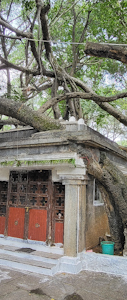
ON THE CAMPUS of Bangalore’s Chitrakala Parishath art college, there is a small Hindu mandir, the Ganapathi Temple. Dedicated in 1984 and built by Mandelia Parmarth Rosh, it contains an effigy of Ganesh and not much else.

What makes this small religious building both fascinating and charming is that its construction incorporates branches of a large, living banyan tree. The tree is growing through part of the temple.

Smoke and flames in a Muslim mausoleum in Baroda (Gujarat)

THE HAZIRA MAQBARA is an impressive octagonal structure in Baroda (Gujarat). It was built in about 1586 in the Mughal style of architecture, such as can be found in Delhi. This beautiful mausoleum houses the graves of Qutb-ud-din Muhammad Khan who was the tutor of Salim, son and successor of Akbar, and also that of his son Naurang Khan who held important posts in Gujarat under Akbar. There are other graves within the building and also nearby on land near it.

The various graves are covered with colourful cloths upon which red rose heads are placed. The roses are replaced daily, and the cloths every Thursday. This we were told by an elderly man who had been praying loudly within the main central chamber of the mausoleum.

Apart from the beauty of the building and its wonderful jaalis (latticework window screens), I was impressed by some things that I have noticed in many other Muslim mausoleums in India.

Incense stick near some gravestones

Within the mausoleum and close to the graves outside it, there were incense sticks (agarbatti) burning, releasing small clouds of fragrant smelling smoke. Within the mausoleum, I spotted at least two oil lamps (diyas), each with small flickering flames.

Agarbatti and diyas are commonly found in Hindu temples, and often at the beginning of the day in shops, restaurants, etc. I first noticed them being used in Islamic settings in India in Sufi dargahs (shrines containing graves) in Bangalore when going on excellent guided walks led by my friend Mansour Ali. Later I begun noticing these things, which I had initially assumed were only associated with Hinduism, in places associated with Islam. I have discussed this commonality of Hindu and Muslim practices in one chapter of my new book about travels in India, which is available from Amazon (eg https://www.amazon.co.uk/HITLER-LOCK-OTHER-TALES-INDIA/dp/B0CFM5JNX5/ ) AND if you live in India, from https://store.pothi.com/book/adam-yamey-hitler-lock-and-other-tales-india/ .

Other chapters in my book about my experiences of visiting India cover a wide variety of subjects. The book, which is aimed both at those who ‘know’ India and those who do not, is both informative and entertaining.

Feeding the faithful at a Hindu temple in Kutch (Gujarat)

THE DHRABUDI TRMPLE complex is near the sea about 5 miles east of the town of Mandvi (Kutch, Gujarat). It is located ated next a small Freshwater lake, where pilgrims can bathe. Our driver told us that baby boys are brought to be blessed at the temple when they reach their first birth anniversary. When we visited, we saw a group of people doing a puja in the open air. They were respecting the first death anniversary of one of their relatives.

While wandering around the temple compound, we saw a group of Rabari women seated in the shade, under a large banyan tree. The Rabari are nomadic cattle and camel herders, as well as shepherds. In India, they aremost frequently found in Gujarat, Punjab, and Rajasthan.

Worshippers come from far and wide to do pujas at the mandir. The temple offers free meals to pilgrims. These are served in a large dining hall. One wall of this is lined with numerous portraits of people who have died. We were told that diners pick up a thali and other eating utensils before lining up to be served food.

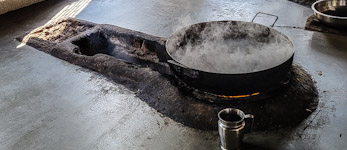
Pit containing glowing charcoal for cooking

The kitchen, which is next door to the dining hall is vast. It was spotlessly clean. I saw a few gas rings, but what really fascinated me was the other method by which food is heated up. I saw three or four pits sunk into the floor. Each one is shaped like a large spoon. Glowing charcoal is heaped in the bowl of the ‘spoon’, and can ve spread along the stem. Pots are placed above the charcoal. The arrangement reminded me of the Turkish ocakbaşı. I imagine that the cooking speed can be adjusted by varying the amounts of glowing charcoal beneath each of the enormous cooking pots.

We did not stay to join the pilgrims having lunch. Although the temple cooks kindly invited us, we had lunch awaiting us at my wife’s cousin’s home.

I always enjoy visiting place of worship. What made Dhrabudi special for me was being shown its wonderful kitchen.

A temple in Mandvi: architectural revival or survival?

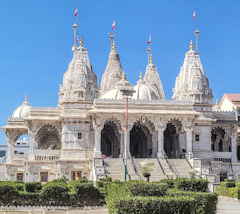
THE SWAMINARAYAN TEMPLE in Mandvi (Kutch, Gujarat) was constructed between 1991 and 1999 to replace a smaller Mandir on the site. Without going into the details of its very fine architectural and decorative features, this edifice was financed by local Kutchi followers of Swaminarayan. The Rajasthani Marble that forms the temple’s structure was hand carved by workmen, all of whom were followers of Swaminarayan. The stones that make up the building were carved in Rajasthan, transported to Mandvi where they were put together to make the edifice. This is similar to how the great temple in London’s Neasden was constructed.

Swaminarayan Mandir in Mandvi

The temple at Mandvi looks very similar to ancient Hindu temples I have seen elsewhere in India. As you look around it, you can see how the very old temples looked when they had just been built many centuries ago. Apart from the fact that Mandvi’s Swaminarayan Mandir looks recently built, a layman like myself, would find it difficult to age the building.

In 19th century England, many new churches were built in the gothic style. Like the newish temple at Mandvi, may of them faithfully reproduce the churches built in mediaeval times. The only thing that differentiates the 19th century Gothic Revival churches from their mediaeval predecessors is that they look too new to be as old as them.

In a book about Gothic Revival written by the art historian Kenneth Clark (1903-1983), he suggests that in England the use of gothic style in architecture never actually died out, and this suggested to me the Gothic Revival was really gothic survival. As far as I can gather, the same is the case for Hindu mandir architecture. If this is really the case, new temples such as Mandvi’s Swaminarayan Mandir is not the revival of the use of an ancient style of architecture, but an example of its survival. Put another way, the new temple at Mandvi is a reincarnation of its predecessor.

Two in one

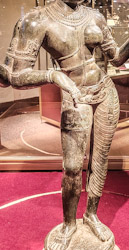
THE GOVERNMENT MUSEUM in Chennai has a magnificent collection of mostly early medieval Hindu and Buddhist bronze sculptures. One of these wonderful religious artworks was exceptionally interesting. At first sight, it seems like a sculpture of a human figure, but soon you will notice many odd things about it.

The figure has two right arms and one left arm. It’s left breast is female in form. The right is male. The right side of the torso has male characteristics, but the left side has sensuous female curves. As for tthe shapes of the buttocks, the right one is different from the larger left one. The right leg is largely unclothed, but the left is covered with a depiction of a cloth covering.

The statue I gave been describing is half male and half female. According to an information panel nearby, this sculpture is an 11th century depiction of Artanarishvara. It is a composite of Shiva (right half) and Parvati (left half). It represents the belief that the Godhead, Shiva, and his consort, Parvati, cannot exist without each other. It also shows that without the coexistence of male and female, human life cannot be propagated and continued. No doubt, there is much more meaning encompassed in this interesting sculpture, but I am not competent to discuss this further. Suffice it to say, seeing this unusual sculpture gave me food for thought.

Until today, I had never seen an Artanarishvara. This beautifully crafted work was one of many lovely pieces in the bronze collection of Chennai’s version of the British Museum.

A tree and two shrines

WHILE TRAVELLING AROUND India, I have seen many trees that serve some kind of Hindu religious purpose. Often they are peepul trees, whose leaves are heart-shaped. Frequently, there is some kind of shrine next to the trunk, and often there are fine threads wrapped around the circumference of the trunk.

Near the middle of the market place in 8the Goan town of Mapusa, there is an old tree next to which there are two shrines. The tree’s leaves did not look like those of a peepul tree. What interested me was that at first sight both of the shrines, which resemble small huts, looked similar.

On closer examination, it could be seen that one of the shrines was, as I expected, Hindu, and the other was, to my surprise, Christian.

Whether this close proximity of the two shrines was pure coincidence or related to the fact that the tree provides good shade, I cannot say. Another possible explanation of the closeness might possibly be a symptom of inter-religious tolerance in this small Goan town. Who can say? Whatever the explanation for the closeness of the two shrines, it was heartening to see.

To beef or not to beef: a mistaken belief

AN INDIAN FRIEND came to the UK to work in the early 1960s. Shortly afterwards, his wife joined him. Back in those days before they became prosperous, one of their occasional treats was to eat in a Wimpy Bar.

My friend and his wife used to order hamburgers, which she enjoyed. Being a devout Hindu, she wanted to avoid eating beef. For years, she believed that the hamburgers were made from ham rather than any other meat. As she enjoyed these burgers so much, her husband decided not to reveal to her that the hamburgers were not made with ham, but with the meat her religion had taught her to avoid. Later, when she discovered that her hamburgers were made with beef, she did forgive her husband for, rather mischievously, concealing that information from her.

This true story, which I was told many years ago, came back to me when I saw a meat store in the grounds of the Bangalore Club (in Bangalore, India). Entertainingly called Meister Wurst, this place sells various prepared meats such as sausages, hams, and salamis. All are made to resemble products made in Germany, but they are manufactured in Bangalore.

There is a large coloured photograph in the front of the store. This image depicts a mouth-watering looking beefburger with the usual accompaniments, all contained between the two halves of a burger bun topped with sesame seeds. Above the photograph are two words, which would have pleased my beef avoiding, hamburger loving friend:
“Ham Burger”.

PS The name ‘hamburger’ has nothing to do with its ingredients. It comes from the name of the German city of Hamburg, where the dish might or might not have been ‘invented’.

Ambling in Ahmedabad

A LAZY MORNING IN AHMEDABAD was just what we needed after a long bus ride from Bhuj the day before. The seat I sat in was uncomfortable.

Our newspaper seller and her assistant were sitting in their usual place on the pavement next to the entrance of the somewhat precious luxury hotel, The House of MG. They sit surrounded by piles of newspapers, both current and out of date. When we are in Ahmedabad, which we have visited 6 or 7 times during the last two years, they reserve a copy of the Indian Express for us. When we go to collect it, they have to rummage around to find it amongst the seemingly disorganized pile of newspapers, new and old.

We set off towards the Khwaja Bazaar and the Teen Darwaza, heading towards the Jumma Masjid. Just before we reached the bazaar, we entered a rather run down café/restaurant, named ‘Irani Restaurant’. This was established in 1950 and does not seem to have been redecorated since. The wall of the long rectangular dining hall has several mirrors, all cracked. However, the marble topped tables and the enormous kitchen are sootlessly clean. In addition to hot food items, this place sells freshly baked bun maska. These soft white bread buns have a very slightly sweet taste; they resemble the French ‘brioche’. I had one of these and ordered chhaas (buttermilk). To my surprise and delight, this was served in a used Pepsi bottle.

We proceeded to the Teen Darwaza, a three arched 15th century gate that was built soon after Shah Ahmed founded Ahmedabad in about 1420. Standing amidst a sea of market stalls and noisy traffic, this venerable stone gateway has decorative features that can be found on Indian structures built long before the Moslems arrived in India. This is also true of many if the 15th century mosques built in the early days of the city’s existence.

The Jumma Masjid is enormous and of great beauty. Like other mosques built in the 15th century in Gujarat, this Masjid displays many decorative and architectural features that the Moslems have adopted from Hindu and Jain temples that were in existence prior to Islamic invasions of western India.

The Jumma Masjid has more than 15 large domes and many smaller ones. Like the domes in earlier Hindu and Jain temples, the larger domes rest on eight lintels arranged octagonally. The lintels rest on eight supporting pillars. The interior of the mosque contains a forest of over 250 stone pillars, the bases of which have been decorated with carved stone motifs typically found in Hindu and Jain temples. I do not know why the newly arrived Moslems borrowed so many features from the temples which they found (and sometimes demolished) when they arrived in western India. Maybe, they employed local Hindus or Jains to construct the mosques, but surely the conquerors would have had some say in how the mosques were designed.

We spotted several terracotta pots placed by the bases of some of the pillars. These, we were told, are for worshippers to expectorate into should they need to during the prayer sessions (namaaz). This saves people from spitting on the floor, which is so common outside of holy places in India.
The Jumma Masjid has five carved stone mihrab niches, all facing towards Mecca. Each of these is decorated differently, but each of them is topped with a carving of a lamp, a symbol of the holiness of Allah. The central of these five niches is made of white marble inlaid with coloured stones. It is disfigured by the presence of a modern electric fan, which we were told is used to cool the Imam during namaaz.

There are numerous window around the mosque. Each of these is decorated by decorative jali work (decorative perforated stone screens). No two windows are decorated with the same design.

The mosque lost its two minarets during the earthquak of 1819, which resulted in an inlet of the Arabian sea being transformed into an arid salt desert (the Rann of Kutch).

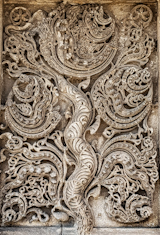
The outer walls of the Masjid that face a huge space enclosed by arched passageways have several stone carvings depicting trees. I imagine these are depictions of the Tree of Life, such as can be seen in the intricate jali work at the Sidi Sayeed mosque.

After a pleasant hour examining the Jumma Masjid, we wended our way through the increasingly busier bazaar back to the Irani Restaurant. I ordered more chhaas, which arrived in used Seven Up bottles. This watery dairy drink, flavoured with cumin and other spiced, made a good accompaniment to my plate of delicious dal fry (dal to which slow fried onions and spices are added at a late stage in its preparation).

By 130 pm, the temperature had risen above 27 degrees Celsius, and it was time to retreat to our air conditioned hotel room. But before that, I made a trip to a local ATM. As with other ATM places in India, all the customers waiting for machines give each other helpful advice, such as “press this” or “remove card” or “enter pin” or “do that”, on how to use the machines. Unlike in the UK, where using an ATM is a very personal affair, in India it appears to be a group activity.

A walled city and two caves

THE FAR WEST OF KUTCH (once an independent kingdom, now part of Gujarat) is very close to India’s border with Pakistan. We made an interesting day trip from Bhuj to this relatively wild and less inhabited part of Kutch.

The countryside west of Nakhatrana becomes hilly and dry with many rocky outcrops. It contains many large sites where lignite is excavated and a huge industrial plant that Gujarat Electricity use to convert it into electricity. The area is also liberally dotted with electricity generating wind turbines and pylons.

We left the main road and wound through undulating dry landscape to reach the Siyot Caves. These rock temples were carved into the cliffs to create Hindu temples sometime between the 1st and 2nd centuries AD. They were later used by Buddhists and are amongst the 80 Buddhist cave temples in the Indus Valley noted by the 7th century Chinese traveller Hiuen Tsang. Today, they are the abode of bats and there walls and pillars are covered with graffiti scratched into the red stone.

Our driver drove us through a sandy landscape with scrubby plants along dirt track with many potholes. We reached a small temple enclosure, where we stopped in order to visit another cave temple. This one, the Guneri Gufa Shiv Temple, was carved out of the living rock by a holy man, whose “spirit left his body about five years ago”, according to the present priest, a Sadhu from Hardwar. The temple, which is faintly reminiscent of the Amdavad ni Gufa (in Ahmedabad), contains a large Shiva lingam. After we had looked around, the picturesquely attired Sadhu prepared tea for us, which we drank from small metal bowls.

Lakhpat was our next stop. Surrounded by intact 18th century city walls, seven kilometres in length, this once thriving port used to be on an inlet of the Arabian Sea. Following an earthquake in 1819, the mouth of the River Indus changed its course and Lakhpat was no longer close to the sea. Rapidly, Lakhpat lost its importance and became depopulated. Today, the impressive city walls enclose a huge empty space with a few houses, a mosque, a few Hindu shrines, and a working Sikh Gurdwara. Staircases allow visitors to reach the ramparts. The view from the top of the walls is of an endless flat sandy area extending to the horizon. Before 1819, what is now the flat Rann of Kutch would have been a seascape with trading vessels.

One of the gates into Lakhpat, the Katha Nako, is still intact with one of its huge metal studded doors hanging on its hinges. The outer wall of the archway leading into the city has a sculpture of a guardian in European garb, such as can be seen at the Aina Mahal in Bhuj. The city wall and this sculpture are evidence of the influence of Ram Singh Malam, who lived for a decade in Holland in the mid 18th century.

Lakhpat is close to the Indian border with Pakistan. The road from the former port city to Narayan Sarovar runs parallel to the frontier. All along the road, there are signs to tracks leading to various Indian border patrol posts.

A causeway leads from the mainland to an island to the west of it. On one side of this is an inlet of the Arabian Sea and on the other there is a freshwater lake, the Narayan Sarovar. According to Hindu mythology this is one of the 5 Sacred Lakes and therefore an important pilgrimage sites.

We stopped near the Koteshwar Temple, which overlooks a pier that reaches out into the sea. We walked along the pier passing a small temple and an enclosure containing sculptures of various Hindu deities. Just over two thirds of the way along the pier there is a barrier beyond which members of the public are not allowed. At this barrier there is a Border Force sign and a smaller one on which is written: “Fishermen frisking point”. Beyond the barrier I saw small buildings in which soldiers were sitting. Several pairs of soldiers’ green trousers were hanging out to dry on a washing line between two small huts. A fleet of small fishing vessels were moored near the part of the pier beyond the barrier. As the tide was out, they rested on the shiny mudflats that glistened in the afternoon sun.

I saw several long legged birds, not flamingos, searching for food out on the damp mudflats. Near to the pier there were lots of amphibians, rather like fat newts, wriggling and scuttling about in the film of water covering the mud.

A short way from Koteshwar is the temple compound at Narayan Sarovar. Surrounded by high castle walls, this walled enclosure contains two large mandirs. A small gate leads to a tiny jetty projecting out over the freshwater lake on which we spotted a moorhen swimming. Some steps led from the outside of the temple compound’s enclosing wall into the lake to allow people to bathe. We left Narayan Sarovar, pleased that we had made the long journey to reach this beautiful, peaceful spot.

We made a brief stop at the popular pilgrimage place Mata no Madh, home of the Ashapura Temple that was first established in the 14th century AD, but completely rebuilt after the 1819 earthquake.

Back in Bhuj, we ate dinner at Noorani, a restaurant that serves good non-veg food. Many of the servers are young men. Out of the blue one of them asked my Indian wife, who speaks fluent Gujarati, whether she was Japanese. We were taken aback; she has no features that make her look Japanese. I had noticed that a couple of Japanese women had occupied a table in another section of the restaurant and wondered whether seeing us, a European with a woman who was clearly not a local, made the boy think that we were as ‘exotic’ as the two Japanese ladies.