A foreign wind

THERE IS A HOUSE in Hampstead’s Downshire Hill, where John Heartfield (1891-1968) lived between 1938 and 1943. Born in Germany as Helmut Herzfeld, he was an artist who employed art, and in particular photomontage, as a political weapon. He was anti-Nazi and fled Germany in 1933, arriving in England in 1938, having spent some time in Czechoslovakia. Nearby, are houses where three other artistic creators lived: Roland Penrose and his wife Lee Miller; and the creator of The Muppets, Jim Henson.

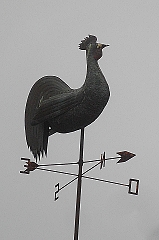
Heartfield’s home on Downshire Hill has a peculiar feature, which might have been added long after he lived there. It is a weathervane. That is not a particularly unusual embellishment, but on closer examination, it is not a run-of-the-mill British weathervane. Weathervanes in England often have the four points of the compass abbreviated as NSEW, that is, north, south, east, and west. The one on Heartfield’s former home has the letters NSOE. At first, I thought that the O was an abbreviation for the German for east, ‘Ost’. If the weathervane was German, it should have had the letters NSOW. Then, I thought that the O is probably an abbreviation for the Italian for west, ‘ovest’ or for ‘oeste’ the Portuguese and Spanish words for west. This makes sense because the other points of the compass in those languages are abbreviated as: N, S, and E. Short of ringing the doorbell to ask, the linguistic identity of the weathervane will have to remain a mystery to me for the present.

Relief below ground

IT IS NOT OFTEN that I feel the need to write about answering the call of nature but after a recent visit to Hampstead’s South End Green, I must satisfy the urge.

There is a yard at South End Green, where buses serving the route number 24 wait before setting off to Victoria station. Long ago, this yard used to have tram tracks as it was the terminus of a tram line. A lovely small café, Matchbox by name, stands beside the yard. Its owner, Mirko, a friendly Slovenian, serves excellent hot beverages and a range of mouth-watering snacks, both sweet and savoury. The nearest public toilets are across the yard, almost opposite to Matchbox.

The toilets are below ground level and accessed by staircases with cast-iron structures above them. It was only on our most recent visit to South End Green, in December 2021, that I had reason to descend into the ‘gents’, and I am pleased that I did, not only for reasons related to my physiology but also to satisfy my curiosity.

The ‘gents’ is magnificent, with its white glazed brick walls decorated with bands of light green bricks, its long narrow, black and white chequered floor, its polished dark wood cubicles, and its row of white urinals all topped with grey (marbled with white streaks) granite separators. Although there is electric lighting, a skylight admits some natural light.

The underground toilet facilities, both the men’s and the ladies’, were constructed in 1897 for the benefit of passengers using the tramway. Stephen Emms, writing in the “Kentish Towner” in October 2013, noted that the gent’s underground facility at South End Green was a pick-up place used by homosexuals. He noted:

“But most memorably South End Green is the only public toilet still in use known to have been visited by iconic 1960s playwright Joe Orton. Apparently it was his “favourite pick-up point” too””

You might be relieved to learn that my recent brief visit was completely uneventful.

Artists and secret agents

A REMARKABLE ENGINEER and furniture entrepreneur Jack Pritchard (1899-1992) and his family lived at 37 Belsize Park Gardens, in London’s Hampstead district. before WW2. Pritchard, who studied engineering and economics at the University of Cambridge, joined Venesta, a company that specialised in plywood goods. It was after this that he began to promote Modernist design. In 1929, he and the Canadian architect Wells Coates (1895-1958) formed the company, Isokon, whose aim was to build Modernist style residential accommodation.

Pritchard and his wife, a psychiatrist, Molly (1900-1985), commissioned Coates to build a block of flats in Lawn Road on a site that they owned. Its design was to be based on the then new ideas for communal housing that had been realised in Germany including the influential Bauhaus in Dessau. The flats are close to Fleet Road and the Mall Studios in Parkhill Road. Completed in 1934, they were, noted the architectural historian Nikolaus Pevsner, “… a milestone in the introduction of the modern idiom to London.” He continued, writing in 1952, clearly critical of the edifice, which:

“…put on a forbidding face towards the street, with large unmitigated concrete surfaces … It is all in the spirit of revolution, unaccommodating and direct to the verge of brutality.”

Well, I quite like the building’s elegant simplicity. In the basement space of the block, there was a refreshment area known as the Isobar. This and its furniture were designed by Marcel Breuer (1902-1981). Regularly, exhibitions were held in the Isobar and, according to an on-line article in The Modern House Journal these were attended by artists including Adrian Stokes, Henry Moore, Barbara Hepworth, Ben Nicholson and Naum Gabo. The article also noted that this refreshment area was frequented by modernist architects such as Erich Mendelsohn, Serge Chermayeff and, Wells Coates, as well as by left-wing politicians. Pritchard occupied the penthouse flat. In 1969, he sold the block, and now it contains accommodation for 25 keyworkers on a shared ownership basis and 11 flats are in private ownership. The block, first known as the Lawn Road Flats, is now called ‘Isokon. Lawn Road Flats’.

T F T Baker, Diane K Bolton and Patricia E C Croot, writing in A History of the County of Middlesex: Volume 9, Hampstead, Paddington, noted that the Lawn Road Flats were built partly to house artistic refugees, who had fled from parts of Europe then oppressed by dictators, notably by Adolf Hitler. Some of them had been associated with the Bauhaus. These included the architect and furniture designer Marcel Breuer, the architect Walter Gropius (1883-1969), and the artist and photographer Laszlo Moholy-Nagy (1895-1946). All three of them are regarded as being masters of 20th century visual arts.

Despite both having come from bourgeois backgrounds, the Pritchards aimed to free themselves from middle-class conventions. The concept and realisation of the Lawn Road Flats, were important landmarks in their quest to achieve a new, alternative way of living. It is accurate to say that the atmosphere that prevailed in the community that either lived in, or frequented, the Lawn Road Flats was predominantly left-wing and extremely welcoming to cultural refugees from Nazi Germany. Probably, it had not been anticipated that the place should become a convenient place for Stalin’s Soviet spies to use as a base. According to a small booklet about the flats Isokon The Story of a New Vision of Urban Living, published in 2016, the flats were home to the following espionage agents, who had been recruited by the NKVD in Central Europe: Arnold Deutsch, Simon Kremer, Jürgen Kuczinski, and Brigitte Kucynski Lewis. Jill Pearlman, one of the book’s several authors, noted that they found the Lawn Road Flats convenient for several reasons:

“Above all, they blended inconspicuously into the sociable community of tenants there. Many tenants too were refugees from Central Europe … Even the Lawn Road Flats building worked well for the spies. One could enter and exit any unit without being seen … no one could see in. At the same time, the cantilevered decks on each floor provided the tenants a perfect vantage point from which to survey the street below.”

Today, there is a small exhibition area in the garage of the flats. This is open on some weekends, but I have yet to visit it.

A lady in Hampstead and Boy George

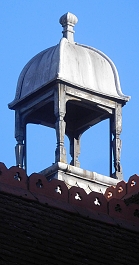
GROVE PLACE IS a short street running southwest from Hampstead’s steeply inclined Christchurch Hill. We often walk along it on our way to the lovely café at nearby Burgh House. A building containing numbers 29-31 Grove Place has often attracted my attention because its roof is topped with a couple of cupolas, each supported by four carved wooden pillars. These stand on either side of a grand central façade. The edifice bears a plaque, which is in an excellent state of preservation, that reads:

“This stone was laid by Mrs Sarah A Gotto on the 13th of July 1886 being the 50th Yr of the reign of her majesty Queen Victoria”

Elsewhere on the wall facing Grove Place there is a metal shield, painted black, which bears the following:

“1871. SPPM”

I was a bit puzzled by this because 1871 was some years before the stone was laid by Mrs Gotto.

I was pleased to discover that this building has been described in a book I possess, “The Streets of Hampstead” by Christopher Wade. He revealed that it was converted in 1970 from Bickersteth Hall, a hall built for the nearby Christ Church in 1895, and named after a former vicar, who later became the Bishop of Exeter. This gentleman was Edward Bickersteth (1825-1906), who had been vicar of Christ Church in Hampstead from 1855 to 1885 (www.praise.org.uk/hymnauthor/bickersteth-edward-henry/). Wade adds that it is confusing that the 1871 St Pancras shield and the 1886 Mrs Gotto plaque have been placed on the building. So, it seems that Mrs Gotto might have had little to do with laying the first brick of the building, but I wondered who she was.

Wade describes Sarah Gotto as Mrs Edward Gotto. Edward was most probably Edward Gotto (1822-1897), a civil engineer and architect who entered a partnership with Frederick Beesley in 1860 to create the engineering firm of Gotto and Beesley, which flourished for 30 years and carried out drainage works in towns all over the world including  Rio de Janeiro, Seaford, Trowbridge, Evesham, Huyton and Roby, Redditch, Brentford and Cheshunt; and the drainage and water-supply of Campos (Brazil), Oswestry, Leominster and Cinderford (www.gracesguide.co.uk/Edward_Gotto). According to his obituary, Mr Gotto lived in Hampstead in a house called The Logs on East Heath Road. Built in 1868, The Logs, was as I have described elsewhere (see https://adam-yamey-writes.com/2021/02/01/finding-boy-george-and-bliss-in-north-london/), much later home to the comedian Marty Feldman and the singer Boy George. Edward’s wife Sarah was born Sarah Ann Porter (1829-1901; https://ancestors.familysearch.org/en/L1Q6-7NL/major-harold-ralph-gotto-1868-1957), She and Edward had eight children, one of whom was Harold Ralph Gotto. He was born in 1868 in Hampstead and later became a major in the British Army.

All of this is interesting enough, but none of it explains (to me) why Sarah is commemorated by the plaque on the house in Grove Place. If anyone knows the reason, I would be pleased to hear from them.

A pottery and a prison

HAMPSTEAD IN NORTH London is full of interesting nooks and crannies.

At the west end of Well Walk in Hampstead, near the lower end of Flask Walk, there is a corner building with a Georgian shop front. It is now a small theatre but was once the Well Walk Pottery, which occupied this place for many years. The pottery was started by the potter Christopher Magarshack in 1959. According to Bohm and Norrie, writing in their “Hampstead: London Hill Town”, published in 1980, Elsie, the widow of the Russian Jewish translator and writer David Magarshack (1899-1977), lived there. She bought this corner building, which had formerly been Sidney Spall’s grocery shop in 1957, for Christopher to use as his pottery. His father, David, left his birthplace Riga, then in Russia in 1918 and later lived above the shop. Elsie died in 1999, aged 100. In addition to selling pottery there, the pottery also held classes for ceramicists, some of whom now have good reputations. David’s daughter Stella, a fine artist, was the Head Art Teacher at King Alfred’s, a ‘progressive’ school situated between Hampstead and Golders Green. In 2016, aged 87, she was brutally attacked in the street close to her home. Now, the premises is to be home to a theatrical enterprise, The Wells Theatre. Its present owners have decorated one of its windows has been  decorated with a pictorial history of the premises.

Before returning uphill along Flask Walk towards the pub, you will pass a pair of doors covered in metal studs arranged neatly in geometric patterns. According to an article in the January 2018 issue of “Heath and Hampstead Society Newsletter”, this pair of studded doors:

“…is supposed to have come from Newgate Prison,”

The prison closed in 1902.

Two freedom fighters in London’s Hampstead

PLATTS LANE WINDS its way between London’s Finchley Road and West Heath Road in Hampstead. It follows the route of a track between Hampstead Heath and West End (now West Hampstead). This track was already in existence by the mid-18th century. According to a historian of Hampstead, Christopher Wade, the thoroughfare was first called Duval’s Lane to commemorate a 17th century French highwayman. Louis (alias Lodewick alias Claude) Duval (alias Brown) who was, according to another historian, Thomas Barratt, famed for being gallant towards his victims, many of whom he robbed on Hampstead Heath. Barratt related:

“It used to be told that, after stopping a coach and robbing the passengers at the point of the pistol on the top of the Hill, he would, having bound the gentlemen of the party, invite the ladies to a minuet on the greensward in the moonlight.”

Duval was hung at Tyburn soon after 1669.

Over time this track’s name became corrupted to Devil’s Lane. A pious local resident, Thomas Pell Platt (1798-1852), probably put an end to that name after he had built his home, Childs Hill House, nearby in about 1840.

Platt graduated at Trinity College in Cambridge in 1820 and became a Major Fellow of his college in 1823. While at Cambridge, he became associated with the British and Foreign Bible Society and was its librarian for a few years. He was also an early member of The Royal Asiatic Society (founded 1823) as well as a member of The Society of Antiquaries of London. In 1823, he prepared a catalogue of the Ethiopian manuscripts in a library in Paris. In addition, he did much work with biblical manuscripts written in the Amharic and Syriac languages. Apart from being a scholar, he was an intensely religious man. He died not in Hampstead but in Dulwich.

Platt lived near the lane named after him for quite a few years. The same cannot be said for a later resident of Platts Lane, Tomas Garrigue Masaryk (1850-1937), who was born in Moravia (now a part of the Czech Republic). Masaryk added the name Garrigue to his own when he married the American born Charlotte Garrigue (1850-1923) in 1878. A politician serving in the Young Czech Party between 1891 and 1893, he founded the Czech Realist Party in 1900. At the outbreak of WW1, he decided that it would best if the Czechs and Slovaks campaigned for independence from the Austro-Hungarian empire. He went into exile in December 1914, staying in various places before settling in London, where he became one of the first staff members of London University’s School of Slavonic and East European Studies, then later a professor of Slavic Research at Kings College London.

In London, Masaryk first lived in a boarding house at number 4 Holford Road in Hampstead (http://tg-masaryk.cz/mapa/index.jsp?id=285&misto=Pobyt-T.-G.-Masaryka-1915-1916). In June 1916, he moved from there to number 21 Platts Lane, which was near to the former Westfield College where his daughter Olga was studying. The house, the whole of which he rented, became a meeting place for the Czechoslovak resistance movement in England. Masaryk stayed in Platts Lane until he departed for Russia in May 1917. It is possible that he returned there briefly when he made a visit to London in late 1918. On the 14th of September 1950, the Czechoslovak community affixed a metal plaque to the three-storey brick house on Platts Lane, which was built in the late 1880s. It reads:

“Here lived and worked during 1914-1918 war TG Masaryk president liberator of Czechoslovakia. Erected by Czechoslovak colony 14.9.1950”

Actually, Masaryk only used the house between 1916 and 1917. The year that the plaque was placed was a century after Masaryk’s birth year. The day chosen, the 14th of September, was that on which he died in 1937.

Not too far away from Masaryk’s Hampstead home, there is a place on West End Lane that used to be called The Czechoslovak Club before it became the Czechoslovak Restaurant and currently Bohemia House. Here you can see a portrait of Masaryk and enjoy yourself sampling Czech beers and food. The establishment is within the Czechoslovak National House, which was founded as a club in 1946.

The houses where Czechoslovakia’s freedom fighter lived in London still stand in Hampstead. However, that is no longer the case for another freedom fighter and founder of a new nation, who lived near Platts lane on West Heath Road, the wealthy barrister and founder of Pakistan, Muhammad Ali Jinnah (1876-1948). In the 1930s, Jinnah practised law in London. One of his biographers, Hector Bolitho (1897-1975) wrote (in 1954):

“One day in June 1931, when Jinnah was walking in Hampstead, he paused before West Heath House, in West Heath Road. It was a three-storied villa, built in the confused style of the 1880s, with many rooms and gables, and a tall tower which gave a splendid view over the surrounding country. There was a lodge, a drive, and eight acres of garden and pasture, leading down to Childs Hill.

All are gone now, and twelve smaller, modern houses occupy the once-pretty Victorian pleasance. Nearby lives Lady Graham Wood, from whom Jinnah bought the house; and she remembers him, on the day when he first called, as “most charming, a great gentleman, most courteous…

… In September 1931 Jinnah took possession of West Heath House, and he assumed the pattérn of life that suited him. In place of Bombay, with the angers of his inheritance for ever pressing upon him, he was able to enjoy the precise, ordained habits of a London house. He breakfasted punctually and, at nine o’clock, Bradbury was at the door with the car, to drive him to his chambers in King’s Bench Walk. There he built up his new career, with less fire of words, and calmer address, than during the early days in Bombay.”

It was at West Heath House that Jinnah entertained Liaquat Ali Khan (1895-1951), another of Pakistan’s founding fathers and its first Prime Minister, who had arrived from India. Bolitho wrote:

“A great part of the fortunes of Pakistan were decided оn the day, in July 1933, when Liaquat Ali Khan crossed Hampstead Heath, to talk to his exiled leader.”

Bolitho recorded that Liaquat’s wife recalled the occasion:

“Jinnah suddenly said, ‘Well, come to dinner on Friday.’ Sо we drove to Hampstead. Іt was a lovely evening. And his big house, with trees—apple trees, I seem to remember. And Miss Jinnah, attending to all his comforts. I felt that nothing could move him out of that security. After dinner, Liaquat repeated his plea, that the Muslims wanted Jinnah and needed him.”

At the end of the evening, Jinnah said to Liaquat:

“’You go back and survey the situation; test the feelings of all parts of the country. I trust your judgment. If you say “Come back,” I’ll give up my life here and return.’”

Jinnah returned to India in 1934, and Pakistan was created in August 1947.

Judging by Bolitho’s description, Jinnah’s Hampstead house could not have been very far from the house which Masaryk rented in Platts Lane, which, like Jinnah’s garden, is close to, or more accurately on, Childs Hill. I have found Jinnah’s house marked on a map surveyed in the 1890s. It was located on the west side of the northern part of West Heath Road, about 430 yards north of Masaryk’s residence on Platts Lane.

It might come as much of a surprise as it was to me to learn that the founders of two countries, each of which was founded soon after the ending of World Wars, both lived in Hampstead for brief periods in their lives.

A small cinematic survivor

THE COUNTY OF Essex is traversed by numerous rivers (http://essexrivershub.org.uk/), one of which is the Crouch. This lies south of the Blackwater and north of the Thames. The small town of Burnham-on-Crouch with its picturesque river front and much-favoured by yacht owners lies on the north bank of the estuary of the Crouch, about five miles from the North Sea. So near London, the town feels so far away from the metropolis – another world. Once home to several boat-building yards and various factories, Burnham appears to have become a centre for leisure activities. If you are staying in the town and have had your fill of pubs, cafés, and bistros, there is also a small cinema that shows the latest films.

The Rio cinema, despite its name, is not on the river front, but not far from it. Its decorative façade and foyer are backed by a shed like building with a corrugated iron roof, which contains the auditorium and screen, which I was not able to enter as we visited Burnham one early morning. The cinema has a long history (http://burnhamrio.co.uk/history.php), which I will summarise.

Burnham’s first cinema, The Electric, opened in 1910, making Burnham-on-Crouch one of the first towns in England to have a cinema. In 1931, this ran into problems when a rival, a purpose-built cinema, The Princess, was opened. The Electric closed and the larger Princess thrived. In the late 1960s, its name was changed to its present one, The Rio.

Burnham-on-Crouch is one of the towns and villages in the Dengie Peninsula, which until quite recently was a relatively impoverished part of Essex. During The Great Depression when money was scarce and people lived literally ‘from hand to mouth’, they had little or no money to buy cinema tickets. In those difficult times, the cinema was prepared to accept goods instead of money for tickets. The history relates:

“A Jam Jar would get you admission for the Saturday morning picture shows. Something as uncommon as an orange would admit a whole family midweek…”

Things have changed in the Dengie Peninsula. Today, many of its inhabitants and visitors are:

“… fat merchant bankers, Hooray Henrys, Minor Celebs and eastern Europe nouveau rich.”

The Rio was one of the last cinemas in England to have a gas-powered emergency lighting system. Reading this reminded me of my visits to The Everyman Cinema in Hampstead during the 1960s. I saw many films there. My enduring memory of the auditorium was that it always smelled of leaking gas. I now wonder whether The Everyman, like The Rio, also had a gas-powered backup lighting system.

The Rio in Burnham has survived two of its rivals, The Flicks in nearby South Woodham Ferrers and The Empire in Maldon, also not far away. The latter, which was housed in an Art Deco building, has sadly been demolished. The Rio’s website makes it clear that the 280 seat cinema is not in the Art Deco style. I am not quite sure which architectural style, if any, can lay claim to it. However, next time we visit Burnham, we will make sure that we watch a screening at the long-lived Rio.

A flourishing pub in Hampstead

ONCE LONDON’S HAMPSTEAD had two pubs or taverns named ‘The Flask’. This should not come as a great surprise as Flask used to be a common name given to pubs. One of them, The Upper Flask, used to be located at the top (northern) end of East Heath Road and the other, The Lower Flask’ was (and still is) on Flask Walk, a street leading off Hampstead High Street.

The Upper Flask used to be a remarkable establishment. Once called ‘The Upper Bowling Green House’ because of its good bowling green, it was a meeting place favoured by fashionable and ‘cultured’ men (mainly) and women during the 18th century. It was a summer meeting place for The Kit Kat Club, which thrived in the early 18th century and whose members included literary figures and political personalities, who supported the Whig Party. The Upper Flask figures several times in “Clarissa”, a lengthy novel by Samuel Richardson (1689-1761), first published in 1747. The place ceased operating as a hospitality business in the 1750s, when it became a private residence (www.british-history.ac.uk/vch/middx/vol9/pp81-91). In 1921, it was demolished to clear the site for building the Queen Mary Maternity Hospital (https://ezitis.myzen.co.uk/queenmaryhampstead.html), which has since become the site of a luxury housing complex.

The Lower Flask (in Flask Walk) is also mentioned in “Clarissa”, but unflatteringly as:

“… a place where second-rate persons are to be found often in a swinish condition,” (quoted from “Old and New London”, by Edward Walford, about 1880).

Unlike the lost Upper Flask, the formerly named Lower Flask is still in business, but much has changed since Richardson published his novel.

Located at the eastern end of the pedestrianised stretch of Flask Walk, the former Lower Flask, renamed The Flask, was rebuilt in 1874 (and extended in 1990; https://historicengland.org.uk/listing/the-list/list-entry/1322190). Formerly, it had been a thatched building and was a place where mineral water from Hampstead’s chalybeate springs was sold. It and Keith Fawkes’ second-hand bookshop are the only things in Flask Walk, which were in existence when I used to visit Hampstead regularly in the 1960s and 1970s. In those, now far-off, days, I remember that there used to be another second-hand bookshop and a butcher, both on the south side of the passageway. Before the 20th century, there used to be a fair held for a few days in August on the triangular open space a few yards downhill from The Flask pub. Close to The Flask, also on Flask Walk, miscreants could be found languishing in the parish stocks. Both the stocks and the fair are now but long distant memories recorded only in books published many decades ago.

Oddly, despite visiting Hampstead literally thousands of times during the last more than 65 years, it was only on Halloween 2021 that I first set foot in the Flask pub, and I am pleased that I did. The front rooms of the pub retain much of their Victorian charm and the rear rooms are spacious. Although we only stopped for a drink, I could see that the Sunday lunches being served to customers around us looked delicious. We hope to return there soon.

A high-tech church in London’s Hampstead

FROM THE STREET, the Victorian gothic façade of Hampstead’s Heath Street Baptist Church is unremarkable. Over the past more than 60 years, I have walked or driven past this place of worship, but it was not until today (20th July 2021) that I entered it for the first time.

The church was designed by the architect and surveyor Charles Gray Searle (1816-81) and completed 1860-61. Searle was himself a Baptist. He had been apprenticed to the renowned master builder Thomas Cubitt (1788-1855), who bought stone from his father, John Searle, who owned a quarry near Wapping. Charles set up his own practice in about 1846.

According to C.W. Ikin, in his “A Revised Guide to Heath Street Chapel” (quoted in https://biblicalstudies.org.uk/pdf/bq/37-5_249.pdf):

“An early print of the proposed chapel shows buttresses but in its method of construction it was more modern, cast iron being used not only for the pillars and probably for the whole interior framework, but also for the gallery fronts and the mouldings of the pew-ends. The strength of the building is based upon this framework formed by the cast-iron pillars in church and hall below and their linking beams. The brick walls cling to the framework and have tiebars linking the hammer beam roof.”

Cast-iron columns

Cast iron, which has high compressive strength, began being used to create buildings at the end of the 18th century. Pillars made of this material can be made slenderer than masonry columns required to support the same load. The slender nature of the columns in the Heath Street Chapel is immediately evident when you enter the building. What is less obvious is that the decorative fronts of the gallery that surrounds the nave are also made from cast-iron. The material has hardly been used for structural elements of buildings since modern steel and concrete became available at the start of the 20th century.

If you do visit this church, do not miss the fine art-nouveau stained glass window at its western end.

Although the Heath Street Chapel was certainly not the first church to be built using cast-iron structural elements, it must have been one of the first buildings of its kind to have been built in Hampstead, which is why I have given this short piece the title “A High-tech Church in Hampstead”.

When we stepped inside the church, two men were setting up things for a lunchtime concert. They told us that these are usually held on Tuesdays at 1 pm. Details about these can be found on the church’s website, http://www.heathstreet.org/activities/lunchtime-concerts/.