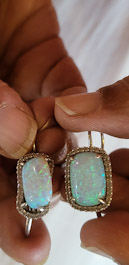
The loss of an earring made by a jeweller in Bosnia

ONE MORNING IN Kutch (part of Gujarat), we set off to see a historical monument not far from the town of Mandvi. On the way, we stopped at a cash machine (ATM) to withdraw some cash.

We inserted the debit card and the appropriate PIN code. After keying in the amount we wanted, the machine made the normal noises, and then asked us to remove the cash and our card. To our great dismay it delivered no cash. Yet, we received an SMS stating we had just withdrawn the amount of cash we had keyed in. This worried us greatly.

Fortunately, there was a branch of our bank near the ATM. We spoke with the manager, and explained what had happened. After taking a few details, he resolved the situation and instructed the cashier to give us the cash we had wanted. From his desk, he also managed to ascertain that the ATM had suffered a technical problem.

We drove on towards our intended destination. Despite information on the Internet and on noticeboards, all of which suggested that the place would be open, it was closed. The watchman at the gate explained that the attraction was closed for repair. However, he let us go in for a couple of minutes, after telling us that if anyone saw us enter, he would be in big trouble.

After this second mishap of the day, our driver took us to see a lovely Hindu temple a few miles away. As we began walking around the place, my wife noticed that one of her earrings had become detached. It was one of a pair that a jeweller in Sarajevo (Bosnia) had made. The pair had been made by the uncle of one my Bosnian dental patients, who, having been pleased with my dentistry, had given them to me to present to my wife. These earrings were of great sentimental value, and Lopa was most unhappy to have lost one.

After retracing our steps in the temple compound and failing to find the piece of jewellery, we decided to return to the bank and the ATM, where during the panic of the debit card problem, it might have fallen. On the way, we returned to the closed visitor attraction. We asked the watchman of he had spotted the earring. He had not.

So, we decided to search the part of the driveway, where we had stopped earlier. Lopa and I looked around in vain. Then, our driver joined the search. Within a couple of minutes, he found the earring in the gravel of the roadway. Sadly, either something had driven over it or stepped on it. The earring was intact but the silver stone setting had been distorted. We will have it repaired by Kalim, our skilful jewellery repairer in Bangalore.

They say things happen in threes. That was the case that morning in Kutch. Fortunately, two of the three problems were resolved in a good way.

Temple bells and a stepwell in Surat (Gujarat)

NOBODY KNOWS WHEN the Bahucharaji stepwell was constructed. Legend has it that this well, located in Surat’s Vishal Nagar area, was built by Vanjara people, who came from outside Surat. These people used to visit the city, and set up camp there. This stepwell is said to have been dug by them to provide a supply of water.

The Vanjaras (Banjaras) are descendants of nomadic traders. Found in many parts of India, they used to have an important role in the economy of the Subcontinent. Wikipedia related that:
“… the Banjaras had a monopoly on the movement of salt prior to the arrival of the East India Company. More generally, they also traded in cattle, moving the beasts around the country’s bazaars, and they rented out their carts. Although some older sources have suggested that they did not use credit, Habib’s analysis of historic sources suggests that they did and that some were reliant on it.”

A Hindu goddess called Mataji appeared in the dream of a Vanjara and inspired the construction of the stepwell. After the vav (stepwell) was constructed, a temple was built within it. This is dedicated to Mataji.

The entrance to the stepwell is within a temple compound, in which footwear must be removed. We visited the place on a Sunday morning in December 2023. A steady stream of worshippers of all ages entered the stepwell’s ground level entrance. As they descended the steps towards the water in the bottom of the vav, they sounded the temple bells suspended above the staircase. Before reaching the water, the steps pass two shrines each containing effigies of Hindu deities. At one of them, a lady in a beautiful sari was involved in a lengthy puja conducted by a priest. She was accompanied by a large-ish group of people. I noticed that some of them were holding on to her sari.

We squeezed past the group and descended further into the vav until we reached a railing from which we had a clear view of the water far below us. Several tortoises were resting on the step closest to the water in the well.

After admiring the beautifully maintained vav, we left the temple compound. Outside it, we spotted some beautiful cockerels wandering around. A few days earlier in Surat when we were visiting another temple dedicated to Mataji, we saw cockerels and were told that the goddess favoured these creatures. Above the entrance to the Bahucharaji Stepwell compound, there is a bas-relief depicting Mataji astride a cockerel.

As for Mataji, I will not try to explain her because, for me trying to explain anything about Hinduism is nearly impossible. All I can say is that for Hindus, it seems that their beliefs and rituals are simply a part of the rhythm of daily life, rather than something compartmentalised as is often the case for Europeans.

A ruined mosque with only one standing minaret

AFTER THE CITY of Ahmedabad was established in about 1420, Mahmud Begada, a Sultan of Gujarat, captured the city of Champaner (near Pavagadh) in 1482. He spent more than 20 years developing it and creating glorious buildings – some fabulous mosques, fortifications, city wall and gates, etc. He renamed the city Muhammabad.

The name ‘Champaner’ was given to the place in the 8th century AD to honour a general serving the Chavda dynasty that founded the city. I have not yet found out how long it was called Muhammabad, but it is no longer known by that name. Now, it is known as Champaner.

In 1535, the then Sultan of Gujarat, Bahadur Shah, fled the city just before it was defeated by the Mughals led by their emperor Humayun. Today, the city is in ruins, and has become a UNESCO World Heritage Site.

We had visited the site twice before, and revisited it a third time in November 2023. Prior to making this trip, we had been advised by a friend to see a ruined mosque located a short distance away from the rest of the ruins. To reach this, the Kamani Masjid, we hired an autorickshaw.

Ek Minar ki Masjid

The Kamani mosque is situated in a jungle away from the main road. We left the latter and drove along a dirt track through the dense vegetation. The sound of our vehicle’s engine disturbed a flock of grazing peacocks, who rushed away from us.

The Kamani Masjid stands in a clearing. It has lost its roof but the rows of pillars and arches that once supported it remain standing and are a beautiful sight. The decorative base of a minaret stands at one corner of this magnificent array of arches. This relatively unvisited ruined mosque is well worth visiting not only because of its beauty but also its peaceful location.

Our autorickshaw driver, realising our interest in historical buildings, suggested that we visit another mosque, which we had not seen before. Called the Ek Minar ki Masjid (ie ‘One Minaret Mosque’), it lives up to its name. Built in the 16th century, at the same time as other mediaeval mosque in Champaner, all that remains today is the large plinth on which it stood, a small fragment of wall, and a single intact minaret. The base of the minaret, like that at Kamani and other mosques built in that era, is decorated with geometric patterns. Standing alone, it is a splendid example of a 16th century minaret.

After seeing the two isolated Masjid, we visited the famous helical stepwell, which we had seen before. On previous visits, the water level had been low and we could see the full extent of the long staircase that spirals down the sides of the circular well. This latest visit we saw only the first few steps because the well was almost full.

Champaner and its archaeological ruins are one of many good reasons to visit Gujarat – a state in India, which does not attract its fair share of foreign visitors, unlike, for example Rajasthan, Goa, and Kerala.

An Albanian born in Italy and buried in Gujarat

KHWAJA SAFAR SULEMANI (1500 – 1546) was born in either Otranto or Brindisi. He entered life as a Christian, named Cosa Zaffar in Italian. But later, after being converted to Islam, his first name became Khwaja Safar. I have written about him before because his most likely heritage interests me. He is most likely to have been the son of Catholic Albanian parents, who fled to Italy to escape the Ottomans who had invaded what is now Albania.

Khundhavan Khan Rojo – a detail

Khwaja was captured by an Ottoman general at sea when he was 15. The Sultan in Istanbul was impressed by him. To cut a long and complicated story short, he was put in charge of vessels to attack the ships of the Portuguese, who were trying to monopolise trade between India and Europe. The Ottomans carried goods from India to places in their Empire on the coasts of Egypt and the Arabian peninsula. From there, they were carried overland to Europe. Their competitors, the Portuguese, carried goods from India to Portugal via the Cape of Good Hope, thereby bypassing transit through lands held by the Ottomans. This proved very damaging to the economy of the Ottomans.

During the Ottoman attack on the Portuguese colony of Diu (on the south coast of Saurashtra – part of modern Gujarat state), Khwaja, whose fighting skills were highly regarded by his opponents, was killed by a cannon ball near, or in Diu. Interestingly, the Portuguese, with whom he joined forces briefly before turning against them, erected a monument in his honour. It stands in Diu, and I have seen it.

And that summarises all I knew until we visited the superb museum housed in the restored fort of Surat. There, I learned that Khwaja’s body was brought from Diu to Surat, where it was buried.

After his burial, a mausoleum was built over his grave. Probably established by his eldest son, Rajab, this lovely edifice, called the Khudhavand Khan Rojo (or Rauza), contains architectural features typical of 15th century mosques in Ahmedabad. It includes structural elements that were influenced by Hindu and Jain temples. By the way, Khwaja became known as ‘Khudhavand Khan’, the title he was given when Sultan Mahmud III made him Governor of Surat.

I entered the domed mausoleum, which contains six gravestones, all covered, as is usual, with coloured cloths. None of these is the grave of the man who was born of Albanian parents in the south of Italy. His body lies somewhere beneath the mausoleum.

As is often the case when I visit India, I come across completely unexpected things. Although I had known about Khwaja’s death in Diu, it was a delightful surprise to come across his final resting place in Surat – a city across the sea from Diu, but not too distant from it.

At first sight, it seems ironic that Khwaja’s Albanian parents fled from the Ottomans, yet their son became prominent in the Ottoman Empire. However, it is not so strange. Many Albanian boys (including Skanderbeg) were abducted, or taken as hostages, by the Ottomans, and later both served in the empire’s army, some of them becoming high officials.

Steps down to the water in the well in Surat city

A STEPWELL OR ‘VAV’ (pronounced ‘vaav’) is a well in which users have to descend to the water within it by steps (staircases). The first one I ever saw is a disused vav in the ruins of Vijaynagar in Karnataka. During several trips to Gujarat, we have looked at many other vavs. Some have just one staircase leading to the water in the well, and others have more than one. Because many stepwells are at least partially, if not wholly, subterranean, the structures maintaining their iintegrity are sometimes quite complex – often a series of arches or layers of galleries. Therefore, the architecture of stepwells is varied and often fascinating.

On our second visit to Surat (in early December 2023), we spent a morning looking at two vavs: the Khammavati, and the larger Chatushmukhi. The former is near the railway station, and the latter is a couple of miles away, next to the Gopi Talav (lake).

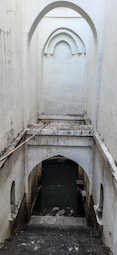
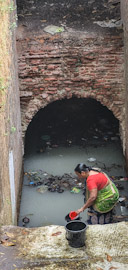
The Khammavati is about 300 years old. It was established by Kansara a devotee of a goddess of stepwells. It is still used regularly, and is a little difficult to find. To reach it, you have to enter a small, rather rundown looking house. After removing your footwear, you walk through the ground floor room towards a door that leads to a staircase. Its steps lead down to the well. It descends below some brick arches that span the gap between the walls on either side of the steps. Before reaching the water, the steps pass through a chamber containing sculptures of Hindu deities.

The water in the well looked quite clear. A gentleman arrived whilst we were looking at it. After removing a few leaves from the surface of the water, he filled a couple of buckets. He told us that it was “good water”.

The Chausmukhi stepwell

Unlike the Khammavati, the Chatushmukhi vav is no longer used. It was constructed in 1510 AD. Apart from being disused, the structure is in very good condition, which is fortunate because it has an interesting design. The centrally located circular well (now dried up) is approached by four short staircases, each of them is at ninety degrees to its neighbours.

The Chausmukhi vav is beside a circular reservoir, the Gopi Talav. This was first built in about 1610 by Malik Gopi, a wealthy merchant of Surat. By 1673, it had become silted up and of no use as a water source. In 1716, some of its stones were removed to be used in the construction of Surat’s city wall. The Talav lost its former glory. However, in 2015, the city’s corporation restored it, and filled it with water. Today it and the vav form part of a well maintained park – a haven to which one can retreat to escape the noise and bustle of this busy city.

Surat, like Milan in Italy, is a throbbing hub of business and commerce. At first sight, it is, like Milan, not obviously attractive. But on closer examination both cities are studded with historical gems (and in the case of Surat, I am not referring to its famous diamond industry).

Catching rats in Surat, a city in Gujarat

PROFESSOR ROBERT HARKNESS was my PhD supervisor between 1973 and 1977. He and his wife remained my close friends for the rest of their lives. Robert was interested in everything. His was not a fleeting interest, but a deep, enquiring passion. He was fascinated by the contents of hardware shops, especially when making his annual overland trips between the UK and the North of Greece.

During his explorations of these shops, he noticed that the designs of traps for rodents varied from place to place. Many of them were constructed so that the rat or other pest was not killed when caught in the trap. Over the years Robert collected a wide variety of differently designed traps.

The rat trap and the man who made it

Today (the 8th of December 2023) when wandering through one of the many bazaars in Surat (Gujarat), we spotted a metal worker’s shop. On a table outside it, there were a pile of rat traps for sale. They looked like little sheds or garages. At one end of each of them, there was a sliding door. Bait is placed in the far end of the trap. When a creature touches this, the trap door drops down and imprisons it. I do not know what the owner of such a device does with the victim enclosed within it. I suspect that the animal might be killed by drowning.

The owner of the shop said that most of the traps on display were made elsewhere, but he showed us one he had made. As we examined the traps and other ironmongery on offer, I thought how much Robert would have enjoyed visiting this shop.

Faith healing in a well in Baroda

ACROSS THE MAIN ROAD from the 16th century Hazira Maqbara – a mausoleum – there is a small stepwell – the Hazira Vav. We have visited it before but never saw it in use.

A flight of tiled steps leads down to the water in the stepwell. To put it mildly, the water looks filthy and completely uninviting.

At the top of the stairs, there is a small Hindu shrine. The small courtyard surrounding the top of the staircase is decorated with coloured images depicting various Hindu deities. A few coconuts hang between them. These nuts are considered auspicious by Hindus. At our Hindu wedding in 1994, coconuts were included on the complex ceremony, which lasted several hours.

While we were looking at the well, a lady in a sari and her husband arrived. The woman descended the steps to the waters edge. Her husband explained to us that she was suffering from itchiness and that the curative waters of the well might help cure her condition.

The lady picked up one of the bucket on the step beside the water, and filled it from the well. Then, she began dowsing herself with the water. Fully dressed, she poured several buckets of the unwholesome looking water over her whole body.

Having watched this, we felt that it was unlikely that the water itself would heal her, but more likely, it was her faith in its curative properties that might have helped. Having seen the water, my thought was that if one bathed in the well, it is likely that you would end up less healthy than before you entered it.

Smoke and flames in a Muslim mausoleum in Baroda (Gujarat)

THE HAZIRA MAQBARA is an impressive octagonal structure in Baroda (Gujarat). It was built in about 1586 in the Mughal style of architecture, such as can be found in Delhi. This beautiful mausoleum houses the graves of Qutb-ud-din Muhammad Khan who was the tutor of Salim, son and successor of Akbar, and also that of his son Naurang Khan who held important posts in Gujarat under Akbar. There are other graves within the building and also nearby on land near it.

The various graves are covered with colourful cloths upon which red rose heads are placed. The roses are replaced daily, and the cloths every Thursday. This we were told by an elderly man who had been praying loudly within the main central chamber of the mausoleum.

Apart from the beauty of the building and its wonderful jaalis (latticework window screens), I was impressed by some things that I have noticed in many other Muslim mausoleums in India.

Incense stick near some gravestones

Within the mausoleum and close to the graves outside it, there were incense sticks (agarbatti) burning, releasing small clouds of fragrant smelling smoke. Within the mausoleum, I spotted at least two oil lamps (diyas), each with small flickering flames.

Agarbatti and diyas are commonly found in Hindu temples, and often at the beginning of the day in shops, restaurants, etc. I first noticed them being used in Islamic settings in India in Sufi dargahs (shrines containing graves) in Bangalore when going on excellent guided walks led by my friend Mansour Ali. Later I begun noticing these things, which I had initially assumed were only associated with Hinduism, in places associated with Islam. I have discussed this commonality of Hindu and Muslim practices in one chapter of my new book about travels in India, which is available from Amazon (eg https://www.amazon.co.uk/HITLER-LOCK-OTHER-TALES-INDIA/dp/B0CFM5JNX5/ ) AND if you live in India, from https://store.pothi.com/book/adam-yamey-hitler-lock-and-other-tales-india/ .

Other chapters in my book about my experiences of visiting India cover a wide variety of subjects. The book, which is aimed both at those who ‘know’ India and those who do not, is both informative and entertaining.

Africans in a royal procession in Kutch painted in 1876

WHAT REMAINS OF the Aina Mahal Palace in Bhuj (Kutch, Gujarat) after the powerful earthquake of 2001 is now open to the public as a fascinating museum. One of its many remarkable exhibits is a painting, which is 15 metres long and 22 cm wide. Painted in 1876 by Mr Juma Ibrahin Wadha, it depicts in minute detail a Kutch State parade during the reign of Maharao Pragmalji II, who was on the throne between 1860 and 1875.

The faces in the painting are all portraits of individuals – actual depictions, not stylised images. The degree of detailing is superb – almost photographic, yet still artistic.

Amongst the many faces that can be seen on the painting are several which have unmistakably black African features. They are all soldiers dressed in armour and guarding the Maharani, the Maharao’s queen. It is possible that they might have been eunuchs, but detailed as the picture is, this cannot be ascertained by examining it!

Black Africans travelled to India (mostly as slaves) from East Africa to Gujarat and Kutch during the 14th to 17th centuries. Mainly of Bantu descent, many of them converted to Islam. Some of them rose to high positions in society. For example, one of them became a general, who founded the Sidi Saiyedd mosque in Ahmedabad. Their descendants are known as members of the Siddi community. Known as Sheedhi in Pakistan, there is apparently a significant number of them in Lowe Sindh and Karachi. Currently, there are about 50000 Siddis in India, of which about one third live not in Gujarat but in Karnataka.

There are many other interesting details on the picture of the parade, but it was the depictions of Siddi soldiers that particularly caught my attention.

Art, Alembic, and brewing in Baroda

THE SINGER LATA MANGESHKAR (1929-2022) has only ever appeared in one advertising film. It was for a medical product, a cough syrup, called Glycolin. This stuff was manufactured by the Alembic pharmaceutical company of Baroda, founded in 1907. In 1960, it was the first company to manufacture penicillin in India. Under the leadership of the Amin family, Alembic produces a wide variety of pharmaceutical products.

The company owns a huge ‘campus’ in north Baroda. This has been named Alembic City. Part of it, which contains repurposed former factory buildings, has been developed to create an art hub, which has been named Alembic Art District.

Alembic Art District

The Art District contains a museum that illustrates the history of the Alembic company. Other buildings house artists’ studios. These are given free of charge to selected artists who have applied for them. There is also gallery space.

A food court has been created. Nearby, there is a good Japanese restaurant (called Bento B). Next door to this is The Brewery.

Those who are familiar with Gujarat will know it is a teetotal state – sale and consumption of alcohol is forbidden. So, what is with The brewery? Well, it is a brewery, but alcohol is not brewed here. It is a kombucha Brewery. We sat in the stylish restaurant within The Brewery, and enjoyed the best kombucha I have ever tasted.

Like the Tate Modern and the Battersea Power Station, both repurposed former industrial sites, Alembic Art District contains remnants of its former existence. However, the resulting environment that has been created is much more delightful than the two places in London mentioned above.