SALT AND A UNIVERSITY FOUNDED BY MAHATMA GANDHI IN AHMEDABAD

THE GUJARAT VIDYAPITH is an educational establishment, now recognised as a university, founded by Mahatma Gandhi in 1920. Until he created the university, most higher education in India was, according to plans laid down by Lord Macaulay, dedicated to training Indians to be useful in the service of the British Empire.

The Vidyapith was, according to its website, part of:
“… a great response to Gandhiji’s command to vacate the English teaching schools and colleges. Now, in order to see that the students who left their education half-way are not deprived of the education, it was decided to estalish National Vidyapith. Out of those five Vidyapiths established during that period, Gujarat Vidyapith was one, estalished by Gandhiji himself on October 18, 1920. Gandhi wanted his Vidyapith to prepare the youths for the task of national reconstruction and usher in ‘Hind Swaraj’, the India of his dream”

The establishment, based in a very peaceful leafy campus, still functions today. Many of its students are members of underprivileged families.

Gandhi on the Salt March in 1930

As we were wandering around the campus, we came across a photograph of Gandhi taken while he was on the Salt March (1930) to Dandi during which the Mahatma and his followers were protesting against the government monopoly on salt production. Underneath the photograph, there was a caption that read as follows:
“Pranjivan Vidyarthi Bhavan was first stop of Historic Dandi March 12/03/1930”

This Bhavan was one of the first buildings on the Vidyapith campus. When the Vidyapith was started, it was located close to Gandhiji’s first ashram, the Kochrab Ashram. However, as an article in the Indian Express explained:
“With space constraints in the bungalow along with looming threat of plague, Vidyapith was shifted to Aga Khan Estate near Nehru bridge, where a building stands now. It ran from there briefly till the foundation stone of Pranjivan Vidyarthi Bhawan was laid by eminent scientist Prafulla Chandra Ray on March 9, 1923 which after completion was inaugurated by Gandhi in 1925.”

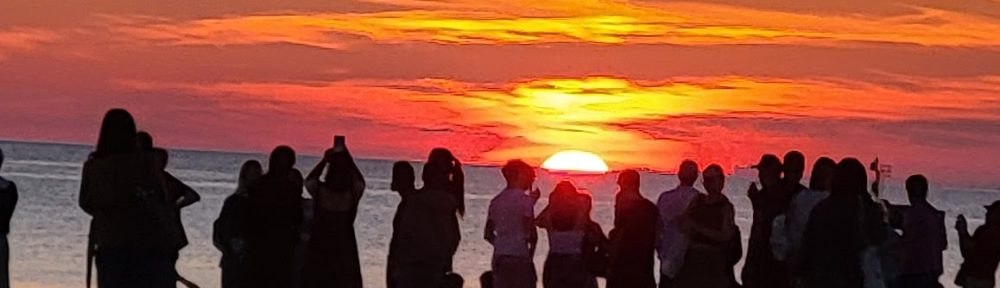
Our friend, Arthur Duff, showed us around the campus. Apart from seeing the memorial to the Salt March, we saw the models of villages outside the university’s folklore museum, which was sadly closed when we arrived. As the sun began to set we walked around the campus, a peaceful oasis in a busy part of Ahmedabad across the river from the old city.

A fine facade in the heart of Ahmedabad

ALTHOUGH WE HAVE visited Ahmedabad (in Gujarat) at least 4 times, we had never been to the hectically busy Manek Chowk area in daylight, which is why we had never noticed a fine building until today, when we went to the area in the morning. After dark, the area is so busy that one needs to be wary of the numerous autorickshaws and motorised two-wheelers whizzing around to notice the architecture of the buildings overlooking the frenetic bazaar.


The building we noticed this morning (1 December 2025) has a facade with some neo-classical detailing and jharokhas (projecting windows). Overall, this edifice, which is far more elegant than its neighbours,  has a European appearance. Above its main entrance, you can see the following words (in English): “The Ahmedabad Share and Stock Brokers Association”.


According to a website (https://www.knocksense.com/ahmedabad/exploring-the-history-of-ahmedabad-stock-exchange-a-symbol-of-entrepreneurship-since-1894), until 1996 :

“… Ahmedabad Stock Exchange functioned in a building constructed in 1919 when the Bombay Share and Stock Brokers association collaborated with the Ahmedabad Share and Stock Brokers association. And that heritage style building served as ASE’s home before it was shifted to Kamdhenu complex in 1996.”

The Kamdhenu Complex is in the outskirts of Ahmedabad.


Following the establishment of the Bombay Stock Exchange in 1875, the Ahmedabad Stock Exchange (‘ASE’) was set up in 1894. At that time and until well after Independence,  Gujarat was part of the former Bombay Presidency. According to an article in Wikipedia, at first:

“… stock exchange functioned under the framework of the Bombay Securities Contracts Act, 1925. Following the passage of The Securities Contract Regulations Act, 1956 the Gujarat Share & Stock Exchange, Indian Share and General Exchange Association and Bombay Share and Stock Exchange, Share and Stock Brokers Association merged with the Ahmedabad Share and Stock Brokers Association and gave rise to ASE.”


The ASE was India’s second oldest stock exchange, the oldest being in Bombay. As already noted, the ASE functioned in the elegant, now disused edifice we saw at Manek Chowk today.

Dining with the dead in Ahmedabad

IN CENTRAL AHMEDABAD, a large city in India’s state of Gujarat, there is a curious café called Lucky. This popular eatery, founded in 1950, is unusual not because it does not serve coffee but because its tables and chairs are placed between Moslem graves. Also, the trunk of an old tree is contained within the restaurant. Its base is within the eatery and it passes out of the place through a hole in Lucky’s ceiling.

Tree trunk and a grave at Lucky

Lucky’s is sited on an old Moslem graveyard, but this does not put off a steady flow of customers from enjoying a wide variety of vegetarian meals and snacks in this eatery. Closer to home, near the south side of London’s Lambeth Bridge, there is another café sited on a former graveyard.

A mosque on the road to the Delhi Gate of Ahmedabad

THE CITY OF Ahmedabad was founded in 1411 AD when Ahmad Shah I of the Gujarat Sultanate moved his capital to the already existing settlement of Ashaval. He renamed the place as Ahmedabad. During the fifteenth and sixteenth centuries, many fine mosques were built in the city. During previous visits to Ahmedabad,  we have looked at many of these edifice.


Today, 29 November 2025, we came across a mosque we had not seen before. It, the Rani Rupamati (aka Rupavati) Masjid, is beside the main road (Mirzapur Rd) that leads from the Sidi Saiyed mosque in the city centre to the Delhi Gate.


The Rani Rupamati Masjid was constructed  in the fifteenth century,  possibly Sultan Mahmud Begada for Rani Rupamati,  whom he married. The mosque and the dargah next door to it are connected with Sunni Sufism.


Architecturally,  the mosque shares many features in common with other mosques built in Ahmedabad and the rest of Gujarat in the fifteenth and sixteenth centuries.  Built in the so-called Indo-Saracenic style, this mosque and others  built in the same era contain architectural and decorative features often found in Hindu and Jain temples. Although rich in decorative ornamentation, the mosques, unlike the temples,  are devoid of representations of people and animals. Floral and leafy motifs can be found at the Rupamati Masjid,  as well as at other mosques built in the same era. The highly decorated bases of two minarets can be seen  but the tall upper parts of the minarets were listed during an earthquake in the early nineteenth century.


 Beside the mosque and within its grounds, there is another structure, topped by two domes. This pillared hall contains the tombs of Rupamati and other worthies.


The mosque is a protected historical monument, but is still used by worshippers.  Although it is an attractive  building,  it does not seem to be on the main ‘tourist trail’.

Caring for pigeons in India

This tall structure with numerous openings is a chabutra (Hindi), a chabutro (Gujarati). It is build to provide nesting places for pigeons. In Gujarat, one can see many of these. Their shapes differ but they all serve the same purpose.

You might wonder why pigeons, which are regarded as pests in the UK, should be provided with these wonderful living spaces in India, especially in Gujarat. Well, you can find out about pigeons in India in my book “88 DAYS IN INDIA: A JOURNEY OF MEMORY AND DISCOVERY”, which can be obtained from Amazon ( https://www.amazon.co.uk/88-DAYS-INDIA-JOURNEY-DISCOVERY/dp/B0FKTFBFM2/ )

Riding from Udaipur to Ahmedabad: a road trip

TODAY WE TRAVELLED by road from Udaipur in Rajasthan to Ahmedabad in the neighbouring state, Gujarat. The 158 mile journey took us about 4.5 hours with a brief stop for tea.

South of Udaipur in Rajasthan

The hilly scenery between Udaipur and the frontier between Rajasthan and Gujarat was pleasant. It was mostly rural with few industrial buildings.

On entering Gujarat, everything changed. The terrain became flat and the countryside was liberally dotted with industrial structures, both small and large. In addition, there were plenty of fields for growing crops. Many of these fields were equipped with elaborate irrigation systems. Compared with the delightful, almost ar arcadian landscape in south5 Rajasthan, the landscape in the part of Gujarat north of Ahmedabad is far from attractive.

Until we reached the outskirts of Ahmedabad, the traffic on the dual-carriageway highway was light. Most of the vehicles we met were trucks. We saw only a few private cars.

After passing Ahmedabad airport, we entered the old city via the recently constructed Sabarmati Riverside road. This passes beneath a bridge being constructed for the new Ahmedabad to Bombay superfast railway, which should e running in about 2 years time.

Although the journey was not the most fascinating we have made on Indian roads,we were driven enough superbly by Rajesh, a driver engaged for us my the helpful Mr Yashwant of PP Tour and Travels in central Udaipur.

An artist who loved Gujarat (in western India)

THERE IS A SUPERB collection of modern art from south Asia, which is being exhibited at Phillips auction house in London’s Berkely Square until 31 July 2025. Amongst the artworks on display are several paintings by the late Maqbool Fida Husain. As you can read in the following excerpt from my book about the first journey I made to Gujarat in western India in 2018, the Husain was keen on the area. We were in Ahmedabad when we stumbled across a restaurant called Lucky.

“We ate lunch at Lucky, an unusual restaurant near our hotel. This vegetarian eatery is divided into two sections: one serving sandwiches and Punjabi-style dishes, the other serving mainly south Indian dishes. In one of them, we noticed a framed painting by the famous Indian painter MF Husain (1915-2011), who was born in a Bohri Muslim family in Maharastra. He often travelled to Gujarat to paint. The picture in Lucky, and the place is truly lucky to have it, is a gift which the artist presented in 2004. This was the second original work by Hussain that we had seen in a restaurant. Earlier, we had seen a sketch by him in Bombay’s Noor Mohammadi Hotel, which serves Bohri dishes. When Hussain’s art works began to offend the extremist nationalist sentiments of some Hindus in India and they threatened his life, he felt forced to exile himself. He lived the last few years of his life in the Gulf States and the UK.

The curious thing about Lucky is not the MF Hussain painting, but its location in a disused Muslim cemetery. Its chairs and tables are placed between unmarked Muslim gravestones, painted green and surrounded by low metal railings painted white. The manager thought that these graves were over 300 years old. In addition to the graves, the thick trunk of a tree grows through the middle of the restaurant. The food and service are both good in this busy but peculiar place.”

You can read about my first trip to Gujarat and the two former Portuguese colonies, Daman and Diu, in my paperback book “Travels through Gujarat, Daman, and Diu” (https://www.amazon.co.uk/TRAVELS-THROUGH-GUJARAT-DAMAN-DIU/dp/0244407983)   and the kindle version “Travelling through Gujarat, Daman, and Diu” (https://www.amazon.co.uk/TRAVELLING-THROUGH-GUJARAT-DAMAN-DIU-ebook/dp/B07GLWZPHD/)

A book about the Gujaratis by Salil Tripathi

WITH ABOUT SIX hundred and forty pages of text, this book published in 2024 covers a lot of ground. Much of what Tripathi writes about Gujarat and the Gujaratis is fascinating. However, the author’s definition of who is a Gujarati may differ from that of many others. His definition of a Gujarati is anyone whose mother tongue is Gujarati. Thus, he includes groups such as the Parsis, the Bohras, and the Khojas. None of those groups, all of whom have Gujarati as their mother tongue, would usually describe themselves as Gujaratis, even if they reside in Gujarat. Although Kachchhis generally speak Kachchhi amongst themselves, most speak Gujarati as well, but most of them would disagree with Tripathi’s calling them ‘Gujaratis’. By using his definition of a Gujarati, the author was able to include many people, who would not have described themselves as Gujarati, in his book.


The book is a mine of information about people that the author describes as being Gujaratis. Much of this information is fascinating, but there were occasional passages that I  felt should have been shortened or omitted. Although Tripathi deals a lot with some of the sadder aspects of life in Gujarat, he also injects humour into his text. However,  he notes that Gujaratis are proud of Mahatma Gandhi, a Gujarati, but in recent years, they seem to be forgetting what he stood for.


I am glad that I read this book, but would advise those planning to read it that it is more of an encyclopaedia than a portrait of the Gujaratis. Tripathi covers a great deal, but I felt that at the end of it, my understanding of the soul of Gujarat and its people had only increased by a small amount.

If you are feeling peckish in Peckham …

GENERALLY, I AM NOT A FAN of food courts. Many of them in England are merely a collection of branches of well-known fast-food chains (such as KFC, McDonalds, Pizza Hut, Subway, and Burger King). A notable exception to this is a food court in Trinity Market in Hull, which visited in April 2025. On 9 May 2025, we visited Peckham in south London, having just viewed an exhibition in nearby Camberwell.

While strolling along Peckham’s busy Rye Lane, we came across the entrance to Rye Lane Market. After entering it and walking along an arcade lined with shops, we arrived in a large, covered area filled with food stalls: a food court. Unlike many other food courts, the food outlets were not branches of well-known chains. Instead, there were stalls catering to the multi-ethnic local population. We sat down at a table that was surrounded by stalls serving Mexican, Carribean, Colombian, and other many cuisines. We ordered the set lunch offered by a small Peruvian kitchen. As first courses, we ate cold boiled potatoes dressed in a red pepper flavoured mayonnaise and a delicately flavoured beef soup. These were followed by a fried rice dish containing chicken, pork, and smoked sausages, and another consisting of a whole fish beautifully fried, served with lentils, rice, and a salad containing onions, lime juice, coriander, and tomatoes. Freshly prepared and reasonably priced, everything was delicious.

There were more stalls serving food from other countries, mostly Latin American and African. One stall offered a range of vegetarian Indian dishes, including a snack, dabeli, that is popular in Kachchh (once an independent state, and now part of Gujarat). The lady working there told us that she is from Rajkot in Gujarat. When we mentioned to her that we have always thought that dabeli is a dish from Kachchh, she said it was Gujarati, but added that:

“It does not matter because the people of Kachchh are our brothers”.

Our first visit to Rye Lane Market’s food court has whet our appetites for further visits. There are so many enticing dishes on offer that I feel sure that we will venture across the Thames more often to sample the fare offered in that food court.

Revolt in two colonies of Portugal in western India

THE TOWN OF SILVASSA is just under 100 miles north of Colaba in Bombay. Known to the Portuguese as ‘Paço de Arcos’, it was the administrative capital of their colony of Dadra and Nagar Haveli, now an Indian Union Territory. Dadra is a small district, roughly circular in shape. It is separated from the larger Nagar Haveli by a small stretch of what is now the Indian State of Gujarat. Between about 1780 and 1954, these two landlocked territories were colonies of Portugal.

During the period when Portugal ruled Dadra and Nagar Haveli, the indigenous people living there were exploited mercilessly and treated harshly by the Portuguese and wealthy local landlords. Neelesh Kulkarni has recently (2024) published a book, “Uprising: The Liberation of Dadra and Nagar Haveli” which describes the struggle to free the two tiny colonies from Portuguese rule, and their eventual incorporation into the Republic of India. His account is not only based on published sources but also interviews with surviving freedom fighters and members of other fighter’s families.

After 1947, when most of what is now India became independent, Portuguese colonies on the Indian Subcontinent remained territorial possessions of Portugal. Kulkarni relates how at least two groups of freedom fighters struggled to evict the Portuguese from Dadra and Nagar Haveli. The Indian government, under the leadership of Jawaharlal Nehru, who had professed to the world to adhere to the principle of non-violence, was unwilling to send troops into the two rebellious Portuguese territories, yet did nothing to hinder the activities of the rebels. The book shows how the rebels planned their attacks on the Portuguese police and militia, collected funds, accumulated weaponry, recruited fighters and trained them.

Being landlocked and separated from their coastal colonies (Daman being the closest) by land, which after 1947 was Indian sovereign territory, made it difficult for the Portuguese to send military aid to their people in Dadra and Nagar Haveli. The Indian government was unwilling to allow military supplies to pass from Daman and Goa through India to the beleaguered landlocked Portuguese colonies. Using guerilla tactics and aided by the Warli tribal people, who had suffered much at the hands of the Portuguese, the Portuguese were eventually driven out of Dadra and Nagar Haveli. At times the situation was hair-raising, and there was a large possibility that the better armed Portuguese might have suppressed the rebellion.

I began reading Kulkarni’s book while waiting at a departure gate in Bangalore’s international airport, and finished its 220 exciting pages several hours later during a flight to London. His book about a relatively unknown freedom struggle in an obscure colony of Portugal is not only well-researched and interesting, but it is also written like a fast-paced thriller. I am really glad that I bought a copy, and will treasure it amongst my slowly growing collection of books about Gujarat and its history.