Brief profile of an author: a bit of self publicity!

Adam Yamey is the author of several books, including: “Albania on my Mind”; “Scrabble with Slivovitz;” (Once upon a time in Yugoslavia); “From Albania to Sicily”; “Exodus to Africa”; “Rediscovering Albania”; “Aliwal”; “Bangalore Revealed”; “Indian Freedom Fighters in London (1905-1910)”; “Imprisoned in India”; “Beneath a Wide Sky: Hampstead and its Environs”; “Beyond Marylebone and Mayfair: Exploring West London”.

His latest book is:

“Golders Green & Hampstead Garden Suburb: Visions of Arcadia”

Buy a copy here: https://www.amazon.co.uk/gp/product/B0BHG873FB/

Born in 1952 in London, he attended Highgate School, and then University College London. After a doctorate in mammalian physiology, he became an undergraduate once more and qualified as a dental surgeon. After 35 years in general dental practice in Kent and London, he retired in September 2017.

Adam married a lady from India in 1994, and, since then, has been visiting her native land frequently. India has become his second home. He is a keen traveller. The periods between his journeys are usefully and enjoyably employed with: family, cooking, writing, photography, blogging, cinema, theatre, and exploring the many delights that London has to offer.

A chance meeting in north London

During the late 1990s, our then young daughter had a baby-sitter called Bridie. Although Bridie was already well into her eighties when we first met her, she was a remarkably sprightly lady. Born in a rural part of the west of Ireland, she came to England in her late teens. On arrival in England, she and her husband were cared for by the Salvation Army in exchange for taking a pledge never to drink alcohol again. Bridie never reneged on this promise.  To earn a living in London, where she settled, she became a domestic servant. Hearing that I had been brought up in northwest London’s Golders Green, she told me the following story.

War memorial clocktower in Golders Green

Sometime before WW2, Bridie was employed as a maid in a Jewish household in Golders Green. She looked after the family’s children and carried out many household duties. Even though it was not a particularly wealthy family, Bridie recalled that she wore uniforms when on duty. There was one outfit that she wore in daytime and in the evening, she changed into another. As she did with our daughter, Bridie became fond of the family’s two young sons.

Many years later, when Bridie had become a grandmother and our daughter’s baby-sitter, she used to spend her spare time travelling around London by bus (making use of her old age free bus pass).  One day, she was waiting for a bus at the stop closest to Golders Green’s Sainsbury’s (on the site of the Ionic cinema), when a well-dressed late middle-aged man in the queue said to her:

“Goodness! Is it you, Bridie? We have not seen each other for so many years.”

After a moment, Bridie realised that she was being addressed by one of the two boys, whom she had looked after in the house in Golders Green before the War. Just then, a bus arrived, and as her former charge was about to embark, he shouted:

“This is my bus. Are you taking it, Bridie?”

Bridie misheard what he had said, and by the time she realised, the bus had pulled away, leaving her at the bus stop. She told me that if she had known he was taking that bus, she would have joined him. As far as I know, she has never seen him again.

Greek in north London’s Golders Green

IN THE EARLY 1960s, the first proper self-service supermarket opened on the corner of Golders Green Road and a small service road called Broadwalk Lane. I cannot recall the name of this store, but it was soon taken over by the Macfisheries company. Later, it became a supermarket where many imported foods, especially products from Israel, were sold. Now, it has become a Tesco Express.

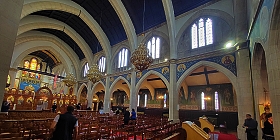
Facing the supermarket (across Golders Green Road) is a gothic revival style church. It has been used by a Greek Orthodox (Christian) congregation since 1968. Now, the The Greek Orthodox Cathedral of the Holy Cross & St. Michael, it was constructed as the Church of England’s ‘St Michael’s Church’ in 1914 to the design of JT Lee. A clock tower, surmounted by a delicate cupola supported by thin columns, was added to the church in 1960. On one of its walls, there is a bas-relief of St Michael with one foot on a serpent. On the northeast corner of the church, there is a plaque listing people who died in WW1. Near this, there is a crucifix standing in the garden next to the church. Its design, typical of C of E crucifixes, predates the arrival of the Greek congregation.

Although the interior of the church maintains some of its original Cof E fittings, such as stained-glass windows, the font designed in a mock mediaeval style, and some wall mounted memorials in English, a great deal of effort has been made to create the atmosphere of a Greek Orthodox place of worship. The walls of the side aisles have been painted with religious scenes. There is a decorated iconostasis and several framed icons. Elaborate chandeliers hang above the nave. Despite the additions to convert the church for Greek Orthodox worship, the original gothic revival features of the building’s interior are evident, but harmonise well with the later additions.

An old bus evokes memories

SEEING A VINTAGE London bus today (20th of March 2022) brought back some memories from the early 1960s.  In those days, my best friend was the son of a medical doctor who worked for London Transport. Nick and I were about 10 years old when we became keen bus spotters. This involved loitering in the open-air bus station at Golders Green station with pencils and notebooks at the ready. As buses arrived in the forecourt, we noted down their serial numbers, which are visible on the sides of the bus or, in some older models, on their engine covers. These differed from the vehicles’ registration numbers. The serial numbers of different models of bus consisted of 1 to 3 letters and up to four numerals, e.g., RF 645 or RLH 24. Routemaster buses, which were replacing older models in the 1960s had serial numbers that began with ‘RM’ or in the case of the extended versions ‘RML’. The double-decker RMs were gradually replacing their predecessors, the RT models (which were in use in London from 1939 to 1979). Although we recorded every bus that passed us, certain examples, e.g., RT5 and RM1, were rare and exciting observations. The two of us and my friend’s younger brother formed the short-lived ‘OBC’, the Omnibus Club, of which we were the only members.

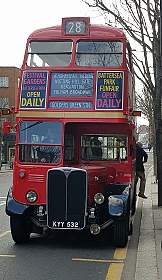
Now in 2022, long after the OBC disbanded, the Routemasters have largely disappeared from London, having been replaced by newer models. So, it was with some surprise that I spotted a RT bus in pristine condition parked in Notting Hill Gate today. For those bus spotters reading this, the vehicle bore the serial number RT1705. It was carrying the route number 28, with its destination board showing “Golders Green”. Today, route 28 still exists, but no longer runs from Chelsea to Golders Green (via Notting Hill Gate and West Hampstead) as it did in the ‘60s. In those days I had a friend who lived in Notting Hill Gate and used to visit him from Golders Green, using that bus route. Today, the same journey can be made using a bus on route 328.

The RT, which I saw today, was being used for private hire. As we were about to travel to West Hampstead, my wife asked the driver if he was going there later. He said he was, but he was not insured to take passengers who were not members of the party which had hired the bus. That was a pity, but as a former bus spotter, who gave up the hobby many decades ago, I was excited to see an RT still working on a London street,

A small zoo in north London

EVERY VISIT TO GOLDERS Hill Park in northwest London gives me great pleasure. Now officially part of Hampstead Heath, it contains a lovely feature, its small zoo. This consists of a large paddock containing deer and sometimes a rhea. Close to this, is a series of cages, an aviary, containing exotic birdlife including a laughing kookaburra. These are located next to an enclosure that contains a small group of ring-tailed lemurs. The lemurs’ neighbours are several wallabies and a couple of donkeys, named Sienna and Calypso. The wallabies and the donkeys have a long rectangular sloping field in which to wander.

I have written about the park and the zoo before, and published it elsewhere (https://adam-yamey-writes.com/2020/11/19/walking-past-wallabies/). When I wrote that piece, I did not explore the small zoo’s history. It was certainly present well over 60 years ago, when I was less than ten years old. As a small boy, I remember seeing wallabies and flamingos. More recently, the flamingos have disappeared and have been replaced by ibis and various other exotic fowl. Before my time, the flamingos used to reside in the duck pond next to the park’s walled garden (https://londongardenstrust.org/conservation/inventory/site-record/?ID=BAR027).

The zoo’s history is difficult to ascertain. After searching the Google entries relating to the park and its history, I found only one reference that alludes to the presence of the zoo prior to WW2. This consists of a recording of an interview (https://sounds.bl.uk/Oral-history/Science/021M-C1379X0029XX-0001V0) with the scientist Sir Anthony Seymour Laughton (1927-2019), an oceanographer. Laughton was born in Golders Green, began his education in Hampstead at Heysham School, a ‘dame school’ (private elementary school) in Branch Hill, and moved to Gerrards Cross during WW2 (https://royalsocietypublishing.org/doi/10.1098/rsbm.2020.0021). As a young child, Laughton lived in one of the small roads that lead of North End Road and back on to Golders Hill Park. He and his brother were often taken to Golders Hill Park where he remembered that there was a small zoo with wallabies. This would have been before 1939, when he and his family moved out of London. So, we can conclude that the zoo was in existence before WW2.

According to Pam Fox, author of “The Jewish Community of Golders Green”, Golders Hill Park was popular with local Jewish families, who went:

“Golders Hill Park on Sundays to watch the peacocks strutting around the grounds of Golders Hill House.”

The House was destroyed in 1941. Laughton did not mention these in his interview and, sadly, there are none to be seen today.

To discover whether the little zoo existed before Laughton’s childhood, that is prior to 1927, I looked at a detailed map, surveyed in 1912. This was after the park was opened to the public by the London County Council in 1899, making it the first public park to have been opened in what was then the Borough of Hendon (now incorporated into the Borough of Barnet). I compared what was on that map with what is on modern maps and found that the park’s layout has not changed much since 1912. The bandstand that you can see today is where there was one back in 1912. Where there is the deer enclosure today, there was a similarly shaped and located fenced field in 1912. The same is the case for the long narrow field where you can see the wallabies and donkeys today. The 1912 map does not show any buildings where the aviary is located today, but apart from that the pattern of land enclosures in the part of the park where animals and birds are kept enclosed today is remarkably similar. The question is, and I cannot answer it, was what is now a deer enclosure, then a deer or other animal enclosure? Here is another as yet unanswerable question: did the long rectangular field where the wallabies live today enclose animals for viewing by the public as long ag as in 1912?

Prior to becoming a public park, Golders Hill Park was the gardens of the now long-since demolished Golders Hill House, built in the 1760s for the merchant Charles Dingley (1711-1769), who traded with Russia (www.leeandstort.co.uk/Stort%20History/Charles%20DINGLEY%20Biography.pdf). I have not found any references to any collections of birds and animals in Golders Hill Park prior to the childhood of Laughton, the oceanographer. It is possible that the merchant Charles Dingley or later owners of the property might have kept deer and even exotic creatures, but there is no evidence to confirm or deny this.

What is important, is that the little zoo, which I remember from the 1950s, is still thriving today and providing enjoyment for children of all ages. Whether the various creatures ‘enjoy’ being caged-up and gawped at is a question I cannot begin to answer.

William Wordsworth and others in Golders Green

HAD YOU VISITED GOLDERS GREEN in 1876, you would have arrived at:
“… a little outlying cluster of cottages, with an inn, the White Swan, whose garden is in great favour with London holiday makers … from the village there are pleasant walks by lanes and footpaths …” So, wrote James Thorne in his “Handbook to the Environs of London”. Of these lanes, Hoop Lane still exists. The White Swan was in business until recently but has disappeared since I took a photograph of it about three years ago.. I do not think that I would recommend Golders Green as a holiday destination anymore. It is not unpleasant, but it is no longer rural and lacks the atmosphere of a resort. The poet and physician Mark Akenside (1721-1770), a friend of the politician Jeremiah Dyson (1722-1776), who had a house in Golders Green, and a frequent visitor to Dyson’s place, wrote, while recovering from an ailment:

“Thy verdant scenes, O Goulder’s Hill,

Once more I seek a languid guest;

With throbbing temples and with burden’d breast

Once more I climb thy steep aerial way,

O faithful cure of oft-returning ill …”

Another poet, now better known than Akenside, William Wordsworth (1770-1850) wrote:

“I am not unfrequently a visitor on Hampstead Heath, and seldom pass by the entrance of Mr Dyson’s villa, on Golder’s Hill, close by, without thinking of the pleasures which Akenside often had there.”

In those far-off days visitors from London could either reach Golders Green by crossing the range of hills north of Hampstead on a road that follows the path of the present North End Road or, after 1835, when it was completed, by travelling along Finchley Road. The end of Golders Green’s existence as a rural outpost of London and its development as a residential suburb began in June 1907, when the  Charing Cross, Euston & Hampstead Railway (now part of the Underground’s Northern Line) opened the above-ground Golders Green Station.

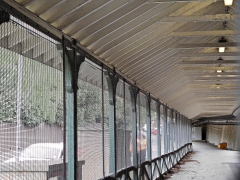
My family used Golders Green Station on an almost daily basis. During my childhood, there were two ways of entering it. One way, which still exists, is from the large station forecourt, the local bus and coach station. The other way, which was closed at least 35 years ago, was from Finchley Road. An entrance beneath the railway bridge led to a long, covered walkway (see the illustration above) under an elaborate wooden structure, open to the outside air on most of its two sides. The husband of one of my father’s secretaries once remarked that the wooden canopy reminded him of structures he had seen in India. Having visited India myself, I now know what made him think of that.  The walkway led to a ticket office, beyond which there was a corridor from which staircases provided access to the outdoor platforms. Our family favoured using the Finchley Road entrance because it was slightly closer to our home in Hampstead Garden Suburb than the other one next to the bus yard.

In the early 1960s, when I was still a young child, northbound Underground trains coming from the centre of London stopped on one of the two northbound tracks that ran through the station. In those days, the doors on both the left and right sides of the train opened in Golders Green. If the train entered on the left track, that closest to the bus yard side of the station, we used to leave the train by the right hand doors, which led to the platform whose access staircases were closest to the Finchley Road entrance. We did this almost like a reflex action, without thinking about it.

One day, after my father had taken me to spend time in town with him, probably at his workplace, the LSE, we returned to Golders Green by Underground. As usual, since the train had stopped at the platform closest to the bus yard, we waited for the opening of the doors on the right-hand side of the train. Standing facing these doors, we could hear the opening of the doors on the left-hand side. We waited and waited, and then the train began to continue its journey northwards towards the next station, Brent. We were astonished that ‘our’ doors had not opened. My father was mildly upset by this. We behaved like creatures of habit. I was really pleased because I had always wanted to travel beyond Golders Green Station to see what exciting scenery lay beyond it.  It was not, I remember, the rural scenes that visitors in the 19th century and earlier would have enjoyed.

Maxim and Ivy: to Russia with love

MEIR HENOCH WALLACH-FINKELSTEIN (1876-1951) is better known as Maxim Maximovich Litvinov. A Bolshevik revolutionary, he became an important Soviet diplomat. In 1930, Stalin appointed him People’s Commissar for Foreign Affairs. Earlier on, shortly after the 1917 Russian Revolution, Maxim was sent to London as the Soviet government’s plenipotentiary representative in Great Britain. While in London, he met and married the writer Ivy (née Low; 1889-1977). I have recently discovered that their lives partially overlapped with mine, not temporally but geographically.

BLOG IVY 5

Ivy was living in London’s Hampstead when she and Maxim were courting. They had met in about 1918 at the home of Dr David Eder (1865-1936), a Zionist socialist and a pioneer of psychoanalysis in Britain. David, whom Ivy regarded as a father figure, and his family lived in Golders Green (actually, in Hampstead Garden Suburb at 103 Hampstead Way, not far from our family home).  According to Ivy’s biographer John Carswell (in his book “The Exile: Ivy Litvinov”):

“Over tea in the Express Dairy in Heath Street where they often met, Ivy helped Maxim to improve his English – throughout her life she adored improving people’s English – and she did more: she guided him in reading English literature.”

Today, the building that used to house the Express Dairy in Heath Street is a branch of the Tesco supermarket empire. However, the building still bears the name ‘Express Dairy’ and the date 1889, the year that Ivy was born.

Ivy’s biographer John Carswell (1918-1997) was the son of one of Ivy’s closest friends, the writer and journalist Catherine Carswell (1879-1946). Ivy met Catherine, a close friend of the writer DH Lawrence who lived in Hampstead, after she had written a favourable review of Ivy’s novel “Growing Pains”, which was published in 1913. Catherine lived in Hampstead at Holly Mount. To be close to her friend, Ivy moved to Hampstead. John, who was born at Hollybush House in Holly Hill, met Ivy several times and has written a good account of her life. It reads well and is extremely informative not only about Ivy but also about her husband.

Ivy and Maxim moved to Russia with their two young children in about 1920 and lived there, with small occasional breaks, until the late 1950s. One of these breaks was when Maxim was appointed Soviet Ambassador to the USA between 1941 and 1943. Her stay in the USSR was also punctuated by short holidays abroad. Living in the USSR, Ivy continued her writing as well as teaching English. Long before he died, Maxim fell out of favour with Stalin and lived in fear of arrest and probable execution. However, he died of natural causes in 1951, just in time to miss Stalin’s last great, but unfulfilled, plan, the anti-Semitic ‘Doctors’ Plot’. On his deathbed, he said to Ivy:

“Englishwoman, go home”.

It was not until 1960 that Ivy did return to England.  But, in 1961, she returned to the USSR, where she remained a pensioned widow until July 1972, when she returned to the UK. She settled in Hove, where she lived the rest of her life. Until her dying day, Ivy wrote, published, and was actively involved with the literary world.

Long before her last visit to England, Ivy had made brief visits. In July 1930, Maxim was appointed People’s Commissar for Foreign Affairs. Soon after his promotion Ivy accompanied him to Geneva. That same winter, the Litvinovs paid a visit to London. John Carswell, then twelve years old, recalled:

“She took me to a Christmas show of which even the name now escapes me; but what is still vivid is the tall, dominating, fur-coated figure sweeping me across the wintry promenade outside the Golders Green Hippodrome, to a torrent of commentary.”

Reading about Carswell’s memory of Ivy taking him to a Christmas show at the Hippodrome reminded me of seeing pantomimes at this same theatre when I was about John’s age or maybe a year or two less. until the mid-1960s, the Hippodrome (built as a 3000-seat music hall in 1913) was a very active repertory theatre, where many plays that would eventually end up in the West End were premiered. In addition to plays, operas and Christmas pantomimes were staged there. In the 1960s, it became a BBC television studio, and lately it has become a venue for Islamic meetings. Like Carswell, I cannot remember what shows I saw there as a child, but I do remember being impressed by the size and fittings (seats arranged in galleries, boxes, and the vast stage) of the Hippodrome. It was as least as impressive as the grandest of West End theatres.

I enjoyed reading Carswell’s biography not only because it provided some insight into what life was like in the Soviet Union during Stalin’s rule but also because it introduced me to the life of an intriguing woman writer whose love for Maxim led her to spend a large part of her life in the USSR. Another thing that appealed to me is that Carswell provided me with new aspects of the history of Hampstead, a part of London which I know well and where I grew up. It is with some reluctance that I will return this enjoyable biography to our local public library.


Polish or Russian

BLOG HOOP 1l Eagle Lodge


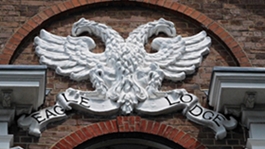
THE DOUBLE-HEADED EAGLE, the symbol of Albania, has fascinated me ever since I first became interested in the country in about 1967. This much-employed imaginary creature, whose origins go back at least 3000 years before the birth of Christ, is not only the national symbol of tiny Albania but also of Imperial, and now modern, Russia. A year or so ago, I was walking along Golders Green Road in northwest London, one of my childhood haunts, when I saw something I had never noticed before. It was a block of flats on which I spotted a large sculpture of a double-headed eagle. The building is appropriately named ‘Eagle Lodge’.

According to Pam Fox, author of “The Jewish Community of Golders Green” a detailed and fascinating book published in 2016, Eagle Lodge was one of a number of mansion blocks built on the sites of former large villas with extensive grounds that used to line Golders Green Road. Next to the mention of ‘Eagle Lodge’, Ms Fox refers to her endnote number 1, which reads:

“It was designed by a Polish architect who carved the Polish eagle onto its façade, giving the block its name.”

Although I doubt that Ms Fox’s book attracts many Polish nationalist readers, this footnote would certainly upset them. The Polish eagle used heraldically or as a symbol has only one head. Having been subjected to domination by the Russians for many years, to confuse the single-headed eagle of Poland with the double headed version used by their Russian neighbours would not go down too well amongst the Polish fraternity.

As for the “Polish architect”, there is another problem. Eagle Lodge was, according to the architectural historian Nikolaus Pevsner, designed by MV Braikevitch and built 1935-37. Mikhail Vasilievich Braikevitch (1874-1940) was a Russian engineer and art collector born in the Ukraine. I found an interesting pamphlet published by the London Borough of Barnet, which contains the district of Golders Green. Titled “The 1917 Revolution & Barnet’s Russian Heritage”, it says:

“Possibly the most interesting Russian resident was Mikhail Vladimirovitch Braikevitch of Woodstock Avenue. He had been an important engineer in the construction of the Trans-Siberian Railway, was the mayor of Odessa before the war, and had been a member of the interim government, who ran Russia between February 1917 and the October Revolution. Remarkable as all these things are, it was his art collection which was most important. Having settled in England, he started to collect works of art smuggled out of Russia from fellow refugees – both in London and Paris – and amassed one of the best collections of Russian art outside of Russia itself. On his death in 1940, he left the collection to the Ashmolean Museum in Oxford, but we can imagine an ordinary house in Golders Green with some of the greatest works of Russian art on the walls.”

It was at Braikevitch’s suggestion and following a visit to his home in Golders Green that the undeservedly lesser known but remarkable Russian composer Nicolas Medtner (1880-1951), a contemporary of Rachmaninoff and Scriabin, shifted from Paris to London in 1935.  The composer and his family settled into a new home on Wentworth Road in Golders Green.

Braikevitch, like Medtner, was buried at Hendon Cemetery and Crematorium, not far from Golders Green.  The architect’s funeral was held at St Philip’s Russian church, Buckingham Palace Road, London. So, all things considered, it is highly likely that the architect of the rather unappealing looking Eagle Lodge with its double-headed eagle was not Polish, and that the bird with two heads has nothing to do with Poland as erroneously suggested by Ms Fox in her end note.  

Orange juice in North London

AT A REUNION LUNCH held for students who (like me) had attended Highgate School in north London during the 1960s, the Headmaster, Mr Petitt, gave a speech. He said that we, the former students, had reached the age when the ‘nostalgia gene’ kicks in. In my case it has kicked with a vengeance. When I lived near Golders Green, which is not far from Highgate, I would never have believed that one day I would write nostalgically about this, let us be honest, fairly unexciting suburb in northwest London, but here I am at the keyboard doing just that. Squeezing some oranges to produce juice to flavour a dish containing red cabbage triggered one of my earliest memories, that of walking with my parents to the church hall next to St Albans Church in Golders Green to collect bottles of orange juice.

The juice collected from the church hall was quite delicious and richly flavoured. It was contained in large glass medicine bottles with cork stoppers. The juice was supplied free of charge by the state during the 1950s. It was first supplied gratis by the state in 1941 and distributed to reduce the risk of vitamin C deficiency amongst young British children. In 1951, just before I was born, the Conservative Party won a General Election. Soon afterwards, the government restricted the supply of free orange juice to children under two years. My sibling was born in 1956, four years after me. Therefore, I must have been well under six years old when we made these trips to the church hall in Golders Green. Thinking about this juice led me to recall other aspects of Golders Green as it was during my early childhood.


BLOG JUICE

St Albans church hall in Golders Green

One dimly recalled early memory of Golders Green is of a delicatessen near the corner of Golders Green Road and Golders Green Crescent. The place was called Apenrodt’s. I remember this shop had a large wooden barrel that contained pickled gherkins submerged in a liquid. This was not a surprising thing to see in a suburb with a large Jewish population, many of eastern European heritage in my early years. My father enjoyed pickled gherkins. I developed a taste for them in my twenties, as I did for smoked salmon. In my childhood, smoked salmon was relatively more expensive than it is today. My parents regarded it as a treat. I remember them buying it at the aptly named Cohen’s Smoked Salmon, which, like Apenrodt’s, was a Jewish delicatessen.

Two shops in Golders Green particularly intrigued me when I was a little boy. One was an old-fashioned shop, Franks. It sold various clothing items, much of it was hosiery and lingerie. It was not the garments that interested me but the pneumatic system that was used to send money and receipts from the shop floor to an office somewhere else in the shop. Money, bills, and receipts were placed in cylindrical capsules that were placed in tubes along which air was pumped to propel them from one part of the shop to another.

The other establishment was Importers, a coffee retailer with a café behind it. The front windows contained cylindrical coffee roasters, which could be seen from the street. The cylinders were made with fine metal meshwork. Filled with coffee beans, they rotated slowly above gas burners. The air inside the shop was filled with a wonderful aroma that must have helped sell the coffee beans and powders stocked on the shelves of the shop and in the sacks on the floor. We used to pass this shop often, but rarely entered it because my mother preferred to buy coffee at the Algerian Coffee Store, which still exists in Old Compton Street in Soho.  Despite this, I always stopped to watch the roasters rotating and savour the odour of the coffee whenever I passed that shop.

During the last three months of 1963, we lived in Chicago, Illinois. There, we experienced and enjoyed self-service supermarkets for the first time. So, I was excited when the first supermarket opened in Golders Green soon after we arrived back from the USA. I cannot recall the supermarket’s original name, but soon it was called Mac Market, when it was taken over by the Mac Fisheries Company. Prior to taking over the new supermarket, the company had run two grocery shops near to Golders Green station. These were stores where one queued up to be served by shopkeepers standing behind counters laden with food items. If you wanted a product, butter for example, the assistant cut the amount you required, weighed it, and wrapped it up.  

The supermarket occupied a plot on the corner of Golders Green Road and a small service road called Broadwalk Lane on which there used to be a small pet shop. Years later, the building that housed Mac Market was occupied by a newer supermarket that stocked many Kosher and Israeli products. Currently, a branch of Tescos occupies the site of Golders Green’s first ever supermarket.  Another supermarket built far later, a branch of Sainsburys, occupies the site of the Ionic, one of Golders Green’s two former cinemas. The other cinema, long since demolished, was the ABC that stood on Golders Green Road northwest of the main shopping area at the end of Ambrose Avenue. A care home now stands in its place. Although another of the area’s entertainment centres still stands, the huge Hippodrome Theatre, where as a child I enjoyed the annual pantomime and adults enjoyed pre-West End runs of new plays, this now houses the Hussainiyat Al-Rasool Al-Adham community centre, a religious organisation.

The supermarket was close to the bridge that carries the Northern Line of the Underground over Golders Green Road. We used to visit a small shop that nestled close to the southwest corner of the bridge. This was Beecholme’s Bakery, which was run by Harry Steigman and his family, who were related to my aunt’s husband. We visited the shop not to buy baked goods, but to greet these relatives of my father’s sister. She lived in South Africa, which felt very distant at a time when international telephone calls were costly, and the means of electronic communication that are now in common use were probably unimaginable even in the minds of science fiction writers.

What I did not know at the time was that one member of the Steigman family, Natty, the youngest of four brothers who helped their parents run the forerunner of Beecholme Bakeries, had volunteered to fight against Franco in the Spanish Civil War.  Tragically, he was killed at the battle of Jarama (in February 1937) only two weeks after his arrival in Spain.  

Crossing the main road from Beecholme’s and walking under the bridge, one reaches Golders Green Public Library. During my childhood, I loved this place. Until a certain age, maybe 12, I was confined to using the well-stocked Children’s Library. When I passed that age, I could borrow books from the much larger, and far more interesting Adults Library. One bookshelf of this section of the library contained books about the sad story of the Jewish people during period of the twentieth century when their persecution and destruction was being carried out to fulfil the evil plans of Adolf Hitler and his sympathisers. Reading books about this terrible period catalysed my interest in twentieth century history and what led up to it. When I was at school in the 1960s, every school year our history syllabuses led us from the arrival of Julius Caesar in Britain to just before the start of WW1, never beyond it. And, the emphasis was not on what happened and why, but on the dates of events. These books in the library opened my eyes to the history of a period that I found far more interesting than what we were expected to learn to pass examinations. Since those days exploring the shelves of Golders Green Library, my interest in history has gradually expanded from the twentieth century back to far earlier times.

The library was next to a branch of Woolworths. This old-fashioned store, a magnificent emporium, stocked everything from plant bulbs to lightbulbs, from liquorice to lawnmowers. Its ceiling was decorated with an elaborate stuccoed pattern. Although illuminated with electric lamps, some of the shop’s old-fashioned gas lamps still hung from the ceiling. They had little chains dangling from them to regulate the gas flow. Shoppers were assisted by salespersons. It was not a self-service store. Oddly, I have no memory of the shop after its modernisation in 1971.

Although the shops I remember from my childhood have disappeared, Golders Green Road’s buildings look much as they did when I lived near there, and the pavements are just as busy as they were in the late 1950s and early 1960s.

All the shops I have described have been replaced by others, reflecting the passing of time and the changes in the ethnic mix of the population living in the area. There is still a strong Jewish presence in Golders Green, albeit now biased towards the ultra-orthodox communities. To this has been added people from a diverse range of backgrounds.  When I was a child, the idea of eating Japanese, Korean, Turkish, or even, surprisingly, Israeli foods would have been unthinkable in Golders Green Road.

St Albans Church, designed by the architect Sir Giles Gilbert Scott and built in 1933, remains unchanged.  Neighbouring St Albans, the church hall, where we used to walk to collect the orange juice, also looks as I remember it so many decades ago. 

Today, the shops that we visited when I was a child and collecting orange juice in corked glass bottles are merely memories of a childhood long since passed. As I type the final words of this piece, another memory of the church hall springs to mind. Between the ages of four and eight, I attended Golders Hill School on Finchley Road. Once, we, the school children, performed a play for our parents. We acted it on the small stage in the church hall. I had a minor role as a magician. The costume I wore included my beige dressing gown onto which my mother had embroidered different coloured cloth patches. They were cut to look like stars. For a long time after that show, I treasured the dressing gown as it held memories of an evening I had enjoyed greatly. I outgrew the dressing gown, but memory of it still lingers in the folds of my brain. And, yes, Mr Petitt was right, my ‘nostalgia gene’, clearly a dominant version of it, has become most powerfully active.

A chance meeting

BRIDIE WAS OUR DAUGHTER’S babysitter for several years. She also collected her from school and looked after her until one of us returned from work. Although she was well over 80 when we first employed her, Bridie was a very sprightly, energetic woman.

LondonUnderground_GoldersGreenStation


She had been brought up in the wilds of western Ireland. Every day, she used to walk several miles over the hills to go to school. She moved to England as a very young lady. On arrival in Britain, she was at first given shelter by the Salvation Army. She had to promise them she would become teetotal. She kept this promise.

One day, Bridie told us an interesting story. When she was young before WW2, she worked as a maid for a Jewish family in north London’s Golders Green.  She wore uniform. There was one uniform for daytime and a different one for the evenings.

When Bridie was not working for us or ironing for our friends, the Wilsons who had introduced her to us, she used to roam around London taking advantage of her free bus pass (given to Londoners over 60 years old).

One day, Bridie visited Golders Green. When she was waiting for a bus to take her home, an elderly gentleman in the queue said to her:

“Excuse me, but are you Bridie?”

“I am,” she replied.

“Well, you looked after me when I was a child sixty years ago”

Bridie realised that the man was from the family, for whom she had worked in Golders Green before WW2.

A bus approached. The man asked her:

“Are you getting on?”

Bridie nodded, thinking he had asked a different question. The man jumped on the bus, leaving Bridie standing by the bus stop. Had she heard his question correctly,  he would have waited behind to reminisce with her: an opportunity lost for ever.

Ever since hearing about Bridie’s chance encounter, I have always considered her story as being rather sad.


Picture of Golders Green bus staion (Wikipedia)