Denmark in the tropics

I HAVE WANTED TO VISIT TRANQUEBAR (now called Tharambangadi) since I first heard of the place when I was a teenager in the 1960s. Danish settlers established a fort and their first trading post in India there in 1620. I had already visited the former Danish colony at Serampore (established by 1770) on the River Hooghly, and was keen to see what remains of Tranquebar.

We drove south from Pondicherry for three hours through flat terrain, passing huge rice paddies, negotiating sprawling towns and villages, and crossing numerous rivers and streams.

Tranquebar, a sleepy little place on the wave washed shore of the Bay of Bengal, contains a sizeable collection of buildings constructed by the Danes during their tenure of the town, which finally ended in 1845, when the Danes sold it to the British.

During the Danish era, there were three main churches. One of them built by the seashore was been destroyed by the sea long ago. The Zion Church, the oldest Protestant church in India, was consecrated in 1701. It is now used by the Church of South India. It was founded by a German Bartholomew Ziegenbald (1682-1719). He was educated at the University of Halle, where my great great grandfather received his doctoral degree in the early 19th century, and was sent (with his fellow student Heinrich Plütschau) by the King of Denmark to become the first Lutheran missionary in India.

Ziegenbald was a remarkable man. During the last few years of his life, which were spent in India, he was involved in Lutheran missionary work (countering the activities of Catholic missionaries), literary work, translating the Holy Bible into Tamil, running a printing press, and conducting church services.

The New Jerusalem Church, larger than the nearby Zion and designed with its nave equal in length as its transept, was consecrated in 1717, two years before Ziegenbald died. He was buried in it. The church remains a Lutheran place of worship. Its parish priest, Mr Samson, guided us around its plain interior and told us that about sixty local families worship there regularly. The church is partly surrounded by a small cemetery, some of its gravestones bearing Danish names.

Ziegenbald’s home, now located within the grounds of a school, contains a small museum. The groundfloor contains a portable reed organ, some manuscripts related to Ziegenbald, and two printing presses that were acquired long after Ziegenbald died. One of these presses, made in London in the 19th century, was being demonstrated to a group of Tamil Lutheran visitors.

I watched as Tamil letters were covered with red ink before being covered with a sheet of white paper. The press was then operated manually. When the paper with Tamil letters was removed and shown to the visitors crowding around with cameras poised in readiness, everyone applauded. Then, the demonstration completed, the group sung a hymn in Tamil, praising God for creating such a technological miracle.

The Ziegenbal house museum is currently curated by a German, Jasmine. She encouraged us to see a small bur lovely exhibition of artworks by two German artists from Halle, where Ziegenbald studied long ago. Then, she introduced us to an Indian artist Asma Menon, who is creating a Cabinet of Curiosities similar to a very old one that is kept in Halle and contains objects collected in India long ago. Her creation that will be housed in a cabinet similar to the one in Germany will contain a series of object that captures the ‘essence’ of Germany, as she found it on a recent visit to Halle and other German cities. We spent time talking with Asma and a young volunteer from Germany.

Aaron Hall, next to the former home of Ziegenbald, is named in memory of Reverend C Aaron (1698-1745). A Tamil, he was the first ever non-European to be ordained as a Lutheran pastor. He was ordained in December 1733. He had been baptized earlier by Ziegenbald. Jasmine told us that when Aaron was ordained, there had been massive objections to this back in Germany, but the ordination took place despite these.

The Neemrana “non-hotel” hotel at Tranquebar is housed in the picturesque former British Collector’s Bungalow close to the sea shore. Unfortunately, its restaurant proved to be rather a ‘non-restaurant’: poor food and very poor service. Most of the other diners were late middle-aged Danish tourists nursing cans of Kingfisher beer. Foolishly, I ordered pasta with “aglio olio”. What turned up was penne drowning in an a virulently bright reddish orange coloured sauce that tasted as if it contained tomato ketchup as its main ingredient.

Lunch over, we strolled along the beach passing a monument recording the arrival of Ziegenbald in India. This overlooks a small harbour surrounded by partially ruined stone walls. Men were bathing in its water which was calmer than the sea around it. From where we were walking, we could see row after row of foam crested waves breaking on the shoreline that stretched away to the southern horizon.

The fort built by the Danes under the command of Admiral Ove Gjedde (1594-1660), Fort Dansborg, is still pretty much intact. It contains a small museum with an odd assortment of exhibits – a bit of a jumble. I was intrigued by several fading Maratha paintings and a 12th century Indian stone carving in good condition.

As I stood by the well in the large central open air courtyard of the Fort with the afternoon sun beating down on me at the temperature well in excess of 30 degrees Celsius, I wondered how the Danish settlers and soldiers coped with a climate so different to what they were used to in Denmark. I was able to dive back into our air conditioned taxi after a few minutes in the sun. This option was not available in the centuries when the Danes and Germans spent months and years in Tranquebar. Even the interior of the Fort, with its thick walls, was not greatly cooler than outside.

The Fort is separate from the former British Collector’s Bungalow and the former Danish Governor’s House by a spacious sandy maidan. The Danish Governor’s House neighbours a smaller and more recent edifice named “Danish Indian Cultural Centre”. This contains a library and a small museum. Amongst the exhibits, there are several drawings and paintings by the former Danish Governor Peter Anker (lived 1744-1833; governed 1788-1806). All of his attractive artworks on display are of Indian subjects.

The former Danish Colony of Tranquebar is in Tamil Nadu. About ten kilometres or less the coastal road leading south from Tranquebar leaves the state of Tamil Nadu and enters a part of the Union Territory of Pondicherry separated from the city of that name by over a hundred kilometres of Tamil Nadu. Like Mahe, a tiny part of Pondicherry on the coast of the Arabian Sea and Chandernagore in West Bengal, this southern territory, containing the town of Karaikal, was a French colony. Yanaon, surrounded by Andhra Pradesh, was yet another French colony and is now part of the Union Territory of Pondicherry.

Karaikal became a French colony in 1674 and remained as such until about 1954. At first sight, it looks like a typical, unexceptional modern Tamil urban area with a few decaying old buildings stuck within a mass of architecturally unexceptional buildings. However, our driver, a Tamil named Pierre, drove us to see what little remains of French colonial Karaikal.

The most notable souvenir is the former French Governor’s mansion. Well conserved, the Governor lived on the first floor and his administration used the ground floor. This building, which is well over 200 years old, is now the Collector’s Office of Karaikal. Nearby, there is a French war memorial commemorating those who died in the two World Wars. The monuments single out campaigns in Algeria and Indo-China. Near this, there are a few architectural details that might have existed during the French era, but little else.

Unlike Pondicherry, which has retained its colonial charm and attracts many tourists, there is little to attract the average tourist to Karaikal. I am glad we went there because I find places like this, which hint at their largely forgotten history, very evocative and fascinating.

While I would not reccomend a visit to Karaikal, a few hours or more spent in Tranquebar will be very rewarding both to those interested in history and to lovers of the seaside.

Black and white

HAVING PARENTS WHO WERE BROUGHT UP IN RACIALLY conscious South Africa, I feel easier calling the two parts of old Pondicherry by their French names, ‘Ville noire’ and ‘Ville blanche’, rather than their English names, ‘Black Town’ and ‘White Town’. The English names are redolent of the sad days of racial segregation in apartheid South Africa.

While Pondicherry was a French colony, most Europeans lived in White Town, and people of local Indian origin lived in Black Town. This kind of racial separation was not unique to the French in India. The British were also keen to keep races separate. Bangalore, for example, was divided into the Cantonment (European area) and the City (local Indian area).

A rather malodorous partially covered canal or drain separates White Town from Black Town (now called ‘Heritage Town’). White Town lies between Black Town and the shore of the Bay of Bengal.

Today, more than 60 years after the French ceased to Govern Pondicherry, the White Town continues to retain its appearance as a French colonial town. Many of the buildings were built by the French and are distinctly European in architectural style. The streets are neatly laid out, tree lined, and wide. There is none of the hustle and bustle associated with most Indian towns and villages. This might be because there is little commercial activity apart from tourist related facilities (accommodation and eateries). You can enjoy a good but costly meal in White Town, but buying a newspaper or fruit and vegetables is hardly, if at all, possible.

Since our last visit to Pondicherry five years ago (just before the great storm that flooded Chennai in late 2015), the city’s authorities have placed plaques along the streets of White Town. Written both in Tamil and English (not French!), they provide short informative histories of the streets’ names.

Cross the covered drain into what used to be called ‘Black Town’, and familiar Indian urban life is flourishing. The streets are crowded; there are shops aplenty; the area is full of traffic: two, three ,four (and more) wheeled vehicles; and there are Hindu temples (as well as churches). Apart from tiny roadside Hindu shrines, the only places of worship in White Town are churches.

In contrast to White Town, the architecture in the old Black Town is not so fine. There are a few traditional Tamil style buildings, but much of the architecture is relatively new and generally lacking in visual appeal.

Apart from being a very pleasant place to visit, Pondicherry and its well preserved historical layout offer an interesting reminder of colonial life and its less savoury racist aspects. That said, the place and its beautiful seaside promenade is a joy for all visitors whether or not they have any interest in history.

So near, yet so far

THE FLIGHT FROM BANGALORE to Chennai (Madras) is short: about forty minutes flying time. Some friends collected us from the airport in Chennai, and plied us with a tasty lunch. They recommended hiring an Uber taxi to ferry us from Chennai to Pondicherry (now ‘Puducherry’), a distance of about 100 miles. After three abortive attempts, a fourth driver pitched up and we set off for Pondicherry.

Our Uber driver was excellent and drove carefully. After just over two hour’s journey southwards along the luxuriant, verdant, well cultivated coastal plain, we reached a Pondicherry check post.

From 1674 until 1954, Pondicherry and its environs was a French colony. Occasionally, it was taken over by the British, but most of the time it was part of France. In 1954, a large majority of city elders voted in favour of ceding drom France. That year it became, and remain, an Indian Union Territory, independent of its hige neighbour Tamil Nadu. Old Pondicherry still contains many fine French colonial buildings and the policemen wear képis. Many of the road names are bilingual: Tamil and French. In addition, the town has no shortage of restaurants offering what is described as ‘French cuisine’. Although well populated with both Indian and foreign tourists, Pondicherry is a delightful place to relax and enjoy warm sea breezes.

To enter the Union Territory of Pondicherry, drivers of cars with registration plates from outside Pondicherry have to buy a permit to drive there. Our Uber driver’s car had Tamil Nadu plates. He stopped at the check post, which is about ten minutes drive from the heart of Pondicherry, and told us it would take about five minutes to get the permit. He gathered up his relevant documents and headed inside the checkpost. While we were waiting for our driver, we were parked next to an unpretentious stall serving Bengali food. It bore signs in three scripts: Bangla, English, and Tamil.

Instead of taking five minutes, we sat waiting for him for forty five minutes. This was because he had set out with one document missing. I sat waiting in the car thinking that without the entry permit, we were so near yet so far from our destination.

After some time and several telephone calls, our driver re-entered the checkpost, and emerged with the desired permit. He explained that he had bern sent a photo of the missing document by WhatsApp. This image of the document, rather than the original, satisfied those who issued the entry permit. We continued our journey. Just beyond the checkpost, I saw an obelisc, which looked old enough to have been put up by the French colonial authorities.

After settling into our accommodation, which I will describe at a later date, we took a pre-prandial stroll along the lovely seaside promenade. I was very pleased to discover that a place that had opened on the promenade a few months before our last visit to Pondicherry five years ago was still flourishing.

The Gelateria Montecatini Terme is a superb ice cream shop. It was set up just over five years ago by an Italian who has a business making luxury boats, anything from canoes to millionaires’ yachts. The gelateria is fully equipped with Italian equipment and refrigerated ice cream display counters. Stepping into this popular ice cream parlour in Pondicherry is just like stepping into a gelateria in Italy, and the ice cream is top class. The queues of customers attest that I am not alone in saying that.

The so-called ‘French food’ in Pondicherry is popular, but in no way matches up to the high standards often encountered in France. In contrast, the ice cream served at the Gelateria Montecatini Terme easily rivals the best in Italy. India never fails to be surprising!

EUROPEAN HAUNTS ON THE HOOGHLY RIVER: Former European trading posts

PLEASE TAKE TIME TO READ INDIGO SEXY”, so announces a sweet female voice over the public address system in the passenger cabins of aeroplanes flown by Indigo Airlines. Actually, this voice is encouraging flyers to read Indigo’s in house magazine “Indigo 6E”. The November 2029 issue of this well produced monthly had an article about places that I have long wanted to visit: the places on the banks of the River Hooghly that were once occupied as trading posts by Europeans from various parts of that continent.
I knew that, apart from Britain, at various times the following nations had had tiny colonies on the banks of the River Hooghly (north of Calcutta): Holland, France and Denmark. Until I read an article in “Indigo 6E”, I was only barely aware that Portugal also claimed a parcel of land. That was at Bandel.
One day, we rented a car with driver to explore the former haunts of the nations listed above. We commenced at Bandel. To reach this place we drive pat endless numbers of heavy trucks north along the National Highway that links Calcutta with Delhi until we reached a road to Bandel.
To our grumpy driver’s indignation the road to the centre of Bandel was amazingly congested with cycles, tricycle rickshaws, autorickshaws, pedestrians, a variety of motorised three wheelers, dogs, trucks, buses, and so on.

Eventually, we reached the imposing church of the Miracle of Our Lady of Bandel that is separated from the Hooghly by a large garden. The church, which was built on a piece of land gifted to the Portuguese in exchange for military assistance given to a local ruler, was built at the very end of the 16th century.

The original church, one of the oldest in Bengal, still stands but has been heavily restored. It has been buried beneath shiny tiling, both outside and inside. The only original feature visible is an altar piece that looks as if it was created many centuries ago. The church was part of an Augustinian monastery, and is now part of a Salesian institution. The cloisters, like the church, are lined with tiling.

We drove south, following the Hooghly, to Chinsura, which the Dutch had occupied from 1656 to 1825. Apparently, there are several Dutch buildings in the town, but we did not find them. Instead, we managed to see the exterior of the town’s Armenian church, which is the second oldest church on Bengal. It is surrounded by a high wall surmounted by fierce looking spikes. A local informed us it wasonly opened up once a year, and we were not in Chinsura on that day! Later, we learnt that it is open for masses one Sunday in three.

Between Bandel and Chinsura, we came across an elegant house standing next to but high above the Hooghly. It was the place that Bankim Chandra Chatterjee (1838-94) lived for several years. Some say it was the place where he composed the patriotic poem “Vande Mataram” in the 1870s. It was set to music by Rabindranath Tagore. The British imperialist authorities made it a punishable offence to sing in the esrly part of the 20th century.

We drove south along congested roads that more or less followed the Hooghly until we arrived at Chandernagore, which was a French enclave until 1947.

The Institut de Chandanagor, a fine colonial building that could do with a little restoration, was once Dupleix House the former residence of the French governor. It now houses a museum that has many exhibits that recall the history of European trading settlements along the Hooghly. It stands in gardens, where once stood a fortress built by the French. The museum faces a lovely riverside promenade that includes a late 19th century pavilion built with French funding. This edifice is adorned with sculptures depicting elephant heads. At the southern end of the promenade, there stands a house, which Rabindranath Tagore has mentioned several times in his writings. When the river rises, its lower storey fills with water, by design.

The church of Sacre Coeur stands about 100 metres back from the promenade. It was built in the late 19th century, but was first established in 1691. Its interior has recently been redecorated with garish colour paint.

It was a long drive to Serampore on the Hooghly. We drove there along through narrow winding lanes and a stretch of the Grand Trunk Road. The Grand Trunk runs from Chittagong, now in Bangladesh, to Kabul in Afghanistan, passing through Calcutta and Delhi. It has existed for at least 2500 years and is one of the longest roads in Asia (almost 3000 miles).

Between 1755 and 1845, Serampore was under Danish control. The Danes knew it as Frederiknagore. We visited the church of St Olave, whose design resembles that of St Martins in the Fields in London. The internal walls of it plain but elegant interior bear memorials to several Danes who worked either for the Danes or for the British, who inherited Serampore from the Danes, or fir both. Serampore is also the home of Serampore College, which was founded in 1818 by Joshua Marsham and William Carey (1761-1834). Carey was born in Paulerspury in Northamptonshire. This village is the home of friends of ours. It was following a visit to them that we were first alerted to the existence of the former Danish colony on the Hooghly.

Before returning to Calcutta, we had coffee at the recently restored Denmark Tavern that overlooks a lovely stretch of the Hooghly. The tavern was first opened in 1786 and appears in a painting by Peter Anker dated 1790. The original building has been beautifully restored and is still serving its original purpose.

Although we only saw a few of the haunts of the former non-British European settlements on the bank of the Hooghly, our visit has made us want to revisit them in the future.

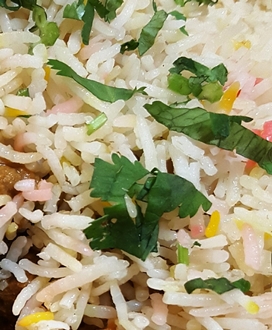
The first time I ate rice

rice


I had a difficult birth. Both my mother and I nearly died when I was born. For the first few weeks of my life, I was not a healthy baby; my future was uncertain. Then, as I grew a little, I was a poor eater. My mother, who worried about me greatly, felt that it was best that I only ate what I liked. As a result, I became a fussy and unadventurous eater. My immediate reaction on being offered something that was outside the tiny range of foods that I was prepared to eat, was to refuse it.

Although at an early age, I was happy to eat tomato sauce either with pasta, which I still enjoy, or with baked beans, which I now dislike intensely. I recall eating a fresh (i.e. uncooked) tomato for the first time when I was about 13.

When I was 20, I joined some friends on a camping trip in France. We travelled around the country by car, camping at night. We would eat picnics for lunch and visit restaurants in the evening. One of our camping places was at Banyuls on the Mediterranean coast of France close to the Spanish border. One evening, we drove across the border to Port Bou in Spain. Naturally as we were in Spain, my friends ordered paella.

Paella, as many people know, is a rice based dish. I was a bit skeptical because I had managed to avoid eating rice (and rice pudding) prior to this brief trip to Spain. Something attracted me to the paella, maybe it was hunger or its delicious appearance, and I tried a portion. As for the rice, it was love at first bite. Since then, I have been a great fan of rice, which I had never tried during the first 20 years of my life. I still dislike rice pudding as it is made in the UK. In contrast, I really enjoy phirni, an Indian version of rice pudding.

Since that trip to Port Bou, my tastes have become quite adventurous. I rarely refuse trying something new, even if only once.

Looking back on my childhood, I now realise that my very conservative tastes deprived me of the delights of many of the gourmet meals, which my parents enjoyed while travelling with me and my sister. They would enjoy fine French or Italian food whilst I stuck to my ham or steak and chips. 

Well, as the French say À chacun son goût. I am glad that mygoût has become more exciting.


Paris

Wallace ladies_500


The recent tragic conflagration of the cathedral of Notre Dame in Paris and its resultant degradation of one of the world’s best-known buildings evoked a sensation that I had not experienced since 1976. In that year, there was a devastating earthquake in the Friuli area of north-east Italy. 

We had good friends living in that area. They had taken us to see many  unique masterpieces of Longobard art and architecture that existed in the area. When we first heard the news, we were extremely worried about the fate of our friends, who, luckily, all survived. We were also concerned about the works of art and architecture we had grown to love.  Fortunately, most of these were restored eventually.

Ten years before the earthquake in Friuli, there was a terrible flood in Florence in November 1966. About 100 people were killed, and many, many valuable works of art perished in the oil-filled flood waters. Our family was extremely upset because we used to visit the Tuscan city every year to see old friends and to enjoy its rich artistic heritage.

We did not visit Florence the following year because of the damage, but recommenced our annual visits in 1968. For years after the flood, the height of the flood water levels was visible on the walls of buildings where central heating oil from the city’s boilers and tanks had mixed with the water and made indelible stains.

The fire in Paris brought back feelings of horror and disbelief that i had experienced in 1966 and ten years later. 

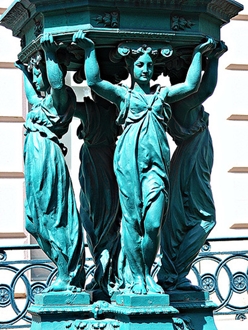
The picture illustrating this blog piece is a reminder of another tragedy that hit Paris: The Siege of Paris (1871) and the Commune. During those difficult times, there were great water supply problems. The English philanthropist Richard Wallace (1818-1890) built a number of drinking fountains for the people of Paris. Each was decorated with the four sculpted ladies shown in my illustration.

Already, many people are offering to donate money to help restore Notre Dame to its former glory. Had he been alive, i am sure Richard wallace would have been a willing contributor.

Tanning at the Tate Modern


One of the great features of possessing a Tate Card (an annual season ticket) is that one can enter (with or without a companion) the regular special exhibitions without paying extra for tickets, which tend to be quite costly. What I particularly like is that if an exhibition does not meet one’s expectations, one can spend a short time viewing without worrying about having wasted, maybe, as much as £18 per person.

Recently, I visited the much-hyped special exhibition of works by the French painter Pierre Bonnard (1867-1947) at the Tate Modern in London. Without the Tate Card, the two of us would have had to shell out £36 (about 30% of the cost of a Tate Card) to see what I thought was a tedious exhibition. 

I like Impressionist and Post-Impressionist art in general, but the Bonnard works left me cold (or at least lukewarm!). I cannot comment on the competence of their execution, but I found them short of visual excitement, almost boring compared with works of other artists painting during Bonnard’s lifetime. Consequently, we did not linger long in the exhibition. I may sound like a Philistine with my comments about the famous Bonnard, but it is only fair to write honestly about how the exhibition affected me. Incidentally, I noticed that many of the visitors at this show were more interested in chatting to each other than looking at Bonnard’s works. I saw one man sitting on a bench reading his newspaper rather than trying to enjoy Bonnard.

As we were still in the mood for looking at art, we decided to enter another special exhibition in the Tate Modern. Using our Tate Card, we saved up to £26 when we entered the exhibition of artworks by the American-born Dorothea Tanning (1910-2012). However, this is an exhibition that is well worth its entrance fee. Bonnard and Tanning’s working lives overlapped for a few years, but the American’s output made a far greater impression on me than the Frenchman’s. 

The exhibition at the Tate Modern commences with paintings from Tanning’s surrealist phase. Her execution and composition sets her amongst the best of the surrealist artists. Each painting has subtlety, excitement,  a sense of adventure, and creative freshness. As Tanning grew older, her works tended towards abstraction in an original way. In brief, Tanning was an artist whose visual language(s) really attract me. Her work has a freshness and impact that I found lacking in Bonnard.

In addition to paintings and designs for stage sets, the exhibition at the Tate includes some of rather weird soft fabric sculptures, which did not appeal to me quite as much as the framed works. However, they display another aspect of Tanning’s undoubted inventive talent.

I am glad we decided to visit the Bonnard, even though it disappointed me, because it got me to visit the Tate Modern after a long break (in India) and to discover the delights of Dorothea Tanning’s  artistic output.


The photo is a detail of a work, “Endgame” , painted by Dorothea Tanning in 1944

Learning from experience

Experience is one thing you can’t get for nothing

[Oscar Wilde]

 Science, my lad, is made up of mistakes, but they are mistakes which it is useful to make, because they lead little by little to the truth.

[Jules Verne]

The only real mistake is the one from which we learn nothing

[Henry Ford]


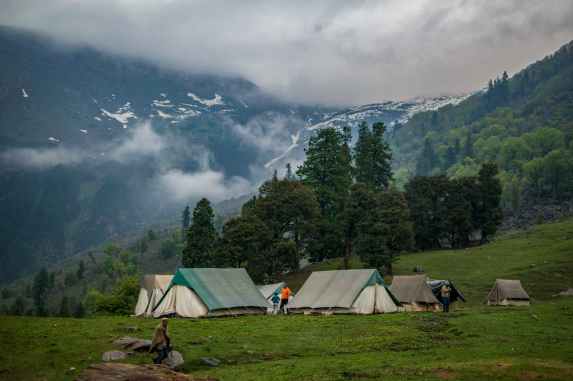
green and white tents near trees

Photo by ajay bhargav GUDURU on Pexels.com

In 1971, I spent about a fortnight driving around France with several friends including the now well-known journalist Matthew Parris. He was our driver, and we travelled in the car that he had driven through Africa and Europe from South Africa to England a year or two earlier.  We camped ‘wild’ wherever possible, avoiding official campsites.

The first night was a disaster for me. We had a canvas tent with an inner room, which had its own built-in groundsheet. The outer room was without its own one. I helped lay out the groundsheet for the outer room and decided (for no good reason at all) to leave its edges protruding beyond the outer wall of that part of the tent. I was one of those assigned to sleep in the outer part of the tent.

I laid out my sleeping bag on the ground sheet, and then crawled into it. To my surprise and horror, I could feel every pebble and stone beneath me. When I had bought the sleeping bag, I had naively believed that it lived up to its name; that it would help me to sleep. Nobody had advised me to buy a Li-Lo, an inflatable mattress which would have cushioned me from the ground beneath me and the misfortune that was about to befall me. 

During the night, there was a thunder storm. The rain came down heavily and before long, my sleeping bag was soaked; the water had crept into the tent via the groundsheet. Although I had a miserable sleepless night, I was not put off the idea of camping. Next day, we tied my soaking sleeping bag onto the roof rack above our car and it dried in the wind as we drove along. We also stopped in the aptly named town of Tonnerre (‘thunder’ in French) in France, where I purchased a Li-Lo. The rest of the holiday went swimmingly so to speak.

Two bookshops: Scotland and Paris

Many years ago, in the 1970s, I accompanied ‘M’ on a trip, my first, to Scotland. We spent a few hours in St Andrews, which is famed for its golf course and its university, at which Prince William first met his future wife Kate. Both M and I were keen on second-hand book buying.

On arrival at St Andrews, we made enquiries about second-hand bookshops. Both of us felt the urge to visit one. We told that there was probably one somewhere in the suburbs of the small town. We drove along a tree-lined road and nearly missed the small sign outside what looked like a normal residence. The doors of its attached garage were open, and it could be seen that its walls were lined with bookshelves filled with books. We got out of the car and approached the garage. As we entered, and just before beginning to browse, a late middle-aged man approached us, saying:

“Do come indoors, I’ll be serving coffee soon.”

We followed him into the house and sat in the large living room with several his other customers. After we had been served with coffee and biscuits, the man, who owned the building and the business, told us that we were free to wander around the house, his home, selecting the books that we wished to buy. He told us that we could select volumes from any room except his office, which was on the first floor at the top of the stairs. Every room in the house was filled with books, even the bedrooms. We were told that he lent rooms to students from the university providing that they did not mind his customers wandering through them when his bookshop was open.


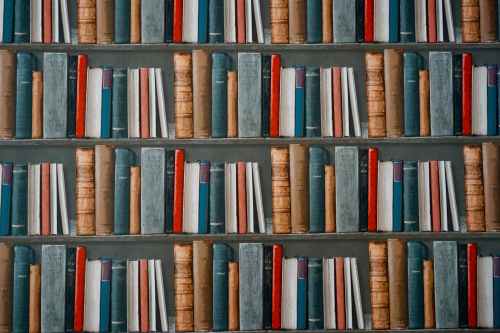
books on bookshelves

Photo by Mikes Photos on Pexels.com

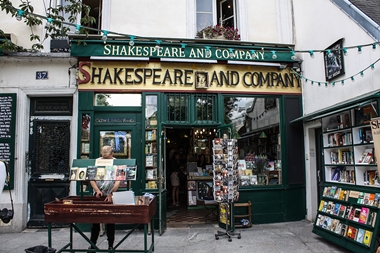
A few years later, I visited some friends of a friend in Paris. They were from the USA. One of them, Duncan, was a dealer in oriental carpets. It was a Sunday, and they served me lunch in their flat, which was on the edge of central Paris. After we had eaten, they invited me to join them for tea in the heart of the city. We headed for one of the quais that faced the Ile de La Cité, and entered a second-hand bookshop called ‘Shakespeare & Co.’ I believe that I had come across this shop before, but this time when we entered it, it was not to purchase books.

Shakespeare & Co. occupied larger premises than the shop in St Andrews and was spread over more floors. Both of the two shops (or maybe the correct term should be ‘establishments’) allowed, or maybe encouraged, young people to take residence amongst the books. Duncan had been one of these when he first arrived in Paris from America. As we climbed the stairs to the top of the building, he told me that we would be attending one of the owner’s famed Sunday tea parties at which anyone who had lived in the shop was always made to feel welcome.

When we reached the crowded apartment at the top of the house, I was introduced to the elderly-looking owner of the shop. Many years later, I discovered that his name was George Whitman. I cannot remember much about him except that a tiny child, who must have been less than 2 years old, was crawling around his feet. Her mother was close by. She was far younger than Mr Whitman and, if I recall correctly, looked as if she was of Far Eastern extraction. I remember being impressed that someone who looked as venerable as Mr Whitman had been capable of producing a child. He was, I have recently discovered, only 68 years old.  Recently, one of my cousins, who was then aged 69, produced a daughter. So, maybe I should not have been so surprised, but in the early 1980s, when I met Mr Whitman, I was less well experienced in the ways of the world! After tea, we left the shop and went our own ways. However, the memory of attending that tea party sticks in my mind.

After M and I had spent nearly two hours exploring the stock in the shop in St Andrews, we heard the owner summoning everyone to the living room. He told us to make ourselves comfortable as he was about to serve tea and cakes. Both M and I staggered into the living room bearing huge piles of books that we had chosen. Tea and cakes were served, and whilst we were enjoying these, we chatted with the book seller. It turned out that he was a graduate of University College London (‘UCL’), where he had studied either English or English Literature, M had studied chemistry, and I had completed my PhD. I do not remember when he was at UCL. He and M did not know anyone in common from the college. I have recently discovered that the present owner of Shakespeare & Co., Sylvia Beach Whitman – that small child who I saw at that Parisian tea party back in the early 1980s – was also an alumnus of UCL, but long after my time there!

When tea was over, we thanked the owner and asked if we could pay for the books we had selected. He added the prices in our books and announced the total. However, before we could pay, he discounted the totals considerably; he would accept no more than the ridiculously low amounts that he mentioned. We loaded the books in the car and set off for our next destination, Aberdeen.

Years later in the early part of this century while I was investigating the ramifications of my mother’s family tree, I discovered that I had many French cousins. I keep in touch with some of them. One of them, who is related to the famous Captain Dreyfus of the Dreyfus Affair, speaks and writes excellent English. On one occasion not too long ago, we met him in Paris outside Shakespeare & Co, where he is well-known. It turns out that he attends a creative writing class organised by the bookshop. It is a small world, as so many people say!


Shaped by nature, not by man

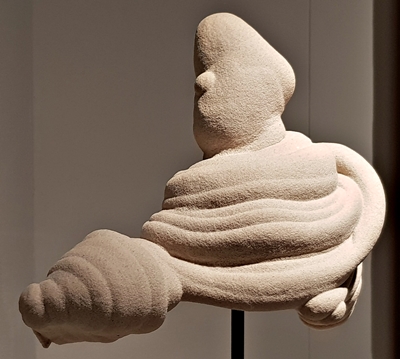
The word GOGOTTE is pronounced ‘go-got’

gogotte 1


Quartz and chalk were fused

millions of years ago

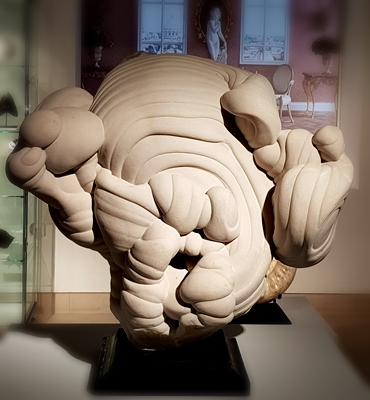
to create  gogottes


gogotte 2


These two gogottes were from Fontainbleu. They were on sale at Christies auction house in London