Do you have middle name(s) and do they embarrass you?

FREQUENTLY PEOPLE HAVE more than one name other than their family name (surname). For example, I am Adam Robert Yamey. My father, an economist, had suggested that I should be called Adam Smith Yamey to commemorate the famous early economist Adam Smith. I would not have minded that, but my mother was not happy with the idea, so I learned much later. More famous examples include the painter John Mallord William Turner and the politicians Winston Leonard Spencer Churchill and Mohandas Karamchand Gandhi. My PhD supervisor at University College London had even more ‘middle’ names. He was Robert Douglas Mignon Innes Kerr Harkness. Often, the middle names are those in memory of ancestors. Such must have the case for Robert Harkness, as well as for Churchill and Gandhi.

Photo source: wikipedia

My mother hated her middle name. It was Bertha. I often wondered why she had been given that name. When I began researching the history of my mother’s family, I discovered why she might have had that name on her birth certificate. Her mother had a cousin called Bertha. The reason my mother disliked this name was that during WW1, the Imperial German Army had a large canon, the 42 centimetre kurze Marinekanone 14 L/12, which was manufactured by the Krupp company in Essen (Germany). What upset my mother was that the artillery piece was commonly known by its nickname ‘Big Bertha’. My mother was born only two years after WW1 ended, and the Big Bertha must have been reasonably well-known when she started going to school. You can imagine how much teasing she got when the other pupils discovered her middle name.

Do you have a middle name (or several middle names) and does it (or they) embarrass you?

Bushy eyebrows running in the family

PEOPLE WHO HAVE met me often remark on my bushy eyebrows. Barbers are always keen to trim them, but I will not let them do that.

Many years ago, sometime in the 1980s if I remember correctly, my father and I were invited to a birthday party to celebrate the 70th birthday of my Dad’s step-brother Frank Walt. It was a large gathering held in a house in London’s St Johns Wood. Apart from my father, there was nobody at the occasion, whom I had met before. While I was wandering about rather aimlessly, a small lady came up to me, and declared in a North American accent:

“You must be a Halperin. You have the Halperin look.”

At that time, I had no idea what she meant by this. Even though I had no clue about what she was talking about, what she said made me feel good – I felt it was special to be recognised as part of a ‘clan’ by someone who did not know me ‘from Adam’, as the saying goes.

I now know about the Halperin family. Put simply, my father’s mother was Leah (née Halperin). She was one of the six children of Joseph and Deborah Halperin. A few days ago (in February 2024), a cousin sent me a photograph of Leah’s brother Wolf Halperin. I looked at it, and immediately realised what my fellow guest at Frank’s party had meant by the ‘Halperin look’. Wearing a Fedora hat, Wolf’s eyebrows immediately reminded me of mine and those of other members of the Yamey family. Seeing this was uncanny.

Wolf Halperin died many years ago, long before I began visiting India. Last November (i.e., 2023), we visited a small shop in Baroda (Gujarat). It was not our first visit. We had been there once about 5 years earlier. The shopkeeper recognised us immediately. As he said (in Gujarati) “I remember you”, he pointed at my eyebrows.

Golden eagle over Grosvenor Square

I LIKE SEEING SCULPTURE in open air locations. For example, I have enjoyed the Yorkshire Sculpture Park, the garden containing works by Henry Moore (near Much Hadham), Barbara Hepworth’s Garden in St Ives (Cornwall), and the annual Frieze sculpture shows in Regents Park. Until the end of August 2023, the Waddington Custot Gallery is exhibiting several large metal sculptures by Bernar Venet (born 1941 in France). Yesterday, the 8th of July 2023, we visited Grosvenor Square where these artworks are on display alfresco. Although they are not the most exciting sculptures I have ever seen, they looked good amongst the trees and lawns of the square.

The west side of Grosvenor Square is occupied by a large building that was until recently (2018) the Embassy of the USA. Constructed in 1960, it was designed by the Finnish architect Eero Saarinen (1910-1961). The structural engineering firm responsible for the edifice was FJ Samuely, which was founded by the Austrian-born Felix James Samuely (1902-1959), who fled to Britain in 1933 to escape the Nazi persecution. When he died, Frank Newby (1926-2001) became the firm’s senior partner. It was he who supervised the structural aspects of the realisation of Saarinen’s project in Grosvenor Square. One of Frank’s colleagues was my uncle Sven Rindl (1921-2007), who joined Samuely in 1954 and later became a director. It was my uncle who played an important role in creating the former embassy’s distinctive appearance when viewed from Grosvenor Square.

Just beneath the top of the centre of the façade of the embassy that faces Grosvenor Square, there is an enormous sculpture of an eagle. Gold coloured, this huge (35 feet wingspan) symbolic creature was created by the Polish-born sculptor Theodore Roszac (1907-1981). What few people know about this very visible open-air sculpture is that it has remained firmly attached to Saarinen’s building for well over 60 years thanks to my uncle Sven. For, it was my uncle who designed the eagle’s tethering to the building.

When we went to Grosvenor Square yesterday, the first thing I did was to see if the eagle was still in place. It was, and as I have just discovered, it is likely to remain there because the building is subject to a statutory conservation order. In contrast, the sculptures by Vernet, part of the Mayfair Sculpture Trail (www.bondstreet.co.uk/articles/art-in-mayfair-sculpture-trail-2023), will be removed by the 29th of August 2023.

PS: Did you know that the Duke of Westminster leased the land on which the Embassy stands to the Americans for one golden peppercorn per year in gratitude for what the USA did to help Britain in WW2?

An interesting intersection

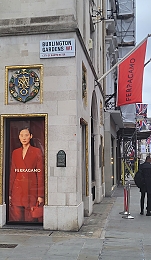
WHERE BURLINGTON GARDENS meets the south end of New Bond Street and the north end of Old Bond Street, there are two things that reminded me of my late mother.

One of them is a shop in a colourfully decorated building. This edifice used to be the home of Atkinson’s – a firm that sold perfumes and beauty products. Founded in 1799, it moved to the building on the corner of Burlington and Old Bond Streets in 1832. The decorative building is surmounted by a carillon of 23 bells, which is played by hand occasionally – to celebrate both public and private special occasions. Currently, the ground-floor is occupied by a branch of Ferragamo’s. And this firm has a connection with memories of my mother.

Salvatore Ferragamo (1898-1960), born in Italy, was a designer of luxury shoes. His clients included the Maharani of Cooch-Behar, Eva Peron, and Marilyn Monroe. He died in Florence (Firenze), where he had a shop on the Via dei Tornabuoni. This shop was close to Via del Giglio, where we as a family used to spend a fortnight in the city every year until I was about 15.

One of my clearest memories of our sojourns in Florence was not the Uffizi or the famous Duomo or the Medici Chapels, or even Michelangelo’s statue of David, but Ferragamo in Via dei Tornabuoni. You might wonder why. It was not that I have a shoe fetish or any great interest in footwear. It was because of my mother. Hardly a day passed without us having to enter Ferragamo’s to watch my mother trying on several pairs of shoes. For a youngster like me this was not an interesting way to spend my precious school holidays. And what is more, I cannot recall my mother ever buying a pair of shoes in that shop.

Facing Ferragamo’s on the corner of New Bond Street and Burlington Gardens, there is a small paved open space. In the middle of it, there is a bronze sculpture of a horse and rider. This was sculpted by Elisabeth Frink (1930-1993). My mother was also a sculptor and met Frink (or ‘Liz Frink’, as we knew her) at St Martins School of Art (in Tottenham Court Road), where they both worked in the Sculpture Department. They became close friends. I used to meet Liz Frink when she was invited to our house for dinner occasionally.

The Frink sculpture has been on Bond Street since 2018. Before that, it was located at the corner of Dover Street and Piccadilly, where it was placed in about 1975. As for the branch of Ferragamo’s that faces it across Burlington Gardens, I am not sure how long it has occupied its present site. However, it was only today that it occurred to me that the intersection of the two Bond Streets with Burlington Gardens has a connection with recollections of my mother.

A leather purse

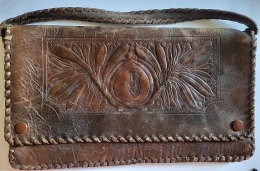
OF MY FOUR GRANDPARENTS, I met only one of them – my father’s mother. The other three died before I was born. My mother’s mother was called Ilse – her parents were born in Prussia and Baden Württemberg before the Unification of Germany in 1870. From what I can recall, my mother told me that her mother was gifted artistically. She painted and made various kinds of objects by hand. One of these came into our possession some years ago. It is a large purse made from leather. With two industrial press-studs, it is held together with stitched leather. The front flap has a leafy design tooled in it. The image has the characteristics of the art-nouveau style that was popular in the late 19th century, and the early part of the following century. In the centre of the design, there is a pair of intertwined initials tooled in the leather. These appear to be “J” and “B”.

When Germans wrote in the late 19th century, they often used what looks to our eyes like the upper-case letter ‘J’ where we would now use the upper-case letter ‘I’. To write the letter ‘J’ (as in jelly), the old German alphabets used a ‘J’ that differed slightly from the ‘J’ used to denote ‘I’. Therefore, the initials on the purse are most likely ‘IB’. Now, IB could either refer to Ilse or to her husband, my grandfather, Iwan B.

Inside the purse, there is some handwriting, which I recognise as my mother’s. It gives her name, Helen B, and the address of the farm her mother bought after having been widowed twice:

“Bantouzelle, Stellenbosch. Phone No. Stellenbosch 2646.”

Beside this, she had written “Poste restante”. I imagine that she had done this because most of the time she was living not in Stellenbosch, but in Cape Town. This would have been before 1948 when she travelled to England to marry my father.

Apart from a few old photographs, this well-made purse is one of the very few material souvenirs of a grandmother whom I never met.

An illustrious ancestor

QUEEN VICTORIA’S SON Prince Alfred (1844-1900) visited India in December 1869. In his honour several schools in India were founded in his name. In the present State of Gujarat, there are at least 3 still in existence. One is in Rajkot, another in Bhavnagar, and one in Bhuj (formerly the capital of the Princely State of Kutch).

Alfred High School in Bhuj

In Bhuj, we have a friend, Pramod Jethi, who is a historian of Kutch. Some of what I am about to relate is based on information kindly provided by him. Much of the rest is gleaned from what my wife’s family have told me.

My wife’s mother’s great grandfather was one Laxmidas Ravji Sapat (aka Sampat), who was born in the mid-19th century, or a bit earlier. Along with Gokaldas Parekh, Laxmidas was one of the first teachers in the Alfred High School in Bhuj (founded by Rao of Cutch, Pragmalji II in 1870). It is likely that he was its headmaster for a time. I have yet to see it, but his portrait hangs in the school. One of my wife’s relatives, also a descendant of Laxmidas, arranged to have it restored a few years ago.

In 1890, Laxmidas left the school. Later, along with his son-in-law, Cullyanji Murarji Thacker, he went to London (UK) to become a barrister. He studied for the Bar at Middle Temple and was called to the Bar on the 27th of June 1900, along with his son-in-law. Mr Thacker, who was my wife’s mother’s grandfather. The two men received financial help for their studies from the Kutch Royal family.
Both men were members of the Bhatia community in Kutch. Back at the end of the 19th and the early 20th it would have been unusual for a man and his son-in-law to travel out of India together to study.

Laxmidas, after leaving the Alfred School, became appointed as police chief of Bhuj, then diwan (Prime Minister) of Jaisalmer, and after that Chief Justice of Jodhpur. Apparently, he was very successful in reducing dacoitry in the Kingdom of Kutch and also Jaisalmer.

Recognising that the dacoits robbed because they were impoverished and starving, he helped make arrangements that reduced these poor peoples’ need to steal. It was this success that attracted other rulers of Princely States to offer him employment.

Regarding Jaisalmer, I discovered this quote:
“On his retirement, one Laxmi Das Raoji Sapat, who had lately served as Police Commissioner in the Kutch State, was appointed as Dewan of Jaisalmer”
This was in 1903.

As for Mr Thacker, he was successful enough to have owned a large house with two separate kitchens (one veg, the other for meat), and to have employed an English governess for my wife’s maternal grandmother, Benabhai, who married the surgeon Haridas Bhatia FRCS (died of septicaemia whilst on duty in 1926).

Incidentally, Benabhai was sent to London to study at the former Bedford College at the same time as her husband was studying for his FRCS. This contrasts with Mahatma Gandhi, who went to study in London, leaving his wife behind in India.

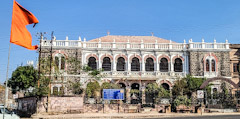
In January 2023, whilst spending a short time in Bhuj, we took a look at the elegant exterior of the city’s Alfred High School, which adjoins the Bhuj Museum. Badly damaged in the earthquake of 2001, the school building has been well restored. A less attractive, newer building was built to enlarge the school. On a future and lengthier visit to Bhuj, we hope to be able to view the portrait of Laxmidas that hangs inside the school.

The artist’s son in her Majesty’s Indian Navy

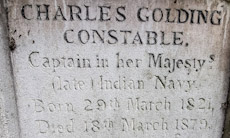
ENCLOSED BY IRON railings, the grave of the artist John Constable (1776-1837) stands at the southern edge of the old part of the churchyard of St John’s Church in Hampstead. The famous painter does not lie alone. He is buried with some other members of his family. One of these people is his second son Charles Golding Constable (1821-1879). I became interested in him when I noticed the words “Captain in her Majesty’s (late) Indian Navy”. The inclusion of the word ‘late’ and its position in the inscription puzzles me.

Charles went to sea as a midshipman in the British East India Company’s navy when he was about 14 years old. According to a genealogical website (www.bomford.net/IrishBomfords/Chapters/Chapter33/chapter33.htm/), he:
“…took to the sea, joined the Indian Marine and eventually became a Captain. Around 1836 he left on his first voyage to China and did not return until after his father’s death so missed his large funeral in London. During the 1850s he gained a place in the reference books for having conducted the first survey of the Persian Gulf. He had to struggle with navigation as a youth so he must have shown considerable determination to be entrusted with this survey. Shortly before his survey the Arab sheikhs bordering the southern end of the Gulf gained their income largely by piracy; this was ended by a treaty or truce arranged by the British, and the Sheikhdoms that signed the truce have been called ever since the Trucial States.” A paragraph in the book “Journey to the East” (published by Daniel Crouch Rare Books Ltd.) related this in some detail:
“Commander Charles Constable, son of the painter John Constable, was attached to the Persian Expeditionary Force, as a surveyor aboard the ship Euphrates. On the conclusion of the war [the First Anglo-Persian War: 1856/57], Constable was ordered to survey the Arabian Gulf, which occupied him from April 1857 to March 1860, with Lieutenant Stiffe as assistant surveyor. The survey (Nos. 2837a and 2837b) which contains the first detailed survey of Abu Dhabi, would become the standard work well into the twentieth century. During the time that Constable was surveying the Gulf, the Suez Canal, one of the greatest civil engineering feats of the nineteenth century was under construction.”
Charles was made a Fellow of the Royal Geographical Society.

While ‘surfing the net’, I found out that sketches made by Charles during his travels have been on sale from time to time in auction houses. His drawings were competent but no match for those executed elsewhere by his famous father.

When John Constable died, his eldest son John Charles Constable became responsible for dealing with his father’s estate. He was then a medical student as well as having studied under the scientist Michael Faraday. According to a website concerning his college in Cambridge (Jesus), John Charles, died suddenly in 1839 after contracting scarlet fever at a lecture in Cambridge’s Addenbrooke’s Hospital, at which a patient suffering this disease was being examined. After his father died, he was left “… numerous paintings and works of art, some of which were known to have adorned his rooms in College.” (www.jesus.cam.ac.uk/articles/archive-month-constable-chapel).
In his will, John Charles left his collection of drawings, paintings, and prints to his younger brother Charles Golding Constable. In 1847/48, Charles was responsible for supervising the dispersal of his father’s studio collection of artworks.

Like the rest of his family, parents and siblings, Charles had lived at several different addresses in Hampstead. Although he was buried with other members of the family in Hampstead, I have not yet found out where he resided at the end of his life.

A station, a friend, a cousin

BEFORE I LEARNED TO drive, I began visiting a friend who lives in the heart of the Cornish countryside, a few miles away from Bodmin. I used to travel by train from London’s Paddington to Bodmin Parkway station, which is a short distance away from the town of Bodmin. My friend, Peter, used to collect me from this small station and drive me to his family’s smallholding deep in the countryside. After passing my driving test in 1982, I began driving to Cornwall. Today, the 10th of October 2022, we dropped off our daughter at Bodmin Parkway station to catch a train to London. This was my first visit to the small station since the early 1980s. It brought back memories of my early visits to see Peter and his family.

Bodmin Parkway station

I met Peter through mutual friends. We clicked. In the years following our first meeting, we saw each other regularly, considering how the great the distance is between our homes. On one visit to Peter’s home, I spotted a photograph of his mother, and remarked that her appearance reminded me of my mother. We thought nothing of this at the time.

In the late 1990s, I began researching the history of my parents’ families. An enquiry to a relative, who lived in Zimbabwe led me to contacting another relative, who worked for New Zealand’s diplomatic service. He got in touch with me and was able to supply information that was missing on one of the family trees connected to my mother’s family. I looked at what he had sent me, and my eyes nearly popped out of my head. For, amongst the people listed in that branch of the family tree were Peter and his children. It turns out that Peter is both my fourth and fifth cousin. The reason for this double relationship is that my mother’s parents were second cousins once removed; they shared a common ancestor. So, it turns out that not only is Peter a good friend but also a cousin. It is interesting that although Peter and I were already good friends, knowing that we are related has enhanced our relationship. Standing on the platform at Bodmin Parkway, waiting for our daughter’s train to arrive, brought back memories of my first encounters with Cornwall, a good friend and his mother’s photograph, and my discovery that he is part of my family.

The place where the artist Tiepolo was born in Venice

GIOVANNI BATTISTA TIEPOLO (1696-1770) is one of my favourite artists. I have been familiar with his works ever since my childhood, when we visited Venice annually from the late 1950s or early 1960s onwards. My parents took me from church to church to see the great master’s paintings, which I prefer to the somewhat more photograph-like paintings of Canaletto.

We used to stay in a pensione on the Fondamente Zattere, a waterfront facing across a wide canal to the Giudecca island. The Gesuati church was a few yards from where we resided in Venice. It contains ceiling panels and a wall painting, all created by Tiepolo. Often, we passed the church and almost always entered it to gaze up at Tiepolo’s ceiling. I cannot remember it, but my sibling recalls that almost every morning, early, my father used to stand quietly and alone in the church for a few minutes.

I became so keen on Tiepolo that I broke my train journey between Ostend and Vienna to spend a night in Würzburg in order to see Tiepolo’s paintings in the city’s Residenz (a palace).

This September (2022), I was walking along a narrow passageway (Calle S Domenico) when I spotted a commemorative plaque above an archway leading into a long narrow courtyard surrounded by tall residential buildings. The plaque recorded that in the courtyard there was the house in which Tiepolo was born on March 1696. Exactly in part the courtyard, the Corte S Domenico, the artist was born, I could not determine. However, I had never seen this place before and was thrilled to have stumbled across the place where one of my favourite artists was born.

My childhood home in north London

I LIVED IN A detached house (see the picture) in north London’s Hampstead Garden Suburb during the first three decades of my life. My bedroom window was that on the first floor facing the street, Hampstead Way. Externally it looks much as it did when I lived there. This is not surprising because the houses in the Suburb are all subject to strict preservation orders,which forbid alterations of the appearances of the exteriors of the Suburb’s buildings.

Although I was privileged to have lived in this part of London, it was never my favourite area of the city because during my youth, it was a dull place to be a child or even an adolescent.

By the way, although the name ‘Hampstead ‘ is part of the suburb’s name, the area is completely different from Hampstead proper: it lacks the vibrancy and vitality of old Hampstead village (or town, if you prefer). As a youngster, and still today, I have always enjoyed my visits to Hampstead Village