British and Chinese

I BET YOU DID NOT KNOW that Michael Alphonsus Shen Fuzong (c1658-1691) was the first documented person from China to visit England. I did not know that he met King James II in 1687. Furthermore, did you know that the Chinese sculptor Tan-Che-Qua (c1728-1796) from Canton, who visited London between 1769 and 1772, not only exhibited at London’s Royal Academy but also met King George III before returning to his native land. Maybe, I might have stumbled across these two notable men from China by accident had I not visited the British Library today (the 20th of March 2023), but this is highly unlikely. Until the 23rd of April 2023, there is a fascinating, well-displayed exhibition called “Chinese and British” at London’s British Library.
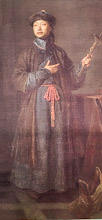
Beginning with the earliest Chinese visitors to Britain, this splendid exhibition charts the growth and considerable achievements of Chinese people who chose to live in Britain. John Hochee (1789-1869) was one of the first people from China to have settled permanently in England. He arrived from Canton in 1819, worked as a property manager with John Fuller Elphinstone (1778-1854; son of William Elphinstone a Director of the EIC: see https://www.rh7.org/factshts/hochee.pdf), whom he probably met whilst working for the East India Company in China. Hochee married an English lady, Charlotte Mole, and James (1832-1897), one of their seven children, became a surgeon. John was naturalized in Brighton in November 1854.

Since Hochee (Ho Chee) settled in Britain, many more people from China have followed in his footsteps. The exhibition at the British Library illustrates this well. Early settlers included many who had worked on ships and had landed in Liverpool or London. Chinese communities became established in the 1880s, notably in London’s East End. The Chinese in Britain established businesses to serve their community and their British neighbours. Chinese restaurants and laundries figured largely amongst the early enterprises. With the advent of laundrettes in the 1950s and 1960s, the Chinese laundry business faded away, but still today the Chinese are very important in Britain’s catering industry. It was after WW2 that restaurants and take-aways really took off in Britain. These outlets supplied both British and Chinese food. Many of their workers and owners were from Canton and Hong Kong.

During WW1, nearly 100,000 Chinese men provided support for The British Army in Europe – digging trenches, burying the dead, and other tasks. Some of these men had signed 3-year contracts, which obliged them to return to China after the war, which most of them did. The exhibition devotes some space to the activities of these men.

Apart from what I have already described, the exhibition has displays illustrating the many other achievements of the Chinese British. One exhibit that particularly amused me was a selection of books in English by Chinese British authors. They were displayed on a ‘lazy Susan’, a revolving serving platform often found in the centre of round tables in Chinese restaurants.

All in all, I am very pleased that a post on Instagram alerted me to this interesting exhibition, and I encourage everyone to visit it.
An artist from Accra

ONE OF THE MANY JOYS of living in London is the ability to view exhibitions in the city’s commercial galleries, many of which can be found in Mayfair and the West End. These galleries display artworks, which are mainly for sale, or occasionally borrowed from places away from London. The exhibitions are of a temporary nature. Visiting them allows members of the public to view works, which might never be on public view again in London because they will be sold to private collectors, big corporations, or to galleries and museums abroad. When we are in London, my wife and I try to visit several of the commercial galleries at least once a week. At the recommendation of our daughter, whose employment is in the world of art, we paid a visit to Pace Gallery in Hanover Square to see an exhibition that will continue until the 15th of April 2023.

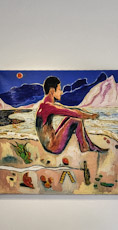
The artist, whose works are being displayed in the spacious modern rooms at Pace, is Gideon Appah. He was born in 1987 in Accra, Ghana. His training as an artist was at the Kwame Nkrumah University of Science and Technology in Ghana. His first major exhibition was in 2022 at the Institute of Contemporary Art at Virginia Commonwealth University in Richmond, Virginia (USA). His paintings have also been exhibited in many other places.

All of Appah’s works on show at Pace are oil and acrylic on canvas. They are all highly colourful and include, with one exception, figures in a variety of landscapes. The figures are positioned in landscapes that have an intensity that makes them look slightly unreal, yet completely compelling. One of the pictures we particularly liked is “Night Vision” which depicts a brightly lit town on a hill at night reflected on a sea of still water. The leaflet issued by the gallery describes Appah’s work as “dreamlike”, and this was also my opinion. On the whole, the dreamy nature of the works is quite distinct from that seen in the works of the great Surrealists of yesteryear. Appah portrays his scenes with the clarity and strangeness that I associate with the dreams I experience. His works are intriguingly eery, but not scary. If you can get to Pace, do so to enjoy the well-executed and fascinating works by this artist from Accra.

Kumihimo in Kensington

THE JAPAN HOUSE in London’s High Street Kensington first opened in 2018, and its aim is to increase people’s awareness and knowledge of Japan, the Japanese, and their culture. Until the 11th of June 2023, the Japan House is host to a superbly laid-out exhibition of Kumihimo – Japanese silk braiding. The braiding is a complex form of plaiting, using dyed silk threads. When, for example, hair is plaited or braided, three or more strands of hair are intertwined to form a plait. Practitioners of Kumihimo plait great numbers of often different coloured threads to create braids with beautiful repeating patterns. The most expert craftsmen and craftswomen can braid patterns using up to 140 different threads.

The exhibition shows how the threads are dyed, then spun into bobbins before finally being woven into braids. The braider uses a stand that holds the reels of thread. The threads are then plaited over each other in a repeating sequence to produce a patterned braid. Great concentration is required to maintain the sequence without making errors. A weight is hung onto the braid to hold it straight and taut whilst it is being created. In addition to examples of the various types of braiding stands, there are well-made videos illustrating braiders at work. There are many examples of finished products, including belts, fashion items, armour plating, and modern artworks. All of them are intricately patterned and incredibly beautiful.

The exhibition was set up by a Tokyo-based company, Domyo, which has been producing braided silk cords since 1652 AD. Kumihimo was a technique imported into Japan between 538 and 794 AD from the Asian mainland, and then refined and developed in Japan

When I learned that I was to visit an exhibition of braiding, I was not filled with enthusiasm. However, as soon as I entered the basement exhibition area, I realised that I was about to see a fine and most interesting display. Not only is there great beauty in the exquisitely detailed braiding, but this was also the case for the way the exhibits have been arranged. To summarise, see this exhibition if you can!

Lucie Rie, a potter in Cambridge

ONE OF MY UNCLES commissioned a ceramic work by the celebrated potter Lucie Rie (née Gomperz; 1902-1995). This used to be on display in my aunt and uncle’s house, which I used to visit often. Thus, I became familiar with the name Lucy Rie.

Lucie was born in Vienna (Austria), where she attended an avant-garde school of arts and crafts from 1922. After graduating, she set up her own studio in Vienna. Bring Jewish, she left Vienna in the late 1930s, and settled in London.

Encouraged by Bernard Leach, she established a studio in London. For a while she worked with the potter Hans Coper, but the artistic styles of the two artists differed considerably. Over the years, Lucie created objects in a variety of styles. She experimented with glazes and other techniques, creating pottery which was truly 20th century. Unlike Leach, whose works reference ancient Chinese and Japanese ceramics and mediaeval English, Lucie was innovative and inventive.

Until the 25th of June 2023, you can see a good exhibition of Lucie’s works, from her earliest to her later creations, at Kettles Yard in Cambridge. Undoubtedly, her works are of a high quality, both artistically and technically, but I was not particularly excited by the show. A video of David Attenborough interviewing Lucie in her studio interested me far more than her works on display.

By all means visit the exhibition, but in my opinion this is a show for Lucie Rie enthusiasts, rather than for the average exhibition goer.

Art behind bars

FORT KOCHI IN Kerala was occupied by three European powers: first by Portugal, then ny the Netherlands, and then by the British until 1947. It was whilst the British were in charge that a small jail was built on what is now Tower Road. Next to a police station and close to a string of roadside seafood restaurants, there is a gate that leads into the Jail of the Freedom Struggle. This prison was built by the British at a forgotten date during the 19th century. One clue to its age is that some of its roof tiles can be dated to 1865. The prison has a row of eight cells, each equipped with a 6 foot long concrete bed.

The prison, which might have been used as a transit establishment for prisoners waiting to be taken elsewhere, is said to have held leading freedom fighters such as Mohammed Rehman, Accamma Cherian, and K J Herschel,  A K Gopalan, E M S Namboothiripad, and Abdurahiman Sahib. However, this is not known for certain. The prison, which had become disused and dilapidated, was restored in 2009, and opened as a museum.

In February 2023, we visited Fort Kochi to explore the 2022 Kochi Muziris Art Biennale. Unconnected with this major event, we visited an exhibition of artworks being displayed in the former prison. This included both paintings and sculptures. What made it an usual exhibition is that the exhibits are all contained within the cells behind strong iron doors with vertical bars. The doors that once prevented the prisoners from leaving the cells now prevent visitors from entering them.

Women in art

SURVEYING THE REPRESENTATION of women by artists in a single exhibition might seem a daunting task, if not impossible. Yet, this is what the exhibition “Visible/Invisible” achieves successfully. Curated by Kamini Sawhney, Arnika Ahldag, Vaishnavi Kambadur, Riya Kumar and Arshad Hakim, this magnificent display of artworks can be viewed at the recently opened (in late February 2023) Museum of Art and Photography (‘MAP’) on Kasturba Road in Bangalore (Bengaluru). The exhibition, which is displayed in most of the rooms on one floor of MAP confines itself to works created by artists, both male and female, from the Indian subcontinent and its diaspora. However, this did not hinder the curators’ aim of demonstrating the female in art over the centuries.

The 130 artworks on show range in date of creation from the 10th century AD to the present. MAP’s website reveals that the various artworks:
“… are interwoven into four key sections based on narratives and counter-narratives: Goddess and Mortal, Sexuality and Desire, Power and Violence, and Struggle and Resistance. Each section presents how women’s lives have been portrayed, the spaces that they occupy and challenges that women have faced in the Indian subcontinent. The themes and ideas explored in Visible/Invisible hopes to encourage audience awareness of the history and role of women and gender in art.”
And the exhibition successfully raised my awareness of the multiple ways in which the lives of women have been portrayed by artists of both genders over the centuries,

The artworks include sculptures, paintings, photographs, film posters, textiles (some created by female artists and others woven in traditional patterns by craftswomen), and prints. Almost every exhibit was a joy to behold, What was particularly interesting were examples of artworks created within the last few decades that demonstrate how Indian women artist have taken control of the way they portray women and their lives, What the viewer sees is how women see themselves, which is a contrast to what has happened in earlier times when women have often been shown in the way that men have viewed their lives.

All in all, this exciting exhibition is compelling both visually and conceptually. The curators have expressed their ideas beautifully and powerfully, but not without considerable subtlety.

Six-pointed stars in Kochi (Kerala)

SIX-POINTED STARS IN KOCHI

MY FIRST VISIT TO Fort Kochi (Fort Cochin) in Kerala was in 1994. By then, I already knew that there was one or more Jewish communitis in Fort Kochi (‘Kochi’). As we drove into Kochi, I noticed many six-pointed stars, all identical to Jewish Stars of David (‘Magen David’). For a while I was amazed by the sight of so many of what I believed then to be Jewish shops and other establishments. Not long after this, I became aware that like the Om and the swastika, the six pointed star is a commonly used Hindu symbol. For example, the Canara Bank, not a Jewish outfit, uses the six pointed star as its logo.

Several communities of Jewish people lived in Jew Town, which is in the district of Mattancherry. Today, flocks of tourists visit the area to explore its numerous handicraft shops and the beautifully preserved Dutch (Paradesi) Synagogue, whose floor is paved with blue and white tiles made many centuries ago in Holland.

Apart from the much-visited synagogue, there are very few other buildings that have recognisable marks that indicate their former Jewish connections. On previous visits, I spotted what must have been another synagogue; a house bearing Magen Davids; and a locked up, well maintained Jewish cemetery.

Today, the 10th of February 2023, I spotted a building with Hebrew lettering above its main door. This edifice, which is undergoing restoration, is close to the Masjid Aisha on Jew Street, and about 0.5 miles south of the Dutch Synagogue. In need of much work, this is what remains of the Kadavumbhagam Mattancherry Synagogue (constructed by 1544 AD).

Kadavumbhagam Synagogue under restoration

Another building with well-documented Jewish connections, but no obvious marks, is currently being used to house exhibitions contemporary with the 2022/23 Kochi Muziris Art Biennale. Called the Kashi Hallegua House, this grand dwelling is about 150 yards south of the Dutch Synagogue. Above its carved wooden framed front door is the date 1761. This was during the period that the Dutch were the dominant European presence in the area: they were intimately connected with Kochi between 1663 and 1814.

For over 250 years, the Dutch house, formerly known as Krathi Veedu, was home to many generations of the Hallegua family. From where they originated, I have not yet found out but they were Paradesi – European Jews who arrived in Kerala from abroad, as opposed to Jewish people whose origins were other than European (no one knows from where they arrived in Kerala).

The last Jewish residents of the house, 85 year old Mrs Juliet Hallegua and her daughter Yael, left for Israel in 2019. The place was then purchased by Edgar Pinto, who converted the huge family home into an art gallery. Although the furnishings used by the Hallegua family have been removed, many of the original wooden window frames and cupboard doors are in place. The kitchen, now a gallery space, has a huge oven and a special carved stone workspace used for grinding food ingredients with a stone rolling pin.

The two Hallegua women were amongst the last of the Kochi Jews living in the town. There was another, Sarah Cohen (1922-2019) who lived very close to the Dutch Synagogue. Until she was in her nineties, she had a shop selling tablecloths and other handmade cloth items, many of them with Jewish decoration. Today, the only Jews in Kochi’s Jew Town are visiting Jewish tourists, a few of whom might have had ancestors who lived there.

Since our last visit in 2019, a couple of shops have opened. Named Shalom, their signboards bear the Jewish six pointed star. The company sells ready-made garments, but I suspect that apart from the name, it has no Jewish connections … but I might be wrong!

A statue and an art biennale

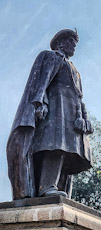
SUBHASH CHANDRA BOSE Park, formerly named Irwin Park, runs parallel to the seashore at Ernakulam in Kerala. At the south end of this pleasant open space, there is a tall statue depicting Sri Sir Rama Varma GCIE, LLD, Maharaja of Cochin (c1861-1941). He reigned between 1932 and 1941. The statue was unveiled in January 1939 by the then Viceroy of India, Lord Linlithgow during a visit to the city. He was Viceroy from 1936 to 1943.

Rama Varma

While visiting Ernakulam that day, the Maharajah arranged for him to watch a display of Bharatnathyam dancing (https://www.cochinroyalhistory.org/). This was held before tea in the grounds of the Maharaja‘s nearby Durbar Hall. The statue was unveiled after tea.

The Durbar Hall was constructed over 100 years ago in extensive grounds owned by the Maharajahs of Cochin. For many years, it has been used as an art gallery. Beautifully restored by the organisation that runs the Kochi Muziris art biennale, it serves as one of the art festival’s venues during the 4 months that the Biennale runs. The current 2022/23 event in the Durbar Hall is a show called “Idam” which contains a variety of visual art exhibits, all of which have been created by 34 Malayali artists. Overall, it is an enjoyable exhibition by artists displaying an exciting variety of interesting imaginative ideas, all expressed in well executed artworks.

The works in the Durbar Hall are in stark contrast to the Maharaja‘s statue that stands in the hot sun not too far away. Unlike the Maharajah, who was probably unwilling to break out of his comfortable colonial mould, the artists are showing that they are willing to attempt to escape from prevailing convention

William Kentridge at the Royal Academy of Art in London

THE ARTIST WILLIAM Kentridge (born 1955), son of a prominent lawyer, is a South African. His creations are usually highly imaginative and often politically challenging and critical of the subjugation of non-European African people. This is fascinating given his privileged background – having been brought up in a South Africa where the ‘white’ people were a highly advantaged section of the population until the ending of the apartheid regime (and maybe even now to some extent).

His artworks are frequently dramatic, often employing cinematographic and sometimes theatrical techniques. The messages they convey to the viewers can be both disturbing and humorous, sometimes both simultaneously. Whenever I have seen them, I have been both fascinated visually as well as moved emotionally.

The Royal Academy of Art in London’s Piccadilly has a large retrospective exhibition of Kentridge’s work until the 11th of December 2022. Apart from numerous drawings, tapestries, and other static artworks, there are plenty of his cinematographic installations on display. In fact, there are too many of these installations. Each one is amazing to see, but having so many together in one place spoiled their intended impact. Just as the first chocolate from a box is wonderful, eating all of them at once gives one indigestion, and this was the case with the Royal Academy’s crowded assemblage of Kentridge’s works. Too much was crammed together in insufficient space. To be fully enjoyed, each of his installations should be seen on their own in a sufficiently spacious environment – they need ample room to breathe and express themselves.This overcrowding was a pity because the exhibition does not allow his works to shine in their full glory.

DEFACED TO DEFY: an exciting exhibition in Cambridge

POLITICAL PROTEST AND CONFLICT can be expressed in a wide variety of ways. Defacement of commonplace items is one of these. It forms the basis of a temporary exhibition, “Defaced!”, being held at the Fitzwilliam Museum in Cambridge (Cambridgeshire) until the 8th of January 2023.

Many of the exhibits on display are banknotes that have been defaced or altered in design to express a political message or protest.  One example of this is a five-dollar US banknote with the words “All Lives Can’t Matter until Black Lives Matter” embossed on its portrait of Abraham Lincoln. Another is a five hundred Indian rupee note with a coloured picture of an endangered rare bird printed over it. Yet another banknote is designed to look like a British £20 note at first sight, but it soon becomes apparent that it is not what it seems: it has been modified to include a portrait of ex-Prime Minister Boris Johnson and the words “The ruling class. We own you.” It also includes the words “We were born to lead, you were born to follow.” Other banknotes have been redesigned so that they appear to be valueless: e.g. zero Japanese Yen and zero US Dollars. The diversity of altered banknotes and parodies of actual banknotes on display is staggering.

Occasionally banknotes lose their value during periods of hyperinflation. The exhibition includes several examples of objects, such as wallets, made using trashed valueless notes. Particularly striking is a life-size sculpture of a hand grenade made using shredded PRC ten Yuan banknotes.

There are also many coins on show. They have all been altered to express protest and/or political sentiments. One dramatic example of this is a coin issued in France during the reign of Napoleon III. This was altered by carefully cutting around and removing the portrait of Napoleon III from the coin, leaving the rest of the coin intact. There are several coins and medals on display that depict political events such as the American Revolution and the Peterloo Massacre. A few coins relate to the unrest in Northern Ireland. One of them is a 1970 Republic of Ireland fifty pence coin with the words “Ulster is British” stamped on it.

The show at the Fitzwilliam does not confine itself to the defacement and parody of currency for political and protest purposes. It also includes currency either modified or specially created for special purposes. Simple examples of these are overprinting of low value notes during hyperinflation and modification of currency for use by the military or in POW camps. There are also coins, notes, and certificates created for specific purposes, for example for use in the Siege of Mafeking and for use by Boer prisoners imprisoned by the British in India.

Although most of the exhibits are related to currency (coins and notes), one room is dedicated to a spectacular sculptural exhibit, an installation called “Big Bang 2. Debt in transit”. A video is projected onto a wall. It shows a Ford Transit van being blown up by explosives. As it flies into pieces, bits of paper all marked with the word ‘debt’ float down like snowflakes. The film is projected in a room in which the fragments of the van are suspended from the ceiling so that the viewer appears to be seeing a still from the video but in three dimensions. The installation, which is a protest on the exorbitant interest on payday loans, makes a very powerful visual impact. (SEE my video of this posted on YouTube: https://youtu.be/7MgdDTfBivw)