Beverages beneath the banyans

ONCE A CITY FILLED with lovely gardens and other verdant open spaces, Bangalore (Bengaluru) is growing alarmingly rapidly. So, public spaces that have been as yet saved from being built on are valuable amenities. One of these areas of greenery is the so-called Tivoli Garden, which is in the grounds of Airlines Hotel in the heart of the city.
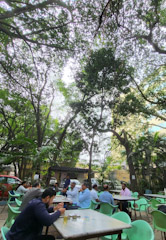
Known popularly as ‘Airlines’, the Tivoli Garden, a name by which it is hardly known, has tables and chairs set out in an open space, a clearing, surrounded by trees, several of them being elderly banyans.

Opened in 1969, the open air café and eatery is still supervised by a man who helped set it up two weeks before it opened all those years ago. Despite its rather untrendy appearance, Airlines is popular with Bangaloreans of all ages. Quite a few of them are students, but many are office workers. Very good South Indian filter coffee is served at Airlines. A wide range of South Indian vegetarian dishes is also served.

The coffee, other drinks, and food are prepared in the kitchen of the hotel. Waiters in white uniforms carry drinks and food across the car park from the kitchen, which is located at the far end of a dingy dining hall, to the garden seating area. Some customers prefer to have their orders served to them whilst sitting in their parked cars.

For my wife and me, Airlines has several attractions. One is the coffee. Another is the pleasant ambience under the trees. And yet another is nostalgia. My wife used to visit Airlines with her family in her late teens. And together with our daughter, my wife and I have been regular visitors to Airlines since when we married in 1994.

For several years, Airlines has been under threat of closure by the people who own the land. Over a decade ago, these people reclaimed half of the area occupied by the café. They built an ugly grey wall (rather like a Berlin Wall) to separate what is left of Airlines from what has now been built on. The supervisor, whom we have known for ages, assured us that as far as he knows the remaining part of the establishment will remain safe from redevelopment.

It would be tragic if Airlines were to disappear, not only because we love it but also it would be yet another example of how what was once a lovely garden city is becoming more and more of an urban jungle
A Turkish delight in London’s Dalston

KINGSLAND ROAD AND nearby in London’s Dalston area is rich in restaurants and other eateries serving Turkish food. Early in this century, “Time Out” magazine rated the Mangal Ocakbasi (now called ‘Mangal 1’) restaurant at number 10 Arcola Street as being one of London’s best Turkish restaurants. For those who do not know, ‘ocakbasi’ means ‘fireside’ and ‘mangal’ means ‘barbecue’ or ‘grill’. When we first went to Mangal, and for many years after that, there were tables alongside the long rectangular pit filled hot charcoal, upon which meat and vegetables are grilled. Recently, the restaurant has been redesigned and the grilling area is no longer alongside the tables.

Lokma

The meat served is top quality. It seems far better than that served in the many other Turkish restaurants we have tried in London. Although there is a wide variety of main courses on offer, the range of ‘starter’ dishes on the menu is not as great as at some other restaurants. If it is starters and meze that you are after, the nearby Umut 2000 (on Crossway) is worth visiting. However, their main meat dishes are not nearly as tasty as those at Mangal in Arcola Street. Having said that, Mangal does serve an excellent freshly grilled aubergine hors d’oeuvre. Desserts are not available, but there are plenty of places along Kingsland Road offering a wide range of very sweet but tasty confectionery.

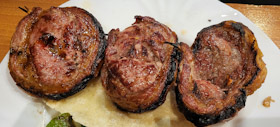
Our favourite dishes at Mangal are lokma, which is grilled rolled fillet of lamb, and yorgutlu Adana, which is pieces of semi-spicy Adana kebab in a yogurt and tomato sauce with lumps of Turkish bread. The lokma and other kebab dishes are served with generous quantities of fresh mixed salad containing many ingredients. As for drinks, you can bring your own alcohol or buy it from the restaurant. If I order a drink apart from water, I always go for Şalgam, which is a purple-coloured drink containing fermented turnip. This has a deliciously sour taste.

We first ate at Mangal in the early 2000s, when we attended a play in which one of my dental patients was acting. The theatre, The Arcola, was across the road from the restaurant, but has now shifted to larger premises on nearby Ashwin Street (close to Dalston Junction station). We loved the food at Mangal from the very first bite. We have been eating there occasionally ever since then, and the quality of the food has never once faltered. We have been there so often that the older members of its staff recognise us, welcome us warmly, and remember what we like eating. Even though this Turkish delight, frequently patronised by the artists Gilbert and George, is far from where we live in Kensington, it is well worth ‘trekking’ across London to get there.

Eating there again at least 50 years later in Venice

EARLY IN SEPTEMBER (2022), I was eating spaghetti alle vongole (spaghetti with clams) in a restaurant in Venice (Italy). The place where I was eating this delicious dish has many memories for me.

Lantern hanging outside the entrance to the Antica Locanda Montin

During the late 1950s and throughout the 1960s, my parents took my sister and me for annual holidays in Venice. My parents were discerning eaters. Unfortunately, back in those now far-off times, there were very few restaurants in Venice which served food that met my parents’ approval.  Eventually, they homed in on one place that they liked enough to return there for every evening meal (our accommodation provided lunch as part of our demi-pension deal). That restaurant is called the Antica Locanda Montin (‘the Montin’). According to its website, it has hosted celebrities including Modigliani, Ezra Pound, Robert de Niro, Luigi Nono, and David Bowie. Well, I did not know that when I used to dine there with my family.

During our recent trip to Venice, we found out that the Montin is still in business, and we booked a table for lunch. To my delight and amazement, the restaurant looks exactly as it did when I last visited it over 50 years ago. It does not seem to have changed one little bit. The front of the Montin faces a small canal. The dining room is long and rectangular. At the far end opposite the front door, a rear door gives access to a pleasant garden, where people can eat in good weather. The walls of the dining room are covered with framed paintings, many of them of great artistic quality. Apparently, they have been donated over the years by artists, who have dined in the restaurant.

I cannot remember what I used to eat at the Montin over 50 years ago. However, my spaghetti alle vongole was tasty and enjoyable. My wife and our daughter were also happy with what they ate. Our lunch was one of the better meals we ate during our four days in Venice. What I enjoyed even more than the food was discovering that the Montin looks as it did when I was much younger. I am glad that the place has survived the trying times we have been through recently and Italy’s various economic crises.

Eating well in a town in Essex

PARADISE IS A café in Great Dunmow, a small town in Essex. With several small eating areas and a cool breeze blowing through it, this comfortable eatery was a good place to eat lunch on a day when the air temperature was 32 degrees Celsius. Judging by its menu, which includes gözleme and shish kebabs, and the fact that the staff were speaking Turkish, it would be correct to say that Paradise is a Turkish run establishment.

Having noted that, it would be fair to say that this place is a well above average “greasy spoon caff”. However, the food is not at all greasy. In addition to food items usually associated with Turkey, Paradise offers the full range of English breakfast items, as well as wraps, burgers, sandwiches, and chicken curry.

One impressive feature of Great Dunmow’s Paradise, apart from the attentive and efficient staff and tasty food, was flexibility: we were able to order exactly what we wanted even if it was not on the menu.

It is always fun to discover reasonably priced, unpretentious places like Paradise. We will return there next time we are in the area.

Breakfast at Shellys in Cheshire

“BREAKFAST LIKE A KING; lunch like a prince; dinner like a pauper”. This popular saying emphasizes the importance of breakfast amongst the meals partaken during the 24 hours of a day. We spent three nights in Widnes (Cheshire) in July (2022), and wanted to enjoy a decent breakfast. A search of Google revealed that the best-rated place for breakfast was Shelly’s Café located close to Harrison Street, a small road leading off the larger Hale Road.

Shelleys café

There is a sign (for Shellys) with an arrow at the corner of Harrison Street and an unnamed short road with a badly damaged surface. This side road, which is lined on one side by dust-covered parked vehicles, some with flat tyres, leads to a pair of large metal gates, which were closed when we arrived. A key-pad next to the gates allows one to ring Shelley’s. When answered, the gates open slowly. We drove through them into a secure industrial area. This contains several buildings, some of which are warehouses and others factories (including several ice-cream manufacturers). In between the buildings, there are numerous parked cars, vans, and caravans. Most of them are old models covered with a thick layer of dust. We learned that some of them have been standing unused for a year or longer.

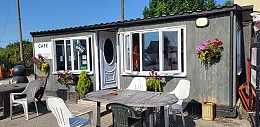
Shellys Café is housed in a single-storey wooden shack, adorned with pots of flowers, next to the electrically operated entrance gates. It has large windows and there were chairs and tables outside. The interior is simply decorated with a few wall plaques relating to the joys of riding motorcycles. Two large blackboards list what is on offer. One corner of the building is occupied by a spacious kitchen where Shelley and her husband prepare customers’ orders.  On each of the three mornings we ate at Shellys, we sat beneath a photograph of Marilyn Monroe.  The café had other framed photographs of film stars.

Everything we ordered was delicious. The fried items (including eggs, bacon, black pudding, mushrooms, sausages, hash browns, and tomatoes) were tasty and totally free of grease. What is on offer at Shellys is basic and unpretentious, but well-prepared. Given that this place is rated the best for breakfast in the Widnes area, it is remarkably good value. Were it nearer our home in London, I am sure that we would drive out to eat there, despite the industrial nature of its location.

The writing on the wall

ALL THAT REMAINS now are the French words ‘moules’, ‘huitres’, and ‘langouste’ (mussels, oysters, crayfish). They are written in large white capital letters attached to a brick wall overlooking Leicester Place, which is a short street running between London’s Leicester Square and Lisle Street.

I am glad these words have not been removed,not only because I enjoy consuming shellfish and crustaceans but also because they provide a reminder of an establishment that thrived between the 1950s and 2006, when it closed for ever: Manzi’s restaurant.

Run by an Italian family, the eatery was famous for its seafood. Although I only ate there a few times, it was always an enjoyable experience.

Another restaurant, which has also closed, was on Lisle Street near Manzi’s. It was a Chinese restaurant called Mr Kong. Like Manzi’s, it had seafood on its menu. Their mussels in black bean sauce were superb. Kong’s also had a vegetarian menu – Chinese vegetarian dishes. I am not a lover of veg dishes, but the vegetarian offerings they rustled up at Kong’s were outstandingly tasty.

Usually, I often remember Mr Kong when I visit Chinatown around Gerrard Street, but it was only when I noticed the French words on the wall that memories of Manzi’s came flooding back.

Eating afer 9 pm in a village in Essex

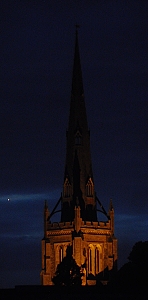
WHILE ELTON JOHN was performing in front of thousands in London’s Hyde Park in late June 2022,  a small ensemble was performing works by the baroque composers Pergolesi and Purcell in the large medieval gothic church in Thaxted (Essex). The superbly performed concert in Thaxted starring the Armonico Consort ended well after 9 pm.  This was not a problem for the many well-healed members of the audience in the church, who lived locally and were able to feed themselves in their own homes.

Thaxted, Essex

We could have eaten before the concert, which commenced at 7 pm, but were not hungry before that early hour. The pubs in Thaxted informed us that their kitchens stopped  taking orders for food before 845 or 9 pm.

At a pub called the Star, someone hearing us asking about food after 9 pm, recommended we should head for Farouk’s. The bar attendant and several bystander’s agreed with our informant. The bar attendant kindly said that we could bring food from Farouk  and she would save a table for us at which we could sit and eat after the concert.

Farouk is the owner of a caravan parked in a yard behind a petrol filling station in Thaxted. He and his colleagues,  all from Turkey,  prepare and sell Turkish food in the caravan. And, his eatery closes not at 845 or 9 pm, but at 11 pm.

After hearing superb renderings of Pergolesi’s “Stabat Mater” and Purcell’s “Dido and Aeneas” (semi-staged), we headed for Farouk’s caravan and the Star pub.

While waiting for our food to be prepared at about 9.40 pm, Farouk explained he had come from Gaziantep. He said that in his part of Turkey, which is quite close to Cyprus, Turkish is spoken with an accent that is very similar to that spoken by Cypriot Turks. During the ten minutes it took to prepare our food, Farouk took many food orders over the phone, which goes to show that in Thaxted there is a healthy demand for food after 9 pm.

We enjoyed our food at the table reserved for us at the Star. This welcoming pub is popular with locals. I suspect that its lively clientele was a different segment of Thaxted’s population from that which attended the concert in the church.

Up and down Molesworth Street

YOU CAN BYPASS the small town of Wadebridge in Cornwall by speeding along the A39 road, which extends from Bath in Somerset to Falmouth in Cornwall, but that would be a pity because it is a charming town. Wadebridge thrives because of its fine bridge across the River Camel. The great writer Daniel Defoe (c1660-1731) wrote about the town and nearby Padstow in his “A Tour Through the Whole Island of Great Britain”, published 1724-26, as follows:

“Padstow is a large town, and stands on a very good harbour for such shipping as use that coast, that is to say, for the Irish trade. The harbour is the mouth of the river Camel or Camal, which rising at Camelford, runs down by Bodmyn to Wodbridge or Wardbridge [sic], a large stone bridge of eight arches, or thereabouts, built by the general goodwill of the country gentlemen; the passage of the river there, before, being very dangerous, and having been the loss of some lives, as well as goods…”

Defoe noted that the passage from Wadebridge to Ireland via Padstow could be achieved in 24 hours. Thus, Wadebridge and its river crossing, now much widened since Defoe’s time, was an important stage for vehicles carrying passengers and goods between England and Ireland. The route for this transport would have been to first cross over the Camel on the bridge and then to proceed north westwards up the slope of Wadebridge’s then main thoroughfare, Molesworth Street. During daylight hours, most of this road is closed to motorised vehicles and provides a pleasant pedestrian precinct.

Molesworth Street is lined with shops, eateries, and some pubs. The Molesworth Arms, a former coaching inn, has existed since the 16th century. It was previously known by other names including The Fox, The King’s Arms and The Fountain. It got its present name in 1817. Nearer the bridge, there is The Swan Hotel near the old bridge, originally named ‘The Commercial’, is much newer than the Molesworth Arms. It was constructed the late 19th century.

I cannot explain why, but spending time on Molesworth Street always satisfies me. The recently opened (late 2021) Dollies café provides good coffee and exceptionally wonderful English breakfast items; everything is prepared freshly after ordering. Up the hill, stands Churchill Bars. Housed in the premises of the still functioning Wadebridge Conservative Club, it comprises a bar and a small restaurant named Winston’s. Popular with locals, this eatery serves generous helpings of lovingly prepared, tasty food. Its speciality, which is well worth trying, is roast belly pork served with roast potatoes, gravy, and vegetables (not overcooked). Unlike so many other places serving food in Cornwall, this place is good value and not pretentious.

Apart from several charity shops, a good newsagent, two butcher’s shops, a hardware store, banks, and so on, there is a small bookshop on Molesworth Street. This independent bookstore stocks a superb range of Cornwall-related books, both fiction and non-fiction. In a backroom, there is a large selection of second-hand books. Small booksellers such as this one on Molesworth Street make a welcome change from the countrywide bookshops such as Daunt’s, Waterstone’s, and WH Smiith’s.

Not as ‘trendy. as places such as Fowey, Falmouth, St Ives, and Padstow, Wadebridge seems a more ‘normal’ or ‘real’ kind of place, not wholly dependent on tourism. It is well placed to make excursions to places all over the county of Cornwall.

Breakfast with Samuel Pepys in Salisbury

THE BOSTON TEA Party in Salisbury’s High Street serves great coffee and tasty breakfast dishes. It is housed in the premises of what used to be The Old George Inn. This hostelry is in a building, whose construction is said to have begun in the 14th century. Most of the older part of the former tavern straddles a pedestrian footway leading from the High Street to a modern shopping mall and its associated multi-storied car park.

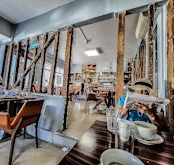
The entrance to The Boston Tea Party is via a shop beneath a building that looks newer than the older looking half-timbered edifice straddling the passageway mentioned above. A staircase leads to a dining area above the shop, which is where we enjoyed breakfast one morning in March 2022. This room has a decoratively patterned plaster ceiling and the remains of an old inscription in gothic script. As we were leaving, I saw a notice that advised customers that if the section, where we ate, was closed, customers should proceed up to the ‘Great Hall’. I was intrigued.

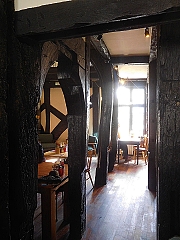
The Great Hall is one of the historical marvels of the city of Salisbury.  Its ceiling is supported by beams cut from old ships’ timbers. The Inn has been rebuilt several times. However, the beams that exist today include wood from trees that were felled in the mid-15th   century (www.buildingconservation.com/articles/george/inn_conservation.htm). Some of the walls are covered with wood panelling decorated with carvings and there are at least two elaborately carved wooden fireplace surrounds. Other decorative features include plasterwork covered with intricate bas-relief designs, and a lovely bow window overlooking the High Street. The hall is overlooked by a gallery with a balustrade. There is also a window with stained glass that includes a depiction of a royal coat-of-arms and the name of a king, probably Edward VI, who reigned from 1547 until 1553. According to the historicengland.org.uk website:

“On lst floor the south room has early C17 plaster work friezes on beams and carved wood overmantel. Projecting to east on north side open hall through 2 storeys. C15 hammerbeam roof, arched braces to collars. Heavy scissor bracing visible on 2nd floor lath decorated wall plates and spandrels. 2 rooms with tie beams and kingposts with 4-way struts.”

Over the centuries, The Old George Inn has had many visitors including William Shakespeare, Oliver Cromwell, Samuel Pepys, and Charles Dickens. It is believed that Shakespeare and his players, whilst on their way to Wilton, rehearsed “As You Like It” in the garden of the inn. Samuel Pepys spent one night at the inn but moved to another after having argued with the innkeeper over his bill.

Once upon a time, the Great Hall of the Old George Inn would have been filled with guests enjoying tankards of beer and ale and hearty meals. Today, in its reincarnation as The Boston Tea Party, the place is bustling with customers drinking cappuccinos and chai lattes as the consume trendy delicacies such as poached eggs on smashed avocado and ‘The Vegan Boss’. Whether or not you are thirsty or hungry, a visit to the Great Hall is a ‘must’ before or after you have viewed the cathedral.

Eating in The Ark

THE SHED IS aptly named. It is a restaurant in a long lean-to shed amongst the more solidly built edifices on Palace Gardens Terrace in Notting Hill Gate. This ramshackle-looking wooden structure has been home to a restaurant for many decades. For most of that time, it was called ‘The Ark’. It served lovely French-influenced food including my favourite on its menu, rack of lamb. The Ark was a popular local eatery, which attracted some celebrities including Prince Charles and Ingrid Bergman in the 1960s.

On one occasion a friend, let us call him ‘X’, who had eaten at our home many times,offered to treat us at The Ark. We accepted willingly. As soon as we sat down, X ordered the restaurant’s most expensive bottle of red wine. When, during our meal, it came to an end, he ordered another of the same. When the bill arrived at the end of our dinner, X fumbled in his pockets, blushed, and then, stammering, said:

“Oh, I have left my wallet at home.”

His home was a long way from Notting Hill Gate. He continued:

“This is all I have got”,

and placed a £10 note on the table. £10 barely covered half the cost of one of the bottles of wine he had ordered. Naturally, we paid the bill, and he said he would refund us the money, which he must have forgotten to do.

The Ark closed and then re-opened as a branch of the restaurants run by the chef Jean-Christophe Novelli. It served what I considered to be rather over-priced pretentious food. On one occasion, the Novelli restaurant took part in a scheme run by the Evening Standard newspaper. For £15, restaurants in the scheme offered a full meal without drinks – a bargain. My wife rang Novelli at the old Ark and asked whether we could book a table that day and use the voucher in the newspaper for the discounted meal. She was told that the restaurant was fully booked. So, I rang about two minutes later and asked to book a table, but without mentioning the newspaper offer. The lady, who answered the ‘phone at the restaurant, told me:

“Certainly, we have plenty of tables. Come when you like.”

Novelli’s closed, and the old Ark building remained empty for a while.

In 2012, the Gladwin brothers opened The Shed restaurant in the shed that once was home to The Ark. Time Out magazine (www.timeout.com/london/restaurants/the-shed) described it well:

“Tucked away behind a curtain of tousled ivy, The Shed serves up small, resourceful dishes built with foraged and locally-grown ingredients from the countryside. Led by the Gladwin Brother trio, who have their own farm and vineyard in Nutbourne, West Sussex, as well as two additional London restaurants, their flagship Shed was quick to become a local neighbourhood favourite when it first opened in 2012.

Though the menu changes seasonally, the original plates are still the best bet. (Note: everything is served tapas-style and 2-3 dishes per person is the recommendation.)”

I have been there a couple of times and found it to be both pleasant and original from the culinary vantage point. The serving staff, which briefly included our daughter, are obliging and well-trained. When ordering, the waiter or waitress discusses the dish and its ingredients knowledgeably. Pleasant as it is, it is not as enjoyable as The Ark was in its time.