A town in California


Just after Christmas in 1994, we flew to San Francisco in California (USA) for a four-week holiday. My wife was in the sixth month of pregnancy. Before booking our trip, we consulted her obstetrician at St Marys Hospital in Paddington, London. We wanted to know whether it was safe for her to travel at this stage in her pregnancy. The obstetrician did not mince her words:

Yes, go ahead, but make sure that you have good travel health insurance because having a premature birth in the United States might well bankrupt you.”

After spending a few days with friends who live across the Golden Gate Bridge in Marin County, we rented a car, an upmarket Toyota, one of the nicest cars I have ever driven. We drove all over California south of San Francisco. Also, we visited the Grand Canyon and saw it under snow. This was a very beautiful sight because the snow had fallen in such a way that the many stepped strata that line the walls of this spectacular gorge were accentuated. We admired this while trudging through very deep snow. In order to enjoy this, we had had to purchase snow chains and to learn how to apply them to the wheels.

One day, we drove south from the snow-covered Grand Canyon to Sedona, a town famed for its vortices of energy. It was a distance of 106 miles. Yet in that short distance the weather had changed from Arctic to summer. And, the following, day we drove further south past Phoenix and Yuma and then through a southern Californian Desert to San Diego. Even though it was freezing up at the Grand Canyon, from Phoenix to San Diego it was so hot that we had to switch on the car’s air-conditioning.

From San Diego, we spent a few days driving along roads close to the Pacific Coast. We visited most of the historic mission stations between San Diego and San Francisco. We also stopped at Nepenthe in Big Sur, where the writer Henry Miller once lived. The building in which the writer lived was open to the public. While we were visiting it, my pregnant wife needed to use a toilet urgently. Without making any fuss, the guardian unlocked the toilet that Miller used to use and allowed my wife to relieve herself.

Being fans of the architect Frank Lloyd Wright, we visited some of the few buildings that the great architect had designed along the route we were taking. One of these, at San Luis Obisco (between Los Angeles and San Francisco), was a particularly lovely medical centre, the Kundert Medical Clinic that was built in 1956.

On the final day of our road trip, I looked at the guidebook and spotted something that I did not want to miss. To reach it, meant adding 60 miles to our already long (300-mile journey) journey. The place that caught my eye was about 90 miles to the east of our destination Marin County on the left bank of the River Sacramento. The small settlement is called Locke.

Locke is in the wetlands of the Sacramento River Delta. In the 1860s, work was undertaken to drain the malarial wetlands. Many poor Chinese labourers were hired to do this work at disgracefully low wages. In about 1912, the settlement of Lockeport, now called ‘Locke’ was established by three local Chinese merchants. Three years later in 1915, the Chinatown in nearby walnut Grove was destroyed by fire. The Chinese community then moved to Locke and a town grew. Because the Californian Alien Land Law of 1913 forbade Asians buying farmland, the Chinese in the area leased the land from a George Locke.

The town’s population reached 1000 to 1500 in its heyday. It acquired a reputation for its gambling halls, opium dens, and brothels. At one point, according to an article in Wikipedia, it became known as ‘California’s Monte Carlo’. In the 1940s and ‘50s, the towns population dwindled because many people migrated from Locke to major American cities. Currently, there are only about ten people living there.

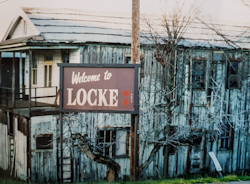
By 1995 when we drove into Locke it was already a ghost town, a lesser-known tourist attraction. However, it did not disappoint us. Most of the main street’s buildings were picturesquely decaying. They were all made of wood, and no doubt highly inflammable. The place looked like a rundown set for a cowboy film, except that it was for real. One of the buildings that had housed a gambling salon, or maybe a brothel or opium den, was open to the public. Its original dingy décor had been preserved. All that was missing was a haze of opium smoke and the poor Chinese workers squandering their hard-earned money.

From Locke we drove west into the setting sun towards Marin County, pleased that we had made the detour to see the fascinating remnant of a far-off era. Our daughter was born three months later, having travelled several thousand miles around the American west in utero.

Hair cut in Italy

Sometime in the 1980s, I was visiting Italy in order to see my sister who lives in the Emilia Romagna region. I landed at Milan and rented a car.

HAIR BLOG

The SEAT vehicle which I hired was tiny and very basic and seemed to lack many items that can be found in other low-cost cars. However, I benefitted from it because it did not consume fuel at a high rate. This was lucky because in those days fuel was extremely expensive in Italy as compared with other countries in Europe. In those days, the petrol price in the UK had just exceeded £1 per GALLON (4.5 litres). In Italy, at the same time, petrol was available at about 1600 Lire per LITRE, and the exchange rate was about 1570 Lire to the Pound Sterling. Nevertheless, I ‘beetled’ around Italy visiting various friends in different places. 

Driving practices in Italy differed from those in the UK. One day, I gave a lift to some Italian friends. At each village or small settlement on the Strada Statale (main road, not a motorway or highway) there were traffic signals at intersections. At one of these, I began to slow down because I could see that the signal was about to turn red. My friends said:

“What are you doing? Why are you slowing down?”

“The signal is turning red,” I replied.

“Don’t be silly, speed up. Don’t let the signal hold us up!”

I cannot remember what I did, but I have lived to tell the tale.

A day or so before I was due to meet my sister, I decided that I ought to have a haircut in order to look presentable. I stopped in a village, where I had spotted a barber shop as I was driving past.

I entered to smart looking salon, and sat amongst three or four other gentlemen awaiting the caring hands of the barber.Eventually, I was invited onto the barber’s throne. I explained what I wanted as best I could with my very rudimentary Italian. However, the barber, a true experienced professional, knew what was needed. 

He began rummaging around in the mop of hair on my head, and then suddenly stepped back as if he had been confronted by a deadly poisonous snake. He raised his hands high above his head, and shouted:

“Forfora”

The other men in the salon shrank back, one or two of them hiding their heads under the newspapers that they were reading. I sat, amazed and wondering about the meaning of ‘forfora’ and why it had caused such alarm.

Then it dawned on me. The barber had discovered dandruff in my hair. He explained something to me that I worked out meant that he needed to apply a special treatment to my hair.  I told him to go ahead. He rubbed some oily liquid into my hair. After a moment, I felt a strong burning sensation. It felt as if something was burrowing down the roots of my hair and into my scalp. As it worked, I thought that whatever had been applied felt as if it was strng enough to kill anything. I just prayed that my hair would not fall as a result of this terrific chemical onslaught.

After a short time, my head began to feel normal, and the barber carried out my haircut. I do not remember how much my cut cost, but I do remember having to pay an extra 5000 Lire for the special treatment.

I doubt that I will ever forget the Italian word for ‘dandruff’, but how often I will make use of this knowledge is questionable.


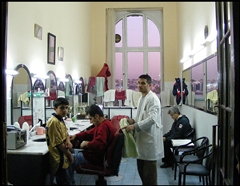
Photo: a hairdresser in Istanbul

Tulips and traffic

When I was a young child, probably less than ten years old, we made one of our regular family holidays to Holland. My parents, having studied Afrikaans to varying degrees of competence, felt easier visiting a country like Holland where the native language, Dutch, was not too exotic for someone to comprehend with a knowledge of Afrikaans.

One Saturday afternoon, my parents decided to take us to see the tulips at Keukenhof gardens. I cannot recall anything about the flowers.

However, I do not think I will ever forget the car park at Keukenhof. We had parked our car early in the afternoon when the parking area was fairly empty. When we came to leave, the car park was very full.

Everyone wanted to leave at the same time. A disorderly tsunami of vehicles converged on the exit gates. Nobody seemed to be regulating the traffic. It took us well over an hour to escape from the motorised mayhem.

Sadly, I associate Keukenhof with traffic rather than tulips, and although I love tulips, seeing them often brings Keukenhof to mind.

So near, yet so far

THE FLIGHT FROM BANGALORE to Chennai (Madras) is short: about forty minutes flying time. Some friends collected us from the airport in Chennai, and plied us with a tasty lunch. They recommended hiring an Uber taxi to ferry us from Chennai to Pondicherry (now ‘Puducherry’), a distance of about 100 miles. After three abortive attempts, a fourth driver pitched up and we set off for Pondicherry.

Our Uber driver was excellent and drove carefully. After just over two hour’s journey southwards along the luxuriant, verdant, well cultivated coastal plain, we reached a Pondicherry check post.

From 1674 until 1954, Pondicherry and its environs was a French colony. Occasionally, it was taken over by the British, but most of the time it was part of France. In 1954, a large majority of city elders voted in favour of ceding drom France. That year it became, and remain, an Indian Union Territory, independent of its hige neighbour Tamil Nadu. Old Pondicherry still contains many fine French colonial buildings and the policemen wear képis. Many of the road names are bilingual: Tamil and French. In addition, the town has no shortage of restaurants offering what is described as ‘French cuisine’. Although well populated with both Indian and foreign tourists, Pondicherry is a delightful place to relax and enjoy warm sea breezes.

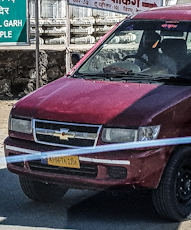
To enter the Union Territory of Pondicherry, drivers of cars with registration plates from outside Pondicherry have to buy a permit to drive there. Our Uber driver’s car had Tamil Nadu plates. He stopped at the check post, which is about ten minutes drive from the heart of Pondicherry, and told us it would take about five minutes to get the permit. He gathered up his relevant documents and headed inside the checkpost. While we were waiting for our driver, we were parked next to an unpretentious stall serving Bengali food. It bore signs in three scripts: Bangla, English, and Tamil.

Instead of taking five minutes, we sat waiting for him for forty five minutes. This was because he had set out with one document missing. I sat waiting in the car thinking that without the entry permit, we were so near yet so far from our destination.

After some time and several telephone calls, our driver re-entered the checkpost, and emerged with the desired permit. He explained that he had bern sent a photo of the missing document by WhatsApp. This image of the document, rather than the original, satisfied those who issued the entry permit. We continued our journey. Just beyond the checkpost, I saw an obelisc, which looked old enough to have been put up by the French colonial authorities.

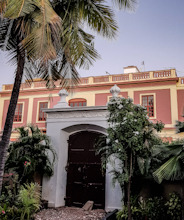
After settling into our accommodation, which I will describe at a later date, we took a pre-prandial stroll along the lovely seaside promenade. I was very pleased to discover that a place that had opened on the promenade a few months before our last visit to Pondicherry five years ago was still flourishing.

The Gelateria Montecatini Terme is a superb ice cream shop. It was set up just over five years ago by an Italian who has a business making luxury boats, anything from canoes to millionaires’ yachts. The gelateria is fully equipped with Italian equipment and refrigerated ice cream display counters. Stepping into this popular ice cream parlour in Pondicherry is just like stepping into a gelateria in Italy, and the ice cream is top class. The queues of customers attest that I am not alone in saying that.

The so-called ‘French food’ in Pondicherry is popular, but in no way matches up to the high standards often encountered in France. In contrast, the ice cream served at the Gelateria Montecatini Terme easily rivals the best in Italy. India never fails to be surprising!

BUS TO MOUNT ABU

WE SPENT MUCH OF NEW YEAR’S 7 Its driver was a friend of our driver. They were pleased to meet and wanted to chat. The other driver suggested to ours that he drove alongside ours so that he could chat with our driver. This did not happen but I liked the idea. Locating which bus we were to travel on proved a bit hair raising because everyone we asked suggested a different part of the bus station from which our bus might depart.

Much of the first half of the bus journey involved travelling northwards through flat cultivated terrain liberally sprinkles with small factories and large villages. We had a ten minute stop at Himatnagar, a small busy city in northern Gujarat.

Beyond Idar, the road began climbing out of the plain. We had a 30 minute break in Ambaji, an important temple town on the Gujarat side of the border of Rajasthan, which we entered immediately after lraving the town.

After Ambaji, our road climbed steadily and with increasingly tight bends through a mountainous landscape with plenty of trees. I was glad we were on a bus rather than a smaller vehicle like a car or jeep because many of these were driven as if their drivers had a suicidal tendency.

After about seven hours we arrived at the ramshackle, seemingly abandoned bus station at Mount Abu. There have been settlements in this area since time immemorial. It is mentioned in ancient Hindu texts, the Puranas. In the 19th century is was the summer capital of the Rajputana State. Many of the Rajput royalty built summer palaces in Mount Abu.

Our hotel is close to the still used polo ground. A beautiful late Victorian polo pavilion built in 1894 overlooks the vast polo playing field and is now used as a library.

The temperature at Mount Abu, which is about 4000 feet above sea level, dropped dramatically as the sun set. The air became icy cold and we were forced to purchase warm jackets. These are sold at stalls at the so-called Nepali Market, which is also called the ‘Tibetan Market’. Nepali or Tibetan, whichever it is, is situated amongst trees to which are attached strings of colourful Buddhist prayer flags such as we have seen fluttering in Darjeeling and Sikkim.

We dined at a simple halal restaurant. My wife asked for a soup listed on the menu. At first, the restaurant owner did not seem so keen on serving it. After a while, he said reluctantly : “If you really want it, I suppose I will have to make it for you”

DEATH OF A DRIVER

THE PEAK OF MOUNT KANCHENJUNGA was covered with snow and clearly visible from our bedroom window in Gangtok at 630 am on the 29th November 2019. By 900 am, it was hidden by clouds.
Our taxi driver collected us and we set off for Darjeeling. Although he was born in Sikkim, his parents are from another part of India. Almost 90% of the inhabitants of Sikkim are not Sikkimese and do not enjoy the special privileges afforded to ‘Sikkim Subjects’, people whose ancestors originated in Sikkim. These privileges include owning land and not paying income tax.

The majority of people who now live in Sikkim arrived there after it was absorbed by India in the mid 1970s.

From Gangtok the route is mainly downhill to Rangpo, the border between Sikkim and West Bengal. The winding road follows the River Rani downstream from Ranipool. As we drove along through the wooded valley, our driver told us about ‘D’, one of the two drivers he employs.

‘D’ was the fifth husband of a lady who owns a restaurant and bar. One night, well after midnight when D’s wife had closed her eatery, D decided to give her a driving lesson.

She sat at the wheel, and just before her lesson was to begin, D dashed into the restaurant building to relieve himself. While he was away, she rashly decided to show her husband that she knew how to drive and did not actually need to be taught by him. When he came out, he saw that the car was moving steadily towards the edge of the road and was about to topple over the edge and drop down onto a very steep slope. He ran to save the car and his wife but he and the runaway vehicle toppled off the road and fell down into the darkness below.

D was killed but his wife, who was sitting in the driver’s seat survived unscathed.

Driving without a licence is an imprisonable offence in India. To avoid risking this, her family, D’s in-laws, arrived and placed her dead spouse in the driving seat so as to make the police believe that he, who carried a driver’s licence, was driving the car when the accident occurred.

We were horrified to hear about this event which had occurred less than a fortnight before we set off from Gangtok. It was clear that D’s employer, our driver, was still stunned by what had happened.

Our driver’s careful driving gave us no cause for concern. However, as we neared Darjeeling and had rung our host to give directions for finding his homestay, our journey struck problems.

First of all, our driver told us he had never before driven to Darjeeling and had no idea about its geography. Secondly, we discovered that taxis with Sikkim registration plates, such as ours, were restricted as to where they can drive in Darjeeling. The result was that our driver had to stop at Jorebunglow, quite a few miles outside Darjeeling. We had to wait there until a local taxi driver took us into town. Despite this, the scenic journey between Gangtok and Darjeeling is a joy to experience.

DESTINATION SIKKIM

When I was in my teens, I found an old military survey map, paper glued on a canvas backing. It covered Darjeeling and neighbouring Sikkim. It intrigued me with its interesting contour lines and the nature of the landscape it encoded. Five decades have passed since my curiosity about Sikkim began. Today, what I had wondered about so long became reality.

Our host in Darjeeling drove us to the shared taxi stand near Chowk Bazaar. We paid for two seats to Gangtok and were led to a parking area filled with Tata and other makes of jeep. We were told that our Tata jeep would only depart when another 8 passengers were found. Soon a young Bangladeshi couple joined us. We waited and no more people turned up. Eventually, the Nepalese driver, Deepen, appeared. He told us that if we were happy to pay a modest supplement, the four of us could have the jeep to ourselves and, more importantly, depart immediately. We and the Bangladeshi couple agreed and we set off.

At first we drove along the Hill Cart Road, following the Toy Train tracks to beyond Ghoom, where we turned on to the road to Sikkim.

Most of the four hour journey is downhill along an often steep winding road with many hairpin bends, as Gangtok is at a far lower altitude than Darjeeling. We saw many beautiful flowers and ferns with huge leaves growing by the road as well as small forests of trees with very tall trunks. Occasional sloping tea gardens punctuated the luxuriantly verdant landscape. Many stretches of the road through the part of West Bengal through which we were driving are surfaced with tarmac from which numerous small hard stones project to make them safer when wet. I did not notice this type of road surface after we entered Sikkim.

For quite a distance, from Melli to well beyond the Sikkimese border town of Rangpo, we drove through the beautiful valley of the River Teesta that flows down from India into Bangladesh. The clear turquoise waters flow between wide white sandy beaches. From Melli to Rangpo we drove on the West Bengal bank of the river, looking across at Sikkim on the opposite bank.

After passing under a decorative arch with the words “Welcome to Sikkim”, we entered Rangpo and parked near to the visitors’ registration office. There, we showed our permit that we had obtained at Sikkim House in Calcutta and our passports. All three documents were stamped and their details entered by hand in a large book.

We continued our journey through a part of Sikkim in which the scenery was less spectacular than between Darjeeling and Rangpo. Also, the architecture of most buildings we saw lacked in aesthetic merit. Many of them are several storeys high.

Our road left the Teesta valley and began winding upwards through unattractive small towns in the environs of Gangtok city. As we approached the latter, the traffic became heavier. Most of the buildings we passed after entering Gangtok have at least 5 storeys and do not look particularly old. If Gangtok were on flat ground, the place would look nondescript. However, because the city clings to steeply rising hillsides, the vistas resulting from the piling of rows of buildings one above another are picturesque and impressive.

Some of the places we drove through were designated “ODF Village”. At first, I was puzzled by this. Then at one place, I saw the words “Open Defecation Free”. This means that emptying bowels in places other than toilets is forbidden.

The shared taxi stand in the centre of Gangtok looks like an ill-maintained multi storey carpark. We drove into an upper storey which was crammed full of jeeps. Some of them, including ours, shuffled back and forth like pieces in a badly made rubik’s cube in order to access a parking space. A lot of shouting accompanied these difficult manoeuvres.

Our drive unloaded our bag. He had driven magnificently with great skill and care, sometimes with his mobile phone in one hand. When we boarded, I had tried to put on a seat belt. He and the local taxi drivers we used on our first day in Gangtok told me that there was no need to use safely belts. It seemed to me that using a seat belt suggests to the drivers that I am not confident that they are going to drive well.

A local taxi delivered us to our hotel. Soon after this, we took another one to Lal Bazaars in central Gangtok. There, we ate lunch in the first floor Potala Restaurant. Some of the tables on one side of this unpretentious eater, were in compartments with curtains that could be closed to provide a degree of privacy. The steamed pork momos I ate were delicious. They are like Chinese dumplings but larger and with thicker doughy coverings, more like polish piroschki. Beneath the restaurant and under a metal roof, there is a long line of shoe polishers and shoe repairers, all sitting on the floor and very busy.

After eating, we climbed a long staircase with many landings. This is lined with all kinds of shops except for food sellers. The staircase leads to MG Marg, a wide almost level pedestrianised shopping street lined with many upmarket shops and a variety of cafés and restaurants. Many people were milling about, looking at shops or just enjoying themselves. Although not nearly as picturesque as the Stradun in Dubrovnik or the Pedonalja in Albania’s Berat and Shkodër, it serves the same purpose: a place to promenade.

After sunset, we returned to our hotel to await dinner. I am pleased that I am fulfilling my long held wish to visit Sikkim, but my first impression of Gangtok is that it is not nearly as attractive as Darjeeling. Despite that, it is beginning to grow on me.

FIRST DAY DAWDLING IN DARJEELING

ISTANBUL AND GJIROKASTER (in Albania) share something in common with Darjeeling. The three places have no shortage of extremely steep inclines. However, Darjeeling beats the other two in steepness. Its footways and streets often seem almost vertical. The thoroughfares are so narrow in many places – wide enough for only one car, and as few of them are one way streets, Darjeeling’s drivers have to be skilled in reversing long distances along them. Driving difficulties are compounded by the oft appalling road surfaces, the steep drops along edges of some streets, and deep gutters.

The Mall and Chowrasta (a square where four roads meet) are vehicle free pedestrian precincts. Some of the buildings in this area are over 100 years old and recall the ‘heyday’ of Darjeeling, when it was a high altitude resort for British colonialists. One of these old structures houses the well stocked Oxford bookshop. It specialises in books about the Himalayas, tea, and natural history.

Two long straggling bazaars start at Chowrasta: the Mall Market that is under a fabric roof supported by bamboo poles, and the Mahakal Market. The latter runs along a path which overlooks a lower part of the town. The Mahakal Temple and a Bhuddist temple perch atop Observatory Hill. These can be reached by walking up a very steep winding path, which was lined by mendicants soliciting alms, often pitifully.

We ate lunch in the very popular Kunga restaurant, which serves Chinese style food. One visit there is enough for me. The restaurant is near a large Victorian gothic edifice with a tall clock tower. Built in 1850, this used to be Darjeeling town hall.

Our quest for a Samsung service centre led us down a long, perilously steep pathway to the busy Chauk Bazaar area. This typical bustling bazaar divided into areas that specialise in one line of business, be it, for example, vegetables or tailoring or sweetmeats or shoes, is laid out higgledy piggledy on an area of level ground that is large by Darjeeling standards.

A taxi conveyed us at great speed up steep winding streets to the huge Sinclairs Hotel where our new friends from Lincolnshire kindly offered us sundowners – well, the sun had actually set long before we reached them.

Returning to our lovely homestay, our young driver forced his poorly powered tiny Suzuki Maruti car along some absolutely appalling roads, which reminded me of some of the worst byways I have experienced in rural Albania and off the beaten track in South Africa.

Dinner dates

A few days ago, some friends invited us to visit them one evening. We sat with them for several hours, drinking and eating light snacks. As time passed, my stomach began rumbling and I wondered when we were going to eat dinner. This reminded me of an evening many years ago when I lived in Kent (UK).

Some Americans invited me to dinner. To reach them, I had to drive through the countryside for two hours. When I arrived at about 7 pm, I was offered a sandwich. I refused this, muttering that I would wait for dinner.

Another guest arrived. We sat talking and the time passed pleasurably. However, there was no mention of dinner or any food at all during the rest of the evening. At 10 pm, I began my two hour return journey without having eaten. As I drove home, it dawned on me that the sandwich I had been offered was actually the only evening meal that my hosts were planning to serve.

When I reached home at midnight, starving, I prepared a hasty snack.

On reflection, on the recent occasion, we had visited our friends assuming that we would have a pre-dinner drink before going out to dinner. In reality, they had only invited us for a drink; they had not mentioned dinner.

Moral: don’t assume anything!

Photo of shaami kebabs