The importance of being British

HBY 60s 36 HW BLOG

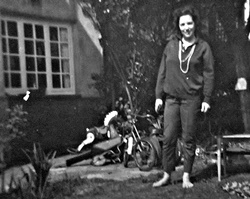
I HAVE ONLY VISITED CRETE once, and that was in the late 1960s with my parents and sister. We were based in Heraklion and made excursions from there around central Crete, visiting sites including Knossos, Matala, the windmills of Lasithi, Malia, Aghios Nikolaos, and Phaistos. This piece concerns three memories of my late mother on that visit.

The first recollection is of the rather non-descript but very comfortable hotel where we stayed in Heraklion. It had its own swimming pool. My mother, who could not swim, and was always a bad sailor, could not bear to look at the pool; it made her feel seasick seeing its water.

The next memory is of a hot day somewhere in the Cretan countryside. We were all thirsty and ready for a drink. We passed a house with a garden. Some people were sitting at a table sipping the tiny cups of coffee that Greeks favour. They were drinking what many people call ‘Turkish Coffee’, which many Greeks prefer to call ‘Greek Coffee’ or even ‘Byzantine Coffee’.

My mother walked up to the gate leading into the garden and using one of the few words of Greek that she knew, called out:

Kafenion?

Kafenion (καφενεῖον) is the Greek word for ‘café’. Another Greek word she knew well was ‘siga’ (σιγά), which means ‘slowly’. She used it almost in every car that we were being driven in Greece. She was terrified that others driving her would have an accident because as a child in South Africa she had been involved in a dreadful car crash.

Getting back to my story, the coffee drinkers invited us into the garden and asked us to join them. My mother was mildly embarrassed to discover that this was a private house, not a ‘kafenion’. Soon, we were all supplied with Turkish Coffee. One of our hosts spoke rudimentary English. He had been a sailor when younger and excitedly told us that he had been to ‘Kong Kong’, in his own words.

Then, my mother noticed a single brightly coloured flower in the hedge surrounding the garden. She pointed at it, exclaiming “oreia” (ωραία), the Greek word for ‘lovely’. Our hosts burst out laughing. They found my mother’s reaction to the flower hilarious. One of them took Mummy to the flower and showed her it was artificial, attached to the hedge with a fine wire.

The third thing I recall about our Cretan odyssey relates to a commodity that was in great demand recently here in the UK: toilet paper. When we used to visit Greece in the 1960s and 1970s, there were usually people sitting at the entrances to public toilets. These folk, often elderly women, were there to sell sheets of toilet paper to people about to make use of the facilities.

We were in one small Cretan village when my mother needed to answer Nature’s call. We found a public convenience. An elderly toilet paper vendor was sitting by its entrance. My mother rummaged in her handbag for small change. While she was doing this, the lady asked my mother:

“Deutsch? German?”

My mother answered:

“British.”

The lady handed her some toilet paper and would not accept the customary two Drachma payment.

We were in Crete at least twenty years after the German occupation of the island had ended in spring 1945. The Germans had perpetrated many horrific deeds on the Cretan population. The woman outside the toilet was certainly old enough to have had strong memories of that ghastly time. Had my mother been German, she would have had to pay for the toilet paper. Being British, she was like the great writer Patrick Leigh Fermor (1915-2011) who fought the Germans in occupied Crete, a representative of  a nation which helped rid the island of its unwelcome occupiers. This toilet attendant’s small act of kindness towards my mother helped drive home how awful it was to have been occupied by the Germans during WW2.
Espresso and extraction

lisb


Back in about 1995, I decided to leave the dental practice where I was working. I went to one or two job interviews, but did not feel that I would have been happy working in them had I been offered a job in any of them.

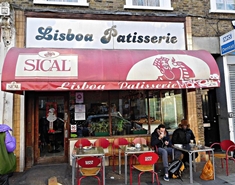
Then, I visited a dental practice next to the Portuguese Lisboa Patisserie in Golborne Road (near London’s famous Portobello Road). The owner of the practice, who has long since retired, knew me, but I could not remember him even though we had studied at the same dental school. 

The interview began well after my future boss had gone next door to get each of us an espresso coffee from the Lisboa. It was one of the best espresso coffees I had ever tasted in London. We got on well, speaking for hours, for so long that I was late for a pre-arranged dinner engagement. 

I took the job and worked in the practice for five interesting years, fixing and/or extracting many of the local’s teeth. I do not believe it was only the espresso coffee that persuaded me to join the practice, but it certainly helped. 

I have long since retired from that practice in Golborne Road and also from dentistry, but still visit the Lisboa Patisserie regularly. The quality of the coffee and Portuguese snacks, both sweet and savoury, has not faltered over the years, and some of the staff are those who were there back in the late 1990s.

I can strongly recommend a visit to Lisboa and its coffee, which was so perfect that it helped direct my career pathway.


57 Golborne Rd, London W10 5NR

Under the trees

The outdoor café at Airlines Hotel in Bangalore has been in existence for many decades and still remains a popular eatery and coffee place. What a great joy it is to sit induer the leafy branches of the trees surrounding the outdoor chairs and tables.

People can be served while they sit in their cars parked in the small car park next to the outdoor seating area. At times, this parking lot can become very full. Cars queuing for entry to Airlines can cause traffic congestion in the street (Madras Bank Road) on which the eatery is located.

The walls enclosing Airline’s compound are decorated with paintings and quotations about tree leaves from the poetry of Kabir Das (1440-1518).

I have been visiting Airlines regularly since 1994, when I first visited Bangalore, and my enjoyment of the place had never diminished.

Taking the plunge


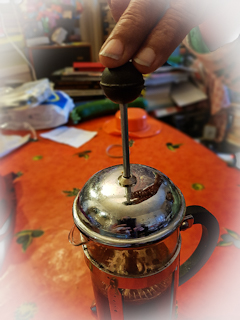
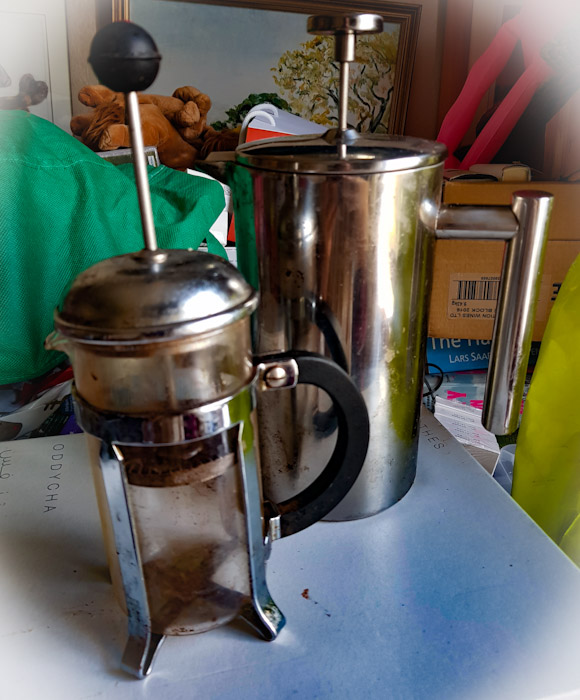
The cafetière (or ‘French press’ or ‘coffee plunger’) has been around for 90 years. It was first invented in 1929. It achieved popularity in England much later. I remember my mother bought one in the 1960s. It was then a ‘trendy’ way of making coffee. My mother used this device to make coffee for some time until one evening something awful happened.

Her brother-in-law, my uncle, was preparing coffee in a cafetière one evening, when suddenly the plunger, which usually needs some pressure to force down the coffee beneath the filter, suddenly shot downwards very quickly. As it did so, boiling hot coffee shot up and burnt my uncle’s hand and arm extremely badly. After this unfortunate accident, my mother, who was a very cautious and safety-conscious person, abandoned using her prized plunger, and reverted to making coffee through conical filter papers.

Although my mother would never use a cafetière again, I continued to do so. Many years after her premature death, I had a strange experience whilst plunging the coffee after feeding dinner to some guests. My wife had filled the cafetière vessel and had left the coffee to ‘infuse’. It was my job to take the plunge so to speak. I pressed down the plunger cautiously. It was harder than usual to press it. The plunger descended a little, but when I removed my hand it began rising. I pushed it again, getting it down a little further, but again the plunger rose up towards its staring position. I kept repeating the procedure, and each time the plunger rose a little. Eventually, I managed to get the plunger to remain near the base of the coffee container, and I poured out the coffee into cups.

I was mystified by our plunger’s abnormal behaviour.

After the guests had left, I opened up the cafetière to clean it. Beneath the plunger amongst the compressed coffee grounds, I disovered the reason for the odd phenomenon. Hidden amongst the dregs of the coffee there was a stainless steel tea spoon. Its previously straight stem had been gradually bent into a U-shape whilst I was trying to press down the plunger. What amazed me when I thought about it afterwards was that it was lucky that the glass vessel was tough enough to withstand the pressure exerted by the spoon on the glass while I was inadvertantly bending it.


Espresso in Ealing

Until a couple of years ago, I considered that the very best coffee served in London could only be found in a few coffee bars, all of which were Italian (e.g. Bar Italia, Lina Stores, and The Algerian Coffee House in Soho; the Portobello Garden Café in Portobello Road), Portuguese (e.g. Lisboa Café in Golborne Road and Madeira Star in Lambeth), or Spanish (e.g. Brindisa near Borough Market). I still consider all of these as good choices for excellent coffee, but need to add another to my list.

A Polish born receptionist working at the dental practice where I used to practise dentistry, suggested that a restaurant in Ealing called ‘Sowa’ (means ‘owl’ in Polish) served good Polish food. We visited this place, but were not impressed by the food. Much better Polish food can be obtained at Café Maja in POSK, the Polish Centre in King Street, Hammersmith.

The well-appointed restaurant at Sowa adjoins a café, which is part of the same establishment. Unlike the restaurant that fails to shine, the café is magnificent. The coffee served here in all forms (espresso, cappuccino, latte, etc.) is at least as good as that we have drunk in the best of the Italian, Portuguese, and Spanish coffee houses in London. Having visited Sowa too many times to remember, I can safely say that the high quality of its coffee never wavers. 

Sowa’s café also offers a mouth-watering range of highly tempting pastries and cakes. It seems in general that the Polish have a magical touch when it comes to making these delightful accompaniments to coffee.

So, if you are in Ealing, ignore every other café, and head for Sowa.

PS: Next door to Sowa, there is a lovely Polish delicatessen that offers a wide range of salamis, hams, and other cooked meats, as well as other Polish food items.

Sowa: 33 High St, London W5 5DB

NB: I have no interest financial or otherwise in Sowa. I am simply a content customer!


Coffee by the yard

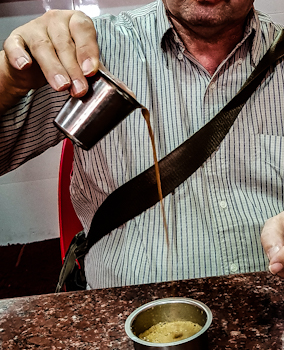
Traditionally, South Indian filter coffee is served piping hot in small conical metal breakers. The beakers, which are almost too hot to hold, stand in deep cylindrical metal saucers, as shown in the picture.

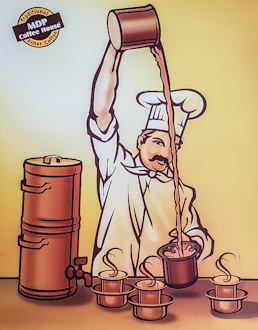
To cool the coffee so that it reaches a drinkable temperature, one lifts the hot beaker out of the saucer, and then pours the coffee from the beaker into the saucer from as greater height as you dare. Then, you pour the slightly cooler coffee back into the saucer. The procedure is repeated until the beverage reaches the desired temperature.

The person making the coffee repeatedly scoops the bubbling boiling milk, which is added to the coffee, from its pot on the heat, and then pours it back from a great height. The stream of boiling milk is often quite long.

My late father-in-law, a witty man, referring to the pouring from a height involved in filter coffee making and drinking, used to ask us when we visited a coffee house in Bangalore : “How many yards of coffee do you want?”

Note: 1 yard is a measure of length a little less than 1 metre

Coffee with ginger

Cochin is a port on the Malabar coast. It provided a haven and home for people from all over the world, including Arabic traders. Now, it attracts foreign tourists from all over the world. This article is about a legacy of the Arab settlers.

I have occasionally drunk coffee flavoured with cardamom in Arabic restaurants. This drink is identical to Turkish coffee but is subtly tinged with cardamom.

An article, published on 28th December 2018 in the Hindu Metroplus (Cochin edition), alerted us to the existence of Kava Kada, a tiny café next to the Mahalari Masjid (mosque) in the Mattancherry district of Cochin in Kerala (India). The café is literally a hole-in-the-wall in the side of the masjid, a few feet away from the main minaret.

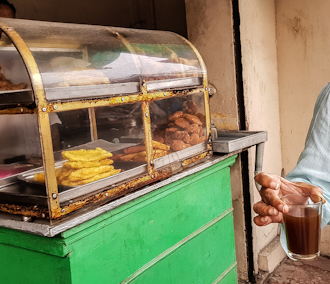
A small, aged glass counter-top display cabinet contains a few fried snacks including batter covered fried bananas. There are a couple of very low benches for customers to sit on. The owner of the café stands behind the counter surrounded by metal pots and a gas stove.

This tiny outlet is famed for its Arabian style ‘kava’. This coffee is served in small thick-walled glasses. I have never tasted coffee like this. At first, I thought I was drinking biryani flavoured sweetened coffee. It was delicious. Quite unlike any other coffee that I have drunk, this kava is flavoured with dry ginger, cloves, sugar, cardamom, black pepper, and other spices.

The café is located close to a bustling intersection of two main roads. Cars, two-wheelers, autorickshaws, and small trucks whizzed passed us a few inches away from where we were sitting. Two goats wandered past, seemingly unconcerned by the traffic.

The coffee shop was set up long ago by the now aged Kochumuhammad, who, as a boy, was taught by Arab migrants how to prepare the special kava. For the past 20 years, the shop has been run by one of his 26 grandchildren, a man called Riyaz.

We spent about 10 minutes sipping our coffee, which is good for the throat, so an autorickshaw driver told us. During our brief stay, there was a steady stream of customers buying kava.

I am very grateful to the intern Amala Rose Boben, who wrote the newspaper article, for alerting us to this fascinating little coffee house.

Filter coffee

South Indian filter coffee is wonderful. Here is how it is prepared. First coffee powder is placed in the upper chamber of a cylindrical metal vessel with a finely perforated base. Hot water is poured on it. Then, the water slowly filters through the powder to produce an intensely strong, undrinkable filtrate, known as ‘decoction’. This filtration takes many hours.

The coffee-maker ladles some decoction into a vessel, often a stainless steel beaker. Then, he or she fills the rest of the beaker with freshly boiled milk (With or without sugar).

If you want your coffee without sugar, ask for “sugarless”.

The coffee cup comes with a deep saucer. To cool the coffee, you pour the coffee from the beaker to the saucer and vice versa.

Then, ENJOY!

Spaghetti House

My parents loved coffee. In particular, they enjoyed drinking well-prepared Italian espresso coffee. Every Saturday morning when I was a child in the late 1950s and early 1960s, we used to drive to the car park by Jack Straws Castle, a pub near Whitestone Pond in Hampstead. Now, the pub no longer exists; it has been adapted to become a block of flats. The car park behind it, where we used to leave our car, still exists.

We used to walk down Heath Street, passing the open-air art exhibition if it was summer-time. Our first stop was a café housed within a building with a triangular floor plan, which still stands on the corner of Heath Street and Elm Row. The Pimpernel café/restaurant, which was run by Italians, no longer exists, but this is where my parents used to take their espresso coffee on Saturday mornings.

In those far-off days, espresso machines were not equipped with pre-set electronic controls as they are today. The person making the coffee had to pull down a leaver, which forced the hot water through the powdered coffee and into the cup waiting below it. The speed at which the leaver is pulled determines the rate at which the hot water flows through the coffee and the length of time that the water remains in contact with the coffee grains. These factors help affect the taste and quality of the final cup of espresso and are dependent on who operates the lever. Thus, using the manual espresso machines requires skill and experience. In my parents’ view those who worked at the Pimpernel had these skills. Whenever we visited this café, the kindly staff would give my sister and me a small matchbox sized piece of Italian nougat (‘torrone’). I remember that the piece of torrone was coated on two sides with thin edible rice paper. That there was paper which was edible really impressed my young mind.

There was another place, whose coffee gained my parents’ approval during the 1950s. This was the Bamboo Bar on Finchley Road in Golders Green. It was located under the Northern Line bridge which straddles Finchley Road close to Golders Green station and opposite a now disused covered walkway which was once an entrance to the station.

SPAG 2

Although the walkway and the Bamboo Bar have been closed for many decades, there is still an eatery in the same place, the popular Artista Italian restaurant. The latter is much larger than its predecessor.

SPAG 1

The walls of the Bamboo Bar were lined with bamboo. It was run by two Italian men, Lorenzo Fraquelli and Simone Lavarini. My parents, who both loved Italy and her people, enjoyed chatting with these fellows. In 1955, they opened the first branch of what was to become the now widespread, extensive chain of Spaghetti Houses.

As mentioned, the Bamboo Bar closed years ago. Sometime in the 1960s, another café, Bar Linda, opened next to the bus station at Golders Green. This souvenir of my childhood still survives and is thriving.

SPAG 3

One branch of the Spaghetti House chain made headline news in 1975. It was the branch, now closed, in Knightsbridge. This was the branch where managers of the various outlets of the chain would meet occasionally to deposit their takings before they were deposited in a nearby bank’s night-safe. On the days of the meetings, this restaurant was closed to the public. On Sunday 28th September, three armed men burst into the restaurant and demanded the takings that had been collected from the branch managers, who were meeting there. They bundled the managers in the basement. Luckily, one of the managers escaped and alerted the police, who arrived promptly.  The bandits held the managers hostage for three days before giving themselves up to the police. This event became known as the ‘Spaghetti House siege’. I am pleased to report that nothing remotely exciting as that has ever occurred during my years of visiting this restaurant chain.

SPAG 4

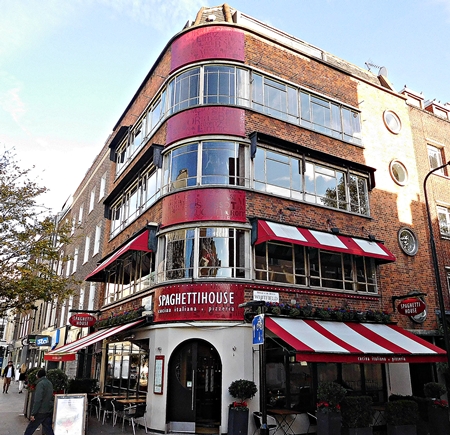
The first branch, which still exists, stands on the corner of Goodge Street and Whitefield Street (see picture above). When I was a young boy, my mother often treated me to a meal at this restaurant. We became quite familiar with the staff.

Many years later in 1970-71 during my first year as a BSc student at University College London (‘UCL’), I used to treat myself to lunch at the Goodge Street Spaghetti House. It was more expensive than the numerous canteens that were available on the UCL campus, but the food was far better. The ground floor of this multi-storey restaurant, like the Bamboo Bar, had walls covered with bamboo. This has long since been replaced by newer wall coverings.  Some of the waiters who were working at the Goodge Street Spaghetti House were getting on in age by the time I began my undergraduate studies. At least one of them used to greet me as she remembered me as a child. Not only had she worked at the Spaghetti House since its opening, but she told me that she had also been a waitress at the Bamboo Bar.

We still eat the occasional meals at various branches of the Spaghetti House chain. The food is usually of a good standard. A few years ago, I met a chap with whom I had been to school before 1960. I had not seen him since about 1971, and then only extremely briefly. We agreed to meet up at a Spaghetti House restaurant. He told me that he preferred meeting people on ‘neutral territory’ in places like restaurants, rather than in homes. Although he had aged quite a bit since we were both 8 years old, he was recognizable. Almost as soon as he met me, he said to me:

“Oh, I thought I was meeting someone else, not you.”