An abbey no more: slavery and sightseeing

ENTIRELY JUSTIFIABLE FURORE over recent unlawful police killings of Afro-American citizens in the USA has heightened awareness of the history of unjust treatment of ‘people of colour’ under colonialism and slavery during years long passed. It was only after enjoying an afternoon in the lovely gardens of Anglesey Abbey near the city of Cambridge that I learned that this delightful place was once owned by someone whose fortune was at least partially derived from  exploitation of India and elsewhere by the East India Company. But first some history of the house, whose gardens we enjoyed despite the rain and gloomy grey late October skies.

Between 1536 and 1541, King Henry VIII disbanded the monasteries, abbeys, and other religious institutions in England. One of these was an Augustinian priory established near Cambridge by Richard de Clare in 1212. This was originally founded as the Hospital of St Mary during the reign of Henry I (that is between 1100 and 1135). The site of this religious establishment became the property of John Hynde, an important judge, who died in 1550. The religious buildings having been largely demolished, the next owner of the place, the Fowkes family who acquired it in 1595, built a Jacobean style house where the priory used to stand. The house incorporated some of the remains of the disbanded priory and abbey.

Later, the house became the property of Thomas Hobson (1544-1631), a Cambridge carrier from whose name the expression ‘Hobson’s choice’ is derived. Hobson maintained a profitable livery stable in Cambridge as well as arranging the carriage of mail between London and Cambridge. ‘Hobson’s choice’, a name derived after Hobson’s death is essentially the choice between ‘take it (i.e. the one thing on offer) or leave it’. Hobson’s son-in-law Thomas Parker and some of his descendants owned Anglesey Abbey (as the property became known). Later, the Member of Parliament for Malmesbury and then Cambridge, Samuel Shepheard (1677-1748), became owner from 1739. We will return to him later.

In 1848, the Reverend John Hailstone (1759-1847), an important geologist, a member of the Linnean Society as well as the Royal Society, bought Anglesey Abbey. He carried out many restorations and planted many trees in the Abbey’s extensive gardens, which we can enjoy today. Jumping ahead, in 1926, two brothers, Urban Huttleston Broughton (later ‘1st Baron Fairhaven’) and Henry Rogers Broughton, bought the property. They made improvements to the house, enhanced their collections of artworks, and developed the gardens. Henry moved out in 1932, leaving Anglesey Abbey to his older brother Urban, then Lord Fairhaven. Urban built a library to store his ever-growing collections of art works and books and restored the working Lode Mill on his property. When Lord Fairhaven died in 1966, the property was bequeathed to the National Trust. Sadly, because of the current covid19 crisis, we were not allowed to enter the lovely house to view his collection.

Between 1717 and 1720, Samuel Shepheard, an early owner of Anglesey Abbey, was involved with the East India Company (founded 1600 during the reign of Queen Elizabeth I). He was elected a director in 1718. His father, Samuel Shepheard (c1648-1719), was one of the so-called ‘interlopers’ who used political connections set up The New East India Company in 1691. So, not much has changed in connection with the overlap of political influence and commercial interests since then! The ‘New’ company thrived alongside the older one for a few years before the two companies merged (https://www.nber.org/system/files/working_papers/w21536/w21536.pdf). Samuel’s father tried to involve his son in the promotion of the New East India Company and is alleged to have been involved in irregularities connected with his son’s political advancement (www.historyofparliamentonline.org/volume/1690-1715/member/shepheard-samuel-ii-1677-1748). The on-line History of Parliament website includes the following about Samuel (junior):

“Concern for trade, and in particular his father’s commercial interests, suggest that he, rather than James Sheppard, twice acted as teller in that session: in favour of engrossing a bill to open up commerce with Africa; and in support of the second reading of a clause for a bill to encourage the tobacco trade.”

As for the former owner of Anglesey Abbey’s connection with India:

“Although serving as a director of the East India Company under George I, he did not seek advancement in the City, preferring the lifestyle of the country gentleman. The establishment of a residence at Exning probably reflected his association with the Cotton family, who were lords of the manor there.”

He became extremely wealthy:

“Dying ‘vastly rich’, he left the bulk of his estate to his natural daughter, who was celebrated as ‘the greatest fortune in England’, and subsequently married Charles Ingram, the future 9th Viscount Irvine.”

Exning is about six and a half miles north-east of Anglesey Abbey. Although Shepheard owned the Abbey, it is unlikely that he resided there as much as in Exning.

Samuel Shepheard was, as already mentioned, a director of the East India Company between 1718 (possibly 1717) and 1720. During that time, the company appears to have been, if not actually involved in, certainly interested in transporting slaves from Madagascar to North America in 1720 (“The William and Mary Quarterly”, Vol. 26, No. 4, pp. 548-577). To what extent Samuel Shepheard and his father were involved in the slave trade remains unclear. The National Trust are also somewhat opaque on this subject as their report (https://nt.global.ssl.fastly.net/documents/colionialism-and-historic-slavery-report.pdf) reveals:

“Shepheard was a wealthy merchant and Cambridgeshire Member of Parliament (MP) who served as director of the new East India Company and headed the South Sea Company. His father, Samuel Shepheard senior (c.1648–1719), was also an MP and merchant, building the family fortune on overseas trade. He was a founder member of the new East India Company and the South Sea Company, where he held the office of deputy-governor from 1713.”

Does the term ‘overseas trade’ include slavery? While we can not be certain whether or not either Samuel Junior or his father were involved in the slave trade, there is little doubt that the East India Company was not averse to it and might well have profited from it (see, for example: www.journals.uchicago.edu/doi/abs/10.2307/2715359?journalCode=jnh and https://aquila.usm.edu/cgi/viewcontent.cgi?article=1153&context=slisconnecting ), certainly in Africa and maybe also in the Indian subcontinent.

Should we let our enjoyment of Anglesey Abbey be disturbed by the knowledge that for a brief period of its existence it was owned by someone, who was involved in a company that ‘plundered’ India and was involved in the slave trade? By stating that Shepheard “… built the family fortune on overseas trade” to quote the National Trust in its report, which was triggered by the recent formation of the ‘Black Lives Matter’ movement, we can get no closer to ascertaining whether we should have a bad conscience about visiting the lovely gardens of Anglesey Abbey or should simply enjoy the experience without being concerned with an ill-defined unsavoury part of its history. After all, as far as we know, neither of the Shepheards, father and son, can yet be tarred with the same brush as, for example, the disgraced Bristol slave-trader Edward Colston (1636-1721), whose lifespan overlapped those of the two Samuel Shepheards. And, furthermore, unlike some other stately homes whose fame is largely due to fortunes made by persons involved in slavery, Anglesey Abbey is not one of them. If anything, the glory and splendour of this house and gardens in Cambridgeshire is due mainly to the efforts of men who owned it many, many years after Samuel Shepheard Junior died.

Almost but not quite nude

IN THE EARLY 1980s, I travelled to the island of Mljet, which is off the Dalmatian coast of what was then Yugoslavia. It was notable for at least two features. One was that most of the island was out of bounds to motorised traffic. The other was that nudism was both tolerated and encouraged.

I had been introduced to nude bathing a year or two earlier when I visited Dubrovnik with some friends from Belgrade. We used to take a ferry from the city to the nearby island of Lokrum. At the island’s ferry station there was a sign. One arrow pointed to the ‘nudismo’ beach and the other to the ‘ne nudismo’ beach. The first time we headed for the nudismo beach, I expressed concern about my modesty. One of my Yugoslav friends told me:

“Don’t worry, there’s always someone on the beach who looks worse than you.”

Surprisingly, these words reassured me.

Our party on Mljet included four people from the British Isles, including me, and three Yugoslavs. One of us Brits and the Yugoslavs were well-versed in nude bathing, but two of us ‘Brits’, including me. were relative novices.

Recently, my wife and I visited the gardens of Anglesey Abbey in Cambridgeshire. This lovely place is home to several outdoor sculptures. One of these is a naked youth carved in white stone. Someone, most probably a visitor, had placed a pair of sunglasses on the sculpture, rendering the youth no longer fully nude. Seeing this reminded me of our holiday in Mljet.

My friend from London and I joined in the nudity that was expected on Mljet, maybe a little anxiously at first but we soon got to enjoy it. After a few days on the island, one of my Yugoslav friends pointed out that unlike the rest of our party, neither of us ‘novices’ were ever completely nude. Either we wore only a sun hat, or a wristwatch, or even just a pair of sunglasses like the statue at Anglesey Abbey.

It is odd what can trigger far-off memories. That statue with the sunglasses did manage to remind me of the wonderful times I spent in Yugoslavia, a country that no longer exists.

A clock on a wall

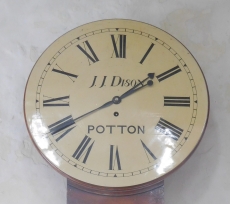
I NOTICED THAT A CLOCK on the south wall of the nave of St Mary’s Church in Ashwell (in Hertfordshire, north of Baldock) bore the makers name “JJ Dison, Potton”. Being by nature curious, I wondered whether any trace of JJ Dison remained in Potton, a small town in Bedfordshire, about nine miles north of Ashwell. So, off we went to Potton, and what we found there was delightful.

In the tenth century, the town’s name was ‘Potun’ and in the Domesday Book (1086), it was listed as ‘Potone’. These names are derived from the Old English meaning ‘farmstead where pots are made’. During the Middle Ages, the Tudor, and Stuart eras, the Market at Potton was one lof the largest in Bedfordshire. This declined after the Great Fire of 1783 during which much of the centre of the town was destroyed. In 1797, the Shambles (a market area including brick buildings) were erected, but these fell into decline in the 1930s. A smaller version of the market building was constructed later, and this now serves as the town’s library. The two women working there were friendly but knew nothing of the clock makers of Potton They sold me three fascinating books that contain historic photographs of Potton.

Today, Potton, which once had its own brewery, is now a commuter town. Its station, first built in 1850, is on the former Great Northern Railway. Currently, commuters can travel into London on trains that terminate at London St Pancras.

We wandered around Potton looking at various old buildings and enjoying a coffee at a pleasant café that had only just reopened after several months of having been closed because of the covid19 pandemic. A pleasant walk along Church Causeway brought us the parish church of St Mary’s, perched on the highest spot in the town. Its construction began in the 13th century and many additions were made in the centuries following. As with so many churches we have visited recently, it was locked up. We walked around its exterior, admiring the many decorative gravestones in the crowded cemetery that surrounds it. We returned to the centre of Potton along the causeway, crossing a couple of fast-flowing streams along the way. These waterways are part of the Potton Brook network, tributaries of the River Ivel, which is itself a tributary of the River Great Ouse which flows into The Wash.

Well, enough about Potton: you must be wondering whether I have forgotten JJ Dison. I have not, but there is not much to say about him, but more than I had expected to discover. James Jeremiah Dison thrived in the early 19th century. His exact dates are not known. Amongst the Potton churchyard inscriptions (pottonhistorysoc.org.uk), there is one for ‘Jeremiah James Dison’, dated 29th September 1844, when Dison was aged 35. His wife, Jane (née Edwards) died in 1840, aged 31. The couple had two children, named George and Sarah.   

Dison is listed (www.clockswatches.com) as working both in Cambridge and Potton. The British Museum contains a beautiful printed watch paper (an ornamental paper place inside a watch case by the maker or repairer of a watch) which informs us the JJ Dison was a ‘silversmith and jeweller’ as well as a ‘clock & watch maker’. It also mentioned ‘jewellery &c carefully repaired’. In a directory of Potton (in a “Directory of Bedfordshire”) dated 1839, JJ Dison is listed as a watch and clock maker at Bull Street. There was another member of his trade, Mr Henry Reynolds, at Moon Corner.

The National Archives in Kew contains an undated will prepared by JJ Dison, which has within its wording:

“Jeremiah James Dison of the towne of Cambridge in the county of Cambridge watchmaker…”. Whether Dison lived both in Potton and Cambridge, it is not clear. However, the watch paper and the clock in Ashwell’s church suggest that at the very least he worked there. Also his burial in Potton, rather than Cambridge, suggests that his main residence might well have been Potton. That he worked in Cambridge is suggested by a post placed on a watch collecting website (https://mb.nawcc.org/) in which the collector noted that he had acquired a watch “…sold by John Dison Cambridge…”.  Another website (i.collector.com) listed:

“Late 18th Century pair cased Pocket Watch, J J Dison, Cambridge, number No 570, the pierced and engraved cock to a Roman enamel dial with later hands, both cased marked for London, 1789, Makers mark W L …”

It might be coincidence or possibly more than that, but James Jeremiah was not the only Dison working on timepieces in the east of England. There was Joseph Dison of Whittlesey and Thomas Dison of Biggleswade. Biggleswade is close to Potton and Whittlesey is just north of Cambridge.

The clock at St Mary’s in Ashwell is a product made by JJ Dison in Potton. A small plaque, which I was unable to read, the clock being too high above the ground, suggests that the timepiece was a donation to Ashwell’s church. Whatever its origin and story, seeking out its maker has been fun and introduced us to a pleasant town not far from London, which we hope to visit again.

Abolishing slavery and an obelisk

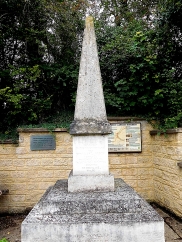
BLACK LIVES MATTERED MUCH to young Thomas Clarkson (1760-1846), who was born in Wisbech, Cambridgeshire. One day when he was walking with his horse from Cambridge to London, he stopped on a slope that was above and in sight of the Feathers Inn at Wadesmill (Hertfordshire) next to a bridge crossing the River Rib on a stretch of the old Roman road known as Ermine Street.

A student at St Johns College in Cambridge, he had just won a prize for his essay (in Latin) that addressed the subject “Is it right to make slaves of others against their will?” Soon after writing his piece, he published an English translation of it. Clarkson, who had done much research into slavery past and in his time, was thoroughly disapproving of the slave trade. The concluding paragraph of his long and well-reasoned essay, rich in factual material, summarises the young man’s objection to slavery:

“For if liberty is only an adventitious right; if men are by no means superiour to brutes; if every social duty is a curse; if cruelty is highly to be esteemed; if murder is strictly honourable, and Christianity is a lye; then it is evident, that the African slavery may be pursued, without either the remorse of conscience, or the imputation of a crime. But if the contrary of this is true, which reason must immediately evince, it is evident that no custom established among men was ever more impious; since it is contrary to reason, justice, nature, the principles of law and government, the whole doctrine, in short, of natural religion, and the revealed voice of God.”

With the Feathers inn ahead of him, he had a revelation. In his own words:

“Coming in sight of Wades Mill in Hertfordshire, I sat down disconsolate on the turf by the roadside and held my horse. Here a thought came into my mind, that if the contents of the Essay were true, it was time some person should see these calamities to their end. Agitated in this manner I reached home. This was in the summer of 1785”

That revelation, like a Dick Whittington moment or the apple falling on Isaac Newton’s head, set Thomas on his life’s mission to abolish slavery. His essay inspired the formation of a small group of Quakers, whose aim was to lobby the British Parliament to campaign against slavery. Soon, this led to the formation of a non-denominational ‘Committee for the Abolition of the Slave Trade’ (in 1787).  Clarkson was a member of this committee. It was he who encouraged the young (and now well-known) William Wilberforce (1759-1833), a Member of Parliament, to join the group.

Although it was Wilberforce who introduced the first Bill to abolish the slave trade in 1791, it was Clarkson, who worked tirelessly to persuade the British public of the desirability to bring an end to the trade in human cargoes. Clarkson travelled about 35,000 miles throughout Britain, amassing information about the slave trade and persuading people of its evil nature. He collected evidence of the cruelties and injustices of slavery from 20,000 sailors who had worked or were working on slave carrying ships. He wrote several pamphlets about the slave trade and its impropriety and assembled visual aids with which he could dramatically purvey its horrors and cruelties to the British public, whom he encountered during his extensive travels.

When, finally in 1807, the Act for Abolition of the Slave Trade was passed by the British Parliament, the poet William Wordsworth (1770-1850) wrote a sonnet in honour of Clarkson’s immense efforts to defeat the slave trade. Called “To Thomas Clarkson On the final passing of the Bill for the Abolition of the Slave Trade, March, 1807.”, it goes like this:

“Clarkson! it was an obstinate Hill to climb:

How toilsome, nay how dire it was, by Thee

Is known,—by none, perhaps, so feelingly;

But Thou, who, starting in thy fervent prime,

Didst first lead forth this pilgrimage sublime,

Hast heard the constant Voice its charge repeat,

Which, out of thy young heart’s oracular seat,

First roused thee.—O true yoke-fellow of Time

With unabating effort, see, the palm

Is won, and by all Nations shall be worn!

The bloody Writing is for ever torn,

And Thou henceforth shalt have a good Man’s calm,

A great Man’s happiness; thy zeal shall find

Repose at length, firm Friend of human kind!”

It was descending the hill to Wadesmill that set Clarkson, the real initiator of the abolition of the slave trade, that set him to “… climb that obstinate Hill…” And his halt near Wademill, in sight of the Feathers inn has not been forgotten. An obelisk by the roadside commemorates Clarkson’s ‘light bulb moment’. The base of the obelisk bears the words:

“On the spot where stands this monument in the month of June 1775 Thomas Clarkson resolved to devote his life to bringing about the abolition of the slave trade.”

The monument was erected in 1879 for a chess playing barrister, Arthur Giles Puller (1833-1885) of Youngsbury, which is close to Wadesmill. According to a web page , http://abolition.e2bn.org/source_27.html:

“In 1833, Basil Montague asked Thomas Clarkson to show a party of abolitionists, the exact spot where he decided to dedicate his life to ending slavery. A young Charles Merivale went with them. Years later he became Dean of Ely and told his story to Arthur Giles Puller, of Youngsbury, who offered to help him fulfil his promise to mark the spot. Charles Merivale unveiled the monument on 8th October, 1879.”

Charles Merivale (1808-1893), apart from becoming the Dean of Ely, was one of the founders of the annual Oxford and Cambridge boat race, which was first held in 1829. Destined for a career in India (which he decided against), he studied both at Haileybury College and St Johns College Cambridge, where Clarkson had also studied.

Clarkson’s monument was restored by members of the US Airforce in the 1950s. in June 1972, it was moved 9 yards up the road to allow some road widening. Finally, in November 2007, a very thorough restoration and repair of the monument was completed. Now in 2020, part of the base looks as if it could benefit from some more repair work.

The monument, unlike many of those that commemorate slave-owners, is a modest memorial to a man whose efforts and achievements have been overshadowed by those of his fellow abolitionist, William Wilberforce. I am very grateful to our dear friends who live in Hatfield (Hertfordshire) for showing me this monument after we had enjoyed a large lunch at the Feathers Inn that Clarkson was able to see when he resolved to bring the slave trade to an end.

The Angel Hotel

BLOG BURY

SOME CLOSE FAMILY FRIENDS used to live in Cambridge. My father had known Cyril S, a ‘don’ at one of the older colleges, since they were both students at the University of Cape Town. Every now and then in the 1960s, we used to be invited to eat Sunday lunch with the S’s in their lovely Victorian house in Cranmer Road. The S family always kept Siamese cats. Their litter tray filled with a greyish coloured gravel occupied part of the black and white tiled floor of the spacious ground floor toilet close to the house’s main entrance. Whenever I used that toilet, I was always afraid that I might step into the litter tray that was usually studded with feline waste deposits. I do not think that I ever did intrude on that part of the cat’s territory.

On one occasion, Cyril invited us to see his rooms in the college. When we were leaving, he said that we could walk across the grassy quadrangle, instead of around it as most ‘ordinary mortals’ must. He told us proudly:
“This is one of the privileges of being a don. I am allowed walk across the grass and I can take my guests with me.”

We could have driven easily straight to Cambridge from our home in northwest London, but we did not. Instead, we used to spend the Saturday night before our Sunday rendezvous in the Angel Hotel in Bury St Edmunds, a small city in Suffolk.

In those far off days, the ivy-covered Angel Hotel opposite the Abbey Gardens was an old-fashioned provincial hotel. The rooms had a curious ‘safety’ feature. The reason I put the word safety in inverted commas will become obvious when I tell you about the feature. Each room had a harness next to its window. The harness was attached to a strong cord, which was connected to a winding mechanism. Had there been a fire, each occupant of a room would in turn fasten the harness around his or her waist, and then climb out of the window. The mechanism was designed to lover the person slowly to the ground outside. The lowered harness could be cranked back up into the room for the next person to escape. Long before we did, the author Charles Dickens stayed at the Angel.

As a child, I could not understand why it was necessary to spend a night in Bury St Edmunds, when the following day we could drive back to London without a stop-over. many years later, it dawned on me that we were not actually breaking a long journey, but it was a way that my parents enjoyed having a night away from home.

Yesterday, the 28th June 2020, we made a day trip to Bury St Edmunds. After eating exceptionally well-prepared fish and chips bought at the amusingly named ‘The Cod Father’ fish and chips shop, run by Bulgarians, we strolled into the centre of the city. The ivy-clad Angel Hotel stands opposite the impressive mid-14th century Abbey Gate. Passing through the Gate tower, one enters the Abbey Gardens. This attractive park is filled with strange looking fragments of what was once a huge abbey complex. Most of them look like oddly shaped piles of stones. They are the rubble cores of what had once been covered with carved masonry. The masonry that adorns the exteriors of mediaeval churches and abbeys is simply a covering for structural cores consisting of rubble and cement of some kind. On some of the fragments in the Abbey Gardens, it is possible to discern the slots into which the carved masonry was placed. However, most of the rubbly remains have disintegrated to become forms that give little clue as to their original shapes.

There is more to the city than the Angel Hotel and the gardens containing the ruins of the abbey. Near the Abbey, there is a cathedral, St Edmundsbury, surrounded by pleasant grounds. At one side of the grounds there is a well-preserved Norman gateway with splendid Romanesque architectural features and a pair of gargoyles that depict serpents with their forked tongues. In the centre of the lawns in the cathedral grounds, there is a fine statue of St Edmund clutching a cross close to his chest. This was sculpted in 1976 by Elizabeth Frink (1930-1993), who was born in Thurlow, which is near to Bury St Edmunds. Frink was a close friend of my late mother. I remember meeting ‘Liz’ at our home, where she was a regular dinner guest.

Seeing the Frink sculpture (for the first time) and the Angel Hotel yet again reinforced my long-held affection for Bury St Edmunds and revived happy memories of the place and our visits to the family of Cyril S, who died suddenly in 1974. His death deprived the world of a lovely man with a great sense of wit and humour.

Some years later, I was staying with Cyril’s widow in Cranmer Road, when she made me a Bloody Mary cocktail. It was the first time I had tried this delicious concoction, and hers was one of the best I have ever tasted.

A sandwich

lgbt

While looking for something to eat on the train between Cambridge and London, I spotted a sandwich in a colourful wrapping (illustrated above). It was a ‘LGBT’ sandwich containing Lettuce, Guacamole, Bacon, and Tomato. Well, the initials ‘LGBT’ usually refer to  ‘lesbian, gay, bisexual, and transgender’. The colours of the sandwich’s  wrapping are those associated with the LGBT ‘community’. 

I wondered whether M&S, the suppliers of this colourfully wrapped sandwich were:

  1. trying to appeal to LGBT customers
  2. trying to be ‘politically correct’
  3. both of the above
  4. neither 1 nor 2
  5. having a laugh at the expense of the LGBT ‘community’
  6. or, all of the above  

Who knows? I did not buy this sandwich, but selected a similar one, the BLT, which lacks guacamole.