Steps down to the water in the well in Surat city

A STEPWELL OR ‘VAV’ (pronounced ‘vaav’) is a well in which users have to descend to the water within it by steps (staircases). The first one I ever saw is a disused vav in the ruins of Vijaynagar in Karnataka. During several trips to Gujarat, we have looked at many other vavs. Some have just one staircase leading to the water in the well, and others have more than one. Because many stepwells are at least partially, if not wholly, subterranean, the structures maintaining their iintegrity are sometimes quite complex – often a series of arches or layers of galleries. Therefore, the architecture of stepwells is varied and often fascinating.

On our second visit to Surat (in early December 2023), we spent a morning looking at two vavs: the Khammavati, and the larger Chatushmukhi. The former is near the railway station, and the latter is a couple of miles away, next to the Gopi Talav (lake).

The Khammavati is about 300 years old. It was established by Kansara a devotee of a goddess of stepwells. It is still used regularly, and is a little difficult to find. To reach it, you have to enter a small, rather rundown looking house. After removing your footwear, you walk through the ground floor room towards a door that leads to a staircase. Its steps lead down to the well. It descends below some brick arches that span the gap between the walls on either side of the steps. Before reaching the water, the steps pass through a chamber containing sculptures of Hindu deities.

The water in the well looked quite clear. A gentleman arrived whilst we were looking at it. After removing a few leaves from the surface of the water, he filled a couple of buckets. He told us that it was “good water”.

The Chausmukhi stepwell

Unlike the Khammavati, the Chatushmukhi vav is no longer used. It was constructed in 1510 AD. Apart from being disused, the structure is in very good condition, which is fortunate because it has an interesting design. The centrally located circular well (now dried up) is approached by four short staircases, each of them is at ninety degrees to its neighbours.

The Chausmukhi vav is beside a circular reservoir, the Gopi Talav. This was first built in about 1610 by Malik Gopi, a wealthy merchant of Surat. By 1673, it had become silted up and of no use as a water source. In 1716, some of its stones were removed to be used in the construction of Surat’s city wall. The Talav lost its former glory. However, in 2015, the city’s corporation restored it, and filled it with water. Today it and the vav form part of a well maintained park – a haven to which one can retreat to escape the noise and bustle of this busy city.

Surat, like Milan in Italy, is a throbbing hub of business and commerce. At first sight, it is, like Milan, not obviously attractive. But on closer examination both cities are studded with historical gems (and in the case of Surat, I am not referring to its famous diamond industry).

Catching rats in Surat, a city in Gujarat

PROFESSOR ROBERT HARKNESS was my PhD supervisor between 1973 and 1977. He and his wife remained my close friends for the rest of their lives. Robert was interested in everything. His was not a fleeting interest, but a deep, enquiring passion. He was fascinated by the contents of hardware shops, especially when making his annual overland trips between the UK and the North of Greece.

During his explorations of these shops, he noticed that the designs of traps for rodents varied from place to place. Many of them were constructed so that the rat or other pest was not killed when caught in the trap. Over the years Robert collected a wide variety of differently designed traps.

The rat trap and the man who made it

Today (the 8th of December 2023) when wandering through one of the many bazaars in Surat (Gujarat), we spotted a metal worker’s shop. On a table outside it, there were a pile of rat traps for sale. They looked like little sheds or garages. At one end of each of them, there was a sliding door. Bait is placed in the far end of the trap. When a creature touches this, the trap door drops down and imprisons it. I do not know what the owner of such a device does with the victim enclosed within it. I suspect that the animal might be killed by drowning.

The owner of the shop said that most of the traps on display were made elsewhere, but he showed us one he had made. As we examined the traps and other ironmongery on offer, I thought how much Robert would have enjoyed visiting this shop.

Faith healing in a well in Baroda

ACROSS THE MAIN ROAD from the 16th century Hazira Maqbara – a mausoleum – there is a small stepwell – the Hazira Vav. We have visited it before but never saw it in use.

A flight of tiled steps leads down to the water in the stepwell. To put it mildly, the water looks filthy and completely uninviting.

At the top of the stairs, there is a small Hindu shrine. The small courtyard surrounding the top of the staircase is decorated with coloured images depicting various Hindu deities. A few coconuts hang between them. These nuts are considered auspicious by Hindus. At our Hindu wedding in 1994, coconuts were included on the complex ceremony, which lasted several hours.

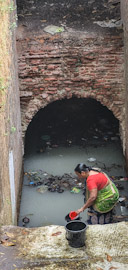
While we were looking at the well, a lady in a sari and her husband arrived. The woman descended the steps to the waters edge. Her husband explained to us that she was suffering from itchiness and that the curative waters of the well might help cure her condition.

The lady picked up one of the bucket on the step beside the water, and filled it from the well. Then, she began dowsing herself with the water. Fully dressed, she poured several buckets of the unwholesome looking water over her whole body.

Having watched this, we felt that it was unlikely that the water itself would heal her, but more likely, it was her faith in its curative properties that might have helped. Having seen the water, my thought was that if one bathed in the well, it is likely that you would end up less healthy than before you entered it.

From revolution to religion and meditation

SRI AUROBINDO (1872-1950) lived in Baroda between 1893 and 1906. During this period, he was an official in the Gaekwad’s government, a professor of English, and the Vice Principal of Baroda College, now the Maharaja Sayajirao University of Baroda.

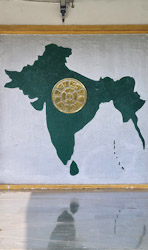
Map at Aurobindo Ashram in Baroda

Today, Aurobindo is best known as a spiritual leader, who spent much of his life in Pondicherry. However, before this he was a keen supporter of ridding India of its domination by the British. During his term as Vice Principal, he began taking an active interest in the growing independence movement.

In 1906, he shifted to Calcutta to become the first principal of National College (now Jadavpur University), which was founded to provide national education to Indian youth. He resigned in 1907 because of his increased involvement in anti-British activities.

In May 1908, Aurobindo was imprisoned for a year because he was suspected of having been involved in the fatal Alipore Bomb case. He was acquitted. During his imprisonment, his interests began to move from revolution to religion. He began practising yoga, and thinking about spiritual matters.

After his release, the British security services kept him under observation despite the fact that his active involvement in nationalist activities was waning. By 1910, he had fled to Pondicherry, which was then a French colony and out of reach of the British authorities. From then on, his activities as a spiritual leader, for which he is best known, took off.

The house where he lived in Baroda between 1900 and 1906 stands surrounded by well tended gardens. It is now known as an Aurobindo ashram. People who believe in him visit the place to meditate and enjoy its peaceful atmosphere.

At the end of one of the gardens, there is a stage. Behind the stage, there is a large map on a wall. It shows the outlines of British India before it became divided into Bangladesh, Burma, India, Pakistan, and Sri Lanka. I do not know when this map was drawn, but it is interesting that it does not depict modern India alone.

As we wandered around the place, I wondered how many of its visitors seeking spiritual solace consider Aurobindo’s earlier less peaceful approach to life.

Smoke and flames in a Muslim mausoleum in Baroda (Gujarat)

THE HAZIRA MAQBARA is an impressive octagonal structure in Baroda (Gujarat). It was built in about 1586 in the Mughal style of architecture, such as can be found in Delhi. This beautiful mausoleum houses the graves of Qutb-ud-din Muhammad Khan who was the tutor of Salim, son and successor of Akbar, and also that of his son Naurang Khan who held important posts in Gujarat under Akbar. There are other graves within the building and also nearby on land near it.

The various graves are covered with colourful cloths upon which red rose heads are placed. The roses are replaced daily, and the cloths every Thursday. This we were told by an elderly man who had been praying loudly within the main central chamber of the mausoleum.

Apart from the beauty of the building and its wonderful jaalis (latticework window screens), I was impressed by some things that I have noticed in many other Muslim mausoleums in India.

Incense stick near some gravestones

Within the mausoleum and close to the graves outside it, there were incense sticks (agarbatti) burning, releasing small clouds of fragrant smelling smoke. Within the mausoleum, I spotted at least two oil lamps (diyas), each with small flickering flames.

Agarbatti and diyas are commonly found in Hindu temples, and often at the beginning of the day in shops, restaurants, etc. I first noticed them being used in Islamic settings in India in Sufi dargahs (shrines containing graves) in Bangalore when going on excellent guided walks led by my friend Mansour Ali. Later I begun noticing these things, which I had initially assumed were only associated with Hinduism, in places associated with Islam. I have discussed this commonality of Hindu and Muslim practices in one chapter of my new book about travels in India, which is available from Amazon (eg https://www.amazon.co.uk/HITLER-LOCK-OTHER-TALES-INDIA/dp/B0CFM5JNX5/ ) AND if you live in India, from https://store.pothi.com/book/adam-yamey-hitler-lock-and-other-tales-india/ .

Other chapters in my book about my experiences of visiting India cover a wide variety of subjects. The book, which is aimed both at those who ‘know’ India and those who do not, is both informative and entertaining.

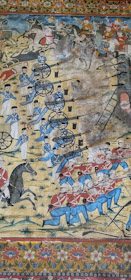
British soldiers on the wall in a house in Baroda

BY THE VERY EARLY 19th century, the armies of the Marathas had been beaten by the armed forces of the British East India Company. After this, from 1805 onwards until 1947, the State of Baroda was ruled by a Hindu Maratha dynasty – the Gaekwads of Baroda. Put simply, the Gaekwads controlled the internal affairs of the state in such a way that British interests were not damaged, and the British controlled the external affairs of the state.

Between 1849 and 1854, Bhau Tambekar (Vithal Khanderao) was the Diwan (prime minister) of Baroda. He lived in a large building, which was probably constructed in the early to mid 19th century. Known as Tambekar Wada, this typical Maratha-style mansion has three storeys and surrounds a courtyard. Currently, the first floor of the front (eastern part) of the building is the only part open to the public.

The part of the building that can be visited is a long rectangular hall with a wooden jaali (perforated screen) near one end of it. The walls of this room are covered with beautiful detailed paintings from floor to ceiling. Many of them depict scenes from the Mahabharata, Ramayana, and Hindu religious images. However, the north wall of the hall is even more fascinating.

Most of the north wall is covered with a mural depicting a battle between the British East India Company and the Marathas. Most of the picture shows features of the British forces in great detail. There are even several flags that resemble Union Jacks. Some British soldiers, dressed in red uniforms, can be seen riding elephants. Whoever painted this wall had a good eye for both detail and representation of battles.

On the same wall as the battle scene, there are several smaller paintings depicting European men and women. On one of these, a woman in European garb seems to be consoling another woman. In another, a man wearing a red jacket is looking at a European lady affectionately.

The purpose of the painted hall is not known for sure. It has been suggested that it was for entertaining guests. The small part enclosed by the screen might have been reserved for ladies. In its heyday, purdah would have been observed in the house. The hall has a set of windows through which one can access a narrow balcony that extends along the entire length of the eastern side of the house. This terrace has a perforated screen through which people on the balcony could look out onto the street without fear of being seen by passers-by.

Although this December (2023), we are enjoying our fourth visit to Baroda, we would not have known about the Tambekar Wada had our friend Nandita A not told us about it. I am very pleased that she introduced us to this gem hidden within the narrow backstreets of Baroda’s Dandia Bazaar district.

Africans in a royal procession in Kutch painted in 1876

WHAT REMAINS OF the Aina Mahal Palace in Bhuj (Kutch, Gujarat) after the powerful earthquake of 2001 is now open to the public as a fascinating museum. One of its many remarkable exhibits is a painting, which is 15 metres long and 22 cm wide. Painted in 1876 by Mr Juma Ibrahin Wadha, it depicts in minute detail a Kutch State parade during the reign of Maharao Pragmalji II, who was on the throne between 1860 and 1875.

The faces in the painting are all portraits of individuals – actual depictions, not stylised images. The degree of detailing is superb – almost photographic, yet still artistic.

Amongst the many faces that can be seen on the painting are several which have unmistakably black African features. They are all soldiers dressed in armour and guarding the Maharani, the Maharao’s queen. It is possible that they might have been eunuchs, but detailed as the picture is, this cannot be ascertained by examining it!

Black Africans travelled to India (mostly as slaves) from East Africa to Gujarat and Kutch during the 14th to 17th centuries. Mainly of Bantu descent, many of them converted to Islam. Some of them rose to high positions in society. For example, one of them became a general, who founded the Sidi Saiyedd mosque in Ahmedabad. Their descendants are known as members of the Siddi community. Known as Sheedhi in Pakistan, there is apparently a significant number of them in Lowe Sindh and Karachi. Currently, there are about 50000 Siddis in India, of which about one third live not in Gujarat but in Karnataka.

There are many other interesting details on the picture of the parade, but it was the depictions of Siddi soldiers that particularly caught my attention.

Art, Alembic, and brewing in Baroda

THE SINGER LATA MANGESHKAR (1929-2022) has only ever appeared in one advertising film. It was for a medical product, a cough syrup, called Glycolin. This stuff was manufactured by the Alembic pharmaceutical company of Baroda, founded in 1907. In 1960, it was the first company to manufacture penicillin in India. Under the leadership of the Amin family, Alembic produces a wide variety of pharmaceutical products.

The company owns a huge ‘campus’ in north Baroda. This has been named Alembic City. Part of it, which contains repurposed former factory buildings, has been developed to create an art hub, which has been named Alembic Art District.

Alembic Art District

The Art District contains a museum that illustrates the history of the Alembic company. Other buildings house artists’ studios. These are given free of charge to selected artists who have applied for them. There is also gallery space.

A food court has been created. Nearby, there is a good Japanese restaurant (called Bento B). Next door to this is The Brewery.

Those who are familiar with Gujarat will know it is a teetotal state – sale and consumption of alcohol is forbidden. So, what is with The brewery? Well, it is a brewery, but alcohol is not brewed here. It is a kombucha Brewery. We sat in the stylish restaurant within The Brewery, and enjoyed the best kombucha I have ever tasted.

Like the Tate Modern and the Battersea Power Station, both repurposed former industrial sites, Alembic Art District contains remnants of its former existence. However, the resulting environment that has been created is much more delightful than the two places in London mentioned above.

A slow journey in the west of India

OUR JOURNEY FROM Bhuj to Baroda (Vadodara), both in Gujarat, began yesterday at 650 am and ended at our hotel just after 8 pm. The distance we travelled was about 265 miles. There are direct trains between Bhuj and Baroda, but these were fully booked on the day we wanted to travel (i.e., 30th November 2023).

The first ‘leg’ of our journey was on a train that carried us from Bhuj to Sabarmati Junction – one of Ahmedabad’s several railway stations. The other passengers in our compartment were 4 young girls and a couple of young men returning to university after their Diwali break. We noted that the girls talked to each other. So, did the boys. But the girls and boys did not converse with each other and showed no interest in each other. The train rattled at high speed through the flat countryside and arrived at Sabarmati only about 8 minutes late. Unlike many Indian trains I have been on, the Bhuj to Sabarmati Superfast had no vendors wandering up and down the train.

It is a few miles between Sabarmati Junction and Ahmedabad’s centrally located main station. We hired an autorickshaw to take us between Sabarmati Jn and the Moti Mahal restaurant near the main station. Our driver tore through the heavy traffic narrowly missing numerous collisions. The eatery proved to be a scruffy but extremely popular place – noisy and lively. We enjoyed a good light lunch before walking to the station.

Although it was only about 200 yards between the restaurant and the station, it was necessary to cross an incredibly busy road with fast moving vehicles. We asked an autorickshaw driver if he would drive us there. He refused, but kindly offered to help us across the road, which resembled a disorderly road race. Using his arms like a traffic policeman he shepherded us across the thoroughfare. Even with his help it was a hair-raising experience.

We had to wait for our next train for about two hours on platform 6. The train we were about to catch was the Porbandar Shalimar Superfast. This train leaves Porbandar in Saurashtra (part of Gujarat) at 850 am on day 1 and arrives at Shalimar (a station in Calcutta) at 3.35 am on day 3 – having travelled a distance of 2544 km. Our journey on this train lasted just under two hours, arriving in Baroda about 20 minutes late.

She sells mats to passengers in the train

Unlike the train from Bhuj, the train to Shalimar was well populated by vendors. The seemingly endless procession of sales people were offering: bottled water; hot tea; snacks including biryani and bhel poori; bags of apples; and mobile phone chargers and cables. One lady in a colourful sari was selling attractive square mats at 10 Rupees each. Every now and then, a deformed invalid literally scuttled along the filthy floor of the corridor. He stopped at each compartment and banged his collecting pot ominously on the ground. Only a few passengers gave him coins.

The sun had set when our train pulled out of Ahmedabad. Through the open window, I saw many small villages, many of them with Hindu temples adorned with coloured lights – many of them flashing decorously. I could also see many brightly lit shops. Within the train, I had an excellent view of the door to one toilet. Even when it was closed it vibrated furiously as the train sped along. Many passengers peered inside the loo, but few dared to enter it.

The train seemed to travel even faster than the one from Bhuj, and it was a relief to disembark in Baroda’s lovely station. After another autorickshaw drive, we arrived at our comfortable hotel. Our reception there was a little reminiscent of an episode from “Fawlty Towers”. Once this was, over, things went smoothly and we enjoyed a good dinner in its dining room.

A wonderful little bookshop in Baroda

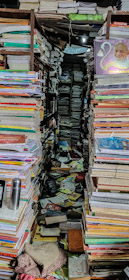
A FEW MINUTES WALK from our hotel in BARODA (Gujarat) brings you to Patel Bookstore. The owner of this small bookshop stocks ‘pre-loved’ (not ‘secondhand’) books. Some of them are arranged on surfaces under the verandah in front of his shop and on its counter. The rest of them are on shelves and on the floor of the part of his store behind the counter. The shop has a chaotic appearance, but I am sure Mr Patel knows what he has in stock.

Mr Patel, a friendly gentleman, has a huge stock of books in English – much fiction and slightly less nonfiction. He also sells books printed in Gujarati.

The owner of the shop is happy to buy back books you have bought from him. When you make a purchase, he writes the price you paid in the book, and how much he would be prepared to buy it back when you have read it. He is also happy to buy other volumes that you wish to dispose of.

Even though I could not see many books that appealed to me, I love visiting idiosyncratic bookstores like that run by Mr Patel.