
Morning light
Shining through leaves on a tree
Shadows thrown upon a wall

Morning light
Shining through leaves on a tree
Shadows thrown upon a wall
THE MUSEUM OF ART and Photography (‘MAP’) on Kasturba Road is a relatively new addition to Bangalore’s cultural scene. When it opened in February 2023, we were amongst its first visitors. Privately financed by the Poddar family, it is housed in a recently constructed edifice. I prefer the appearance of its interior to that of its exterior.
MAP describes itself as a museum of art and photography. The institution is home to a large collection of photographs created over the many years since the technique was invented. Much photography is in my opinion also art. However, the present exhibition at MAP, which is on until the 24th of March 2024, combines a traditional art form – painting – with photography. The show is called “What the camera didn’t see”.
The British born artist Alexander Gorlizki (born 1967) , who holds a higher degree from the Slade School of Art (at University College London) and now works in NYC, has teamed up with Pink City Studio – a group of miniaturist painters in Jaipur – to present historic photographs in a new light.
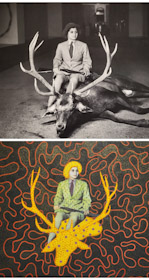
The exhibition at MAP consists of several old photographs from the museum’s collection and new reproductions or prints of these vintage images. Gorlizki and his colleagues have taken the reproductions and painted over them in the traditional Mughal miniature style, but leaving faces in the photographs uncovered by paint.
The resulting ‘doctored’ photographs are mostly quite whimsical and witty. The highly imaginative ideas of the artists are skilfully and beautifully superimposed on the reproductions of the old photographs. Thus, the art of the original photographers has been metamorphosed by contemporary painters in Jaipur in collaboration with their curator, Alexander Gorlizki. The results, which are on display at MAP, are both amusing and most pleasing aesthetically . This is an exhibition well worth seeing.
THE AUTHOR CHETAN Bhagat was born in 1974 in New Delhi. He was educated at two prestigious institutions: Indian Institute of Technology (Delhi) and the Indian Institute of Management (Ahmedabad). After graduating he had various jobs including working at the Hong Kong office of the bankers Goldman Sachs. There, he was unhappy with his boss, whom, according to Wikipedia, he:
“ … characterized the villain in his second novel One Night @ the Call Center.”
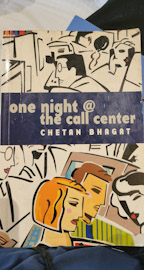
The novel about the call centre was first published in 2005. The villain is Bakshi, the head of a department of a call centre that services customers in the USA. As its title suggests, the book is about one night at the call centre and its main characters are five young people working under Bakshi. I will not give the plot away, but I can tell you that the story is both entertaining and, in parts, profound. All that I will reveal is that the problems that the five workers are experiencing and described in the novel become insignificant after they receive a telephobe call … from God. But, do not worry: the book is not a religious tract. The book deals with many things, including the perception that some young Indians have: that their country is inferior to the USA.
Chetan Bhagat is a highly creative and imaginative story teller. His plots are rich in unexpected twists and turns. He has a great eye for detail and a good understanding of the minds of young Indians and they way they perceive today’s world.
Recently, a couple of people suggested that Bhagat’s humour is inadvertent rather than intentional. I completely disagree with this point of view. He concocts humorous situations in his novels with great care and expertise, and inserts them in his stories skilfully. Like Chinese sweet and sour dishes, Bhagat’s novels contain a harmonious blend of humour and seriousness, both complementing each other intelligently.
What I particularly enjoy about Bhagat’s writing – and by now I have read four of his novels – is his easy-going narrative style. As I read his books, I felt as if he was a good friend sitting and chatting with me in a bar or cafe. His books are easy to read yet full of profound observations about life, expressed effectively but with a light touch.
IF YOU HAVE ONLY a short time to look at Bangalore, there is one place that you must try not to miss. I am not referring to Tipu’s summer palace or the Bull Temple or Lalbagh Garden or Cubbon Park or many of the other oft-mentioned places in the city. My first choice of ‘must-see’ places is the Bangalore NGMA (National Gallery of Modern Art), which is located on Palace Road.

The NGMA opened its doors to the public in February 2009. It is housed in the elegant former Manikvelu Mansion and the beautiful modern extensions that have been added to it in such a way that the beauty of the old building has not been impaired.
The NGMA stands Inn spacious grounds with a landscaped garden. Within the garden, there are modern sculptures – part of the NGMA’s permanent collection.
The modern extensions contain galleries for displaying artworks, a shop, an auditorium, a library and a very pleasant café under a deep veranda. Even if you have little interest in seeing artworks, the harmonious ensemble of architectural styles is well worth seeing.
The galleries, located both in the old mansion and on the new extensions, are well lit and vary in size. Usually, some of the permanent collection is displayed as well as an often fascinating temporary exhibition. Currently (January 2024), there is a wonderful temporary exhibition of paintings by the Bengali artist Nandalal Bose – I will write about that soon.
Situated not far from bustling Shivajinagar and busy Cunningham Road, the NGMA is a peaceful haven – a place to enjoy some of the best of modern Indian art. In a city where so many modern developments are of dubious aesthetic value, the NGMA on Palace Road is a feast for the eyes.
WE NEEDED TO TRAVEL in an Uber cab from Bangalore’s Catholic Club to the Bangalore Club – not far, but we had heavy baggage. A uniformed security guard kindly agreed to book a cab. He was, he told us, from Assam – a member of the large Assamese Bodo community.
Before he ordered the taxi, he looked at us – a European man and an Indian lady, and asked us if we needed one car or two. My wife explained that we are married, and only needed one car.
I believe that the reason the guard asked us how many cars we required was that, coming from a traditional community at the Eastern edge of India, it must have seemed unlikely to him that people from totally different communities, such as my wife and I, would ever become joined in matrimony.
I was struck by his enquiry because when we have travelled in many parts of Gujarat, people have often expressed surprise, and even disbelief, when they learn that a ‘desi’ (Indian) woman has married a ‘gora’ (pale coloured) such as I am. I have described this kind of incredulity in great detail in my book about travelling in India: “The Hitler Lock and Other Tales of India”, which is available from Amazon:
https://www.amazon.co.uk/HITLER-LOCK-OTHER-TALES-INDIA/dp/B0CFM5JNX5/
UNTIL RECENTLY, PHOTOGRAPHY was not permitted in the Bangalore branch of the NGMA (National Gallery of Modern Art). On a recent visit in January 2024, we discovered that photography was now permissible.

I have been visiting the NGMA regularly since it first opened a few years ago (2009). Each time I have been, with one exception, I have noticed a painting by Lawrence Alma-Tadema (1836-1912). It depicts a lady leaning over a parapet beside a lake with mountains in the distance. It bears the title “At the Close of a Joyful Day”. It is currently hanging on a wall beside several portrait paintings by a Parsi artist named Pithawala. I have always wondered how this painting by Alma-Tadema has ended up as part of the collection of India’s NGMA.
According to an article published in “American Art News” (New York, 25th of April 1908), the painting had been the part of the “Coghill collection” and had sold at London’s Christie’s auction house for £966. The purchaser was not mentioned. I have not yet discovered anything relevant about the above-mentioned collection.
In connection with the sale of a painting by Alma-Tadema in 2019, the Sotheby’s auction house website mentions a letter that Alma-Tadema wrote in 1894 to the German egyptologist George Ebers. Here is an interesting excerpt from the website:
“… Alma-Tadema commented of one of his compositions, “It is a single figure girl, which has ascended to the highest point of a building to see far away out of the picture over some sort of Starnberger See, a second use of the study I painted when with you mingled with recollections… so you see my mind is still often with the dear friend at Tutzing” (letter from Alma-Tadema to Ebers, December 29, 1893, as quoted in Swanson, p. 77). While he is referring to ‘At the close of a joyful day’ (1894 …), the artist could just as easily be describing the mis-en-scene of the present work.” (That is the work in the auction.)
This essay, published to accompany an auction held in New York in February 2019, mentioned that “the current location [of ‘At the Close of a Joyful Day’] is unknown”.
Well, at least, I know where to find it.
What I would really like to know is how the painting reached India. Who owned it after it was sold in 1909, and how did it end up in the NGMA collection.
[The painting’s NGMA accession number is 02186]
ONE OF THE MANY things that fascinates me whenever I visit India is what often appears in one brief glance. It is far from unusual for there to be in one field of vision both something that has been in existence many centuries, or even milliennia, alongside something that is brand new.
Yesterday, I was enjoying lunch in Bangalore’s Kamath Hotel near Commercial Street when I looked up and saw the following reflected in a mirror. A man was sitting working on the restaurant’s computer – probably 21st century technology. Above his head, there were idols depicting Hindu deities, which were in place because the management hoped that their divine influence would benefit the business.
Whereas the computer is but a few years old, the abiding belief in the importance of the Hindu deities in the smooth running of life has been around for much longer than anyone can remember.
WE HAVE STAYED in the guest accommodation at Calcutta’s Tollygunge Club several times. On our most recent visit, I spent a few minutes looking at the boards on which the names of the Club’s past Presidents are listed.

Between the year in which the Club was founded – 1895 – and 1968 – twenty-one years after Indian Independence- all of the Presidents had British surnames.
In 1969, the post was held by Brigadier RB Chopra. His surname is Indian. He was succeeded in 1970 by HA Whittle – someone with a British surname. Mr SP Achary, who was the next President (in 1971) had an Indian surname.
Mr Achary was followed by CJN Will CBE in 1973. Thereafter, most, but not all, of the Presidents had Indian sounding surnames. An exception was the President in 1979, who was AWG Macintyre, CBE. He was a senior executive in the Dunlop tyre company.
Seeing all of these Presidents with British surnames holding their positions so long after India became independent got me wondering. Already I knew that even after independence, some private clubs and other institutions in India restricted admission to Europeans and refused entry to all but a very few Indians. I became curious to know when the Tollygunge Club began welcoming Indians as members. The answer is that the colour bar was lifted in 1961. Indians were then admitted as “Associate Members”. They had no voting rights. The first non-white Associate Member was the then Japanese consul. In 1967, the first batch of 30 Associate Members (I.e., Indians) were made Permanent Members. The first Indian President, Brig. Chopra was amongst this batch.
Various factors must have swayed the Club towards admitting Indians. One of these might have been the slowly declining British presence in Calcutta. Another was more serious. Cutting a long story short, in the late 1950s, the West Bengal government, acting to some extent on guidelines from Central government, began to question the future of the elite clubs of India.
The government of West Bengal drew up a plan to construct a housing estate on the extensive grounds of the Tollygunge Club golf course. The clubhouse would have then been converted to some kind of communal amenity. These plans caused great concern to Calcutta’s British community. This plan was aborted. I have heard one explanation of why this happened, but it would be best if I do not reveal it.
Declining Club revenues and increased taxation must have also led to the Club enlarging its membership by accepting Indians as full members. During the very early 1970s, my father-in-law, a senior executive in a large company, was offered membership by the Tollygunge Club. He turned down the offer because he was reluctant to join a club that had refused membership to Indians for so many years after India became independent.
It is fortunate that the Tollygunge Club with its lovely grounds has survived because, although still quite exclusive, it is a wonderful place to relax and make new friends.
OUR TAXI PULLED up outside the departure section of Calcutta’s huge airport terminal on the 20th of January 2024. We were dismayed to see the extremely long lines of people waiting with trolleys laden with assorted baggage. They were all waiting to pass through the police security check points to enter the terminal.
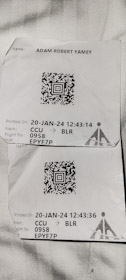
We soon realised that even if we were to have been at the head of one of these queues, we would not have been able to pass through the checkpoint without having first registered with DijiYatra.
If you have not flown from an Indian airport recently, you will be as puzzled as we were. DijiYatra is an electronic system depending on AI facial recognition to allow passengers to pass the various checkpoints on their way to the ‘plane without having to keep on showing paper documents at each point.
An app exists for DijiYatra, but we did not have this on our telephones. Looking perplexed, an airport official working for our airline, Indigo, led us to some electronic terminals. A man standing by it entered our PNR code, and took pictures of our faces. Following thus we were each handed small flimsy squares of paper bearing our names, flight details and a QR code. We were directed to a policeman standing nearby.
The policeman scanned our DijiYatra paper slips and checked our passports against the faces now recorded in the system. After this, we were sent to one of the checkpoints next to the entrance to the terminal. There was only one person in front of us. After having our small paper slips and our faces scanned, gates opened and we could proceed to the baggage drop-off counters.
At another checkpoint at the entrance to the security checking area, we scanned our DijiYatra slips once again. When the system matched the slip to a scan of our faces, we proceeded into the security control area.
The idea behind DijiYatra is to reduce the use of paper checking and to replace it by facial recognition systems. All well and good, but in our experience the system did rely on keeping two easy-to-lose tiny bits of paper. I guess that had we downloaded the app, the paper slips would not have been required.
What puzzled me were the long queues. Everyone in them had registered for DijiYatra.
TODAY, MY SHOULDER bag broke suddenly whilst on my way to Calcutta’s New Market – one of my favourite shopping districts. Humayun Place, which leads from Chowringhee to one side of New Market, is lined with pavement vendors. We stopped at one selling bags, and asked to see one that I hoped might be a suitable replacement for the bag whose strap had just broken.

The bag was ‘ok’ but not ideal. We asked the price, and were quoted 950 rupees (about £9.50). We told the seller that seemed too much for such a bag. We told him that we had paid about 500 for the old bag less than a year ago. Hearing that, he said we could have it for 500, and as he spoke those words, he put it into a plastic carrier bag.
I was still not sure that this was the ideal replacement, and we began to walk away. The seller then offered us the bag for 400, saying that if we bought it would be his ‘bohni’ for the day. Hearing that and feeling that the bag was worth 400, we purchased it.
In India (and Pakistan), the custom of bohni is commonly observed. The bohni is the vendor’s first sale of the day (or at the start of some other defined period of time). Many shopkeepers believe that the bohni establishes the success of his or her business during the rest of the day.
So, one of the risks faced by those who shop soon after the stores or stalls open is they will be made to feel that they ought to buy something in order not to jeopardise the vendor’s success during the rest of the day. For, being the first to enter a shop or halt at a stall without purchasing a bohni is a bad omen for sellers.
Although I am sure most vendors who tell you that by making a purchase you are doing the bohni for the day are bona fide, there must be a few who try to achieve a sale by saying it is the bohni when it is not.
 yamey
yamey 