FURNIVALL GARDENS IS a pleasant grassy open space that lies between the busy Great West Road (part of the A4) and Hammersmith’s riverside at Lower Mall. The park was created as part of the Festival of Britain (1951). Prior to WW2, the area upon which the garden now stands was mostly occupied by industrial premises and slums. Part of this area was occupied by the Quakers (of Hammersmith) Friends’ Meeting House and its adjoining Friends’ burial ground. A little bit of the land owned by the Quakers is now covered by the carriageways of the A4. The Quakers gave up their land to Hammersmith Borough Council when they were planning Furnivall Gardens.
There have been Quakers living and worshipping in Hammersmith since 1658 (see: https://hammersmithquakers.org.uk/history/). In 1677, they built their first Meeting House at number 28 Lower Mall near Hammersmith Creek (now covered up), which used to run along the western edge of what is now Furnivall Gardens. This tributary of the Thames ran through a very poor area of Hammersmith. In 1765, the meeting House was rebuilt and remained in use until a few years after the Creek was covered over in 1936. On the 24th of July 1944, this venerable Meeting House was destroyed by a flying bomb.
I have walked through Furnivall Gardens many times, but it was only today (the 18th of February 2024) that we took time to look at a noticeboard with its history. My wife noticed that the former Quaker Meeting House and burial ground are mentioned on this informative board. It indicated an area of the Gardens, where a memorial stone can be found. The simple monument in an area walled off from the rest of the park is surmounted by a circular metal plate on which the following words are inscribed:
“This garden is on the site of the Friends’ Meeting House and burial ground 1765-1944”.
It is an unassuming little memorial, which you might not notice if you did not know it existed. It has taken me several decades to become aware of it. I have driven along the stretch of the A4 that runs alongside Furnivall Gardens many times. And until today, I had no idea that my car’s tyres were racing over land where once Quakers were buried.
BERMONDSEY STREET IS only about 500 yards in length, and about 200 yards of it runs under the railway tracks and has no shops, eateries, or any other outlet open to the public. The remaining 300 yards of this thoroughfare is a delight to visit. It is lined with numerous cafés, restaurants, and a couple of pubs. In addition, there is a good picture framer, several art galleries, some fashionable shops, a church, and a museum of fashion and textiles. There are also a couple of open spaces – small parks. Apart from the magnificent Caphe House – a superb Vietnamese restaurant, one of my favourite places on this street is London Glassblowing (see: https://londonglassblowing.co.uk/).
London Glassblowing is a gallery dedicated to the display and sales of artistic glasswork creations. It was founded by Peter Layton, who was born in 1937 in Prague (then in Czechoslovakia). Fleeing the Nazis, his family moved to Britain in 1939. They settled in Bradford near his grandfather, a pathologist who was a colleague of Sigmund Freud. Initially specialising in ceramics, Peter went to teach at the University of Iowa in the USA. While he was there, Peter soon became fascinated with glass and studied in the institution’s glass blowing programme. After his return to the UK, where artistic glass blowing was not yet highly developed or even highly regarded, he opened the London Glassblowing Workshop in Rotherhithe in 1976. After moving to several different locations, it arrived at its present home on Bermondsey Street.
In addition to displaying fine works of art made with glass, visitors to the gallery can watch the glass blowers at work. This is fascinating to see. When we visited yesterday, the 16th of February 2024, there was a group of young children watching the glass blowers at work. A gentleman was patiently explaining what the glass blowers were doing and how they were achieving the exquisite multicoloured vase they were making. It was only when I got home that I realised that the person explaining was none other than Peter Layton.
MR HUSSAIN WAS a charming old gentleman full of ‘joie de vivre’, even when infirmity confined him to his bed. A retired businessman, we knew him as ‘Mahomet Uncle’. He was a Kutchi Memon (a Muslim whose ancestors had migrated from Kutch – now a part of Gujarat – to Karnataka). He was immensely popular. His many friends and relatives used to visit him to enjoy his company and to share their news. Once, near the end of his life, we went to his house to wish him ‘Eid Mubarak’ at the end of Ramazan. While we were in his bedroom, where he used to ‘hold court’, a seemingly endless stream of people passed through his front door to celebrate the occasion with him. His death was a great loss not only to his family but also to a vast number of people in Bangalore, who knew and loved him.
We were introduced to Mahomet Uncle by one of his sons who was studying in London at the same time as my then future wife, Lopa, and I were undertaking post-graduate courses. Mahomet Uncle lived in a house on Aly Asker Road Cross, a quiet lane close to the busy Cunningham Road. The Cross road is an offshoot of the larger Aly Asker Road. We have often travelled along this thoroughfare, not only to visit Mahomet Uncle but also other friends who live close by. In addition, when returning from the excellent Shezan Restaurant (on Cunningham Road) to the Bangalore Club, where we often stay, the best route is along Aly Asker Road.
For many years, I have wondered about Aly Asker and why a road should have been given his name. The answer was provided only recently, at the end of January 2024 just before we flew from Bangalore back to London. My friend Subhash Agarwal, with whom I often enjoy an afternoon cup of tea on the lawn in front of the main building of the Bangalore Club, knowing of my interest in the history of Bangalore, kindly presented me with a book, which has the title “Agha Aly Asker”. Published in 2019, it was written by Syeda Mirza, the wife of Aly Asker’s great grandson. The book is well-researched and a pleasant, compelling read. Apart from detailing his life, the author gives many insights into the traditional Persian ways of life.
Aly Asker, a Persian, was born in Shiraz (Persia) in 1808. In 1824, along with his two brothers, he set off for India to sell horses to the British military. They travelled with 200 horses by sea to Mangalore, and then travelled overland to Bangalore. The brothers left him and the horses in Bangalore, where he began selling them to the army of the East India Company. The business was successful, and he imported more batches of horses to sell. Ali Asker became a successful businessman and was befriended by Sir Mark Cubbon (1775-1861), who was the Chief Commissioner of Mysore between 1834 and 1861. Amongst Cubbon’s many achievements were the introduction of Kannada and Marathi as the official state languages, instead of the formerly used Urdu, Hindi, and Persian.
Cubbon was very fond of horses, and is said to have had up to 60 in his stables. His equestrian interests helped develop his friendship with Aly Asker. As a result, Cubbon asked Aly Asker, who had already built himself a fine bungalow, to build 100 bungalows to accommodate the growing military establishment that was developing in Bangalore. Cubbon offered the land free of charge, but Aly Asker told him that he was happy to pay for it, which he did. The residences were constructed on land near today’s Palace Road, Sankey Road, Cunningham Road, and Richmond Road. Many of these houses no longer exist – Bangalorean property developers seem to value heritage far less than profit. One notable example that still stands is the Balabrooie State Guest House. Aly Asker also owned the land on which the luxurious Windsor Manor Hotel now stands.
Aly Asker’s interest in horses extended beyond trading, He was keen on horse-racing, and is said to have been important in putting Bangalore on the horse-racing map of India. His biographer, Syeda Mirza, includes an appendix in which the many victories of Aly Asker’s horses are listed. He was a frequent visitor to the racetrack in Bombay, and then later in Bangalore.
It was their interest in horses that drew together Aly Asker and another noteworthy person in Mysore State – Mummadi Krishnaraja Wodeyar III (1794-1868), the 22nd Maharajah of Mysore. It was through Aly Asker’s help that the British were encouraged to allow the Maharajah’s adopted son Chamarajendra Wadiyar X (1863 – 1894) to become his successor on the throne. Initially, the British, who effectively ruled the state, were reluctant to recognise him as the successor, and it was partly due to the gifts that Aly Asker chose for Queen Victoria that changed their mind in his favour.
Aly Asker died in Bangalore in 1891. He is buried in a cemetery near to the city’s Hosur Road. This is a Persian Cemetery that stands on land granted to Aly Asker and his heirs in 1865. His simple grave is beside that of his wife, and is shown in in a photograph in Mrs Mirza’s book. She noted that he established Bangalore’s first Shia Muslim community. It was when he married Sheher Bano that the first Muharram rituals were first observed in the city. In his will, Aly Asker left money to build the Masjid-e-Askari. It was built in 1909, and still remains as the city’s oldest Shia mosque.
So, having read Syeda Mirza’s book, I now know why there are roads in Bangalore named after Aly Asker. In addition to detailing his life in, and contributions to, the development of Bangalore, Mrs Mirza also described the exciting journey that Aly Asker made between his native land and India. Oddly, Aly Asker does not appear in the index of the authoritative history of Bangalore. “Bangalore Through The Centuries” by M Fazlul Hasan (publ. 1970). In a later (2014) comprehensive history of the city, Maya Jayapal makes one mention of Aly Asker Road, but gives no description of Aly Asker’s contribution to the story of Bangalore. It is therefore valuable that Syeda Mirza took the trouble to write about Aly Askar. As her book bears no ISBN number, and I could not find it either on Amazon or the much wider ranging bookfinder.com, it might well have been privately published, and is now probably quite a rare volume. I am very grateful to Subhash Agarwal for gifting me this informative book – a window on a hitherto poorly described aspect of Bangalore’s history.
ONE OF THE MANY advantages of living close to central London is that it does not take long for us to reach the numerous commercial art galleries in Mayfair and Marylebone. Many of these hold exhibitions of modern and contemporary art, which is often fascinating to see. My mother was a sculptor, many of whose works were abstract rather than figurative. Being brought up in close proximity to someone so interested in the contemporary art world (of the 1960s and 1970s) might well have been a source of my lifelong interest in seeing works of contemporary artists (as well as modern artists who no longer live). My enthusiasm for viewing art has been enhanced by two people close to me. My wife has always had an interest in art in general and ‘modern art’ in particular. Our daughter, who works in the world of art and its propagation, has added to our enjoyment of experiencing artistic creations by recommending galleries with exhibitions that often prove to be most fascinating.
Recently, our daughter suggested that we see an exhibition, “As Above So Below”, by an artist with whom she is working. Creations of British born Tania Kovats (born 1966) are being displayed at an exhibition in a small Gallery, Parafin, in Woodstock Street (close to Bond Street Underground station) until the 24th of February 2024. Although she is known for her work in a wide range of artistic activities, she best known for her drawings and sculptures. The present exhibition includes many drawings and a few sculptural creations. The gallery’s ‘flyer’ (or handout) explained that:
“… Kovats’ enduring themes are the experience and understanding of landscape, geological processes, patterns of growth and the intersection of landscape, nature and culture and how art can speak to our critical climate crisis.”
This summarises what the artist is trying to convey with her artworks. Everything on display at the exhibition was pleasing visually and meticulously executed, but just by looking at the works I was unable to grasp anything about them but their beauty. Fortunately, the gallery’s flyer helps to explain the artist’s intentions.
Many of the works on display relate to the sea and evoke it beautifully. One exhibit, also connected with the sea, was a series of images of numbered, but un-named, graves of 20 migrants who lost their lives crossing the sea from Africa to the Italian island of Lampedusa. Near this artwork, there was another work – a line of used school shoes. This is Tania’s memorial to her son’s childhood, and (to quote the flyer):
“… explores how growth houses loss, and is built into the child’s progress towards individualisation.”
The passage of time is depicted in another work in the exhibition, “Luna”, in which a series of pictures depicting the phases of the moon as they change during a lunar month.
I am very pleased that our daughter recommended this exhibition by an artist, who we had not encountered before. Although I greatly enjoyed the exhibition, now that I write about it and reflect on what I saw and read, I feel that I would like to see the show once again because at a second viewing I will gain much more from it than during my first visit.
MY LATEST BOOK, “The Hitler Lock & Other Tales of India”, is mainly aboutmy very varied and fascinating experiences of travelling in India and only a little bit about Adolf Hitler. Here is a brief excerpt from the book:
Some say that when he was a young boy at school, India’s Prime Minister Narendra Modi helped in his family’s tea stall. Although he never became a chaiwallah, I have met one tea maker who became actively involved in politics. He was the owner of Chai Day Teahouse in Bangalore’s Johnson Market. I visited his establishment a couple of times in 2016, but when I looked for it four years later, it had disappeared.
Chai Day was more of a café than a tea stall. It had tables and chairs within its premises. What struck me immediately was that the walls of the seating area were covered with slogans, such as “Don’t promise when you are happy. Don’t reply when you are angry. Don’t decide when you are sad.”, and “We are not use less. We are used less”, and “Thanking you your faith for Syed Arif Bukhari.” The latter refers to the name of the owner, and the fact that he used to, and may still, put himself forward for election to positions, including MLA, in the Government of Karnataka. He told us that he is an independent and that his symbol is an electronic calculator. Just in case that is meaningless to you, I should explain that all political parties in India identify themselves with symbols as well as their names. For example, the Congress Party symbol is a raised right hand, and that of the BJP is a flowering lotus. This is done so that voters who have difficulty reading can find the party for which they want to vote. After chatting amiably with the charming Mr Bukhari, he said:
“If one chaiwallah can become a Prime Minister, maybe I can do the same.”
He might have been joking, but who can tell what the future will bring.
We are fond of drinking tiny cups of sweet, milky, often spiced, tea at the numerous tea stalls that can be found all over India. During a visit to the Gujarati city of Baroda (Vadodara), we spoke to two tea makers one morning. One of them was a charming lady, who told us about the working life she led. She operates her stall from 630 am until 730 pm daily. She boils her tea with milk and spices on a gas ring, as do most other chaiwallahs. Each of her gas cylinders contain enough fuel (domestic LPG, which contains butane or propane or a mixture of them) to keep her stall going for 15 days.
The other chaiwallah we spoke with was Gopal. He has a tea stall near the entrance to one of the former pols (see below) of Vadodara. He works from 10 am to 6 pm. His stall was very busy when we visited it that morning. It faces a peepal tree with numerous Hindu offerings around the base of its trunk. One of the daily offerings to the gods is the first cup of tea that Gopal makes each morning. Like many other chaiwallahs we have visited in Gujarat, Gopal adds fresh herbs and spices to his tea. That morning, he had large sprigs of mint leaves and bunches of lemon grass and ginger. He pounds the latter in a pestle and mortar. He told us that pounding the ginger releases more flavour than grating it, which is what many other tea makers do. I asked Gopal whether I could take photographs of him and his stall. He allowed me to do so. As we were leaving him, he told his customers proudly (in Gujarati):
“Our Prime Minister must go to the UK and USA to have his picture taken. See, people from the UK have come all the way from London to Vadodara to photograph me.”
[Note: A pol is an ancient form of gated community, built for protection, found in the historic centres of Varodara and (more prevalently) in Ahmedabad].
You can buy a copy of the book either as a paperback or as a Kindle e-book from Amazon:
THE EARLY WORKS OF artists, who became famous for their successful experimentation in style and expression (such as Matisse, Picasso, Van Gogh, Miro, and Hockney), began by making quite conventional figurative pictures – always competently executed. Such was also the case with the artist Philip Guston (1913-1980), who was born in Canada, son of Jewish parents who had migrated from Czarist Russia. Born ‘Goldstein’, he later changed his surname to ‘Guston’. His family moved to Los Angeles (USA) in 1922. His childhood was filled with trauma: his father committed suicide, and soon after that his brother was killed in a motor accident. He began to be involved with art as a way of dealing with these sad events. In the 1930s, he engaged with political activity, fighting racism and anti-Semitism at a time when the Ku Klux Klan was enjoying some prominence. Several of his paintings depict hoods, such as were worn by the Klan.
There is a retrospective exhibition of Guston’s works at London’s Tate Modern until the 25th of February 2024. The paintings are exhibited chronologically on the walls of eleven interconnecting display areas. Like the artists listed at the beginning of this piece, Guston’s early works are figurative and very beautifully painted. Many of these powerful images reflect his concerns about the adverse political developments he observed during the 1930s. Later, in the 1940s, he became friends with artists like Mark Rothko and Willem de Kooning, and he moved successfully from figurative painting to abstraction. He became well-known as an abstract artist. After that, in the 1960s, his art seemed to my eyes to go downhill.
Guston’s later works, which are partly figurative and partly abstract, and created in and after the late 1960s, were undoubtedly created to send messages to the viewer. However, I found them to be crudely executed in comparison with his earlier abstract and much earlier figurative works. Whether this crudeness was deliberate or reflected a decline in the artist’s ability I cannot say. These later works express the artist’s personal crises and his reaction to injustices and other global catastrophes, but they did not do much for me from an aesthetic point of view. Had I left the exhibition without seeing them, my admiration for Guston would have been higher than it is having seen them.
THE ORIGINAL SERPENTINE Gallery in London’s Kensington Gardens is housed in a former tea pavilion that was built in 1934. It began to be used as a contemporary art exhibition space in 1970. Since then, it has been showing modern and contemporary artworks in a series of temporary exhibitions. I have been visiting this gallery and its newer branch, Serpentine North, regularly since the 1990s (the North branch opened in 2013). Almost without exception, the art displayed in the Serpentine galleries has been both exciting and adventurous – sometimes quite challenging. The latest exhibition, which is on until the 17th of March 2024 in the original gallery, is of artworks by the American (USA) artist Barbara Kruger, who was born in Newark (NJ) in 1945.
Kruger’s art is not purely visual. It is designed to convey ideas that challenge the viewer to question commonly held contemporary beliefs in an eye-catching, often witty way. The exhibition, “Thinking of You. I mean Me. I mean You” consists of 12 art installations that reference or parody everyday things such as advertising, magazine illustration, video art, social media, the Internet, and other media that bombard us on a daily basis. Each of them present messages that subvert political ideas, the moral code, and the meanings of words. Kruger makes much use of video techniques. Several of the exhibits have words projected sequentially to make up sentences. Often, the words change on the screen to alter the perceived meaning of the text being projected. However, her art is not simply all about words and their meanings in different textual environments. The words are harmoniously accompanied by intriguing visual images, often continuously changing.
Although the exhibition is about words and their usage and varying meanings, words alone cannot describe this exhibition adequately. Therefore, if you can, it is worth taking a look at this interesting – nay, challenging – show. Having viewed the show, I was heartened to discover this artist from America who is perceptive enough to see where her country is heading and brave enough to criticise the political direction in which it appears to be moving. After seeing her exhibition, I would hazard a guess that she will not be voting for Mr Trump.
INDIA IS A very large country. At its greatest width, it spans almost 1800 miles from east (the Manipur/Bangladesh border) to the west (the western edge of Kutch where it borders Pakistan.). When it is 4 am (GMT) in London, 1500 miles away in Moscow (Russia) and 1800 miles away in Ankara (Turkey), it is 7 am. Yet, when the sun rises at 4 am in the far east of India, people in Kutch (western Gujarat) will not see the sun rise until 5.30 am. In both places, the clock will show ‘4 am’. This difference arises because all of India (as well as Bangladesh and Sri Lanka) are in the same time zone (Indian Standard Time: ‘IST’). IST is five and a half hours ahead of Greenwich Mean Time (‘GMT’). Incidentally, while researching this piece, I noticed that clocks in Nepal are 5 ¾ hours ahead of GMT.
Some countries spanning many degrees of longitude such as India does, are divided into several time zones (e.g. the USA, the Democratic Republic of the Congo, and Russia). However, all of India is in a single time zone, I wondered why and whose idea it was in the first place.
Prior to the colonisation of India by the British, various methods of standardising time were adopted in different eras and under varying ruling regimes. For example, in the 4th century BC, the prime meridian was chosen as a line passing through what is now the modern town of Ujjain (in Madhya Pradesh) and the unit of time was based on the ‘prana’ (about 4 seconds – the length of a normal breath).
In 1802, John Goldingham, the official astronomer of the British East India Company, established Madras Time, which was 5 hours, 21 minutes and 14 seconds ahead of GMT. In 1884, Calcutta Standard Time was established. This was 5 hours, 53 minutes and 20 seconds ahead of GMT. It remained in use until 1948 despite other changes in time zoning having already occurred in India. At the same time as Calcutta Standard Time was created, Bombay Standard Time also came into existence – it was 4 hours and 51 minutes ahead of GMT. Although it no longer exists, it is still used in Parsi fire temples in Bombay.
Madras Time was used by the railways in British India until the 1st of January 1906, when IST came into existence. It was then that the geographical reference point for time standardisation was moved from Madras to Shankargarh Fort in the district of Allahabad. The reference meridian chosen, 82 degrees and 30 seconds East, was deemed to be the midpoint of India, as it was under British rule. In 1947, when India became independent, IST was kept as the country’s official time. However, both Calcutta Time and Bombay Time remained in use until 1948 and 1955 respectively. The idea of splitting India into two time zones has been mooted, but has yet to happen.
Although IST is the official time in all parts of India, an interesting variation is still in use in the tea gardens in the far east of the country (www.timeanddate.com/time/zone/india). Called ‘Chai Bagan Time (Tea Garden Time), it is one hour ahead of IST (and 6 ½ hours ahead of GMT). It was introduced by British tea companies to increase the number of daylight hours available for working, and is still in use. Using this timing, the sun rises at 5 in the morning instead of at 4 (IST) and sets at about 6 in the evening instead of 5 (IST).
Bombay Time has all but disappeared from use. However, it has been replaced by what some call ‘Bombay timing’, which refers to the habit of people to arrive incredibly late for appointments – especially social engagements. Finally, in a book about Bangalore by Peter Colaco, there is mention of yet another measure of time. There is ‘fie-mint’, which does not mean ‘five minutes’, but does mean ‘not very soon’. For example, he wrote:
“A waiter in a restaurant, once told me our order would take ‘fie-mint’. Did he mean a ‘five minute ‘fie-mint’ or a 30-minute ‘fie-mint’, I asked. He considered the question seriously. ‘Twenty-mint fie-mint’, he clarified.”
IF I WERE to tell you that I have just seen an exhibition of well over fifty photographic portraits of one person, all reproduced from the same original print, and enjoyed it, you might begin to wonder about me and my sense of aesthetics. Well, I really did enjoy this exhibition at the Thaddeus Ropac gallery in London’s Mayfair. If you wish to share the experience, you will have to hurry, because the show ends on the 9th of February 2024.
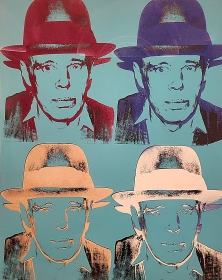
On or soon after the 30th of October 1979, the German artist and political activist (e.g., a co-founder of the German Green Party) Joseph Beuys (1921-1986), who was in New York City for the installation of a retrospective exhibition of his works at the Guggenheim Museum, was taken to meet the American Pop artist Andy Warhol (1928-1987). During that encounter, Warhol used his Polaroid camera to make a portrait of Beuys wearing his characteristic felt hat. It was not the first time that Warhol had photographed Beuys. He had also used his Polaroid when he first met Beuys earlier in 1979 at the Hans Mayer gallery in Düsseldorf (Germany). This meeting has been recorded on film (see https://youtu.be/PRrC8EJ3KxI?si=DM4RoR9nDrX_cJbX).
Between 1980 and 1986, Warhol used his Polaroid photograph of Beuys as the source image for a series of screen-printed portraits. As the Press Release on the website of the Thaddeus Ropac Gallery explained:
“Repeating Beuys’s arresting gaze on different scales and in different formats, Warhol exercised his characteristically experimental approach to materials in the portraits. Amongst the paintings, unique Trial Proofs, line drawings, and unique and editioned works on paper, are examples of some of the artist’s earliest uses of diamond dust in portraits. These sit alongside images that have had their tonal values inverted to give the effect of photographic negatives. Belonging to the Reversal Series in which Warhol reproduced key subjects from across his wide-reaching body of work – including his iconic portraits of Marilyn Monroe, the Mona Lisa and Mao …”
In the 1940s, Warhol began his working life in commercial and advertising art. By the 1950s, he had discovered the secret of repeating images making small changes to produce variations on a theme. In 1952, he had his first solo exhibition in an art gallery (in NYC). Although it was not well received, it was not long before he became recognised as an artist of note. In 1962, he learned screen-printing techniques, and became one of the first artists to use this process for creating artworks. These include most of the images on display at Thaddeus Ropac.
The results, which we were able to see at the gallery were far from monotonous, despite being repetitions of the same photograph. By modifying the sizes, colouration, and many other aspects of the photographic portrait, Warhol managed to bring a considerable degree of liveliness to this image. As I saw the various diverse presentations of the single image of Beuys, the German artist began to feel oddly familiar. It was almost as if I was meeting an old friend.
Before seeing the exhibition, I had my doubts about viewing what I had heard were multiple reproductions of the same photograph. My worries were dispelled within a few seconds of looking at the exhibition. I was fascinated how one image could be altered in so many different ways and the effect that seeing the results had on me, There are now less than 24 hours left before the show ends. So, if you can, hurry up and view it.



 yamey
yamey 