With her two horns
She ambles along the busy road
Mindless of traffic
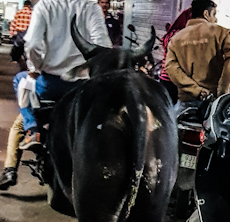

With her two horns
She ambles along the busy road
Mindless of traffic

WE SHOULD NEVER have booked to travel on the 945 am Gujarat State Road Transport Company’s (GSRTC) bus from Ahmedabad to Mandvi in Kutch. The distance between the two towns is about 390 kilometres. According to Google maps, the journey should take seven hours by car. Allowing for stops en-route, a bus should take no more than an hour longer. The 945 bus from Ahmedabad took eleven and a quarter hours, with no more than a total of an hour stoppng at various bus stations along the way. Why, you may wonder, did our bus take so long despite the fact that we encountered no traffic traffic congestion at all and we were not involved in any accidents.
The first three hours of the journey, our bus travelled through small towns in the great plain of Gujarat that were far from the direct and shortest route. Many of these places, such as Lakhatar and Surendranagar contain stretches of largely intact historic city walls. After visiting these places in what was effectively a huge detour, we rejoined the direct highway at Dhranghadra. We had travelled a little under 100 kilometres from Ahmedabad in three hours.
At Surendranagar, the driver and conductor left the bus and were replaced by a new crew. The new driver spent more time chatting to the conductor who was sitting to his left and behind him. Most of the time, the driver had his head turned away from the road to see the conductor. He would take frequent brief glances at the road ahead in between his lengthier glances at the conductor. Despite this seeming lack of concentration on the road, he drove well, something that cannot be said of many of the other road users. Some of the overtaking I observed was just short of suicidal.
For a while, we drove along the very good 6 lane highway barely making any stops to pick up or drop off passengers. We had a ten minute break near Halvad, just long enough to buy some snacks and to use the toilets.
Soon after re-joining the motorway, the bus, which was moving quite fast, was overtaken by a Royal Enfield motorcycle. It was being driven by a young man and a largish lady was sitting side saddle behind him. The cyclist was sounding his horn repeatedly, more than necessary, and the lady was smiling sweetly at our bus. I thought that she was just having fun, but as the bike passed the front of our bus, it swerved in front of it. The bus slowed down and stopped and the smiling lady climbed on board and purchased a ticket. She told us that she had seen our bus leaving from Halvad and chased after it unsuccessfully. The young man had offered to take her on his bike and then chase after the bus that he wanted to catch.
We crossed over the Surajbari river bridge, and entered the former kingdom of Kutch, now part of the State of Gujarat. For several kilometres we drove through an estuarine area with acres of saltpans punctuated by tall white pyramids of freshly harvested sea salt. This area is one of India’s most important salt producers.
The highway, from which, amazingly, we had not yet deviated, was heavily used by large trucks. The flat countryside was filled with industrial plants, some quite large with chimneys belching clouds of smoke which were stirred up into interesting shapes by the strong prevailing wind.
As the sun began sinking into the hazy (polluted?) sky on the western horizon, we pulled into Gandidham. This city, established just after 1947, is built on land donated by the Maharao of Kutch, the last ruler of the Princely State of Kutch. The city became home to many Sindhi Hindus who had fled during the Partition from nearby Sindh when it became incorporated into the newly formed Pakistan. Gandidham is not far from the port of Kandla, about which you can learn much more from my book “Travels through Gujarat, Daman and Diu” (published in India by pothi.com as “Gujarat Unwrapped”). I guessed that the heavy truck presence was because of the industrialisation of this part of Kutch and activities at Kandla.
It was at Kandla where we received information that made our hearts sink. The conductor told us that from Gandidham onwards, it was going to take us another three hours to reach Mandvi. Instead of taking a direct route, our bus had to visit numerous villages to drop off and pick up passengers. He explained that being a state run bus, this service is like a lifeline; it is almost the only way that people could travel between these places by public transport. We trundled through the darkness, stopping here and there. I felt sorry for the driver because many other road users travel along the unlit country roads either without lights or with only dim front lights switched on. Of course, cattle and other animals, who routinely share the road with human traffic, are completely without lighting.
All along our route, we saw animals on the road. Cattle and goats are routinely herded along or across roads of all sorts, even the high speed six lane highways. If my knowledge of ornithology was less rudimentary, I would have been able to describe the rich variety of birds that we saw along our route.
In the road lit up by the lights on our bus, I saw a dog which was lying dead at the side of the road. Another dog, maybe a companion of the dead one, was standing close by looking at it sadly or maybe disbelievingly. It was a tragic sight.
Some weeks earlier we were on a car in Hyderabad when I noticed that drivers were making sudden manoeuvres to avoid something lying in the middle of the road. It was a cat that had been knocked down. Lying on its side, its legs were moving frantically in the air as if it were trying to run away. This fleeting image of an animal in the throes of death affected me greatly. I can still see that poor creature in my mind’s eye.
Eventually, we crossed the River Rukmavati and drove along the riverside next to substantial remains of the impressive wall that used to surround the city of Mandvi. We disembarked at the almost deserted modern bus station. While we waited for the car that was going to collect us, a cow wandered past us investigating bits of rubbish on the floor, hoping to find something worth eating.
Though tiring and exceptionally lengthy, our bus journey through the flat countryside between Ahmedabad and Mandvi was far from dull. Our fellow passengers ranged from westernized Gujaratis in European style clothing to rustic looking folk: women wearing saris and salwar kameez, and men attired in very baggy trousers that resembled dhotis and turbans or headscarves. Mobile phones kept ringing and there were many loud conversations. Outside the bus, we saw many vignettes of small town and village life through the filthy windows of our trusty bus.
Next time we visit Kutch from Ahmedabad, we will follow the advice of our GSRTC bus conductor:
“Go by private bus”.
Abu? Jaipur?
Where can I take you?
My taxi is waiting nearby.
DURING VARIOUS VISITS TO AHMEDABAD, we have often driven past the Ahmed Shah Masjid, but never visited this venerable mosque. Close to the great Bhadra Fort and built in about 1414 AD by Ahmed Shah, the founder of Ahmedabad, this is the oldest extant mosque in the city. Today, we entered this exquisite mosque and its garden and discovered a perfect example of Indo-Islamic architecture.

When this mosque, and many others built in western India up to at least a century later, was constructed its creators incorporated many design features that can be seen in Hindu and Jain temples that were constructed centuries before believers of Islam entered/invaded India.
The grounds of the Ahmed Shah Masjid are entered through a small stone pavilion. The step inside it is just like the entrance steps to Hindu and Jain temples in that it includes a centrally located semicircular projection.
The patterning on the exterior stonework of the mosque and the many pillars within it would not look out of place on pre Islamic places of worship in India. However, the presence of figurative carving found in Hindu and Jain temples is completely absent in mosques. One small exception, which I saw at the Ahmed Shah Masjid and others in Ahmedabad, are carvings of trees, the Tree of Life.
The Ahmed Shah mosque and many other medieval mosques in Gujarat are topped with numerous domes. Seen from the outside of the mosques, they do not look exceptional, but viewed from within, the influence of Hindu/Jain temple architecture is obvious.
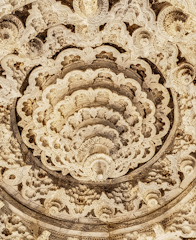
The domes are usually supported by 8 pillars arranged as a regular octagon. Neighbouring pillars support horizontal lintels, which together form an octagon. The dome rests on these lintels. The internal surfaces of the domes, when seen from below, consist of a series of concentric rings that decrease in circumference as they approach the top of the dome. The stonework of the rings can be either plain or elaborately ornamented. The design of these domes and their supporting supporting pillar systems are identical to what can be seen in Indian temples built long before Islam arrived in India.
Unlike the non-Muslim temples that inspired their design, medieval mosques contain features that are unique to mosques, such as elaborately decorated mihrabs, niches in the wall of the that worshippers face when they pray.
The Ahmed Shah mosque has an elevated internal chamber, where the king could pray separated from the rest of the congregation.
Having at last visited this fascinating mosque, I would reccomend all visitors to Ahmedabad to visit it first before exploring the other wonderful 15th and 16th century mosques that enrich the city.
The Ahmed Shah Masjid is a fine example of how conquerors can be conquered by the culture of those whom they have invaded. Just as the Muslims were bewitched by the wonders of Indian culture, so were the British many years later, as well exemplified by the Brighton Pavilion.
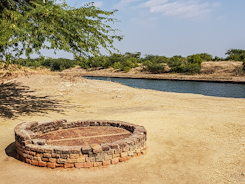
OSTIA ANTICA, THE PORT of Ancient Rome is constructed mainly with baked clay bricks. When I visited it some years ago, I remember thinking that it looked like a recently built place because of the brickwork that looked so contemporary. Ostia dates back no further than the 4th century BC. The port at Lothal in Gujarat (western India) thrived long before Ostia, probably between 2500 and 1900 BC, but like the Roman port, the remains of Lothal are mainly (sun baked) clay bricks, giving them a far from ancient appearance. Lothal, excavated in the 1950s, was a port inhabited by people of the Bronze Age Harrapan (or Indus Valley) civilisation that thrived between about 3300 to 1300 BC.
We drove to Lothal from Ahmedabad along a good highway that runs through flat landscape with numerous tidy looking factories. We arrived after about 75 minutes of steady driving. The archaeological site, maintained by the Archaeological Survey of India (ASI), is in the middle of very flat fertile agricultural land far from the nearest village. Unlike most other ASI sites that charge an entrance fee, that at Lothal is the same for both foreigners, who are usually charged a high fee and Indians. Each ticket cost only 5 Rupees.
The ticket gives access to a small but well laid out museum, whose exhibitsand information panels demonstrate how Lothal fits into current understanding of Harappan civilisation and what life might have been like in the ancient port. A fairly simplistic video was shown. It concentrated mainly on Mohenjo-Daro, a large Harappan site now in Pakistan. The evidence dug up at Lothal and other Harappan sites shows that the civilisation was both technically and artistically sophisticated. On display, were systems of weights and ingeniously crafted fine jewellery, both examples of products that could only have been produced by people of great intellectual ability.
The ruins are, as already mentioned, mostly made of brick. A low mound, known as the ‘Acropolis’, is covered with structures that might have been warehouses or residences of the upper echelons of Lothal. The mound overlooks what looks like a huge rectangular brick lined swimming pool, now filled with rainwater. When Lothal was thriving, this dock was connected to the nearby sea (now the Gulf of Khambat) by a channel along which vessels could sail. Over the millennia, the coastline has shifted and what was once Lothal is separated from the sea, far away from it. The ASI keep the dock filled with rainwater to show what the dock must have looked like in its heyday.
Various other structures outlined by brickwork, including circular wellheads, can be visited. These include the former bead factory, a cemetery (where all the skeletons discovered were from people who died aged 30 or less; maybe older people were cremated), and a ‘lower town’. What little that has been excavated is well looked after, but without the explanations provided in the museum the casual visitor would have no idea of what he or she was seeing or how ancient these remains are. With a little background information it was thrilling to walk in the footsteps of townsfolk and traders who lived and thrived so many, many years before us.
We met only three other visitors while wandering around the ruins. They were all from Bangalore. They were touring Gujarat but lamented the fact that most signs are only in Gujarati script. In Karnataka, where they live and where we visit often, signs are often not only in the local script but also in English and/or Hindi.
There are no refreshments available at the Lothal site. An employee suggested that we might get tea in the modern village of Lothal, a few kilometres away. Our driver had his doubts about this and so did I when we drove along the winding dusty road through the small village. There were no shops or stalls to be found.
We parked outside a pair of wrought iron gates separating two houses. A lady appeared in the door of one of them, and my wife asked (in Gujarati) whether tea was available in the village. The lady said she would make some for us.
We followed her through the gates and into a long wide alley lined with houses. Two ladies were embroidering gold thread, jewels, and sequins onto long silk saris spread out along the incredibly clean concrete floor of the alley. Other ladies were sitting around.
Our hostess brought us each a plastic chair from her home. We sat chatting with the ladies while we awaited our tea. The alley was lined with houses that a farmer had built for his sons. Each of the ladies was one of his daughters in law.
Our hostess arrived with a large metal cup filled with tea and two china saucers. Each of us was handed a saucer, which she filled with hot tea. We slurped the tea from the saucers as is the custom when sharing tea in Gujarat (often one person drinks from a cup and the other who is sharing it drinks from the saucer: a system known as ‘cutting chai’).
The ladies doing the embroidery take about a day to decorate a whole sari with a complex design. The silk is sent to Lothal from Surat, where the decorated saris are later sold. An old lady with barely one tooth in her smile, the mother in law of the women we were talking with, joined us. This wizened relative asked if it was true that a man’s haircut would cost 1000 rupees in the USA, as she had seen on YouTube. We told her that it would cost at least that. She was then told to go back to rest on her charpoy in the nearby farmyard.
We asked where the menfolk were. They answered: “In the fields. What else could they be doing?”
Our hostess, who seemed to be the brightest of the very hospitable women, took us to see the cow whose milk had been used to make our tea. We thsnked her calf for sharing his mothers milk. She also proudly showed us the two fine horses the family owned.
Just before we left, my wife asked our hostess whether we could leave a small gift for her children. She said that they were at school and there was no need for a gift. She told us that she was very keen that they should do well at school, and hoped that they would be able to study in the USA, because she said: “There is no future for them, nothing here anymore.”
As we drove away from our new acquaintances through the village, people waved to us. We waved at three old men on a bench. They waved back. We felt that we had received a warm welcome at ground level in Gujarat.

This tale is based on a true story related to me
Life has not treated Zafar well. Even his wife Zubeida feels that her burqa is barely sufficient to hide her shame. The couple scrimped and saved to pay to educate their daughter Rubina so that she was qualified sufficiently to be able to enter a college in Ahmedabad.
And, what made their beloved daughter do what she has done? And, why did she run off with her Hindu neighbour’s son Rajesh? And, what came over her to marry Rajesh, who is little more than a dunce with no prospects whatsoever? Did she not trust her parents to choose a suitable grroom for her? Only He above might possibly know.
By choosing a ‘love marriage’, that selfish Rubina has not only shunned her parents but has also caused her family to be ostracised by the rest of their community. And, there is more woe to relate. The imam of Zafar’s community has instigated a case against his family, a case to be tried under Shariah law. Zafar is already facing a hefty fine imposed by his community and, even worse, he has already had to pay the hospital’s huge fees required to recover his wife from a paralysis brought on by Rubina’s selfish act of folly.
And, with sorrow, there is yet more to relate. Zafar has since lost his good job. Who would want to employ a man who has lost control of his daughter, you might well ask. Ask you might, but whatever the answer might be, life has not treated Zafar well.

Today, 7th January 2020, we bought tickets for onwards bus journeys at Ahmedabad’s Geetamandir bus station. The young man at the ticket counter was an excellent salesman.
We stopped at the Raipur Gate, one of the several gates on the now demolished city wall. Only the gates remain as mementos of this wall.
Next to the gate, there were several spinning kite cord winders. They were preparing the cords that would be attached to the kites flown to celebrate the festival of Uttarayan (end of winter), which is celebrated all over Gujarat.
White thread is fed through a basin of coloured dye and then coated with finely ground glass and glue before being wound onto large spinning bobbins. The thread, when dried, is wound onto smaller bobbins that are sold to kite flyers. The ground glass is added to the thread so that kite flyers can use their kites to cut through the strings of other kites while they are airborne. The men making the threads were not Gujaratis, but from outside the state, from Bihar and UP, for example.
Ahmedabad now hosts an annual International Kite Festival.
The kites, made mostly of paper, are sold along a street leading away from the Raipur Gate. Kite flyers need to buy their kites and reels of thread (to attach to them) separately. We spotted numerous small stalls selling adhesive tape. One of the vendors of these explained that pne wraps this tape around fingers to stop them being injured by the very abrasive glass coated kite threads. Masks were also on sale. These are worn during the kite festival.
When we asked someone where we could watch the kites being flown, we were told: “In the air, up in the sky”. On further questioning, we were told, as if we were idiots, that the kites can be seen flying in the heavens.
Some years ago we visited Ahmedabad in late March. Even so long after Uttarayan, the branches of trees were filled with the remains of kites that had been caught in them.

LAST BUT NOT LEAST on our visit to Mount Abu was a visit to Guru Shikhar, the highest peak of the Mount Abu district. Being a Sunday, the winding road leading to it had heavy traffic. Many of the private cars had Gujarati registration plates, and judging by the general lack of driving skill and courtesy I guessed that many of the drivers had little if any experience of negotiating mountain roads. There is an observatory perched on the very top of the mountain. It is part of the Indian Space Research Organisation. The views from the summit were spectacular especially because the air was uncharacteristically free of mists and heat haze. We were surrounded by lower peaks and in one direction there was a good view of the plain far below us. Mount Abu is the highest point in Rajasthan and neighbouring Gujarat. We left this peak to visit other sights dotted around on the far from flat Mount Abu plateau.
A short visit to Shankar Math will suffice all but the most devout of Hindus. A modern structure surmonted by an enormous lingam houses a much older and slightly older lingam carved in white stone with bluish grey striations.
Achal Garh has several attractions. There is a large attractive Jain Temple, which looked quite old. It was surrounded by newly carved sculptural fragments which were being used to replace worn out stone elements of the temple. Old parts were being exchanged for newly made replicas.
Close to the Jain temple at Achal Ghar, there is a market place catering mostly to tourists. Beyond the market a well made road winds upwards to Kapoor Tank, a peaceful water body where we saw women washing laundry in its calm water. Little children, including a tiny three year old girl, offered to guide us around the area.
The road continues to ascend above Kapoor Tank until it reaches the gates of an old fortress. It was built in 1452 by a local Rajput ruler, Maharana Khumbar of Mewar, on the site of an older fort. Not much remains to be seen. The area within the fort contains various Jain temples, which I hope to look at on a future visit.
The Jain temples at Adhar Devi, high up on a mountain slope, can only be reached by climbing more than 350 stone steps. I did not feel like doing that, so there is little I can tell you about them except that one of them is called Arbuda Devi Temple, Arbuda being the pre-British name of Abu, as in Mount Abu.
The highlight of our excursion was not the highest peak but an incredibly beautiful lake surrounded by rocks in the middle of a wildlife nature reserve. A badly surfaced road leads from the main road between Mount Abu and Guru Shikhar to Trevor’s Tank. This water body was created in 1897 by Colonel GH Trevor to breed crocodiles. A fading notice on of the huge rocks surrounding the pool advises visitors not to enter the water because of the very real risk of meeting these creatures. Some German hikers, whom we met, pointed at some crocs resting on a rock across the Tank, but I could not see them. The land for the wildlife sanctuary had been gifted to Trevor by the Maharaja of Sirohi, in whose kingdom Mount Abu is located.
The Tank has to be seen to believed. Its smooth water reflects the finest details of the rocks and vegetation surrounding it. Our new friend Dr Sharma told us that one of the joys of Trevor’s Tank is listening to the sounds of nature. During our visit, these had to compete with the sounds made by the excited groups of mainly young trippers. If there is limited time available when you visit Mount Abu, then Trevor’s Tank and the Dilwara Jain Temples should be seen before anything else. But, it would be foolish not to allot at least several days to savour Mount Abu.
We ate lunch in the restaurant of the Jaipur House hotel, the highest of the former Rajputana palaces in Mount Abu . Its windows provide superb views over the Nakki Lake, the Polo Ground and the rest of Mount Abu town. The former palace, now a hotel, is elegant without being flamboyant.
We strolled down from the palace through the town to our hotel feeling sad that on the following morning we would be leaving Mount Abu, which has captured our hearts.

“HOW COULD YOU SPEND FIVE DAYS IN MOUNT ABU?”, someone asked me, adding that “one day is more than enough – you see the Jain temple, and that’s it”. How wrong this is. Even a fortnight would not be long enough to absorb all that Mount Abu (in Rajasthan) and its surroundings have to offer. I write this not because I was lucky enough to meet the amazing Dr Arun Sharma, but because even before we met him I had that idea.
Dr Sharma, a local medical practitioner, is an artist who expresses his ideas by composing music, painting canvases, as well as writing poetry and dramas. He is also a mine of information about the history of Mount Abu.
Major General Arthur Thomas Moore (1830 – 1913 or 1923) was a British officer in India. At the age of 26, and serving in the 3rd Bombay Light Cavalry, he was awarded a Victoria Cross for bravery at the Battle of Khushab in Persia.
Dr Sharma told us that for many years Moore’s whereabouts in India during a period of 3 or 4 years were completely unknown. After he resurfaced and returned to Europe, he died in his native land Ireland, where he is buried.
The regiment that Moore served has been renamed The Pune Horse, but nowadays it uses tanks instead of horses. Since 1947, it has been involved in over 60 skirmishes and battles and never been defeated. The members of the regiment believe that the spirit of the incredibly brave Moore is their guardian angel.
The regiment was delighted when in 2006, Dr Sharma accidentally stumbled on a cave near Sunset Point in Mount Abu. This cave had inscriptions carved in beautiful handwriting by Arthur Thomas Moore. These inscriptions include the date 1901, which was during the period that Moore had gone missing. What Moore was doing in this cave that Dr Sharma discovered we may never know, but at least we now know that Mount Abu was one of the places he visited during his period of disappearance.
Dr Sharma took us to see the cave, whose restoration he instigated, and proudly showed us the informative memorial plaque he created.
This cave and many more natural and man made historical sights and sites have convinced me that Mount Abu has more to see than most people realise.
I wish to thank Dr Sharma for opening my eyes to the exciting history of Mount Abu and its surroundings.
LAST NIGHT WE MET DR ARUN SHARMA. He was introduced to us by Mr Kashyap Jani, the owner of Hotel Saraswati, where we stayed in Mount Abu. Not only is Sharma a medical doctor in Mount Abu but he is also an accomplished writer, a prolific poet, a composer of music, a keen and well informed local historian, and also a skilful painter. In addition to singing an excerpt from one of his many operas, he told us a bit about the history and mythology of Mount Abu, which he believes is the oldest place on earth. Partly at his suggestion and partly because we had seen some information displayed at our hotel, we decided to take a driver to visit historic places around the base of Mount Abu and its associated peaks.
Our driver, Zakir, picked us up early in the morning and drove us to a food stall next to the Madina Masjid, the only mosque in Mount Abu. We joined some men who were keeping warm around a bonfire and had tea and omelettes. Throughout Mount Abu, locals make bonfires to keep warm, especially after sunset.
We drive downhill from Mount Abu along the winding mountain road, Abu’s only road link to the ‘outside world ‘. The picturesqueness of the landscape was enhanced by patches of morning mist.
Our first stop was at the Badrakali Hindu temple, which is extremely old. We were told it is 8000 years old, but this seems unlikely. We entered the inner sanctum to see the idol depicting the principal deity.
We were followed by a man, who walked over to an enormous speaker and turned it on. We were blasted with incredibly loud music: mostly rhythmic drumming with frequent blasts on conch shells. The volume was as high as, or even greater than most discotheques.
The priest within the chamber with the main idol waved around a smoking censer before lighting several lamps on a metal holder, creating what looked like a fiery comb. While ring a bell with his left hand, he waved the flaming comb around the inner sanctum, up and down the principal idol and other lesser ones. All the time, the loud music thudded deafeningly. Suddenly, he put down the comb of flames, picked up a conch shell and used it to throw water at all of us facing him. As suddenly as it had begun, the music ended. The priest continued chanting while all those attending this ‘aarti’ left the temple. We were lucky to have witnessed this dramatic yet very moving ceremony because it is only performed twice a day.
A short drive, during which we saw wild peacocks and plenty of greyish monkeys with black faces, brought us to another ancient temple, the Hrishikesh, a very peaceful spot. After walking past cattle and a large number of monkeys, we entered thetemple compound. A young boy was cleaning an idol of the ‘guru’ which faced the main idol of the temple located in the innermost sanctum. This chamber was covered by a cloth curtain. The priest llowed us to peer inside, where he was carefully cleaning the idol. He told us that only when the goddess had been cleaned and dressed, could she be revealed to worshippers. The temple and its compound contains numerous finely carved religious stone artworks.
After a lovely drive through very rustic landscape, Zakir drove us along a rough track to the isoated Toda Paladi, a very small Hindu temple. We chatted to the priest, who, after inviting us to sit with him, asked us if we were at peace and content. Then, we looked at the old stepwell (‘vav’) near the temple. It was almost overflowing with water covered with a thin layer of green algae. The priest had told us that the well always received a good supply of water that flowed down from nearby Mount Abu. We left the customary donation to the temple. The priest explained that when enough money had been collected, he hoped that it would be spent on improving the road leading to his temple.
The Sun Temple at Varman was built in the 10th century AD. Somewhat ruined, but maintained by the Archaeological Survey of India, it contains carved stone features such as some of those that we saw at the great Jain temples at Mount Abu. The Sun Temple is, even though now incomplete, a gem.
Not far from the Sun Temple, we drove along a very sandy road until Zakir said the car could go no further safely. I disembarked and walked with some difficulty through vey soft fine sand towards a pair of huge banyan trees. Near these are the unguarded remains of Krishna Vat. A passing local with flamboyant facial hair typical of that seen on many Rajasthani men made me understand that the temple had been destroyed long ago by invaders. Despite the temple being a disorganised pile of exquisitely carved stones, people still worship there. For that reason my ‘guide’ asked me to remove my sandals while I prowled around the ruins, taking photos. My companion explained to me in Hindi what I was looking at, but I barely understood what he was saying. However, he did make it clear that a small rectangular patch of earth surrounded on three sides by stones was all that remains of the innermost sanctum of the temple.
After a relatively long drive, we reached the Behra Tarak Jain temple, which was built about 20 years ago. Although recently constructed, this temple, like most other contemporary Jain temples, is designed in the same way as those which were built over 1000 years ago. Thus, this new temple gives the visitor a good idea of how the historic temples must have looked when they were just completed. In all of the modern Jain temples we have visited both in Gujarat and Rajasthan no expense has been spared to create or recreate the perfection seen in the earliest temples.
Another drive along country lanes brought us close to the Karodi Dhwaj Hindu temple. I had to climb about 150 metres up a track too rough for our taxi to reach this small old temple compound clinging to the rocky slopes of Mount Abu. A staircase cut into a huge rock led down to a pool of water deep in a rocky cleft. The temple buildings overlooked this. Although of great beauty, they had been heavily painted with silver and other coloured paints. Some of the finer details of the carved stone idols were also hidden under deep layers of garish coloured paint. This temple almost hidden away in the rocks reminded me of some monasteries I have visited in Serbia. They were located next to the sources of streams at the heads of valleys to make them less accessible to foreign invaders, in their case the Ottoman soldiers.
The Mirpur Jain temple is definitely not concealed. It overlooks the plain surrounding Mount Abu. The mountainside makes an impressive backdrop to this beautiful temple constructed in a rare stone with light blue streaks. Constructed before the better known Dilwara temples, this could well have been the model which inspired the builders at Dilwara. Many of the finely carved features seen at Dilwara, where photography is firbidden, are in evidence at Mirpur. Almost as breathtaking as Dilwara, seeing Mirpur is a ‘must’.
The last stop on our tour was a Hindu temple within a natural rock cave, the Vastanji Shiva temple. This is located above a slope that was covered with litter. We were welcomed by several friendly temple assistants to the cave temple with its low painted rock ceiling. After we had admired the deity, we were invited into a neighbouring building, where men and women were keeping warm around a wood fire in a hearth on the floor. We were given a warm welcome and cups of tea. Pur new acquaintances invited to stay for a night of prayer at the temple. They told us that we would be offered food and bedding. Many people make the pilgrimage to this place and avail the hospitality offered. The sleeping quarters are flattish surfaces below the temple under colourful cloth shamianas. I guessed that much of the litter lying around was the result of the previous night’s pilgrims. All around we saw monkeys busy eating discarded vegetables and flower garlands.
We drive back up to Mount Abu after sunset, and disembarked at the grandiose former summer palace of the rulers of Bikaner, an erstwhile princely state in Rajasthan. It is now a ‘heritage’ hotel. We ate an indifferent meal in one of the dining rooms. The place was so cold that all of the diners were wearing inelegant padded jackets for outdoor use rather than dinner jackets and other fine garments that would have been worn when the hotel was a royal palace.
Thus, ended a fine day that was inspired by the historical research which Dr Sharma has been doing for years and by the publicity given to it at our hotel by its owner.

