From his garden to his grave

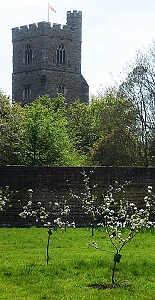
IT IS PLEASANT to stroll beside the Thames along Chiswick Mall. Occasionally, we take a look at the graveyard of Chiswick’s St Nicholas Church. On a recent visit to this place, we walked deeper into it than usual and spotted a grave marked by a remarkable sculpture.
The idyllic, romantic, leafy churchyard by the river is chock full of graves. Several of them caught my attention. One is that for the artist William Hogarth, who lived close-by. His monument is protected by a cast-iron fence. An urn on a plinth decorated with an artist’s palette and brushes. It was erected after the death of his sister in 1781 (who is also commemorated on this monument) and was restored by a William Hogarth of Aberdeen in 1856. Another painter, Philippe Jacques de Loutherbourg (1740-1812), who was born in Strasbourg, is buried with his wife Lucy de Loutherborg (née Paget). Like Hogarth’s, their decaying monument on the north side of the cemetery is surrounded by cast iron railings. In 1789, Philippe gave up painting temporarily to develop his interest in alchemy and the supernatural. Later, he and his wife took up faith-healing. The remains of yet another painter, James Abbott McNeill Whistler (1834-1903), lie in the cemetery.

Private Frederick Hitch (1856-1913) is less famous than these artists. He was awarded the Victoria Cross for his brave actions during the Battle of Rorke’s Drift (January 1879) in the Anglo-Zulu War fought in South Africa. He is also buried in this large cemetery.

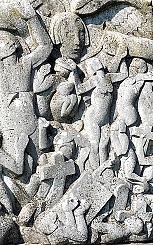
Amongst the more recent graves is the one with the unusual sculpture. It is that of Baronet Percy Harris (1876-1952), who was a Liberal politician. Son of a Polish immigrant, he was born in Kensington, and died there after a long career in parliamentary politics. According to a website listing British Jews in WW1, Percy was Jewish, yet his grave is distinctly Christian in sentiment. Aesthetically, his grave is the most remarkable one in the cemetery next to St Nicholas. It includes a semi-abstract, vorticist carving of The Resurrection of the Dead, created by the sculptor Edward Bainbridge Copnall (1903-1973) in the 1920s. Harris had acquired it for display in his garden long before it was moved to adorn his grave.

Although Percy Harris was born Jewish, he is buried in the graveyard of a Church of England parish church. Despite searching the Internet, including reading his extensive entry in the Dictionary of National Biography, I cannot determine whether or not he converted to Christianity sometime during his life.

Don’t even think about doing these things

AS A SPECIAL TREAT when I was a young child, I was allowed to feed the pigeons on Piazza Signoria in Florence (Italy), a city we visited annually during my childhood. My parents used to purchase paper cones filled with corn kernels for my sister and me. We used to put a few of these in the palms of our hands and allow the pigeons to perch on our fingertips whilst they fed on the corn. Looking back on this activity, which gave me great pleasure, I am surprised that my health and hygiene conscious mother allowed what the former Mayor of London, Ken Livingstone, called ‘rats with wings’ to risk sullying our hands and harming our health.

Oddly, when we were kids, we fed the pigeons in Florence but never fed their cousins that flocked around Trafalgar Square in London. Today, the 25th of April 2022, my wife and I walked across Trafalgar Square and observed that nowadays there are signs that indicate that feeding pigeons is forbidden. However, this activity, which I enjoyed as a child on holiday in Florence, is not the only thing forbidden in Trafalgar Square. The lovely fountains in the square now contain signs in the water, on which the words “No Entry” are written. Yet another activity in the square is no longer allowed. There are signs to deter visitors from climbing on the sculptures of the lions that lie at the base of Nelson’s Column. So, when you next visit Trafalgar Square with plans of feeding the pigeons, or bathing in the fountains (even to celebrate New Year), or straddling a lion, do not realise any of them: they are all outlawed.

Remembering a generous lady in Westminster Abbey

CALL ME UNINFORMED but until the afternoon of the 22nd of April 2022 when I attended a service in Westminster Abbey, I had thought that Sidney Sussex College in Cambridge was named after someone called Sidney Sussex. Now, I know better.

On the 22nd, we attended choral Evensong in Westminster Abbey. The choir was that of Sidney Sussex College, and they sung well despite the not too brilliant acoustics in the huge church. After the service, a select group of us, consisting mainly of people associated with the College, moved over to a small side chapel behind and north of the High Altar: The Chapel of St Paul. When we were all crowded into the small chapel, already filled with funerary monuments, the choir of Sidney Sussex squeezed in. They sung a short mass, and then the Master of the College laid a floral wreath at the foot of the monument to Frances Sidney, Countess of Sussex (c1531-1589). This ceremony, commemorating the founding of Sidney Sussex College, has been performed annually since her death.

Frances Sidney, aunt of the poet Phillip Sidney (1554-1587), was a philanthropist. She had inherited a great deal of money when her husband Thomas Radcliffe, Lord Fitzwalter, Lord Deputy of Ireland and from1557 the 3rd Earl of Sussex, died in 1583.  One of her many good deeds is recorded on her colourful stone monument in Westminster Abbey. As per tradition, the Master of Sidney Sussex read out aloud the resumé of Frances’s life as recorded on the monument. The part that is pertinent to the college is as follows:

“…By her last will and testament she instituted a divinitie lectur to be redd in this Collegiate Church and by the same her testament gave also fyve thowsande powndes towards the buildinge of a newe colledge in the Universitie of Cambridge, with sufficient yerelie revenew for the continuall maintenaunce of one Maister, X Fellowes, and XX Schollers, eyther in ye same Colledge or ells in another house in ye said Universitie already builded, comenlie [commonly] called Clare Hall…”

To put it in plainer English, on her death in 1589, she bequeathed £5,000 (worth far more than £ 1 million today) to pay for the building of a new college in the University of Cambridge and to provide an annual revenue sufficient to finance 1 Master, 10 Fellows (i.e., academic teachers) and 20 scholars. The first sentence of the quote states that a “divine lectur” (i.e., prayers) should be said annually in the Abbey. And this is what was being done as we stood assembled in the small chapel. It was a curiously moving occasion especially when the wreath was laid at her monument. Later, one of the clerics who had been present at the ceremony explained to me that not only had Frances Sidney paid for the college, which is named in her memory but also she would have had to pay for the elaborate marble and alabaster monument erected to remember her.

As for the name of the college, Sidney Sussex, this is a shortened version of its full name: The College of the Lady Frances Sidney Sussex.

Eight bells and a bridge

BELIEVE IT OR NOT, busy Fulham in west London was a small country village in the early 19th century. Today, what was once the heart of the village, is the site of two bridges spanning the Thames. One carries the District Line railway tracks and pedestrians, and the other, an elegant stone bridge with five arches carries a road across the river. Known as Putney Bridge, the latter was completed in 1886 and designed by the prolific civil engineer Joseph Bazalgette.

Inside The Eight Bells in Fulham

Prior to the construction of the stone bridge, there was an earlier wooden bridge, known as ‘Fulham Bridge’. With roofed gatehouses at both ends and 26 arches (or openings), it was designed by Sir Jacob Acworth and completed in 1729. Its approach road was Fulham High Street. The bridge has long-since been demolished but a blind-ended, short inlet of the river, now named Swan Drawdock Nature Reserve runs right next to where the old bridge would have once begun.

The Eight Bells pub, which still serves customers, stands on Fulham High Street. Now housed in a Victorian building, it might have been first established as early as the 17th century. When the old bridge stood, it would have attracted much business from folk using the wooden crossing. Things changed when the new, current, bridge was constructed.

The approach to the new crossing, Putney Bridge, was not via Fulham High Street but by way of a new road, the present Putney Bridge Approach (the A 219), which does not pass the front of the Eight Bells. This led to a considerable loss of business for the pub, whose owners received £1000 in compensation: a great deal of money in the late 1880s.

The Eight Bells and its neighbour, a wonderful second-hand book shop, along with a few other shops near Putney Bridge station, although definitely not rural in appearance, retain a ‘villagey’ feel.

A slave trade abolitionist in Fulham

LESS FAMOUS THAN William Wilberforce (1759-1833), but equally important in helping to end Britain’s involvement in the slave trade, was Granville Sharp (1735-1813). Born in Durham, Sharp was apprenticed to a linen draper in London at the age of 15. A scholar at heart, he left his apprenticeship to become Clerk in the Ordnance Office at the Tower of London, a job that gave him more time to pursue his scholarly studies and music. One of his brothers, William Sharp (1729-1810), was a physician, who is believed to have treated King George III.

All Saints church in Fulham

One of William’s patients was Jonathon Strong (c1747-1773), a black slave from the West Indies, who had been badly beaten-up by his master, a lawyer called David Lisle. William and Granville helped tend to Strong’s injuries and paid for him to spend four months in St Bartholomew’s Hospital. Lisle instigated a number of court cases to protect his ‘possession’ of Strong. Granville was deeply involved with making sure he lost them and that Strong became a freed man. The Strong case was the beginning of his keen and active involvement in the movement to abolish slavery. His involvement with this and subsequent legal cases connected with the unjustness of the slave trade gave him the reputation of being a “protector of the Negro”.  

In 1787, Granville became one of the founder members of the Society for Effecting the Abolition of the Slave Trade. Though sometimes overshadowed today by other abolitionists such as Wilberforce and Thomas Clarkson (1760-1846) played a major role in hastening the end of the slave trade and slavery in places ruled by the British.

By the 1780s, there were approximately 15,000 ‘black’ people in Britain, many of them without employment. Ideas began to circulate that it would be a good idea to form a settlement in Africa to which the Africans could ‘return home’ and live as free individuals. One place that was suggested was Sierra Leone. Granville Sharp was consulted on this and felt that it would be an ideal location to set up a model community for the ‘blacks’. He suggested calling it ‘The Province of Freedom’. Sadly, the well-intentioned province that included a settlement called Granville Town was a failure.

Granville lived long enough to learn that the Act of Abolition received Royal Assent in 1807, but not long enough to know about the final abolition of the slave trade in the British Empire (in 1833). Granville’s brother William had a country dwelling, Fulham House, in Fulham. It was here that the ageing Granville moved after William died. He lived there with William’s widow, Catherine, and her family. It was in this house that Granville breathed his last.

Probably Fulham’s greatest resident, Granville Sharp was buried in the cemetery of Fulham’s parish church (All Saints). His funerary monument, which stands close to the boundary fence of Fulham Palace commemorates him, his brother William, and his sister Elizabeth Prowse. William’s wife Catharine (née Barwick) is also buried beneath this stone, which was restored in 2007.

Roman recycling

TOLLESBURY IN ESSEX on the Blackwater River estuary is a village just over 5 miles southeast of Tiptree, a small town close to the Wilkinson jam factory and museum. This charming village, where a good friend of ours lives, has a venerable parish church, St Mary the Virgin.

Roman bricks used to construct the arch above the south entrance of St Mary’s in Tollesbury, Essex.

In common with most of the parish churches we have visited during our extensive roamings around the English countryside, this church, whose construction had begun by the 11th century, contains a rich selection of interesting features. These are well described in a copiously illustrated booklet about the edifice published by the Friends of St Mary’s Tollesbury in early 2020. Amongst the interesting things we saw within St Mary’s, one of them particularly intrigued me: the incorporation of Roman bricks in the fabric of the church.

Archaeologists have uncovered the remains of a Romano-British cemetery near the village. They have concluded from their findings that in about 200 AD, there was a significant rural settlement located near Tollesbury at that time. Other remains are evidence that the district around the estuarine village has been the site of human activity since the Neolithic era (4000-2000 BC).

As if to prove that recycling is not simply a recent trend, the church of St Mary incorporates bricks made whilst the Romans occupied England. These can be seen clearly above the south doorway within the church. The 11th century arch above this portal is made entirely of recycled Roman bricks. Some more brickwork made with Roman bricks can be seen exposed above the gothic archway in the western wall of the nave, which is also part of the late 11th century bell tower.

Although the re-used Roman bricks have been ‘highlighted’ in St Mary’s, the structure of the parish church in the nearby village of Goldhanger also contains recycled Roman bricks. Making bricks at the time when these churches were built would have been far more laborious than making bricks using today’s industrial techniques. So, re-using bricks that had already been made would have been very sensible.

The fantastic herons

ON SUNNY EASTER Sunday (2022), we took a morning walk along the Thames Path from the Black Lion pub (and the excellent Elderpress Café facing it) to Dukes Meadows, upstream from the pub. Dodging the endless stream of mostly courteous joggers and less polite cyclists, we enjoyed splendid views of the River Thames and the many old buildings lining Chiswick Mall. Several of the buildings were covered with flowering wisteria.

The Fantastic Herons

The river was well-populated with waterfowl including swans; geese of various kinds; ducks; a pair of cormorants resting on a buoy; and several herons. The latter were either standing on the sand and mud at the waterside or in the water close to the bank. Eventually, we reached Dukes Meadows, which consists of fields formerly part of the estate of nearby Chiswick House.

Near the Hammersmith end of the Meadows, we saw a metal sculpture, ‘The Fantastic Herons’, on top of a tall pole. Created by the artist Kevin Herlihy (born 1962) along with pupils from Cavendish Primary School and unveiled in 2004, it depicts three herons standing on a nest. Like most of Herlihy’s creations which often depict animal life, it is made from recycled waste materials. Funded by Singapore Airlines, who held a series of art workshops in the school, it is an appropriate sculpture for the area as herons can often be standing by, or in, the Thames flowing past the Meadows.

Covid is over

IT WAS EASTER Saturday (2022), the sun was shining, the air was warm, and we paid a visit to the world famous, popular Portobello Road Market. For the first time after over two years of pandemic-induced suppression of London’s ‘joie-de-vivre’, the market was buzzing with activity, crowded with foreign tourists and local visitors. As it was before Covid19, the market was bustling and business at the stalls, which offer everything from artichokes to antiques and pancakes to paella, seemed to be brisk.

Portobello Road

A friend, who lives in rural France, said to me a few days ago when we were walking near Leicester Square:

“It’s hard to believe that there was ever a deadly pandemic in this city.”

And as we walked along a short street in the area, he added:

“There are more people out in this street than there are living in my hometown.”

Yet, Covid infection rates are high in the UK. Friends in India have been telling us that they are thinking twice before visiting the UK because the risk of becoming infected here is so great at the moment. Recently, I have heard that approximately between 1 in 12 and 1 and 15 people in the UK are likely to be infected with a Covid19 virus, and therefore capable of spreading it to others.

Apart from personal hygiene and wearing face coverings, good ventilation is considered to be useful for reducing the risk of spreading the viruses. So, when I boarded a bus in South Kensington recently, I opened the window closest to me – each window on London buses has a label saying “Open this window”. Immediately after following this instruction, which has been given for reasons of prevention of infection, the lady sitting behind me, who was not wearing a face covering, stood up and slammed it shut. I stood up, opened it, and told her not to touch it. She said, speaking angrily with an Eastern European accent:

“You don’t need to open it. You are wearing mask and have three vaccinations.”

How she knew my vaccination status, I do not know. My wife said to her:

“Don’t you know that one in twelve are infected?”

To which the lady replied:

“Believe what you like.”

Then to my great surprise, she added:

“Covid is over”

Buried behind Berry Brothers

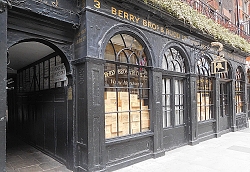
LONDON’S NOOKS AND crannies are often worth exploring. One, which I must have passed often but of whose existence I only became aware in April 2022, is Pickering Place, a narrow, covered passageway between numbers 5 and 3 St James Street, close to St James Palace.  Immediately on entering this timber lined alleyway, I noticed a metal plaque, which commemorates the short-lived Legation of the Republic of Texas to The Court of St James. The legation existed from 1842 to 1845, whilst the Republic existed from 1836 to 1846. It rented the premises from the property’s owner, Berry Brothers.

Pickering Place was in existence by 1690, when it was then known as ‘Stroud’s Court’.  Prior to that date, the site was:

“… once home to the medieval maidens’ leper colony of St James, before playing host to King Henry VIII’s royal tennis court.” (https://blog.bbr.com/2015/04/10/the-other-no-3/)

 The alleyway leads into a small open space, a courtyard that is believed to be Britain’s smallest square. The name Pickering relates to the company of Berry Brothers and Rudd (‘Berry’s’) that occupy most, if not all of the buildings around the courtyard and on the south side of the alleyway. In 1698, a widow with the surname Bourne began the business, at first a grocery shop, now known as Berry Brothers & Rudd. Her daughter, Elizabeth, married William Pickering (died 1734). They continued the business, supplying the coffee houses of St James with coffee. The company adopted the coffee mill as their symbol. The shop at number 3 St James Street and Stroud’s Court were then rebuilt by the family. William and Elizabeth’s sons, John and William Junior, continued the running of the firm. After John died in 1754, William Junior brought a relative, John Clarke, to be a partner in the business.

George Berry, John Clarke’s grandson, joined the business in 1803 and by 1810, his name became the firm’s name. George moved the firm’s activities into focussing on wine and spirits. In 1845, his sons, George Junior and Henry, took over the firm, hence the ‘Brothers’ in the company’s name. Hugh Rudd, a wine merchant with a keen interest in the wines of Bordeaux, joined the firm as a partner in 1920. His arrival in the company greatly increased its expertise in the wine trade. In 1923, the company created a new whisky which they called Cutty Sark Scotch. Its label was designed by the artist James McBey, whose studio was at the top end of Holland Park Avenue. The firm is still run by the Berry and Rudd families and flourishes.

Immediately after leaving the covered alleyway, you will see an orrery and beyond it, a carved stone portrait of a man with his head facing towards his left. Nobody we asked seemed to know whom it portrays. Various websites suggest it depicts the politician and former Prime Minister Lord Palmerston (1784-1865), who lived in Pickering Place for some time. The author Graham Greene also lived in Pickering Place for a while.

Doorways in the courtyard lead to various underground rooms including the Pickering and Suffolk Cellars. Once used to store wine and other products sold by Berry’s, parts of them are now also used as a wine school, as well as for banquets and similar gatherings. One of the cellars is named The Napoleon Cellar, after the exiled Napoleon III (1808-1873), a friend of George Berry Junior. In 1846, fearing assassination, the exiled Frenchman hid in the Berry Brother’s cellar, now named in his memory. Number 3 Pickering Place, built in the 1690s, is a well-preserved example of a William and Mary era townhouse.

Part of the tiny courtyard has outdoor tables and chairs. These can be used by patrons of the St Jacques restaurant, which occupies number 5 St James Street whose southern wall forms the northern wall of the alleyway. The southern wall of the passage is part of the wall of number 3, which houses the original Berry’s shop. This well-preserved historical shop is lined with wood-panelling and contains much of the old shop fittings.  These include old desks, shelving with old bottles, and a large hand-operated coffee grinder. Suspended from the ceiling, there is a large grocer’s weighing scales. According to Berry’s detailed company history (www.bbr.com/about/history):

“It was in the time of William Jr. and John Clarke that the famous grocer’s weighing scales began to be used to weigh the shop’s many notable customers, a fashionable pastime that continues to this day.”

Had it not been for noticing the alleyway which I have passed often without noticing it, and then spotting the portrait in the courtyard, I doubt we would have ever entered the old shop at number 3. Incidentally, if you wish to purchase wines or spirits from Berry’s, you will need to walk around the corner into Pall Mall, where the company has a newer shop … or, less interestingly, you can make purchases online.