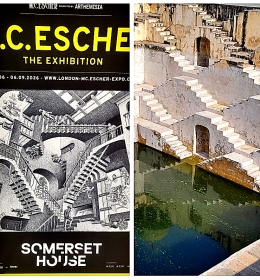
THERE ARE MANY stepwells in India. For those, who have never seen any of them, a stepwell is, putting it simply, an enclosure built around a deep well. Its walls have sets of staircases, often geometrically arranged with landings at regular intervals. The steps allow people to access the water, whose level varies according to the season. In rainy periods, the water level is high, but in other periods, it is far below ground level, and people use the steps to reach the it.
Whenever I see a stepwell, and I have seen many of them during travels in India, I think of the creations – optical illusions – of the Dutch graphic artist MC Escher (1898-1972). He produced images in two dimensions of subjects that cannot possibly exist in three dimensions. Several of his pictures include interconnecting staircases, which unlike those seen in stepwells, could not be constructed in three dimensional reality.
As far as I can establish, Escher never travelled to India. I always wonder if Escher’s staircase images were influenced by having seen drawings or photographs of stepwells in the Indian Subcontinent. It would be interesting to know if he did see pictures of these interesting water sources.
Here is another extract – a ‘taster’ – from my forthcoming book “ROAD TO HEAVEN – a passage through India”, which has reached the final editing stage. This sample relates to Maheshwar in Madhya Pradesh, a state in central India
+ + + + + + +
Maheshwar is a 58-mile drive south of Indore, a journey that took us about 2 ½ hours. Much of the way was through hilly countryside. In places the road goes through rock faced cuttings. Every now and then we saw distant high peaks, that looked bluish in the heat haze. During our journey, we passed pedestrians carrying bags and bedding rolls on their backs. These people walking in the hot sunshine were pilgrims, about whom I will tell you more soon. Occasionally, we had to slow down when we met flocks of goats and herds of cattle being led along the road – a common sight on country roads, including motorways, in India.
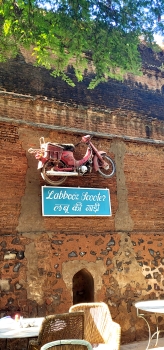
When we arrived in Maheshwar, our driver had difficulty both navigating and negotiating the maze of narrow, winding lanes in the lower, newer districts of the small town. Eventually, we drove up the steep, straight road leading to the main gateway in the walls that surround Maheshwar Fort. Traffic is not generally allowed into the heart of the fort, but as our accommodation, at Laboo’z Café and Lodge, was in the traffic-restricted zone, a barrier was lifted to allow us through. Nestling within a corner of the fort’s walls, Laboo’z is an attractive café with outdoor tables and chairs. An old motorbike is attached high up on the tall stone wall facing the seating area. Below it, there is a sign that reads: “Labooz’s Scooter”. The cafe was established in 2002 by Richard Holkar, a scion of the Holkar family that once ruled the Kingdom of Indore. Richard is the son of Yeshwant Rao Holkar II (reigned 1926-1948), who commissioned, and had built, a Modernist style palace in Indore, which was designed by the German architect Eckhart Muthesius (1904-1989).The palace, Manik Bagh, still exists. Stripped of its Modernist furnishings and sculptures by Constantin Brancusi, it now houses governmental offices. When Richard and his half-sister were children, they used to be ferried around Maheshwar on the bike now adorning the cafe. The driver who took them on the motorbike was tall (‘lambu’ in Hindustani). Over the years, he became known affectionately by the nickname ‘Labboo’. The scooter on the wall commemorates him.
THE NATIONAL GALLERY, the Tate Galleries (Britain and Modern), the Wallace Collection, Kenwood House, The Courtauld, the Royal Academy, the Barbican Gallery, the Hayward Gallery, Whitechapel Art Gallery, Dulwich Art Gallery, and the Victoria and Albert Museum are all well-known places in London where art lovers can view fine pictures and other artworks. However, these are only the tip of the iceberg. London has a huge number of less well-known places where great art can be enjoyed.
By Paulo Nimer Pjota
First, there are the commercial art galleries, many of them, but not all, in Mayfair. Among those which I visit often are Thaddeus Ropac, Annely Juda Fine Art, Pace, David Zwirner, Waddington Custot, White Cube (both in Mayfair and Bermondsey), Beers London (near the Barbican), Lisson Gallery, Gagosian, Richard Greene, Grosvenor, Hause & Wirth, Victoria Miro, and Goodmans. There are others, but those listed are the ones I visit most. At these locations, modern and contemporary art can be viewed and, if you have plenty of spare cash, purchased.
Other interesting places to view art of all types and from all eras are the auction houses. Christies, Sotheby’s, Bonhams, and Phillips, all in Mayfair, hold exhibitions of art works that are going to be auctioned. Many of these pieces have been offered for sale by private collectors or their descendants, and have never been seen by the public. Seeing them prior to the auction is a precious experience because many of them will return to private collectors after the auction, and will once again be hidden from general view.
Another place that deserves visitors is the South London Gallery in Peckham Road, London SE5 8UH. Part of the former Camberwell School of Art, it has an annex nearby in a former fire station. Today, 24 July 2026, we visited an exhibition, “Encantados”, which was a collection of paintings by the Brazilian artist Paulo Nimer Pjota, who was born in 1988.
Pjota’s intricately executed, colourful paintings hang in the gallery’s large rectangular space. The wall space between, above, and below the paintings contain drawings, which were specially executed for the show by the artist. Thus, the whole room, paintings and walls, has been transformed into an artwork. The large paintings are populated with depictions of mythical creatures and fantastic plant forms. Although occasionally weird, the paintings are generally joyous, and uplifting to behold. The exhibition continues until 23 August 2026, and should not be missed.
By confining oneself to the best-known venues listed in the first paragraph, one will certainly see great art, but will miss hidden gems such as the pictures I saw today at the South London Gallery.
LONG QUEUES OF people were waiting to have their bags checked at the main entrance to London’s Tate Modern Museum. Most of them had booked tickets to see the poorly reviewed Frida Kahlo exhibition, which I have been told by a reliable source is very disappointing. This is a pity because elsewhere in the Tate Modern, there is an exhibition that is very well worth viewing.
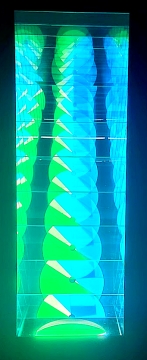
The exhibition, which is in the Blavatnik Building, is of works by the Argentine artist Julio Le Parc, who was born in Palmira (Argentina) in 1928, and moved to France in 1958. He died in Paris in May 2026. Parc specialised in kinetic and ‘op art’, and the exhibition is filled with his dazzling works. As the Tate’s website explained, Parc believed that the viewer was part of an artwork. He felt that a piece was incomplete until the viewer engages with it, either by stepping into it or, simply, encountering it. And everything at the Tate’s exhibition is visually engaging and highly absorbing. The website (https://www.tate.org.uk/whats-on/tate-modern/julio-le-parc/julio-le-parc) added:
“From 1959, Le Parc used light as a sculptural medium. He used it systematically, exploring ways of creating reflection, refraction and vibration. In his ‘Continual Light Mobiles’, opaque, reflective or translucent forms sway in response to slight breezes, reflecting light from spotlights or natural light sources to create ever-changing reflections.”
These fascinating works need to be seen rather than be described in words. The website also noted:
“Le Parc wanted to make viewers feel active, with their acts of looking and experiencing bringing each artwork to life; to make more democratic art that everyone can easily enjoy.”
And seeing his works was enjoyable. Although ingeniously conceived, Parc’s works did not seem to have the profundity often associated with other artists’ creations. They had been created to give the viewer pleasure and to lighten his or her life. Instead of being a ‘deeply meaningful’ experience, Parc’s work is both full of fun and visually intriguing.
Without reading other people’s minds, I guess that seeing this exhibition would give most of those queueing for Frida a far better time than trudging around the crowded rooms in which Kahlo and her works are on show.
WHILE HAVING MY hair trimmed recently by an Albanian barber, who came to London from Prishtina in Kosovo, I recalled a visit to a barbershop in rural Italy.
Before and after
It was in the 1980s and I was driving through northern Italy on my way to visiting my sister, who lived further south. I decided that I should have my hair tidied up before I saw her, and stopped my hired car outside a hair cutting establishment in a small village.
I entered the parrucchiere and was summoned to a chair by one of the barbers. He began cutting my hair, and then stopped suddenly. Throwing his hands up above his head, he exclaimed operatically:
“Forfore!”,
Which is the Italian word for ‘dandruff’.
Hearing this, other customers sitting in the shop, awaiting their turn, looked alarmed, and covered their heads with their hands.
Without asking me, the barber applied a lotion to my head. Whatever it was, it felt as if it was boring its way into my skull. This medication added an extra 5000 lire (£4 at the time, but about £10 in today’s money) to my bill (those were the days before Italy adopted the Euro).
Well, I am pleased to report that today my barber from Kosovo did not feel it necessary to throw up his hands and exclaim in Albanian:
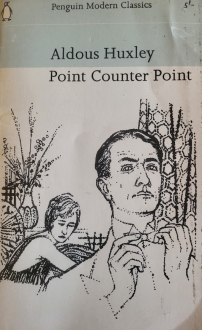
ALDOUS HUXLEY published his novel “Point Counter Point” in 1928.
In the first chapter of the book, Walter takes an Underground train from Chalk Farm station to Leicester Square station. When he arrives there:
“He stepped out on to the platform and made his way towards thelifts.”
When I read the word ‘lifts’ (elevators in US English), I was puzzled.
I have been using Leicester Square Station since the early 1960s, and never noticed lifts from the platform to street level. As long as I can remember, passengers use escalators, not lifts. Had Huxley got it wrong – unlikely – or were there once lifts at the station?
Out of curiosity, I consulted that font of all knowledge Wikipedia. From their article about the station (https://en.wikipedia.org/wiki/Leicester_Square_tube_station), I learned that it had lifts at the time when Huxley wrote his novel. In the 1930s when the usage of the station began to increase significantly, it was rebuilt to accommodate escalators, which replaced the lifts. As for the now unnecessary, Wikipedia revealed:
“ The redundant lifts were removed but the lift shaft remains in use as a ventilation shaft hidden behind a small door on the first landing of the Cranbourn Street entrance stairs. The redeveloped station opened in 1935.”
So, as the saying goes, ‘there you have it’. Until the 1930s, lifts operated at Leicester Square Station. I would have been unlikely to know that has I not started reading “Point Counter Point”.
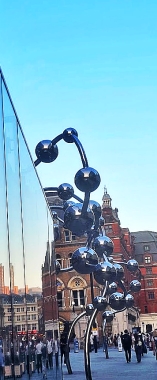
ELECTRONS ORBIT around the nucleus of an atom in an organised way, so I recall from science lessons I attended many years ago. Whether they are considered as particles or waves, they are located at discrete distances away from the nucleus. They can ‘jump’ between different orbits, but cannot remain between them. This oversimplified scientific knowledge came back to me yesterday (16 July 2026) when I first set eyes on a wonderful outdoor sculpture, “Infinite Accumulation”, by Yayoi Kusama. It stands near to the Liverpool Street station entrance on London’s Elizabeth Line railway.
Like the electrons in their pre-determined discrete orbits around an atom’s nucleus, passengers travelling on a train can only embark or disembark at discrete points, the stations, along the line, but not between them.
Kusama’s sculpture, which at first sight resembled a disorganised version of the Atomium in Brussels, consists of highly polished, curving stainless steel tubes, which are punctuated at intervals by equally shiny spheres. Although the artist might have intended something different, I interpreted the spheres as representing stations along the route of a railway line (the tubes connecting the reflective balls). Seeing the discrete, separated spheres was what made me think about the atom and is electrons.
“Yayoi Kusama is best known for her use of massed, repeated polka dots, which first emerged in her work in the 1960s and have become one of her signature motifs … For this monumental site-specific work, Kusama has expanded the polka dot into linked forms which interact with and define the public spaces outside the new Elizabeth line entrance to Liverpool Street station. These dynamic serpentine arches were created intuitively by Kusama, hand-twisting the wires on the original models for the artwork … This dynamic, highly reflective architectural form, mirroring the viewer and the world around it, means Infinite Accumulation responds to both individual and collective experience within the changing spaces of the urban landscape of London.”
All this makes sense, but I cannot escape from the idea that the artwork is an abstracted three-dimensional version of a schematic route map for an Underground line.
PS: my apologies are due to any physicists or chemists, who find my scientific knowledge to be too rudimentary.
UNITY MITFORD WAS one of the famous Mitford sisters. She had sympathy for the German Nazis, and in particular its leader, Adolf Hitler. It is likely that she had a crush on him.
In Munich, Hitler used to like dining at an Italian restaurant called Osteria Bavaria, an old establishment first opened in 1890. Knowing that Hitler used to frequent the restaurant, Unity Mitford used to arrive there, sit opposite the dictator’s usual table. When he arrived, she would try to catch his eye, and would be invited to join his table. All this occurred long ago before I paid a visit to Munich in the early 2000s.
While in the city, I discovered that the restaurant was still in existence, but had been renamed Osteria Italiana. We reserved a table for dinner. Our table was in one of the place’s several dining rooms. The walls of the dining area had been maintained as they were when the Osteria first opened. The Italian food we were served was first-class. Our friend, who lived in Munich, warned us not to mention Hitler while we were in the restaurant. She was terrified that if any of our fellow, mostly German, diners heard his name, they would have been embarrassed. We did as she asked.
As we were leaving the Osteria, I noticed something at the entrance, which I had not seen when we arrived. It was a sign, both in German and English, that read:
“In touch with history.”
I thought that was a great way of alluding to a hateful person, who made a huge impact on the affairs of the world.