
Forget Frida but do not miss Julio at London’s Tate Modern

LONG QUEUES OF people were waiting to have their bags checked at the main entrance to London’s Tate Modern Museum. Most of them had booked tickets to see the poorly reviewed Frida Kahlo exhibition, which I have been told by a reliable source is very disappointing. This is a pity because elsewhere in the Tate Modern, there is an exhibition that is very well worth viewing.
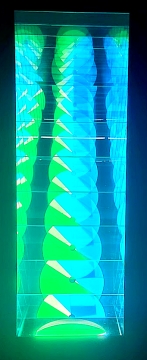
The exhibition, which is in the Blavatnik Building, is of works by the Argentine artist Julio Le Parc, who was born in Palmira (Argentina) in 1928, and moved to France in 1958. He died in Paris in May 2026.  Parc specialised in kinetic and ‘op art’, and the exhibition is filled with his dazzling works. As the Tate’s website explained, Parc believed that the viewer was part of an artwork. He felt that a piece was incomplete until the viewer engages with it, either by stepping into it or, simply, encountering it. And everything at the Tate’s exhibition is visually engaging and highly absorbing. The website (https://www.tate.org.uk/whats-on/tate-modern/julio-le-parc/julio-le-parc) added:

From 1959, Le Parc used light as a sculptural medium. He used it systematically, exploring ways of creating reflection, refraction and vibration. In his ‘Continual Light Mobiles’, opaque, reflective or translucent forms sway in response to slight breezes, reflecting light from spotlights or natural light sources to create ever-changing reflections.

These fascinating works need to be seen rather than be described in words. The website also noted:

Le Parc wanted to make viewers feel active, with their acts of looking and experiencing bringing each artwork to life; to make more democratic art that everyone can easily enjoy.”

And seeing his works was enjoyable. Although ingeniously conceived, Parc’s works did not seem to have the profundity often associated with other artists’ creations. They had been created to give the viewer pleasure and to lighten his or her life. Instead of being a ‘deeply meaningful’ experience, Parc’s work is both full of fun and visually intriguing.

Without reading other people’s minds, I guess that seeing this exhibition would give most of those queueing for Frida a far better time than trudging around the crowded rooms in which Kahlo and her works are on show.
A sculpture through which you are invited to walk

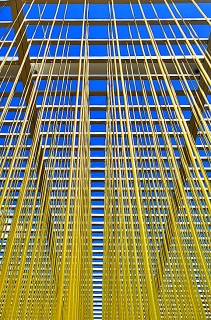
NEXT TO THE 2026 Serpentine Pavilion, a wonderful structure that makes creative use of brickwork, there is another creation, an artwork by Jesus Rafael Soto (born in Venezuela in 1923, and died in 2005). It consists of a rectangular frame filled with a grid of finely spaced rectangles and supported by three pairs of vertical pillars. 4000 identical, 10 metre long, thin, yellow PVC tubes hang down from the frame, almost reaching the ground beneath it.  This work, first made in 1999 and then recreated in 2023, is called “Pénétrable BBL Jaune”.

The structure is an example of kinetic art. As the Serpentine’s website explained:

From a distance, the closely spaced strands seem to shimmer and shift due to a moiré effect. Visitors are invited to walk through the work, allowing their movement to activate and transform the space around them.”

And many visitors, including me, were tempted to enter the sculpture and make one’s way through the forest of plastic fibres, which, although they look as light as feathers, offer some resistance to one’s passage.

Soto’s sculpture is is both intriguing to enter and to observe from outside it. The seemingly simple array of yellow tubes provides an interesting spectacle as it is disturbed both by breezes and people wandering through it. It will remain on view until 26 October 2026.

Fascinating artworks at a gallery in Cambridge

ARTSPACE 5-7 IS A small gallery housed in a pre-WW2 Modernist building in Portugal Place, a side street that leads away from Bridge Street in the university town of Cambridge. We visited the gallery in August 2025, and viewed a collection of sculptures and drawings by the London born artist Richard Bray (born 1955). A few years after being awarded a degree in Photographic Arts at the Central London Polytechnic, he was awarded a degree in Fine Art at Norwich School of Art and Design. His exhibition at Cambridge is called “Visible Invisible”.

Whereas kinetic art depends on its movement for effect, Bray’s finely crafted sculptures and prints are static. However, as the viewer moves around his artworks, viewing them from different perspectives, what can be seen changes. Bray’s works seem to acquire internal movement that can only be perceived when the viewer moves past or around them. These effects, which add great beauty to his works, cannot be captured using still photography. Three of the sculptures were on display in the churchyard of St Clements opposite the gallery

Bray spent time in Tanzania during the 1980s. What he must have seen in the way of local design and crafts has clearly influenced the appearance of the works we saw in Cambridge. In fact, when I first entered the exhibition, I saw what I mistakenly thought was a collection of sculptures from Africa.

The gallery because of its Modernist design is worth seeking out when you visit Cambridge. The exhibition of Bray’s works, about which we knew nothing in advance, were refreshingly exciting to see.