
ELECTRONS ORBIT around the nucleus of an atom in an organised way, so I recall from science lessons I attended many years ago. Whether they are considered as particles or waves, they are located at discrete distances away from the nucleus. They can ‘jump’ between different orbits, but cannot remain between them. This oversimplified scientific knowledge came back to me yesterday (16 July 2026) when I first set eyes on a wonderful outdoor sculpture, “Infinite Accumulation”, by Yayoi Kusama. It stands near to the Liverpool Street station entrance on London’s Elizabeth Line railway.
Like the electrons in their pre-determined discrete orbits around an atom’s nucleus, passengers travelling on a train can only embark or disembark at discrete points, the stations, along the line, but not between them.
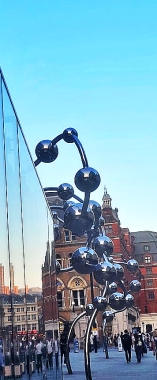
Kusama’s sculpture, which at first sight resembled a disorganised version of the Atomium in Brussels, consists of highly polished, curving stainless steel tubes, which are punctuated at intervals by equally shiny spheres. Although the artist might have intended something different, I interpreted the spheres as representing stations along the route of a railway line (the tubes connecting the reflective balls). Seeing the discrete, separated spheres was what made me think about the atom and is electrons.
My interpretation differs from that on a website (https://art.tfl.gov.uk/projects/infiniteaccumulation/) about the artwork:
“Yayoi Kusama is best known for her use of massed, repeated polka dots, which first emerged in her work in the 1960s and have become one of her signature motifs … For this monumental site-specific work, Kusama has expanded the polka dot into linked forms which interact with and define the public spaces outside the new Elizabeth line entrance to Liverpool Street station. These dynamic serpentine arches were created intuitively by Kusama, hand-twisting the wires on the original models for the artwork … This dynamic, highly reflective architectural form, mirroring the viewer and the world around it, means Infinite Accumulation responds to both individual and collective experience within the changing spaces of the urban landscape of London.”
All this makes sense, but I cannot escape from the idea that the artwork is an abstracted three-dimensional version of a schematic route map for an Underground line.
PS: my apologies are due to any physicists or chemists, who find my scientific knowledge to be too rudimentary.
 yamey
yamey 