Over the centuries, there have been many notable female leaders. These include Hatshepsut, Cleopatra, Boadicea (Boudica), Joan of Arc, Elizabeth I, Catherine the Great, Queen Victoria, the Rani of Jhansi, and Indira Gandhi … to name but a few.
During a recent trip to Madhya Pradesh, a state in Central India, we stayed in the small town called Maheshwar, which had a famous resident, a queen called Ahilyabai. I must admit I had never heard of her until we visited the town, and this is not good because she was at least as remarkable as, if not more amazing than any of the women I listed above.
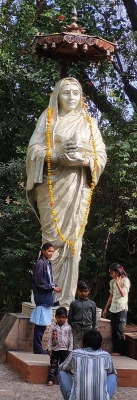
Ahilyabai was born in 1725 in the village of Chaundi, now in Maharashtra. Her father, Mankoji Sindhia (Shinde), a scion of the Dhangar family, was the Patil (village headman). Although it was at a time when women were not allowed to go to school, Ahilyabai’s father taught her to read and write. When the Maratha ruler of Malwa (now part of Madhya Pradesh), Malhar Rao Holkar (lived 1693-1766), was travelling to Pune in 1733, he spotted Ahilyabai and was so impressed by her that he arranged for her to be married to his 10-year-old son Khanderao Holkar (1723-1754). Her husband, who admired Ahilyabai, fought in many battles, and was killed at the Fort of Khumber in 1754. As was the tradition of those times, Ahilyabai wanted to commit sati by throwing herself on Khanderao’s flaming funeral pyre, but Malhar Rao stopped her.
From 1754 onwards, he trained her in military matters and administrative skills. Soon, she became competent in both, and successfully carried out several military operations against enemies of the Holkars. When Mahar Rao died, his successor was Ahilyabai’s 21-year-old son, Male Rao Holkar (1745-1767), who went insane, and died a year after he came to the throne. The writer, John Malcolm (1769-1833), who lived in India between 1783 and 1831 and knew people close to the Holkars, and wrote about them in his “Memoir Of Central India Including Malwa Vol.1” (published in 1824) included descriptions of Male Rao’s madness, such as:
“It was a common usage with him to place scorpions in clothes and slippers that he gave them; he also put these venomous reptiles in pots filled with rupees, which he invited the holy mendicants to take; and, when their eager cupidity caused them to be stung, his joy was as excessive …”
Unwilling to adopt an heir, Ahilyabai wrote to the Peshwa (senior official of the Marathas), petitioning him to appoint her as ruler of Malwa. He sent her a letter, appointing her. Immediately after this, she appointed Tukoji Holkar (1723-1797), the great nephew of her father-in-law, Mahar Rao, as commander of her army and to manage Malwa’s military affairs. This allowed her to concentrate on administering Malwa and other Holkar estates. Until her death, Ahilyabai and Tukoji worked together harmoniously. After she died, he became the ruler of Malwa, and was known as Tukoji Rao I Holkar. John Malcom met people who remembered Ahilyabai, and they told him she was a good ruler:
“Her first principle of government appears to have been moderate assessment, and an almost sacred respect for the native rights of village officers and proprietors of lands. She heard every complaint in person; and although she continually referred causes to courts of equity and arbitration, and to her ministers, for settlement, she was always accessible: and so strong was her sense of duty, on all points connected with the distribution of justice, that she is represented as not only patient, but unwearied in the investigation of the most insignificant causes, when appeals were made to her decision.”
During her reign, Ahilyabai did much to make Indore into a prosperous and beautiful city, but shifted her capital to Maheshwar. She did much work to improve the roads and forts in Malwa, as well as making many religious endowments (including mandirs, dharamshalas, tanks, bathing ghats, etc) in the kingdom. A man, Baramul Dada, who knew Ahilyabai well, related to Malcolm that:
“… she rose one hour before daybreak to say her morning prayers, and perform the customary ceremonies. She then heard the sacred volumes of her faith read for a fixed period, distributed alms, and gave food, in person, to a number of Brahmins. Her own breakfast was then brought, which was always of vegetable diet; for, although the rules of her tribe did not require it, she had forsworn animal food. After breakfast she again went to prayers, and then took a short repose; after rising from which, and dressing herself, she went about two o’clock to her Durbar, or court, where she usually remained till six in the evening; and when two or three hours had been devoted to religious exercises and a frugal repast, business recommenced about nine o’clock, and continued until eleven, at which hour she retired to rest.”
Her good works in connection with her religion extended well beyond the boundaries of Malwa. Using inherited Holkar money, rather than public funds, she ordered the construction of religious edifices in places including Varanasi, Kashi, Gaya, Somnath, Ayodhya, Mathura, Hardwar, Kanchi, Avanti, Dwarka, Badrinarayan, Rameshwar and Jaganathpuri. Ahilyabai. After shifting her capital to Maheshwar, she did much to improve the place.
During her life as queen and after her death, Ahilyabai’s reputation was legendary, and remains so. In what was once Malwa (and elsewhere), she is regarded as a saint. It is worth noting that Ahilyabai was not the only female Maratha ruler. Earlier, Tarabai Bhonsle (1675-1751) was the regent of the Maratha Empire from 1700 until 1708. Undoubtedly,
Ahilyabai was one of the most remarkable women in India’s long history. Indore’s airport, where we landed, is now named after her. To digress slightly, when we were in Bombay, we saw a statue of her – a bust – close to the city’s busy Churchgate train station. It is in a prominent place, but market stalls and vegetation around it make it difficult to view her properly.