
LONG QUEUES OF people were waiting to have their bags checked at the main entrance to London’s Tate Modern Museum. Most of them had booked tickets to see the poorly reviewed Frida Kahlo exhibition, which I have been told by a reliable source is very disappointing. This is a pity because elsewhere in the Tate Modern, there is an exhibition that is very well worth viewing.
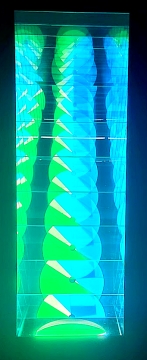
The exhibition, which is in the Blavatnik Building, is of works by the Argentine artist Julio Le Parc, who was born in Palmira (Argentina) in 1928, and moved to France in 1958. He died in Paris in May 2026. Parc specialised in kinetic and ‘op art’, and the exhibition is filled with his dazzling works. As the Tate’s website explained, Parc believed that the viewer was part of an artwork. He felt that a piece was incomplete until the viewer engages with it, either by stepping into it or, simply, encountering it. And everything at the Tate’s exhibition is visually engaging and highly absorbing. The website (https://www.tate.org.uk/whats-on/tate-modern/julio-le-parc/julio-le-parc) added:
“From 1959, Le Parc used light as a sculptural medium. He used it systematically, exploring ways of creating reflection, refraction and vibration. In his ‘Continual Light Mobiles’, opaque, reflective or translucent forms sway in response to slight breezes, reflecting light from spotlights or natural light sources to create ever-changing reflections.”
These fascinating works need to be seen rather than be described in words. The website also noted:
“Le Parc wanted to make viewers feel active, with their acts of looking and experiencing bringing each artwork to life; to make more democratic art that everyone can easily enjoy.”
And seeing his works was enjoyable. Although ingeniously conceived, Parc’s works did not seem to have the profundity often associated with other artists’ creations. They had been created to give the viewer pleasure and to lighten his or her life. Instead of being a ‘deeply meaningful’ experience, Parc’s work is both full of fun and visually intriguing.
Without reading other people’s minds, I guess that seeing this exhibition would give most of those queueing for Frida a far better time than trudging around the crowded rooms in which Kahlo and her works are on show.

