SINCE I LEFT school in 1970, I have only worn a shirt and tie on occasions when I can not avoid doing so. Frankly, I hate wearing ties and formal outfits, but unfortunately, I cannot always avoid engagements where this get-up is obligatory. Usually, I wear a tie with a long-sleeved white shirt.
Some years ago, there used to be many street sellers’ stalls on Bangalore’s Mahatma Gandhi Road (‘MG Road’). One day, we spotted a stall selling white 100% cotton shirts for formal wear. They were ridiculously cheap. The seller was asking 100 Indian Rupees (approximately £1 Sterling) for one shirt. The shirts were new, probably surplus stock. I bought two of them.
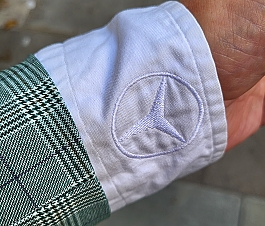
One of the shirts was perfectly satisfactory, but nothing exceptional. The other one had a feature that I only noticed when I first wore it. On its left sleeve cuff, there is a beautifully embroidered Mercedes Benz logo. Otherwise, there was nothing untoward about it. One label inside it bears the words “New England Gentleman” and near it another informs the wearer that it was tailored in Honduras. I suspect that the shirt was part of a batch made for a Mercedes Benz dealership, Whenever I wear it, I do not feel short changed (shirt changed ??), but instead I think that owning it is the closest I have got to possessing a Mercedes Benz.
TODAY THE TEMPERATURE in Athens (Greece) will exceed 35 degrees Celsius, and in Rome it is predicted to reach 42 degrees in two days’ time. Two years ago, a temperature of 48 degrees was recorded in Sicily. So, it seems that so-called Global Warming is happening with vigour. Meanwhile, this Sunday (16th of July 2023) in London, we enjoyed a breezy morning with temperatures not greater than a pleasant 21.
While walking along Portobello Road this Sunday, we spotted a beautifully cared for open-topped Ford Zodiac. These vehicles were manufactured between 1950 and 1972. I remember seeing them in my childhood and teenage years. In those days, I was not much interested in cars, but now when I see one that used to be common in my earlier years, I find them worthy of examination. I took several photographs of the Zodiac and then headed for the bus stop from which we were returning home.
Despite the external temperature being 21 degrees or less, it was far warmer inside the bus although its windows being open. The higher temperatures that we have been experiencing here in London and are now affecting places near the Mediterranean are commonly believed to be at least partly due to emissions produced by fossil fuels, such as petrol. As we moved homewards, a thought struck me. The beautiful Ford Zodiac, which we had just seen, is aesthetically pleasing and a souvenir of one of the great eras of automobile engineering, but it is also an ‘ancestor’ of Global Warming. Beautiful as it is, it too burns fossil fuel and makes its own contribution to what is believed to be causing dangerously high air temperatures in many parts of the world.
DESPITE THE PRESENCE of many distinctive buildings constructed on the south bank of the River Thames since the end of WW2, the OXO tower built in about 1929 is still a noteworthy and unusual landmark. OXO, just in case you do not already know, is a company that is most famous for its meat extract cubes, which can be dissolved to make soups, nutritious teas, and gravies. The company uses a process for making meat extract (in liquid form) that was invented in 1840 by the German scientist Baron Justus von Liebig (1803-1873). In 1866, Liebig’s Extract of Meat Company (‘LEMCO’) was founded in Britain. At first it produced the liquid form of the meat extract, which was quite costly. So, they developed a cheaper solid form, which was sold as OXO cubes, and they are still available today.
In the 1920s, LEMCO acquired the riverside building (opposite St Paul’s Cathedral), which had been first used as a power station for the Post Office. The company modified it considerably to produce an edifice with Art Deco features. This was designed by the company’s architect Albert Moore between 1928 and 1929. LEMCO wanted their effectively new building to include a tower with illuminated advertising signs. However, at that time, planning permission for skyline advertising near the riverfront was refused. The architect came up with a brilliant solution to get around the planning regulations.
The square tower was designed with three windows on each of its four external walls. Each set of windows were shaped as a pair of circles separated by a cross shaped like an ‘X’. Thus, each of the four sets of windows spelled the name ‘OXO’. Even during daytime, when there are no lights switched on behind the windows’ glass panes, the name OXO can be seen from quite a distance. Because they were designed as windows, the planning authorities were in a weak position to object, and LEMCO got away with their attempt to use the tower to advertise.
By the 1970s, the OXO building had fallen into disuse. In the 1990s, the building along with its distinctive tower began to be redeveloped for use as housing, retail, and recreational purposes (including a now famous restaurant). At night the windows on the tower now are surrounded by neon lighting and the windows spelling out ‘OXO; can be seen from afar. OXO still exists, but it is now owned in the UK by Premier Foods.
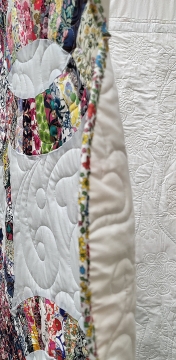
OUR FRIEND MIKAEL is an accomplished creative quilter (maker of quilts). Some of her artistic quilting is on display alongside works by other quilters in London’s Swiss Cottage Library until the 26th of July 2023. I must admit that when I learned that we were going to see an exhibition of quilts, my heart sank a bit. However, I am glad we went. I had no idea how creative and imaginative quilt makers can be. Well displayed in Swiss Cottage Library, there is a collection of extremely artistic contemporary quilts, which are well worth seeing. Far from simply being scraps of material stitched together, the quilters have used their imaginations and skills to create artworks which are not only beautiful but superbly innovative.
Until I entered Swiss Cottage Library today, I cannot recall having been inside it since about 1965 when I left the nearby Hall School, aged 13. I have passed its distinctive exterior often but never bothered to go inside. I was at the school between 1960 and 1965, and I remember visiting the then new library after it opened in November 1964. It was designed in the Modernist style by Basil Spence (1907-1976), who was born in Bombay. He based his library on the design of several that he had visited in Scandinavia. All that I can recall of the new library was that its shelves contained a far better range of books than our local library in Golders Green. Being a pupil in the area, I was able to borrow books from the Swiss Cottage Library, which I used to visit often because I found it to be so wonderful.
Although I can remember the superb collection of books that existed in 1964-1965, I could not recall the appearance of the library’s interior. It was only today when we visited the quilting show that I appreciated what a superb job had been done by Basil Spence and his team. Even though it was designed in the early 1960s, the style of the well-lit spacious interior has not dated at all. The interior of the library is far more intelligently conceived than most new British buildings created in the last few years. It is uplifting to wander around the various peaceful spaces within the library. If it were nearer home, it would be a place where I would want to go regularly to read and write.
I am grateful that Mikael invited us to see the quilting exhibition not only because it contained aesthetically pleasing works of art but also because I got to go back inside the library. Although I was not particularly interested in architecture when I was 11, my fascination with it began to grow a few years later. There was even a brief period in my life when I toyed with the idea of becoming an architect. Even though I did not pursue that profession, my love of good architecture – both modern and historical – has persisted. I believe that now, in my retirement, my appreciation of great buildings (such as Swiss Cottage Library) is greater than it has ever been. Even if you miss the quilting exhibition, it is worth making a detour to see Spence’s wonderful creation – both inside and outside.
RECENTLY I PUBLISHED a book about the highly innovative Victorian photographer Julia Margaret Cameron (‘JMC’; 1815-1879). She married a British colonial administrator and lived during the heyday of the British Empire. In my book, I tried to portray her sympathetically, but I do hint briefly that she was a ‘child of her times’ as far as he attitudes towards the colonised was concerned. Today, the 11th of July 2023, I paid a visit to London’s National Portrait Gallery (‘NPG’) to see how JMC and her works are currently presented.
JMC was a friend of the painter George Frederic Watts. His portrait of her hangs in the NPG. Another portrait by Watts hanging in the gallery depicts the historian and social commentator Thomas Carlyle (1795-1881). Nearby in another room, you can see Carlyle as portrayed in a photograph taken by JMC. This photograph is close to JMC’s photograph (see photo above) of Edward John Eyre (1815-1901). As British Governor of Jamaica, this gentleman was responsible for the brutal suppression of a revolt against British rule on the island. Under his command, 1000 homes were burned and 439 people were killed. Although this outraged many in Britain, it was defended by people such as Carlyle. Eyre’s portrait, made whilst he was awaiting trial, was, according to the NPG’s label, crafted by JMC to make him seem as if he was vulnerable and not:
“… a ruthless murderer but a sensitive man of duty.”
Another caption, next to a photograph of JMC by an unknown photographer suggests that her:
“… photographs are admired for their beauty and artistry. They also reflect the values of the Victorian era. Her portrait of Governor Eyre indicates her support for him following his violent suppression of the Morant Bay uprising.”
From what I have just written, you might get the impression that someone who composes the labels in the NPG is disapproving of JMC. Much as I feel that JMC’s apparent support for Eyre (and Carlyle) is not to my 21st century taste, one must remember that Cameron was living in a time when any uprising in the colonies would have been regarded as a dangerous – even apocalyptic – threat to the privileged life that she and her contemporaries enjoyed.
In all fairness to the NPG, they also have on public display one of JMC’s photographs of a less controversial sitter – the scientist Sir John Herschel (1792-1871). JMC met him in South Africa whilst she was convalescing from an illness she caught in India where she was living in 1837. It was Herschel who sparked off JMC’s enduring fascination with photography, which really ‘took off’ when she received her first camera in late 1863. She was then living on the Isle of Wight next door to her friend the poet Alfred Lord Tennyson.
JMC did not confine herself to taking photographs of defenders of colonialism. She made wonderful photographs of anyone she could find – both famous and completely unknown. What distinguished her work from that of her contemporaries is that, by experimenting with techniques in the studio and also in the darkroom, she created photographs that were works of art rather than slavish attempts to record real life accurately. Like great portrait painters, her photographic portraits give the viewer a sense of the sitter’s inner personality as well as his or her physical appearance.
NOW FILLED WITH TOURISTS and pigeons, the area which is currently Trafalgar Square was where Royalty kept their hawks between the 13th century and 1534. In that year the Royal Mews, where the hawks were kept, burnt down, and were replaced by stables for the royal horses. The stabling was moved to Buckingham Palace in the reign (1820-1830) of King George IV. In 1826, the clearance of the stables from the area began, and following the plans of John Nash, a new square began to be laid out. Initially named in honour of King William IV, it was later named Trafalgar Square to commemorate Nelson’s victory at the Battle of Trafalgar in 1805. Nelson’s Column (145 feet tall) was erected in May 1854.
At each of the four corners of the Square there is a stone plinth designed to support a sculpture. At the northeast corner, the plinth supports a statue of King George IV. Major-General Henry Havelock (1795-1857), who was involved in suppressing the First Indian War of Independence, is perched on the southeast plinth. He died of dysentery in Lucknow after relieving Kanpur from a siege. General Sir Charles James Napier (1782-1853) is portrayed sculpturally on the southwest plinth. His mother was the great-granddaughter of King Charles II. As a Major-General in the Bombay Army, he led the British conquest (1843) of the Indian province of Sindh. It is said that on achieving this, Napier reported in Latin “Peccavi”, which means ‘I have sinned.’
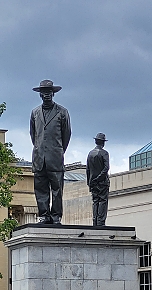
The fourth plinth on the northwest corner of the Square was destined to have a statue of King William IV. Because of insufficient funds, the king’s statue was never made, and the plinth remained empty until 1999 when the Royal Society of Arts (‘RSA’) conceived the idea of using the plinth to display a series of artworks by contemporary artists. Three artists displayed works between 1999 and 2001 on what is now known as The Fourth Plinth. Since 2005, under the supervision of London’s Lord mayors, a series of artworks by different creators have been displayed on the Fourth Plinth. Currently (since September 2022), the plinth (see photograph) displays a sculpture, “Antelope”, by Samson Kambalu. Recently, I heard this highly intelligent artist speak at a conference. His work on the plinth, based on a photograph taken in 1914, portrays the Baptist preacher and pan-Africanist John Chilembwe and the European missionary John Chorley. As the website www.london.gov.uk explained:
“The photograph was taken in 1914 at the opening of Chilembwe’s new church in Nyasaland, now Malawi. Chilembwe has his hat on, defying the colonial rule that forbade Africans from wearing hats in front of white people. A year later, he led an uprising against colonial rule. Chilembwe was killed and his church was destroyed by the colonial police.
On the plinth, Chilembwe is larger than life, while Chorley is life-size. By increasing his scale, the artist elevates Chilembwe and his story, revealing the hidden narratives of underrepresented peoples in the history of the British Empire in Africa, and beyond.”
Kambalu’s piece is a powerful work of art, and its message of resisting colonialism, makes stark contrast to the exploits of the other people portrayed on the Square’s plinths.
I LIKE SEEING SCULPTURE in open air locations. For example, I have enjoyed the Yorkshire Sculpture Park, the garden containing works by Henry Moore (near Much Hadham), Barbara Hepworth’s Garden in St Ives (Cornwall), and the annual Frieze sculpture shows in Regents Park. Until the end of August 2023, the Waddington Custot Gallery is exhibiting several large metal sculptures by Bernar Venet (born 1941 in France). Yesterday, the 8th of July 2023, we visited Grosvenor Square where these artworks are on display alfresco. Although they are not the most exciting sculptures I have ever seen, they looked good amongst the trees and lawns of the square.
The west side of Grosvenor Square is occupied by a large building that was until recently (2018) the Embassy of the USA. Constructed in 1960, it was designed by the Finnish architect Eero Saarinen (1910-1961). The structural engineering firm responsible for the edifice was FJ Samuely, which was founded by the Austrian-born Felix James Samuely (1902-1959), who fled to Britain in 1933 to escape the Nazi persecution. When he died, Frank Newby (1926-2001) became the firm’s senior partner. It was he who supervised the structural aspects of the realisation of Saarinen’s project in Grosvenor Square. One of Frank’s colleagues was my uncle Sven Rindl (1921-2007), who joined Samuely in 1954 and later became a director. It was my uncle who played an important role in creating the former embassy’s distinctive appearance when viewed from Grosvenor Square.
Just beneath the top of the centre of the façade of the embassy that faces Grosvenor Square, there is an enormous sculpture of an eagle. Gold coloured, this huge (35 feet wingspan) symbolic creature was created by the Polish-born sculptor Theodore Roszac (1907-1981). What few people know about this very visible open-air sculpture is that it has remained firmly attached to Saarinen’s building for well over 60 years thanks to my uncle Sven. For, it was my uncle who designed the eagle’s tethering to the building.
When we went to Grosvenor Square yesterday, the first thing I did was to see if the eagle was still in place. It was, and as I have just discovered, it is likely to remain there because the building is subject to a statutory conservation order. In contrast, the sculptures by Vernet, part of the Mayfair Sculpture Trail (www.bondstreet.co.uk/articles/art-in-mayfair-sculpture-trail-2023), will be removed by the 29th of August 2023.
PS: Did you know that the Duke of Westminster leased the land on which the Embassy stands to the Americans for one golden peppercorn per year in gratitude for what the USA did to help Britain in WW2?
JOHN LINNELL (1792-1882) painted the Kensington gravel pits in about 1811. The picture hangs in London’s Tate Britain These pits lay alongside Bayswater Road and Notting Hill Gate. They provided gravel for building projects in England and as far away as Imperial Russia.
Today, the pits no longer exist. They have been built over, but street names such as St Petersburg Place and Moscow Road commemorate the fortunes made by selling gravel from these pits to Russia.
You can discover more about this and much more about Paddington and Kensington and points further west in my book “BEYOND MARYLEBONE AND MAYFAIR: EXPLORING WEST LONDON” (see https://www.amazon.co.uk/gp/aw/d/B0B7CR679W/