Protesting on wheels

INDIAN INGENUITY KNOWS NO BOUNDS. Recently in many Indian cities, there have been public protests against unpopular new legislation. Bangalore is one of these cities.

To counter the protestors there have been temporary bans on large groups assembling to protest. In some places the police have arrested and even attacked some protestors, causing injuries and deaths.

On the 23rd December, I was walking along Museum Road in central Bangalore. Suddenly, I saw swarms of motorcycles streaming past. Many of the people on the cycles were carrying the Indian tricolour, the national flag. The flags flew behind the bikes. Some of the passengers on the motorcycles were carrying paper banners with words expressing dislike of the new legislation.

The motorcycles were most probably heading towards a planned public protest. But, they might also have been carrying out a mobile protest, which being at a high speed made it difficult for the police to control. Even if they were only travelling towards the site of a protest gathering, it struck me that this high velocity and noisy protest on wheels was an ingenious way of attracting public attention whilst minimising the risk of police interference.

A WALK IN THE PARK

BANGALORE IS RAPIDLY BECOMING AN URBAN DESERT, but luckily there are some green oases. One of these is Cubbon Park, named in honour of Sir Mark Cubbon (1775-1861). When it was first laid out in 1870 it was called ‘Meades Park’. Now, its official name is ‘Sri Chamarajendra Park’, although few Bangaloreans would recognize that name as being Cubbon Park.

Although a few roads traverse the park, they do not detract from ots pleasant sylvan nature. And, on Sundays many of these roads are closed to make them free of traffic.

Most of the park is not laid out in an obviously planned way and much of it is pleasantly in the shade of the leafy branches of huge old trees. Wherever you go, you will encounter dogs with their owners, wild dogs, people sitting or sleeping on benches or logs, people exercising, and picnickers. During a recent visit, I saw groups of young art students sitting in circles on the ground. They were cutting up old newspapers and magazines to gather materials for collages they were preparing.

Cubbon Park has its own metro station. One of its entrances is close to both a statue of King Edward VII of Great Britain and also a disused fighter jet, advertising the products of HAL, whose offices face the park.

After passing through the security check, which is present at all metro stations, I descended to the subterranean concourse. This and other parts of the station has been decorated by artworks created, with varying degrees of skill, by students of the Shristi school of design, which is located at Yelahanka, in between Bangalore and its Kempe Gowda Airport.

I was escorted by one of the Shristi students through the metro ticket barrier to another concourse that can be entered via a station entrance near the Chinnaswamy Cricket Stadium. This particular concourse had a temporary exhibition of photos of Indians who served in British armed forces during WW2. Sadly, this exhibition looked hastily conceived and did not make much of an impact either visually or historically. The involvement of Indian troops and officers during WW2 is undoubtedly of great interest, but this exhibition did not really explore this even superficially. While I was looking at the show, a Sikh gentleman spoke with me and pointed to one of the photos on display. It showed his father, who had fought during the War.

The exhibition ends on the 22nd December, but the delights of Cubbon Park remain … at least for the foreseeable future, but for how long it is impossible to say in a city that gives more importance to real estate investments than to preservation of heritage.

Buying a postage stamp in Bangalore

MERRY CHRISTMAS!

ALL I NEEDED WAS A POSTAGE STAMP. I could have walked around the corner to the post office in nearby Museum Road, but I chose to do otherwise. I found that there is a post office in Shivajinagar, a busy district in central Bangalore that contains many places of interest with ‘local colour’.

I asked directions to the post office from a couple of men standing in their tiny silver shops on the corner of Jewellery Street and Ebrahim Saheb Street. One of the men pointed in one direction and the other at the opposite. After some discussion, these kind gentlemen decided that I should head towards the large mosque at the top end of Commercial Street.

The Jumma Masjid stands at one end of Commercial Street on a traffic filled lane. A wider street lined with shops and market stalls leads from this centre of Muslim worship to St Mary’s Basilica whose tall spire dominates the skyline. The church and its grounds were exuberantly decorated with Christmas decorations. A portrait of Mother Teresa overlooks the busy courtyard in front of the church. A stall was selling gawdy decorations including a model of Father Christmas playing a brass coloured saxophone.

One side of the square outside of the church compound was lined with stalls selling decorative Christmas items, ranging from paper stars to models of Nativity cribs.

A building with indo-arabesque domes lines part of another side of the square. This is Russell Market, an indoor food bazaar. The picturesque building was built by the British in 1927.

Russell is not the only market in Shivajinagar. On my rambles today, I came across a couple of other food markets. These are not housed in buildings like the Russell Market, but in simple shacks. Years ago while wandering in Shivajinagar, I came across an open air bazaar specialising in spare parts for automobiles. I have not been able to find this chaotic jumble of motoring spares again, but I have been told it still exists.

HKP Road leads away from the Square that contains Russell Market. I had never been along this road before. The first thing that caught my eye was the covered Beef Market, which bears the date 1932. Near its entrance I saw butchers working on huge pieces of unrefrigerated beef. There is another beef market, which I have visited before, at Johnson Market at the south of the city centre.

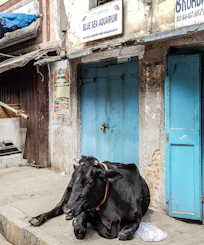
Outside the Beef Market, there were numerous cages containing birds for sale as pets. Proceeding a few yards away from the Beef Market, I had to step aside to avoid bumping into a live cow occupying most of the pavement outside a shop called “Blue Sea Aquarium”. This was close to a shop specialising in repairing sewing machines, both electrical and pedal operated.

After crossing a canal, or maybe, judging by its smell, an open sewer, I spotted an old house with ornate shades over its windows. I photographed it.

The old house is opposite a tiny post office, which I entered. Three men were sitting behind the counter in a disordered office space. Eventually, one of them attended to me. After weighing my letter and scrutinising the address on its envelope, I was handed a 5 Rupee stamp. Using glue from a pot on the counter I affixed the stamp.

I had already handed over twenty Rupees, but received no change. When I had stuck on the stamp, I asked for my change. The post office employee who had sold me the stamp seemed surprised. One of his colleagues rummaged around in a drawer, and handed me ten Rupees. Neither I nor the post office had five Rupees to give the correct change. I felt it was worth losing 5 Rupees at this transaction because my journey to reach it had been far more interesting than had I walked to the post office nearest to where I was staying.

After leaving the post office, I began walking back along HKP Road. A motor scooter pulled up alongside me. It was being driven by a man. Behind him sat his child and his wife in full burqa. He said that he had seen me taking a picture of his old house. I told him that I am interested in the old buildings of Bangalore. He told me that his house was over 100 years old and that I should visit his clothing shop in Commercial Street.

Captured by the British

COVER blog


This true story in this recently published book covers three contintents:

* It concerns the adventures of an educated South African, who was captured by the British during the Boer war (1899-1902)

* The prisoner of war (POW) was held in prison camps in what was then British India.

*Whilst in Captivity, he visited Indian localities such as Madras, Trichinopoly, Kolar, Amritsar, and Bangalore. Being observant, he made notes on what he experienced. His observations form the centrepiece of this book, which is also rich in South African history.

* The POW’s descriptions of Bangalore in 1901 are particularly detailed, and will fascinate anyone who knows the city today

* This book will appeal to anyone interested in the histories of South Africa and/or India 


IMPRISONED IN INDIA” by Adam Yamey

is available as a paperback (ISBN: 9780244826161) at:

http://www.lulu.com/shop/adam-yamey/imprisoned-in-india/paperback/product-24280162.html

For readers in India: https://pothi.com/pothi/book/adam-yamey-imprisoned-india

and on Kindle

Climate, cycles, and trees

cycle


Undoubtedly, there is much concern about the future of planet Earth’s climate. So much so that children are missing school to go on protest marches because they are worried that they might never complete their lives because of catastrophic flooding or abnormally high ambient temperatures. Whether or not the dire predictions will turn out to be fulfilled remains to be seen, but there is no harm in trying to do something to address and then ameliorate or extinguish the perceived causes of the predicted ultimate disaster(s).

One of many measures being taken in London to reduce the output of gases toxic to the environment is to encourage the use of bicycles instead of motor vehicles. At present, cycling in London is fraught with dangers. There have been many collisions between cyclists and motor vehicles with quite a few fatalities amongst the cyclists. Many attempts are being made to segregate cyclists from other road traffic by constructing dedicated cycle lanes. Countries like the Netherlands have demonstrated very successfully that cycling can be made both safe and enjoyable by means of a comprehensive network of cycle lanes. 

Recently, there was a plan to construct a cycle lane along the tree-lined Holland Park Avenue in west London. From my frequent observations of this thoroughfare, there is only heavy cycle traffic in the morning and evening rush hours. Outside these busy times, there are few cyclists using this stretch of road. I felt that because of this a cycle lane was of questionable value.

To build the proposed cycle lane, planners faced a problem, which they might not have anticipated. In order to construct the cycle lane, twenty mature leafy trees would have had to be removed from Holland Park Avenue. This prospect aroused the anger of protestors in the area, who felt it was wrong to chop down trees to make way for a cycle lane. In a way they were correct.

Trees, as most people now know, help to protect the climate, which motorists (in cars powered by fuels other than electricity) are destroying. One need only look at the recent international protests against cutting down the rainforests in Brazil to understand the perceived importance of trees. Granted, Holland Park Avenue is hardly a rain forest, but chopping down trees does not seem like a good thing. In Bangalore (India), many trees have been removed to accomodate the needs of a rapidly growing metropolis, and the city’s climate and water supply are being adversely affected by factors such as this.

So, we have a conundrum: cyclists or trees? Rather than sit on the fence, let me give you my answer. The object of encouraging cycling and preserving trees is to save the future of human existence. If that is accepted, then saving cyclists’ lives and protecting them from harm has to take preference over saving twenty undoubtedly attractive trees.

All I ask of the cyclists is to protect themselves and pedestrians by obeying traffic signals.

For more about the Holland Park cycle lane, see:

https://www.bbc.co.uk/news/uk-england-london-48635369

PHD on arrival

Arriving_240


A few years ago, the new airport at Devanahalli just north of Bangalore (Bengaluru) was opened for use. It was already too small when it opened and in recent years there has been much new construction to more than double its size and passenger handling capacity. 

On arrival passengers from some flights enter the airport by airbridges that connect the aeroplanes to the terminal building. Passengers proceed up escalators to the first floor where they walk along a gallery overlooking the departure lounge. We have spent many hours in the departure lounges awaiting the departures of flights which often depart in the dark early hours of the early morning. For a few years, there used to be a branch of the Pizza Hut chain available for passengers awaiting departure.

One year, I was truly surprised to reach the gallery overlooking the departure lounge because there was a large sign above the Pizza Hut counter, which bore the letters ‘PHD’. What, I wondered connected the Pizza Hut with the academic degree of Doctorate of Philosophy (‘PhD’)? ‘Surely some mistake’, as the British satirical magazine Private Eye often says.

Very soon I learnt that according to Pizza Hut, PHD stood for ‘Pizza Home Delivery’. Sadly, the Pizza Hut outlet has long since closed. It has been replaced by costlier eateries hoping for wealthy foreign travellers.


PHD-offer

No outside food


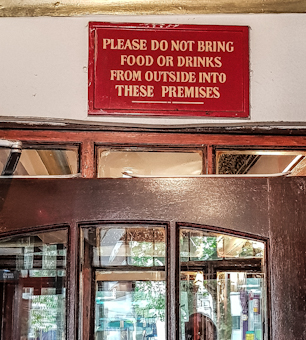
The Coffee Cup café in London’s Hampstead has been in business since 1953, and has been very popular since I first remembered it in the early 1960s. I have visited it several times, but never before noticed the sign at its entrance, which reads: “Please do not bring food or drinks from outside into these premises.” This instruction is not seen frequently in restaurants and cafés in the UK. Seeing this sign reminded me of what is very common in eateries in India, namely, signs reading: “Outside food not allowed.” Customers are forbidden to bring into the estblishment food or drink they have obtained elsewhere. That is fair enough, I suppose.

Cinemas in India, like in many other countries, try to sell food and drink to their customers, often at outrageously high prices. Apparently, watching a film is for many people more enjoyable if you are stuffing popcorn into your mouth at the same time as spilling it on the floor in the dark.

Back in 2001, my family, my in-laws, and my wife’s brothers family went to watch the recently released Bollywood blockbuster Kabhi Khushi Kabhie Gham at a large cinema in Bangalore (India). After purchasing the tickets, we had to wait in a queue before all of our baggage, shopping baskets, handbags etc., were searched by uniformed security personnel. I wondered what these officials were looking for. Was it guns or explosives, I asked my sister-in-law after we had reached the auditorium. No, it was not that, she replied. They were looking for food and drinks brought from outside the cinema. She told me that outside food was not allowed into the cinema, and then showed me inside her shopping basket, All I could see was a shawl (some cinemas are too cool because of air-conditioning). She moved the shawl aside to reveal that her bag was filled with sufficient drinks and snacks to easily satisfy all eight of us during the three and a half hour film. So much for the security check! Had we been carrying anything more dangerous than ‘outside food’, this would have also been missed by the not so vigilant security people.

It is odd how a chance sighting of something like the sign in the Coffee Cup can bring back distant memories.

Smoking prohibited

No smoking_640


A few years ago, it became illegal to smoke in any public place in the UK, be it a place of work or a place of leisure. Other countries have the same prohibitions on smoking.

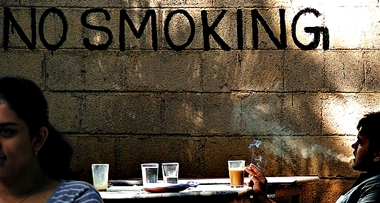
We spent a holiday in Istanbul in 2010 and noticed that all bars, cafés, and restaurants were places where smoking was forbidden. Yet in one tea house on the Asian side of the Bosphorous, we saw everyone was puffing away on cigarettes, even those who were sitting close to the ‘no smoking’ signs. The picture attached to this blog article was taken in Bangalore, India. It shows how much notice is taken of a ‘no smoking’ sign.

A couple of years ago, we were staying in Goa’s capital Panjim. Our host told us that smoking is forbidden in all public places including on the streets. How seriously this is policed, I do not know.

One of the objects of anti-smoking policies is to reduce the chances of secondary smoking, which is inhalation of exhaled cigarette smoke by people near to a smoker but not smoking themselves. This is a worthy and sensible reason for banning smoking in public places. 

The prohibition of smoking makes pubs far more pleasant, but I have a reservation about restaurants. Having been brought up eating in restaurants where some diners are smoking, I feel that the current absencse of smoking in these places detracts from their ambience ever so slightly.

Chopsticks


My earliest recollection of eating Chinese food was in a restaurant called ‘Tung Hsing’ in Golders Green almost opposite the old Hippodrome Theatre. It opened in the 1960s and was one of the first restaurants in London to serve Pekinese food, rather than the then usual Cantonese cuisine. The restaurant was owned by a retired ambassador from Chiang Kai-shek’s nationalist China and his wife, whom I believe was responsible for the very excellent food served. 

Although I am sure they were available, I am not sure whether I used chopsticks when eating at the Tung Hsing. Maybe, I learned to use them there, but I really cannot remember. Whatever the case, I have been eating Chinese food with chopsticks for many decades. I would not say that I am 100 percent proficient with them, but I feel that using them to eat Chinese food satisfies me.

Chinese-style food is very popular in India. Most Indians eat in Chinese restaurants using western utensils such as plate, fork and spoon. If you ask for chopsticks, they are usually available, but they are not supplied as default table settings.

Some years ago, early this century, a new Chinese restaurant opened in Museum Road in Bangalore. We visited soon after its inauguration. It was a lovely restaurant and the food was good by Indian Chinese restaurant standards. As usual, we asked for bowls and chopsticks. The waiter disappeared for a while, and then returned empty-handed.

“There are no chopsticks,” he told us.

“Why not?” we asked.

“I will ask the manager.”

The Manager came over, and explained:

“We have been so busy since we opened, and many of the guests have taken them home as souvenirs. So, we have run out of them”