Green hops and beer at a pub near Tonbridge in Kent

THROUGHOUT THE COUNTY of Kent, you will spot the conical roofs of oast houses in which the hops used to flavour beer are dried. Many of these curious looking buildings are no longer used for their original purpose. Many of them have been converted into picturesque residences. In late October 2025, we booked a table to eat lunch at the Dovecote Inn, a pub near Capel, which is not far from Tonbridge in Kent. We were advised that it might be noisy because there would be a beer festival going on when we were there.

The event was “The Dovecote Green Hop Festival”. Green hops, sometimes called ‘wet hops’, are hops harvested from the vines (the ‘bines’), and used to make beer within 24 hours of having been picked. The beers produced with these fresh, rather than dried, hops, have their own distinctive flavours, which are fresher and more vibrant than other beers. This is because the green hops contain ingredients that are lost when hops are dried out. However, to produce beer with the freshly picked hops, a far greater quantity of hops is required than when using the dried ones. I tried one of the green hop bitters, and it tasted wonderful.

The Dovecote Inn turned out to be a delightful, small late eighteenth century establishment. Its landlord was extremely friendly, as were his team of staff. Although we had to wait a long time for our food, it was well-worth waiting for. As for the noisy festival about which we had been warned, it did not seemed to have taken off by the time we ate there early on a Friday afternoon. We looked around at the customers and amongst about twenty people, only four of them were drinking beer. I suspect that had we stayed until the evening, the beer consumption level would have increased by then.

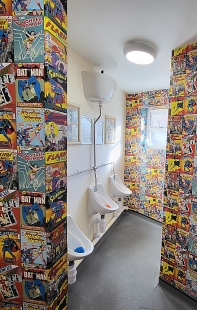
On the way out, I paid a visit to the men’s toilet. This was a sight to be seen. The walls of this part of the pub are covered with an eye-catching wallpaper whose design is a dazzling collage of American comic covers (“Bat Man”, “Wonderwoman”, Superman”, etc.).

Only a few miles from Tonbridge, The Dovecote Inn is well worth a visit, but if you plan on eating there, leave plenty of time.

Two men each with a beer mug in their right hands

I FIRST BECAME AWARE of Birra Moretti when I visited the city of Udine in northeast Italy in the late 1960s. This brewery was founded in Udine in1859, Its logo includes a man in a hat, holding a glass tankard of beer in his right hand.

Today, I visited a pub near Hatfield in Hertfordshire. Within the gents’ toilet, I noticed a sticker attached to a cistern. At first sight, it looks like the Birra Moretti logo, After a moment, I saw that it is a parody of the logo issued by a football (soccer) club in Stevenage, Hertfordshire. Where the original logo is topped with the words ‘Birra Moretti’, the parodied version has the name ‘Steve Evans’.

And who, you might be wondering, is Steve Evans? Between 2022 and 2024, he was the manager of Stevenage Football Club. During his time in this role, the team won 57 out of 120 matches.

Memories of the Italian city of Udine in a restaurant in Essex

LAST NIGHT I ENJOYED a pint of Moretti beer in a pizzeria on Mersea Island (Essex). The beer company was formed in 1859 in a town in northeast Italy: Udine. The company logo is a man wearing a hat and holding a glass tankard of beer.

In the 1960s, a young lady from Udine, Adriana, came to London to teach Italian at the LSE, where my father was a professor of economics. My parents, who loved Italy and Italians, used to invite Adriana to our home. Soon, she became a family friend.

After her return to Italy, we used to visit Adriana and her hospitable parents in Udine. In Udine and all over the region of Friuli-Venezia Giulia, in which the city is located, there were advertising hoardings for Birra Moretti. The images of the hatted beer drinker were as ubiquitous as were images of Tito in Yugoslavia or of Lenin in the USSR.

As I drank my pint of Moretti in West Mersea, happy memories of Adriana, her family, and trips made to Udine came back to me.

By the way, the Waterfront Pizza in West Mersea, where I drank the Moretti, is a superb place to enjoy an evening. Not only are the pizzas high quality, but also the ambience and management of the place is excellent. Although we were eating on an island next to the coast of Essex, it felt as if we were hundreds of miles away on the shores of the Mediterranean.

Dusty no more: a town on the Thames

HENLEY-ON-THAMES is located at the Oxford end of a bridge across the River Thames, which separates the county of Oxfordshire from its neighbour Berkshire. Located on the old main road between London and Oxford, it retains much ‘olde-worlde’ charm. Its streets are lined with many buildings that were constructed in the 18th century and before. Some of these used to be coaching inns but are no longer. However, some of the hostelries that served wayfarers in times long ago are still serving thirsty and hungry customers today, for example: The Red Lion, where William III might have visited, now an upmarket restaurant; and The Catherine Wheel, now a branch of the Wetherspoons company. On a recent visit in April 2022, we enjoyed superb coffee at Pavilion on The Market Place, close to the Town Hall.

Beer lovers will not need reminding that Henley is the home of Brakspear & Sons, the brewery company. Founded in Henley in 1722, beer was brewed in the town since then, although some of the comapany’s products are now brewed elsewhere. Many of the brewery’s older buildings, now converted for new purposes, can be seen alongside New Street. The company’s offices are now located on Bull Courtyard off Bell Street.

The stone bridge across the river was built in 1788. It is the finishing place of the annual Henley Royal Regatta held in summer, ever since its inception in 1839. Near the bridge, stands Henley’s parish church of St Mary the Virgin, which has a 16th century tower. The exterior walls of the southeast corner of the church is an eye-catching chequerboard of alternating masonry and flint squares. The church’s interior has been much modified by the Victorians. The churchyard north of the church is surrounded mainly by almshouses. Immediately next to the north side of the church stands a two-storied, half-timbered building, the Chantry House, some of whose beams come from trees felled in 1461 (according to scientific dating methods). Between 1552 and 1778, this edifice housed a school. Since 1923, it has housed the Parish Rooms.

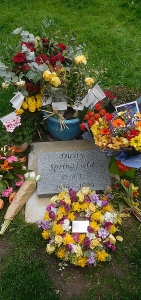
The churchyard is filled with many gravestones. One of them immediately attracts the visitor as it is surrounded by generous amounts of fresh flowers. It is a memorial to the singer Dusty Springfield (1939-1999), who died in Henley. In the 1990s, Dusty lived by the Thames at Hurley near Henley. While in the area, she suffered from several bouts of breast cancer, the cause of her demise. Her funeral at St Mary’s in Henley was attended by many of her fans and leading lights in the British popular music scene including Elvis Costello, Lulu and the Pet Shop Boys. According to her wishes, Dusty was cremated, and some of her ashes were scattered in Henley and the rest in Ireland.

Dusty was not the only music celebrity to have lived in Henley. A man we met outside his house in the town reminded us that the Beatle George Harrison (1943-2001) had also lived in the town. He also mentioned that Henley’s former MP, the present Prime Minister Boris Johnson, had attended meetings in his home, and that he could tell us a thing or two … but he did not!

Czech it out

JAN GARRIGUE MASARYK was born in Prague (Czechoslovakia) in 1886. Son of the first President of Czechoslovakia, Tomáš Garrigue Masaryk (1850-1937), Jan was Foreign Minister of his country between 1940 and 1948, when two things happened. First, the Communists began tightening their grip on Czechoslovakia and possibly connected with that, Jan Masaryk was found dead in his pyjamas in the courtyard of the Foreign Ministry in Prague on the 10th of March. By 1948, Prague already had a reputation for defenestration. Whether or not Jan was pushed out of a window remains uncertain. Two years earlier, a large non-descript house in Hampstead’s West End Lane became home to the recently formed National House, a meeting place for Czechoslovaks (mainly war veterans) in London. Now, it is known as Bohemia House. Its website (https://bohemiahouse.london/beginning-of-national-house/) explains:

“After communist revolution in 1948 and the USSR invasion to Czechoslovakia in 1968, providing the homely atmosphere as well as traditional cuisine. Converted into public house in mid 80’s, the National House serves also as a traditional restaurant showcasing Czech & Slovak cuisines to the public.”

It was in the 1980s that I first began visiting the place to sample Czechoslovak food and drink. After many years, I revisited the place recently (in March 2022).

If it were not for the sign advertising Pilsner Urquell beer projecting above a tall privet hedge, most passers-by would hardly notice that they were passing what is now a bar and restaurant. Immediately after entering via the front door, I noticed several commemorative plaques. One of them honours the British historian RW Seton-Watson (1879-1951), who fought for the rights of the Czechs and Slovaks and other subject people/nations of the former Austro-Hungarian Empireafter WW1. Next to that, there is a large metal plate remembering the Czechoslovak “soldiers, airmen, and patriots”, who fell in WW2. It makes special mention of the Czechoslovak men who flew from Leamington Spa and were parachuted into their Nazi-occupied country to assassinate Heydrich (see https://adam-yamey-writes.com/2021/11/25/leamington-spa-heydrich-and-the-tragedy-at-lidice/).

A doorway from the hallway leads into a front room used as a formal dining room. This is decorated in a mildly baroque style. A gold-framed portrait of TG Masaryk faces the door. Various other framed portraits including one of Queen Elizabeth II hang on the walls. A metal bust of TG Masaryk stands on a mantlepiece next to a credit card machine and a metal sculpture of a Czech airman and there is an old-fashioned gramophone with an LP on its turntable between the two metal sculptures. The formal dining room is separated by a folding screen from a much larger room behind it. The latter, with tables and chairs, a pool table, and a table-football unit, is a less formal space, which I do not remember from the 1980s. In those days, food was served to ‘outsiders’ in the formal front room.

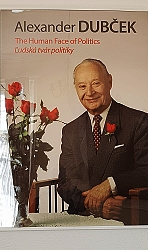
The larger, rear room with windows overlooking the back garden has several interesting objects on its walls. A sombre-looking metal plate covered with many names lists those who “gave their lives for Freedom” between 1939 and 1945. On the wall facing this, there are two posters with photographs of Alexander Dubček (1921-1992), a Slovak Communist politician, who tried to reform the Communist government during the Prague Spring of 1968, which ended after a few months when the Soviet Army invaded his country. On a wall behind the table-football unit, there are two large, colourful, framed maps. One is of the Czech Republic and the other of the Slovak Republic. Between the end of WW1 and 1993, the two now independent countries were parts of one country: the former Czechoslovakia.

A visit to the toilet involves climbing the stairs to the first floor. After ascending the first flight of stairs, the next short flight approaches a huge painting depicting TG Masaryk dressed in a flowing light beige coat and sporting a straw hat with a black ribbon tied above its rim.

Today, Bohemia House continues to welcome guests, both from the lands, which were once Czechoslovakia, as well as others. Its bar offers a range of beers, spirits, wines, and soft drinks, from that region of Central Europe. I sampled a can of Kofola, a carbonated Czech soft drink, whose taste vaguely resembles Coca Cola. The pint of Pilsner Urquell beer was more enjoyable. We also tried a variety of dishes typically cooked in the Czech and Slovak republics. They were enjoyable enough, but I prefer the cuisines of both Poland and Hungary. However, do not let this comment put you off paying a visit to Bohemia House, where you will receive a warm welcome from its charming staff. And … if you wish to know more about Hampstead’s Czechoslovak, other Central European, and Soviet historical associations, you could do no better than to read my new book about the area, available from Amazon [https://www.amazon.co.uk/dp/B09R2WRK92] and bookdepository.com [https://www.bookdepository.com/BENEATH-WIDE-SKY-HAMPSTEAD-ITS-ENVIRONS-2022-Adam-Yamey/9798407539520]).

They are only there for the beer

DESPITE LIVING IN KENT for eleven years and having visited the county numerous times, it was only in October 2021 that I first stepped inside an oast house. Dotted all over the county with their tall conical (sometimes pyramidical) roofs surmounted by distinctive cowls, they play(ed) an important role in the production of beers.

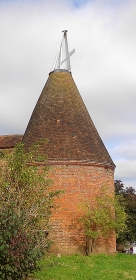
An oast house with conical roof

Hops are the flowers (or seed cones) of the hop plant known by botanists as Humulus lupulus, a member of the Cannabaceae family of plants, whose members include Cannabis, the plant which is the source of marijuana. Only the flowers of the female hop plant are used in beer making. When dried to a well-defined degree, hops are added to the beer-making process both to add flavour and because of their antibacterial effects that prevent unwanted organisms growing whilst the beer is being brewed.

Traditionally in England, hops are dried out in oast houses. Picked hops are laid out on perforated drying floors in the upper levels of the oast house. A wood or charcoal fired kiln on the ground floor of the oast house produces hot air that drifts upwards through the layers of drying hops and then escapes through the cowl at the top of the oast house’s conical roof. The cowl has a vane that catches the wind and rotates the cowl so that the wind continuously draws the smoke from the kiln up through the oast house. The air that carries the smoke upwards is drawn into the oast house through perforations in the brickwork at the lower levels of the building. The tall conical design of the roof increases the draught of air through the hops. The drying process must be carefully monitored so that the hops are removed before they are dried out too much.

The earliest known record of hop cultivation was in a document dated 736 AD. It referred to hops being grown in Germany. The use of hops in beer production seems to have taken off in a big way by the 13th century. Before hops became used routinely in beer production, a mixture of herbs and flowers, known as ‘gruit’, was used for the same reason as hops. In Germany, hops became favoured over gruit in the early 16th century because unlike the latter, which were subject to taxation, the former were not (https://en.wikipedia.org/wiki/Hops).

Hops were introduced to England during the 16th century. The oldest description of an oast house (more accurately, a building for drying hops) was written in 1574. What was described was different in design to what we recognise as an oast house today. The earliest surviving oast house was built sometime during the following century. Today, hops are no longer dried in oast houses. They are processed in industrial premises that are not nearly as picturesque as oast houses, many of which have now been repurposed as dwellings and for other uses.

On the estate of Sissinghurst Castle, a former manor house rather than a castle, a set of former oast houses has been tastefully modified by the National Trust to create an exhibition space that includes information about oast houses and hop drying. Although the kilns are no longer present, the internal structures of the tall roofs have been preserved. By entering the exhibition space, I managed to see inside an oast house for the first time. I would be curious to see within an oast house that still contains its kiln and other equipment, but what I saw at Sissinghurst began to quench my thirst for knowledge about these curious looking buildings, which were only there for the beer and can be seen throughout the landscape of Kent.

Only the name is the same

AFTER A SUNNY DAY spent at Whitby in North Yorkshire, we stopped for a drink at sundown in a small pub for a pre-prandial alcoholic beverage. Behind and slightly above the pub, we could see a well-maintained 12th century parish church with later modifications and a square tower. Below the pub, a narrow stream, lined with bushes and trees, ran alongside the main road. Apart from the infrequent passing car, the place was silent except for some pleasant birdsong. From where we sat on the terrace of the hostelry, we could see a small, sloping village square with a simple war memorial, some parked cars, and a small post box. At first, I did not realise where we had stopped. Then, I noticed that the village is called Kilburn.

Kilburn, North Yorkshire

There is another Kilburn about 215 miles south of the lovely village where we stopped for an evening drink. The latter is in North Yorkshire and the place with the same name many miles south of it is in north London. Apart from sharing the same name, London’s Kilburn is anything but rustic and peaceful, as many Londoners will know. London’s Kilburn is not really picturesque in conventional people’s eyes; it might appeal to lovers of urban sprawl.  It is a crowded metropolitan area with much commercial activity and a racial profile infinitely more diverse than that of the village in North Yorkshire.

I am not sure which of the two Kilburns is the oldest. North Yorkshire’s village was mentioned in the Domesday Book of 1086 and named ‘Chileburne’. London’s Kilburn was a settlement on an ancient Celtic route, a track between the places now known as St Albans and Canterbury. A priory was constructed on a stream that flowed through where London’s Kilburn now stands. The stream was known variously as ‘Cuneburna’, ‘Kelebourne’, and ‘Cyebourne’.

Whatever the origins of these two Kilburns, I know which of them is the place where I would prefer to linger in front of a glass of bitter.

The writing on the wall

WE USED TO DRIVE to France during the early 1960s when I was a child and before the M2 motorway was in use. The first part of the drive was from London to Dover and prior to the opening of the M2, it was a slow journey because the main road went through numerous small towns in Kent instead of bypassing them, which the M2 does. To break the tedium of the lengthy drive, I used to count how many Esso filling stations we passed as well as the number of Fremlin signs along the road. I liked the name Fremlin, but in my childhood, I was unaware that this was the name of a brewery based in Maidstone (Kent) and founded in 1861. It is a long time since I passed the time on journeys by counting signs such as Esso and Fremlins, whose name appealed to me. Recently, we drove through the centre of Hertford (in Hertfordshire) and I spotted several buildings bearing a name that intrigued me because we have friends with the same name (as surname). The name is McMullen and it, like Fremlins, is the name of a brewery.

Peter McMullen (1791-1881), the son of a Scottish nurseryman, founded his first brewery at Railway Street in Hertford in 1827. It was his wife’s idea. She suggested that it would be better to open a brewery rather than to continue his hitherto rather unsatisfactory life poaching and undertaking failed apprenticeships (www.mcmullens.co.uk/about-us/our-history).  Given that the first railway station opened in Hertford in 1843 (www.hertford.net/history/railway.php), Railway Street must have had another name when the brewery was established. The business was expanded in 1860 by his sons Alexander and Osmond McMullen, when they took over the brewery. They bought some other breweries and opened several pubs run by tenants. By 1910, McMullen was one of 1284 brewing companies that were in business in the UK. By the 21st century, it was one of the 38 of these that remains.  Now in 2021, it is run by the sixth generation of Peter McMullen’s family (https://en.wikipedia.org/wiki/McMullen%27s_Brewery).

One of the first beers brewed by Mcmullen, which has been available since 1833, was Mcmullen AK. This and several other brews are cask ales. The company also produces bottled beers including McMullen Hertford Castle, which is named after Hertford Castle, where Queen Elizabeth I visited frequently during both her childhood and her reign. The castle still exists: the remains of an early motte; Norman encircling walls; the so-called Gatehouse, built by Henry VIII; and other more recent additions. Incidentally, the Castle was the home of The East India Company College between 1805 and 1809, which then moved to Hailey, also in Hertforshire. The college’s presence in Hertford was before McMullen began producing beer in the town.

The company produce an IPA (Indian Pale Ale), suitable for exporting to tropical climes, but I do not know whether this was ever shipped out to India. The company’s history relates:

“The McMullen relationship with IPA can be traced back to the 1800’s when Peter McMullen recorded the brewing of an East India Pale Ale with connotations of the brew being commissioned to quench the thirst of the British Army at the East India Company College originally in Hertford.” (www.mcmullens.co.uk/blog/2019/04/mcmullen-rebranding#.YJKaSrVKhPY)

Well, you do not have to travel as far as India to sample beer brewed by McMullen. It can be drunk in pubs in the English counties of Hertfordshire, Essex, Buckinghamshire, Kent, Middlesex, Berkshire, Bedfordshire, and more (www.mcmullens.co.uk/our-locals).

After seeing the name of our friends prominently displayed on buildings in Hertford, I rang them and asked them whether they are related to the brewing family. As far as they know, they are not, but they did tell me that there used to be a pub near where they live in north London, which did serve McMullen’s beers, but sadly that has now gone out of business.

Next time, we visit the charming town of Hertford, one of the things I plan to do, which I have not yet done, is to sample some of McMullen’s beer or maybe beers.

PS: One building prominently bearing the name McMullen in Hertford was part of a former seed merchants, A McMullen, established by a brother of Peter Mc Mullen.

Three pubs and a hero

LESS THAN 580 FEET long, Rathbone Street runs parallel to part of London’s Charlotte Street. Short though it is, it is not lacking in interest. The quiet thoroughfare was originally named ‘Glanville Street’, before being renamed Upper Rathbone Place, and then its present name (www.british-history.ac.uk/survey-london/vol21/pt3/p12). Rathbone after whom Rathbone Place and Street were named was a carpenter and builder, Thomas Rathbone (died 1722), who lived in a house on the Place around 1684. Rathbone Street was laid out 1764-65 (www.ucl.ac.uk/bartlett/architecture/sites/bartlett/files/chapter31_hanway_street_and_rathbone_place.pdf). During the late 18th and early 19th centuries, Rathbone Street was occupied by various artists including the sculptor M Bordier and the painter John Rubens Smith. Today, various vestiges of the past can be seen on the short street.

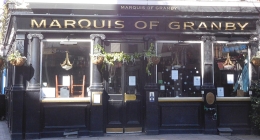
The Marquis of Granby pub at the southern end of Rathbone Street was named in honour of Lieutenant-General John Manners, Marquess of Granby (1721-1770), who fought heroically at the Battle of Warburg (1760) during The Seven Years War (1756-1763). He became Commander of the British Army in 1766. There are many pubs named after him because, it is said, he set up many of his soldiers as publicans when they retired from military service. The pub bears old boundary markers marking the demarcation line between the parishes of St Pancras and St Marylebone. The pub now stands in both the Boroughs of Camden and Westminster. In the past, the pub’s customers have included Dylan Thomas and TS Eliot. The building housing the pub was already built by 1765.

There are two other pubs in Rathbone Street. One of them halfway along it is The Newman Arms, another haunt of Dylan Thomas and also frequented by George Orwell. Established in the 1730s, this pub features in two of Orwell’s novels: “1984” and “Keep the Aspidistra Flying”. Once upon a time, the pub was a brothel. A painting depicting a prostitute in period costume covers a bricked in upper storey window. Across the road from the pub there is a plaque on a building that bears the words: “Hearts of Oak Benefit Society” and the date 1888. This marked the rear entrance to the offices of the Society. Its main entrance was 15-17 Charlotte Street (www.londonremembers.com/memorials/hearts-of-oak-benefit-society-w1). At the north end of the street, there is a third pub, The Duke of York. Bearing the date 1791, it was where the author Anthony Burgess was drinking when he witnessed an attack by a gang bearing razors (https://en.wikipedia.org/wiki/The_Duke_of_York,_Fitzrovia). The pub’s sign bears a portrait of someone who is far younger than the pub, the current Prince Andrew. This pub is the only one with the name The Duke of York which has a pub sign depicting the current Duke of York. The pub was originally named to honour an earlier Duke of York.

Rathbone Street, short as it is, contains three pubs. Its continuation southwards towards Oxford Street, Rathbone Place, contains two pubs and another drinking place, once a pub but now named The Liquorette, in a stretch of road even shorter than Rathbone Street. Thus, there used to be 6 pubs within a stretch of roadway 364 yards in length.

Returning to the south end of Rathbone Street, its southwestern corner, we reach what first got me interested in this short lane. During WW2, there was a London Auxiliary Fire Station, Sub Fire Station 72Z, on this spot. During the night of the 17th of September 1940, it was hit by a bomb dropped by the German Luftwaffe. The building burst into flames. Seven firemen lost their lives. However, two men were saved by the brave actions of Fireman Harry Errington, who was later awarded a George Cross to recognise his bravery. He rescued two of his comrades from the flaming ruins. Harry Errington (formerly ‘Ehrengott’) was son of Jewish immigrants living in Soho. Harry, son of Baila and Shepsel Ehrengott who arrived in London from Poland in 1908, was born in Soho in 1910 (https://british-jewry.org.uk/New%20Member%20Area/BJ%20News/100806/Microsoft%20Word-B-JNews8final.pdf).  

After training to become an engraver, he had to abandon this because his lungs became affected by nitric acid fumes. Then, he joined a relative, a tailor in the Savile Row firm of Errington and Whyte. He became a master tailor. Then, WW2 broke out. Mike Joseph wrote in the “B-J News” of August 2006:

“It was in 1940 that Harry earned true celebrity status. Having joined the Auxiliary Fire Service at the outbreak of the Second World War a year earlier, he was one of several firemen on duty in a basement rest-room during an air raid, when the building collapsed. An enemy bomb had scored a direct hit, and twenty people died, including six firemen; Harry was lucky: he was only knocked out! When he came round, the building was on fire. He could have escaped with little difficulty, but two of his comrades were trapped under rubble: how could he leave them? He wrapped a blanket round his head against the flames and, digging with his bare hands, managed to free one of the men. He dragged him to safety, upstairs into the street, and then, although he was already badly burned, went back and rescued the other man.”

Harry was true to the words quoted from the Book of Joshua, which are written on one of the two commemorative plaques marking the former fire station in Rathbone Street:

“Be strong and of good courage.”

Harry returned to tailoring when the War was over but remained in touch with the London Fire Brigade. When he died in 2004, he was the last surviving Jewish holder of the George Cross.

Though less lively than nearby Charlotte Street in ‘normal’ times, Rathbone Street is worth a detour, if only to quench your thirst in one of its three pubs. I wonder whether Harry Ehrengott and his colleagues made use of any of these drinking holes during the odd quiet moments between their brave firefighting tasks.  

Beer and biryani in Hampstead High Street

MANY PEOPLE HAVE FAVOURITE restaurants. My parents were no exceptions. Amongst the restaurants they frequented often in London during the early 1960s were Mon Plaisir in Monmouth Street; Otello in Soho; Cellier du Midi in Hampstead; and the Tung Hsing in Golders Green, one of the first restaurants in London to serve ‘Pekinese’ cuisine. For Indian food, they patronised the Shahbhag in Hampstead High Street. 135 feet west of that still extant restaurant there is an archway decorated with sculptures depicting sheaves of barley and an inscription that reads:

“Established 1720. BREWERY. Rebuilt 1869”

The archway is at the street entrance of a covered cobbled lane that leads to a converted Victorian industrial building, now named ‘Clive House’, within a yard of varying width. The yard contains a well-head covering a well that looks quite old, and certainly not of recent construction.

The brewery was that of the ‘Hampstead Brewery Co. Ltd’ founded in 1720 by John Vincent (died 1755).  In about 1713, Vincent, already a landowner, acquired the Jack Straws Castle pub near Hampstead’s Whitestone Pond (www.british-history.ac.uk/vch/middx/vol9/pp66-71). He founded the brewery behind a pub called the “King of Bohemia’s Head” in 1720. In 1733, he was granted a 33-year lease of a spring by the trustees of an estate in Hampstead, which contained it and other wells including those with curative mineral waters. It was:

“…used only to supply the Vincents’ brewery in High Street and a few adjoining houses, was of little value to anyone other than the brewer.” (www.british-history.ac.uk/vch/middx/vol9/pp169-172).

Thomas J Barratt, a historian of Hampstead, wrote (in 1912) that Vincent selfishly believed that:

“… he could utilise the water to his own profit and the benefit of some of his neighbours; therefore, with the leave of the trustees, he laid down pipes and conveyed water from the pond not only to his brewery but also to a number of better-class houses in the town. He charged the householders for the water, and no doubt did well out of the transaction; but when, after many years, the Chancery decree brought about a day of reckoning he was ordered to pay £322 for arrears of rent, and the water was advertised to be let to the highest bidder. When Gayton Road, a thoroughfare now connecting Well Walk with High Street, was being formed, remains of the pipes conveying this water to the brewery were discovered a few feet below the surface.”

In addition to the brewery, Vincent acquired much other property in Hampstead including several pubs. On his death in 1755, Vincent’s brewery and other properties passed to his younger son Robert, who is thought to have continued running the brewery with his elder brother Richard (www.british-history.ac.uk/vch/middx/vol9/pp111-130). Richard entered Wadham College, Oxford, in April 1736 and became a barrister (Inner Temple) in 1743 (https://en.wikisource.org/wiki/Page:Alumni_Oxoniensis_(1715-1886)_volume_4.djvu/270).

In 1787, Robert’s widow Elizabeth became involved in running the business and some of the Vincents’ pubs in Hampstead including the ‘George’, the ‘Black Boy’, and the ‘Coach and Horses’. She retained an interest in the brewery until 1812, which is well after it was taken over by Messrs Shepheard and Buckland in 1797. The brewery was rebuilt in 1869 with two shopfronts on the High Street, and by the 1880s, it was owned by Mure & Co. In 1928, the company had 184 employees, but it closed in about 1931. Reffell’s Bexley Brewery acquired it in 1931 (https://builtforbrewing.wordpress.com/2012/08/06/on-hampstead-high-street/).  

The brewery buildings had become quite dilapidated by 1959 when they were being used for motor repairs. Later, the structure was converted for use as office space and an attractive group of residences were built within its compound.  The main brewery building is now named Clive House. It is currently the offices of the Pears Foundation, which is:

“…an independent, British family foundation, rooted in Jewish values, that takes £15 ‐ 20 million of private money every year and invests it in good causes.” (https://pearsfoundation.org.uk/who-we-are/).

The Brewery’s grounds were adjacent to the grounds of a church, which has been converted into residential dwellings, which retain some of the original windows topped with ogival arches. This building is labelled as ‘Trinity Presbyterian Church’ on a map surveyed in 1866. It was founded in 1844 and had its roots in Calvinist theology. The church’s story is as follows (https://search.lma.gov.uk/scripts/mwimain.dll/144/LMA_OPAC/web_detail/REFD+LMA~2F4352?SESSIONSEARCH):

“Trinity Presbyterian Church began after a report by the Presbyterian district visitor for Hampstead that Scottish inhabitants needed a preaching station … By the end of 1845 the average attendance was 130 in the morning and 80 in the evening … The congregation moved to Well Walk Chapel in 1853, however, the building was dilapidated, so a site at 2 High Street, on the corner of Willoughby Road, was bought in 1861. The new church opened in 1862. It was demolished in 1962 … Shops were built on the site and the hall was converted into Trinity Close.”

So, what can be seen today was the church hall.

All this history is making me hungry. So, let us return to the Shahbhag, which my parents enjoyed back when I was a youngster. I went there once in the early 1970s and had a pleasant meal. Then, I did not return to it until the mid- to late 1990s.  It looked different to what I remembered of it, but its location was the same as of old. I sat down and ordered a meal. While I was waiting for it to arrive, I looked around at what was arriving on the plates being served to other diners and I did not like what I saw. It looked and smelled far less attractive than the food that I was used to having in other Indian restaurants at the time. I was beginning to regret having entered this restaurant, mainly for nostalgic reasons. I waited and waited for an extremely long time, but my food did not arrive. I looked at the time, almost 45 minutes had elapsed since giving my order, and realised that soon I had to meet my wife and some friends. I called the waiter and told him that I could wait no longer and that I would be cancelling my order. He seemed undismayed as I walked out of the restaurant.

Recently (January 2020) when I explored the grounds of the former Hampstead Brewery, I noticed that the Shahbhag was still in existence but closed for the time being because of the current viral pandemic. I am glad it still exists as it is something that reminds me of my parents, but I doubt I will be entering it again when it reopens. When restrictions relating to covid19 ease up, I would rather have a beer than a biryani in Hampstead.