Problems with identifying gender in London and Bangalore (Bengaluru)

WHEN OUR DAUGHTER was about two years old and able to walk unassisted, she often wore overalls (jump suits), rather than girlish frocks. One day we were walking in London’s Kensington Gardens when we passed a couple of elderly ladies.  One of them looked at our child, and said to us: “What a cute little boy you have”

We replied:

“Actuually, she is our daughter.”

To which one of the ladies said to her friend: “it’s so difficult to tell one from the other these days.”


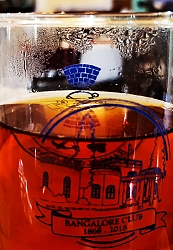
The former Men’s Bar at the Bangalore Club

Some months later, we were in India at the Bangalore Club (in Bangalore). In those days, the late 1990s, the club had a Men’s Bar, to which only men were admitted. Its wood panelled walls bear hunting trophies and archaic weapons.

One day, I was having a drink in that bar with my father-in-law, when our daughter arrived in the adjoining room with my wife. Excited to see us, our daughter,  dressed in her overalls, dashed into the Men’s Bar. An elderly gentleman, seeing a child in the bar, said to our daughter:

“You are too young to come in, young man. When you are 21, you will be welcome here.”

To which, my wife standing close to the entrance, said: “She’s our daughter.”

The gentleman then responded: “In that case, you will never be able to enter our bar”.

 How wrong he was.

Sometime during the early twenty-first century, the rules changed: now both men and women can use what had been the Men’s Bar.  Now, this bar has been renamed: it is simply The Bar.

Today, almost 28 years later, nobody would have any difficulty identifying our daughter as a young lady.

The Sport of Kings and a bar in Bangalore

I MUST ADMIT that I have never been much of a sportsma, and I know hardly anything about the game of polo, apart from the fact that it involves both horses and humans. Yesterday evening, as I enjoyed a postprandial brandy in the recently renamed ‘Polo Bar’ (formerly, ‘The Mixed Bar’) at the Bangalore Club, I spotted a large ‘coffee table’ book by Jaisal Singh about Polo and India.

What surprised me is the great age of the game of Polo. It seems to have been existence in some recognisable form as long ago as the 6th century BC. Then, it was played by some nomadic peoples in Central Asia. The book in the Polo Bar has a photograph of a terracotta model of a Chinese woman playing polo. This model was made between the 7th and 11th century AD. Another photograph shows the earliest known picture of a Polo player. This depicts a man on a horse, and was created in the same era as the model.

Much of the rest of the book is about polo in India. It charts the rise in popularity of the game amongst the wealthy rulers of the Princely States and the upper echelons of the British administrators and military in India.

The Polo Bar, which until recently was known by another name, has been decorated with polo memorabilia (e.g., photographs, trophies, and horseshoes). The handle on the door leading into the bar is horse-shaped. However, for me, the most interesting polo related item is in the Club’s Gardens. It is an inscribed stone block, which was the foundation stone of the Domlur Polo Pavilion laid in January 1914 by Lady Daly, wife of the British Resident.

The stone includes the information that one Major C Rankin was “Hon-Secy” and R Evans Esq was the architect. Both were military personnel, members of the “7th (Q.O.) Hussars”. The pavilion’s building contractor was BV Venkataswami Naidu.

In “Bangalore, the Story of a City”, by M Jayapal, the author wrote that initially the race course was out at Domlur. [Hence, the existence of Old Race Course Road]. In the late 19th century it moved to near Lalbagh, and then to its present position near to High Grounds. Presumably, because there had been equine facilities at Domlur, this would have been a suitable place for the Bangalore Club to locate its polo club there. I am not sure whether anything remains of the polo club pavilion whose foundation stone stands in the Bangalore Club gardens.

According to a blog article (https://wp.me/p1YuI1-1xA) about the pavilion, this is of interest:
“Information, thanks to the Bygone Bangalore group on Facebook: The Polo Club was located on Cambridge Road, in the area that is now Cambridge Layout. Opposite the Sai Baba Temple, there exists a portion of an old building which is said to be a part of the Polo Club.”
Incidentally, the centre of Cambridge Layout is less than a mile from the heart of Domlur.

As for the Bangalore Club’s association with polo, the following words quoted from the Club’s website (www.bangaloreclub.com) are of interest:
“Bangalore Club was established in 1868 as the Bangalore United Services Club for the officers of the British Empire. Originally the buildings were occupied by the Polo Club which moved out in the beginning of the 1860’s.”

I do not know how many current members of the Club play Polo these days. Even if it is not many, the Club’s former associations with the military ( the Club was formerly a club for military officers) and the land upon which it stands justify the naming of one of its bars to commemorate what was once known as “The Sport of Kings”.

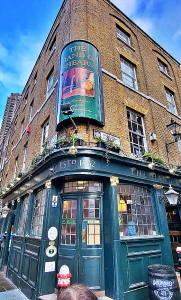
Once it was a hospital, now it is a bar

I STUDIED AT University College London (‘UCL’) between 1970 and 1982. I was not there for so long because I kept failing examinations. Instead, I was a student there while I completed three different degree courses. Today (and during the years I attended UCL), the Students Union building is still located in a not particularly attractive building on the southwest corner of Gower Place and Gordon Street. Whereas it was a popular haunt of many of my fellow students, I hardly ever entered it except for a very brief period in the mid-1970s, when I was a PhD student in the Physiology Department.

During that short period, an Italian man opened a small restaurant on one of the floors of the Union building. His menu was limited to beautifully prepared beefsteaks that were accompanied by salad. This wonderful steak was priced no more than the often mediocre (or sometimes even poor) food that was available in the various subsidised student canteens in UCL. The reason for the Italian’s low priced, superb fare became obvious when after a few weeks, his eatery closed – or was closed. It turned out  (so I was led to believe) that he was using the Union’s premises, but not paying the rent that he owed.

Winding the clock forward to the 26th of June 2023, we walked past the Union building, and I noticed something that I had never seen before. The building has a commemorative plaque that reads:

“This building housed the London School of Tropical Medicine and the Hospital for Tropical Diseases. 1920-1939.”

The plaque was placed by the Seamen’s Hospital Society, based in Greenwich. I do not know when the memorial was affixed to the Union, but I feel sure that it was not there when I was a student. It is interesting that what was once a hospital has become a centre for hospitality.

Winston Churchill and a newspaper reading stand

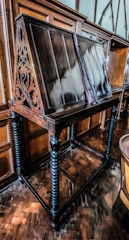
THERE IS A LOVELY old wooden newspaper reading stand is located in the formerly men only bar in the Bangalore Club. It bears the insignia “US” at one end, the S being back to front. Before about 1947, the club was the United Services Club.

Winston Churchill, who was never too fond of India, was briefly a member of the Club (in the late 1890s) , and incurred a small, but never paid debt there. I wonder whether the reading stand is old enough to have been used by Churchill.

Coiffure at the Club

I HAVE NEVER LEFT a barber’s shop without leaving a tip. This is a habit that was instilled in me by my mother during my childhood. Whether the cut was good or bad, I have always left my hairdresser with a gratuity.

In January 1994, I first visited the Bangalore Club in southern India. A few days before my wedding to a member, my in-laws decided that my hair needed a trim. Back in those days, the Club barber shop was located in a hut behind the Men’s Bar, which until a few years ago did not allow the entry of women and girls. Now renamed, this former bastion of maleness permits all drinkers regardless of their genders.

My haircut was at the very least satisfactory and cost all of 20 Indian Rupees, which was debited to my wife’s club account. In those days one pound Sterling was, if I recall correctly, about 40 Rupees. So, my haircut was remarkably good value compared with what I would have paid for it in London.

At the end of my session with the barber, I fumbled in my pocket to find some money for the tip. All I  could find was a 50 Rupees note, which I handed to the man who had looked after my coiffure.

When I related my experience to my wife-to-be, she was horrified that I had tipped more than twice the fee. I suspect that the barber was delighted.

Thrown out of a library

When she was about two years old, our daughter dressed in a unisex romper outfit, rushed into the Men’s Bar at the Bangalore Club. An elderly gentleman conducted her back to the entrance of the bar, saying: “You can’t come in here yet, young man. You’ll have to wait until you’re twenty one.”

My wife explained that our child is a girl. The gentleman replied: “In that case, my dear, you will never be able to enter the Men’s Bar.”

The Bangalore Club was founded by British officers in 1868 at the time when Mahatma Gandhi was born in faraway Gujarat. Until after about 1945, women were not allowed into the main Club House. There was a separate annexe reserved for women. And until 1947, with the exception of servants and a very few high ranking military officers, no Indians were permitted to enter any part of the Club.

The Bangalore Club and many other similar still existing colonial era clubs in India maintain many of the old-fashioned rules that applied in elite clubs in the UK. For many years, men could only enter the Club House at the Bangalore Club wearing ‘proper’ shoes, not sports shoes or sandals. Now, sandals are allowed providing they have a back strap around the ankle.

Once, I stayed at the Kodaikanal Club deep in the southern Indian state of Tamil Nadu. Dress code seemed to be non-existent there until I stepped into the club’s small library. Within a few seconds, a member of the library staff escorted me out of the library. I was wearing sandals. I was told that one could only enter the library if formal leather shoes were being worn.

Well, if you join a club, you should respect its rules however idiotic they might seem. Vide the UK and the EU.

As time moves on, rules change. A couple of years ago , for reasons best not explored here and they were nothing to do with gender equality, women were permitted to enter and use the Men’s Bar at the Bangalore Club. Since that date, the formerly masculine sanctuary has been renamed “The Bar”.

The old gentlemen who evicted our daughter from the Men’s Bar is probably no longer alive. I wonder what he would have thought when his prediction proved to be wrong. Let’s finish by raising a glass to his memory.

A theatre resurrected…

Early in November 2018, I saw the opening performance of a new production of “Love Lies Bleeding” by Don de Lillo, which was premiered in 2005, at the Print Room in London’s Notting Hill Gate. The play deals with the question of euthanasia in a situation of a person with persistent vegetative state. The playwright deals with moral and other questions relating to this in a sensitive way. As with most Print Room productions I have seen, the acting was superb, at times gripping.

COR 1

The Print Room theatre began its life in 2010 in a converted printers’ warehouse in Hereford Road, close to Westbourne Grove. We attended several excellent performances there, seated on not very comfortable chairs. In summer the warehouse, which was poorly ventilated, could become very hot. I remember watching “The Kingdom of the Earth” by Tennessee Williams one hot May evening. The heat in the theatre complimented the seediness of the characters. A year or two ago, the Print Room shifted to the Coronet in Notting Hill Gate.

When I began living near this place, the Coronet was a cinema. It was the last cinema in London to permit smoking in the auditorium. Smokers had to sit in the balcony seats, not in the stalls below them. The cinema had two screens, the larger of which was in what looked like an Edwardian theatre. Indeed, the Coronet started life as a theatre when it was opened in late 1898 (see: http://www.arthurlloyd.co.uk/CoronetTheatreNottingHillGate.htm).    It was designed by a theatre architect WGR Sprague (1863-1933). Eighteen years later, the theatre began to be used as a cinema. Many of its original features were retained. By 1923 it became a full-time cinema.

COR 3

In 1972, the Coronet was threatened with demolition. It was saved and made subject to conservation regulations following local residents’ successful protests. In 1993, when I first came to live close to the Coronet, the cinema looked run down but romantically picturesque. The local Kensington Temple Church bought the Coronet in 2004, planning to use it as a place of worship (as has happened with so many former cinemas in London). As a digression, it is interesting to note that cinemas in London have been converted to churches, whereas in Communist Albania the reverse was true during its period of official atheism.

COR4

The Kensington Temple spruced up and restored the Coronet, but kept it running as a cinema. They used it occasionally as a place where their congregation could listen to preachers. Once on a Sunday morning I passed the Coronet, whose doors were open, and looked into the auditorium where a very enthusiastic clergyman was rousing his lively audience.

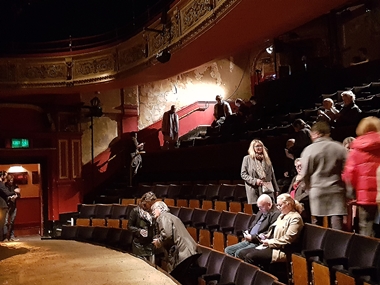
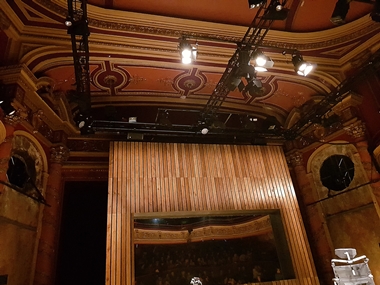
The Coronet cinema closed in 2014. It had been bought by the Print Room, which had shifted from Hereford Road. Thus, the Coronet became a theatre once more. The Print room have preserved many of the decorative features of the original theatre but have made some major internal modifications. A new stage has been built to cover the space where the original lower level stalls were once. This stage extends to the lower level of the raked seating that had formerly been the original theatre’s Dress Circle. The seats in this Circle have become the new auditorium. Although much has been done to preserve original features, the theatre has been decorated to give its walls a fashionable distressed appearance. The place reminds me a little of what I remember of the Theatre des Bouffes du Nord in Paris when I saw it in the 1970s soon after the British director Peter Brook re-opened it.

COR 5

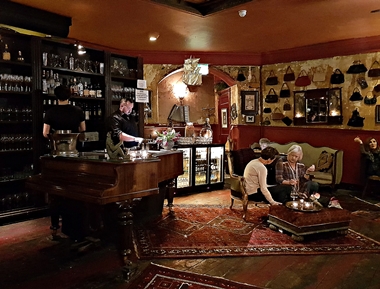
Although the theatre and its productions are wonderful, the bar must not be missed. It is located beneath the new stage in the space where once the stalls were located. Its concave floor reflects the raking of the seats that were once affixed to it. A grand piano serves as the bar where drinks are sold. The dimly lit bar is decorated quirkily with all manner of bric-a-brac, largely chosen by the staff and, no doubt, sourced from the nearby Portobello and Golborne markets. The bar is open an hour before and an hour after a performance. It is closed during performances because its ceiling is the theatre stage. Even if you cannot manage a play, a visit to the Coronet’s bar is a treat.