An artist from Sweden near London’s Smithfield meat market

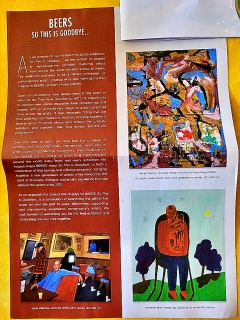
KURT BEERS IS probably unique amongst owners of commercial art galleries in London because he was once a ‘Mountie’, a member of the Royal Canadian Mounted Police. His gallery in Little Britain (near the Smithfield meat market and the Barbican) specialises in showcasing contemporary paintings created by up-and-coming artists and those in mid-career. Often, the gallery shows the works of painters, who are not yet well-known, but deserve to become better recognised.  Until 23 May 2026, Beers has an exhibition of works by Alice Herbst.

Alice was born in Sweden in 1993. She studied art at the Stockholm School of Fine Art, and then at the Gerlesberg School of Fine Art. Her show at Beers is called “The Whispering Game”, and is a collection of paintings made between 2025 and 2026. As soon as I saw the paintings, I liked them. Excellently executed, well-composed, and intriguing, they are highly original: a breath of fresh air. Without knowing exactly what, I felt that each painting told a story. What that story was intended to be by the artist did not matter because the viewer can make up his or her interpretation of what was being portrayed.

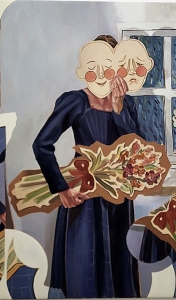
In many of the paintings, masks can be seen, either being worn or just on their own. In a couple of paintings, faces were partially obscured. Why the masks and the hidden faces are so prevalent would make interesting subject matter for a psychologist. Another feature in Alice’s paintings are depictions of paintings within the paintings. For example, in one picture a masked woman seems to be holding a bunch of flowers. After a moment, one can see that it is not a bouquet in her hand but a board with a painting of flowers upon it. In another painting, a still life that includes a vase with flowers, the flowers appear to be a painting of flowers on a board, rather than real flowers. These types of images within images and the profusion of masks make Alice’s paintings more than pretty pictures, and give one cause to wonder.

As with all the shows we have viewed at Beers, Alice’s paintings were well-displayed on the whitewashed walls of the gallery. Though far from the large group of art galleries in Mayfair, Beers deserves regular visits.

The eyes have it near London’s Smithfield Market

GINNY ON FREDERICK is a tiny art gallery at 99 Charterhouse Street, next to Smithfield meat market. We had never heard of it before, and after seeing it mentioned in the Financial Times newspaper, we went there today (11 March 2026) to view a collection of portrait paintings by British-born Hanna Murray (b. 1994). She received her MFA from New York Academy of Art in 2021, and now lives and works in Brooklyn, New York (USA). Like the gallery, the artist was new to us.

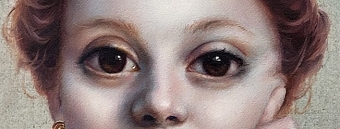
The six paintings on display were all portraits, beautifully executed. What makes each of them special is the artist’s depictions of her subjects’ eyes. They are literally eye-catching, and especially alluring. Along with her choice of colouring, the eves give the portraits an almost dreamlike quality, slightly weird but in a positive way. The gallery’s excellently written handout mentions the eyes, suggesting (quite correctly) that the subjects depicted:

“ … appear to observe themselves being observed.”

Difficult to find because it is so small and without a noticeable sign outside it, Ginny on Frederick was well worth the visit, and seeing the works by Hannah Murray was a delightful experience.

A wonderful pub near to London’s Smithfield Market

HERE IS A LONDON hostelry worth visiting.

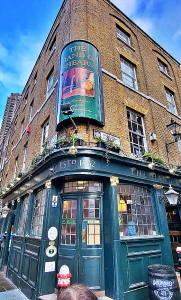
The Hand and Shears pub near London’s Smithfield Market is a delightful, old-fashioned drinking hole. It was granted a licence in 1552, but may have been in existence before that date. The building housing the pub was constructed in about 1852, and its interior has hardly changed since then. Apart from selling booze, the pub used to be a place where meetings were held, as well as coroner’s inquests.

The pub’s name derives from the that the building in which it is located was used by cloth merchants to settle arguments and other matters relating to their business.

Its centrally positioned bar serves customers in each of four rooms surrounding it. The rooms are separated from each other by partitions, but all of them face the bar which they surround. We visited the pub on a weekday at lunchtime. Many local business people were enjoying a sociable pint or two while chatting amongst themselves.

The Hand and Shears is what I believe a pub should be.

Sell the wife at Smithfield instead of divorcing her

IF YOU WISH to see the meat market at London’s Smithfield in action, either you must go to bed very late or wake up quite early, because the market is only open between 2 am and 10 am. This April, we visited it at about 1.30 in the afternoon, and there was little to see and there was hardly any odour in the air.

Back in October 2017, I walked from Clerkenwell to Smithfield, and wrote about it in a blog I published (https://londonadam.travellerspoint.com/44/). Here is what I wrote about the meat market:

At Peters Lane, Cowcross street turns southward towards to meet St Johns Street, which commences at the north side of Smithfield Market, an indoor wholesale meat marketplace. Smithfield’s central Grand Avenue is entered through an archway flanked by two heraldic dragons and a pair of stone sculptures. The Avenue runs beneath a high roof supported by ornate painted ironwork arches. Side aisles are lined with the meat dealers’ stalls and glass-covered display cabinets. In 1852, London’s livestock market was moved from Smithfield to Copenhagen Fields in Islington (off Caledonian Road, where the Caledonian Park is now located). This cleared the area for the construction of the present meat market, which was completed by 1868. Constructed in an era before refrigerators were used, the market was designed to keep out the sun and to take advantages of prevailing breezes.

I continued as follows:

In mediaeval times, Smithfield had a bad reputation. It was known for criminal activity, violence, and public executions. In the early 19th century, when obtaining divorce was difficult, men brought their unwanted wives to Smithfield to sell them, then a legal way of ending a marriage (see: “Meat, Commerce and the City: The London Food Market, 1800–1855”, by RS Metcalfe, publ. 2015).

In relation to disposing of a spouse, I quoted the following verse by an unknown author quoted in “Modern Street Ballads”, by John Ashton (published 1888):

“He married Jane Carter,

No damsel look’d smarter;

But he caught a tartar,

John Hobbs, John Hobbs;

Yes, he caught a tartar, John Hobbs.

He tied a rope to her, John Hobbs, John Hobbs;

He tied a rope to her, John Hobbs!

To ‘scape from hot water,

To Smithfield he brought her;

But nobody bought her …”

What I did not mention in my 2017 piece is that John Ashton noted in his book:

Wives at the market did not fetch good prices; the highest I know of, is recorded in The Times, September 19, 1797: “An hostler’s wife, in the country, lately fetched twenty-five guineas.” But this was extravagance, as, with the exception of a man who exchanged his wife for an ox, which he sold for six guineas, the next highest quotation is three and a half guineas; but this rapidly dwindled down to shillings, and even pence. In 1881, a wife was sold at Sheffield for a quart of beer; in 1862, another was purchased at Selby Market Cross for a pint; and the South Wales Daily News, May 2, 1882, tells us that one was parted with for a glass of ale. Sometimes they were unsaleable …”

Fascinating, but horrific when you think about it. In any case, you will be pleased to know that although I visited Smithfield with my wife a few days ago, I had no intention of selling her! Instead, we enjoyed some liquid refreshment in the nearby branch of the Pret A Manger café chain.