An Australian artist in London

THE ARTIST DAMIEN Hirst has given London’s art lovers a great gift. In October 2015, he opened his Newport Street Gallery (near Lambeth Bridge) to the public. Housed in a former theatre scenery workshop, which has been beautifully modernised, the gallery puts on a series of exhibitions of artworks (mainly paintings) from Hirst’s enormous personal collection, which he has been creating since the late 1980s. The current exhibition, “Cloud of Witness”, which ends on the 10th of July 2022, is of works by an artist born in Australia, who created many of his paintings in London: Keith Cunningham (1929-2014). I had never heard of him before seeing the exhibition.

Cunningham arrived in London in 1949 and enrolled at the Central School of Art and Design, where he aimed to improve his skills as a graphic designer. In 1952, having developed an interest in painting, he joined the Royal College of Art (‘RCA’), where he worked alongside now famous artists including Leon Kossoff, Joe Tilson, and Frank Auerbach. He exhibited in the prestigious London Group in 1956 and the two years following. This group had been formed as an association of modernist artists, who wished to escape the restrictive criteria of the Royal Academy. In 1964, he was invited to become a full member of the Group, but for unknown reasons he declined. By 1967, he had ceased exhibiting his work and was making his living as a graphic designer and teaching at the London College of Printing. Despite this, he continued producing paintings until his death. He kept his paintings hidden from view in a spare room. So, it is fortunate for us that Damien Hirst acquired many of them and put them on public display this year.

The Newport Street Gallery website (www.newportstreetgallery.com) describes his work succinctly:

“Cunningham’s paintings were produced in London during the post-war period, an artistic environment dominated by the likes of Francis Bacon and Lucian Freud. A student at the Royal College of Art in the mid-1950s, Cunningham worked alongside major artists such as Frank Auerbach, Leon Kossoff and Jo Tilson.

Cunningham’s sombre paintings, coated in layers of dense, sculptural brushstrokes, are populated by skulls, fighting dogs and darkly altered human figures. Like his schoolmates and teachers at the Royal College, Cunningham was interested in figurative painting, transforming the reality of everyday life into loose, slowly disintegrating forms.

His canvases, like those of Bacon, Kossoff and Auerbach, are covered in powerful strokes of dark pigments conveying strikingly expressive forms. The Cloud of Witness seeks to redefine Cunningham’s role in the London art scene of the 1950s, highlighting not only his ability but also the variety of his inspirations. To this effect, it coincides with the major show at the Royal Academy of Arts, Francis Bacon: Man and Beast, encouraging visitors to compare and contrast the works of these two artists.” Having already seen the Bacon exhibition at the Royal Academy and works by other artists mentioned in the quote, I feel that it is a good summary of what we saw at Newport Street. My favourite works in the exhibition were some of the portraits and some of the more abstract works. Undoubtedly, Cunningham was a competent artist, but having seen the exhibition, I can understand why he is not amongst the better-known artists of his generation

Hampstead and the Tate Britain Gallery

THE TATE BRITAIN pleases me far more that its younger relative, The Tate Modern, and its cousins in Liverpool and St Ives. I do not know why, but I feel far more comfortable in the old institution on London’s Millbank. Today (31st of March 2022), I took a leisurely wander through some of the Tate Britain’s galleries. I was on the lookout for works by artists, who have been associated with Hampstead in north London. My only disappointment was that there were no works by John Constable (1776-1837) on display. Buried next to Hampstead’s parish church, he worked and lived (for several years) in Hampstead. I had better luck with one of his contemporaries, George Romney (1734-1802). His “A Lady in a brown Dress: The Parson’s Daughter” hangs in the Tate. “Roadside Inn” was painted in about 1790 by George Morland (1763-1804), who used to visit Hampstead to teach. The gallery also contains a picture, “Punch or May Day”, by the painter Benjamin Haydon (1786-1846), who is known to have visited Hampstead, where he met the essayist and critic Leigh Hunt and walked with the poet Wordsworth.

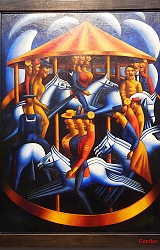
By Mark Gertler

It was the painter William Rothenstein (1872-1945), who found accommodation for, and looked after the great Indian literary genius Rabindranath Tagore, when he stayed in Hampstead briefly in 1912. The artist, who also lived in Hampstead for a while, is represented by at least two of his paintings in the Tate Britain: one was painted in 1891 and the other in 1899-1900.

It was during the first five decades of the 20th century that Hampstead became a mecca for artists, who are remembered today and whose works are displayed in Tate Britain. “The Merry-Go-Round”, a colourful painting created by Mark Gertler (1891-1939), who had a studio in Hampstead, depicts a fairground attraction on Hampstead Heath. It was painted in 1916. Gertler studied at the Slade School of Art at the same time as the painter Stanley Spencer (1891-1959), who had a studio in Hampstead’s Vale of Health for a while. It is therefore apt that Gertler’s painting hangs next to one by Spencer: “The Resurrection, Cookham”.

Another juxtaposition is a wooden sculpture by John Skeaping (1901-1980) and a painting by Ben Nicholson (1894-1982). Both worked in Hampstead in the 1930s and both were married to the sculptor Barbara Hepworth (1903-1975). She divorced Skeaping to marry Nicholson. One of her sculptures is on display close to another artwork by her second husband. I spotted one more work by Hepworth. That was a painting, a sketch for a sculpture she was planning in 1957. The three artists all worked at various times in the Mall Studios near Parkhill Road.

David Bomberg (1890-1957), who, like Gertler and Spencer, studied at the Slade, lived in West Hampstead between 1928 and 1934. There are several of his dazzling, colourful paintings hanging in the Tate Britain.

Henry Moore (1898-1986), who lived for a while in Hampstead, is the best represented of all the artists who lived or visited that locality. Tate Britain has many of his sculptures on display and some of the sketches he made during WW2. These images depict people sheltering in deep Underground stations to be safe from the bombs being dropped by the Luftwaffe. Moore lived for a while in the modernist and relatively bomb-resistant Lawn Road Flats (‘The Isokon’) near South End Green (and, incidentally, near the Mall Studios). I have read that it is likely that Moore made some of his dramatic wartime sketches in the nearby Belsize Park and Hampstead Underground stations.

It was fun visiting the Tate and seeing pictures by some of the artists, whom I have written about in my new book about Hampstead: “Beneath a Wide Sky: Hampstead and its Environs”. This work contains two chapters detailing Hampstead’s myriad artistic connections. If you wish to learn more about this and about other aspects of Hampstead and its surroundings, my book (and Kindle edition) can be obtained from Amazon (https://www.amazon.co.uk/dp/B09R2WRK92).

An experiment in modern living

HERE ARE TWO brief extracts from my new book about Hampstead. They are from the chapter about the ‘modern artists’ who lived in Hampstead between the two World Wars and, also, the Lawn Road Flats, the Isokon, a revolutionary block of flats, built in the 1930s. The extracts are as follows:

Extract 1

“…  the painter Paul Nash (1889-1946) lived at number 3 Eldon Grove between 1936 and 1939. Close by at 60 Parkhill Road the artist Piet Mondrian (1872-1944) lived and worked between 1938 and 1941. Prior to moving to Parkhill Road, Mondrian had lived with a remarkable engineer and furniture entrepreneur Jack Pritchard (1899-1992).

Jack and his family lived at 37 Belsize Park Gardens, having moved there from Platts Lane. Pritchard, who studied engineering and economics at the University of Cambridge, joined Venesta, a company that specialised in plywood goods. It was after this that he began to promote Modernist design. In 1929, he and the Canadian architect Wells Coates (1895-1958) formed the company, Isokon, whose aim was to build Modernist style residential accommodation. Pritchard and his wife, a psychiatrist, Molly (1900-1985), commissioned Coates to build a block of flats in Lawn Road on a site that they owned. Its design was to be based on the then revolutionary new communal housing projects that they had visited in Germany, including at the influential Bauhaus in Dessau. The resulting Lawn Road Flats are close to both Fleet Road and the Mall Studios in Parkhill Road. Completed in 1934, they were, noted the architectural historian Nikolaus Pevsner, ‘… a milestone in the introduction of the modern idiom to London’ …”

Extract 2

“… T F T Baker, Diane K Bolton and Patricia E C Croot, writing in “A History of the County of Middlesex: Volume 9, Hampstead, Paddington”, noted that the Lawn Road Flats were built partly to house artistic refugees, who had fled from parts of Europe then oppressed by dictators, notably by Adolf Hitler. Some of them had been associated with the Bauhaus. These included the architect and furniture designer Marcel Breuer, the architect Walter Gropius (1883-1969), and the artist and photographer Laszlo Moholy-Nagy (1895-1946). All three are regarded as masters of 20th century visual arts.

Despite both having come from bourgeois backgrounds, the Pritchards aimed to free themselves from middle-class conventions. The concept and realisation of the Lawn Road Flats were important landmarks in their quest to achieve a new, alternative way of living. The atmosphere that prevailed in the community that either lived in, or frequented, the Lawn Road Flats and its Isobar was predominantly left-wing, and extremely welcoming to cultural refugees from Nazi Germany. Probably, it had not been anticipated that the place would become a convenient place for Stalin’s Soviet spies to use as a base. According to a small booklet about the flats, “Isokon The Story of a New Vision of Urban Living”, published in 2016, the flats were home to the following espionage agents …”

“BENEATH A WIDE SKY: HAMPSTEAD AND ITS ENVIRONS” by Adam Yamey is available from Amazon (https://www.amazon.co.uk/dp/B09R2WRK92), bookdepository.com (https://www.bookdepository.com/BENEATH-WIDE-SKY-HAMPSTEAD-ITS-ENVIRONS-2022-Adam-Yamey/9798407539520), and on Kindle.

Brothers in art

RECENTLY, WE DROVE to Southend-on-Sea in Essex to see an exhibition, “Brothers in Art”, at the town’s superb Beecroft Art Gallery. There, we enjoyed visiting a temporary exhibition of the paintings of two artists, about whom we knew nothing: the brothers Walter (1908-1997) and Harold (1911-1971) Steggles. They were members of the East London Group of artists, East End workers who created and exhibited together between 1928 and 1936. Influenced by the artists John Albert Cooper (1894-43) and Walter Sickert (1860-1942), the group produced pictures that often-depicted everyday scenes and mundane sites in a joyful way.

The Steggles were born in Ilford (east London), sons of the manager of a high-class footwear store in London’s Strand. They were not born into a family that had any history of artistic talents. At an early age, the brothers began visiting art exhibitions, including, in 1925, one at the Bethnal Green Men’s Institute Art Club at the Bethnal Green Museum. This led them to join the art classes there. Walter was 17 and Harold was 14. Unhappy with the classes at Bethnal Green, they joined the art classes conducted by John Cooper at the Bromley & Bow Institute. He encouraged the brothers to paint scenes near the institute. Soon they became members of the East London Group.

In 1928, the Group held an exhibition at the Whitechapel Art Gallery. The brothers exhibited several of their paintings at this prestigious public art venue. Many influential members of the art scene attended the show, one of them being the then director of the Tate Gallery. Several of the brothers’ paintings at the exhibition were acquired by the Tate.

The East End Group also held regular exhibitions at the Lefevre Gallery in London’s West End. The gallery, which existed from 1926 until 2002, represented leading artists including, to mention only a few, Seurat, Matisse, Degas, Picasso, Dali and Kandinski. The two brothers:

“… found themselves part of a cosmopolitan artistic milieu that included Ben Nicholson, Charles Ginner, Philip Wilson Steer, George Braque and Raoul Dufy … Before long they found themselves sought after by other galleries and Harold became a protégé of the flamboyant aesthete Eddie Marsh who lived near his office in Gray’s Inn as well as accepting a prestigious commission from Villiers David to paint the gentlemen’s clubs of St James.” (https://spitalfieldslife.com/2017/07/26/harold-walter-steggles-artists/).

Harold recalled that the first picture he sold was bought by the highly influential art dealer Sir Joseph Duveen (1869-1939) and was hung at the Tate Gallery in 1929. In 1936, Walter had one of his paintings exhibited in the Venice Biennale.

Walter and Harold sold their paintings and became prosperous enough to buy a car. This allowed them to make forays into East Anglia where they painted things they saw.  Some of these East Anglian scenes were on display at the exhibition in Southend alongside their paintings of sights in London; many of these places have disappeared since WW2.  Both Walter and Harold were commissioned by the Shell petrol company to create posters. These display places in England, beautifully depicted. Several of these were also on display.

Even though the brothers were successful as artists, they had to continue working in non-artistic jobs to gain a sufficient income. When Walter retired, he was able to concentrate fully on painting.

With the death of John Cooper in 1943, the East End Group declined and the works it had created faded from the artistic world’s limelight. What the group created was not as excitingly innovative as the art produced by the now better-known artists, some of which I mentioned above. However, the work of the Group and, in particular, of the Steggle brothers is of high quality and very pleasing aesthetically. It was well worth trekking out to Southend to see their paintings.

David Hockney painted here

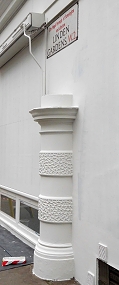
AT THE EASTERN END of Notting Hill Gate, there is a road called Linden Gardens. In the 1860s, only the eastern part of this existed and it was named Linden Grove. To the west of Linden Grove was Linden Lodge, set in extensive grounds with a large pond or lake. It was designed by the engraver, architect, and property developer Thomas Allason (1790-1852) and constructed in 1826. He lived there until about 1838. In the late 1860s, the Lodge was demolished, and houses were built around the edge of, and on, its grounds. This occurred because of the construction of the Metropolitan Railway in the mid-1860s. The gateposts of the lodge still stand, partially embedded in the buildings at the south end of Linden Gardens.

The website british-history.ac.uk noted that it was probably the peacefulness of the Grove:

“… which attracted two other artists, William Mulready, who lived in the southernmost of the eight paired houses (now demolished) from 1828 until his death in 1863, and Thomas Creswick, who lived at the still surviving No. 42 from 1838 until 1866. In the latter year this house was affected by the building of the Metropolitan Railway. Creswick therefore moved to Mulready’s now vacant house, and also, apparently, occupied the adjoining house to the north (with which it formed a pair) until his death in 1869.”

William Mulready (1786-1863) was the designer of the penny postage envelope depicting Britannia. Creswick (1811-1869) was a landscape painter and illustrator. Someone, who lived in Linden Gardens, told me that some of Queen Victoria’s children received art lessons in a studio in Linden Grove, but I have found no evidence to confirm this. However, it is certain that David Hockney painted Mr and Mrs Clark and Percy, a portrait of the dress-designer Ossie Clark (1942-1996) and his wife in their flat in Linden Gardens. The balustrades in the painting are typical of those on most of the first-floor balconies of the houses in the Gardens.

Another artist, Elsa Fraenkel (1892-1975), a German-Jewish born sculptor and Fellow of The Royal Society of Arts, who fled from the Nazis, also lived briefly in Linden Gardens, so I was informed by her daughter, who lives in Bangalore (India), where Elsa died.

Hampstead: a town on a hill

Hampstead High Street

A town on high

Home of famous artists and authors

Hampstead by name

ENJOY my new book which takes a fresh look at north London’s Hampstead: its sites, its personalities, its character, and history. “Beneath a Wide Sky: Hampstead and its Environs” is available from Amazon: https://www.amazon.co.uk/dp/B09R2WRK92

A NEW book about Hampstead in north London

AVAILABLE FROM AMAZON WEBSITES:

e.g.: https://www.amazon.co.uk/dp/B09R2WRK92

Hampstead is one of the highest places in London. There, the heavens are vast
and wide. Beneath this expanse of sky is an area with an eventful past and a
vibrant present. This book takes a fresh look at the locality and shows that
Hampstead is richly imbued with historical memories and has been home to a
multitude of fascinating and noteworthy people. Many books have been written
about Hampstead. Doubtless, there will be more. This one is different. It looks
at Hampstead from unusual as well as familiar viewpoints and gives the reader
a richer appreciation of what makes the place both delightful and intriguing.
This volume explores a wide variety of subjects, familiar and obscure, as well as
some which have never been described in other books about the locality. Here
is a fresh and at times quirky look at this place on a hill, one of London’s
treasures: a district, which is familiar to many people, yet full of surprises.
Although the bulk of this book is about Hampstead, there are also sections
describing some of its environs.

By reading this book, you can find out why John Constable, Samuel Johnson, Boy George, Mohammed Ali Jinnah, Mahatma Gandhi, Peter Sellers, Henry Moore, Maxim Litvinov, General de Gaulle, Stanley Spencer, Thomas Masaryk, Lee Miller, Agatha Christie, Jim Henson, Ian Flemming, Ernő Goldfinger, and many others, both famous and familiar, were all connected with Hampstead.

The book has several sections:
1. a brief survey of Hampstead’s general history and geography.
2. an introduction to Hampstead’s main thoroughfares with some
reminiscences of the area as it was during my youth.
3. the largest section of the book is a collection of chapters about
various aspects of Hampstead’s past and present. Recently, a friend of mine
bemoaned the fact that Hampstead High Street and Heath Street are lined with
branches of shops and cafés that can be found all over London. He is right. So,
if you wish to capture the true character of Hampstead, you need to stray into
the side streets and explore, which is what I hope this book will stimulate you to
do.
4. The last few sections of the book deal with some places of interest near to
Hampstead: Primrose Hill, North End, Go
lders Green, and Highgate.

TABLE OF CONTENTS

PREFACE … 7
INTRODUCTION: OH NO, NOT IN HAMPSTEAD … 7
SOME GEOGRAPHY AND HISTORY … 13
HEATH AND HIGH STREETS WITH SOME MEMORIES … 25
SATURDAY STROLLS … 25
PERRINS LANE, THE EVERYMAN, AND LOUIS … 34
DISCOVERING HAMPSTEAD … 41
A HOUSE ON HEATH STREET AND THE KIT CAT CLUB … 41
A CHURCH ON HEATH STREET … 45
FLASK WALK AND THE HAMPSTEAD SPA … 46
MORE ABOUT THE SPA … 56
THE VALE OF HEALTH … 60
POETS AND THE VALE OF HEALTH … 70
FRENCH CONNECTIONS AND ST MARYS ON HOLLY WALK … 76
ARTISTS IN HAMPSTEAD: ROMNEY, CONSTABLE, AND OTHERS 84
MODERN ARTISTS AND THE ISOKON … 95
BOLSHEVISM AND HEATH STREET … 109
A SINGER AND A PHILOSOPHER ON BRANCH HILL … 114
JUDGES WALK … 118
WHITESTONE POND … 122
EAST HEATH ROAD AND SOUTH END GREEN … 126
SIR HARRY AND ROSSLYN HILL … 137
PILGRIMS LANE AND MORE ON ROSSLYN HILL … 143
NEW END, CHOLERA, AND GROVE PLACE … 150
FITZJOHNS AVENUE AND SWISS COTTAGE … 155
SHEPHERDS WELL … 171
CHURCH ROW … 174
GRACIE FIELDS, FROGNAL WAY, AND FROGNAL … 179
WEST HEATH ROAD AND PLATTS LANE … 187
WEST HAMPSTEAD … 193
SHOOT UP HILL … 198
PRIMROSE HILL … 201
NORTH END AND GOLDERS GREEN … 211
NORTH END AND GOLDERS HILL PARK … 211
POETS AND GOLDERS GREEN … 228
LIFE AND DEATH ON HOOP LANE … 232
HIGHGATE … 241
CODA … 273
SOME BOOKS CONSULTED … 275
ACKNOWLEDGEMENTS … 278
INDEX … 279

Constable and the clouds

THE ARTIST JOHN Constable (1776-1837) loved Hampstead and eventually lived there. It was in that part of London, then a large village, that he became fascinated by the depiction of clouds. Here is an extract relating to this from a book about Hampstead, which I am in the process of writing:

In the last of a series lectures he gave to the Royal Institution in Albermarle Street in 1836, Constable emphasised his systematic approach to depicting nature, by saying:

“Painting is a science and should be pursued as an inquiry into the laws of nature. Why, may not landscape painting be considered a branch of natural philosophy, of which pictures are but the experiments?”

Clouds over Hampstead Heath by John Constable

One of Hampstead’s attractions for Constable was its wide expanse of sky, which, as the historian Thomas Barratt wrote, the artist:

“… regarded as the keynote of landscape art, and so assiduously did he study cloud, sky, and atmosphere in the Hampstead days that Leslie, his biographer, was able to become possessed of twenty of these special studies, each dated and described. Constable was a man of Wordsworthian simplicity of character, fond of all things rural, and devotedly attached to birds and animals.”

The website of Cambridge’s Fitzwilliam Museum reinforces what Barratt wrote:

“While living at Hampstead, Constable made a series of oil sketches of the sky alone, each one marked with the date, time and a short description of the conditions. His interest in clouds was influenced partly by the work of the scientist Luke Howard, who had in 1803 written a pioneering study, classifying different types of cloud …”

In “The Invention of Clouds” by Richard Hamblyn, a biography of the chemist and amateur meteorologist, who devised the modern classification of clouds (cumulus, nimbus, etc.), Luke Howard (1772-1864), it is noted that Constable, who was familiar with Howard’s work, focussed his concentration:

“… on the extension of his observational range and clouds were the means that he had chosen for the task. After years of searching for an isolated image, seeking a motif upon which to weigh his technical advancement as a painter, he had found it at last in the unending sequences of clouds that emerged and dissolved before his eyes like images on a photographic plate.”

During the summers of 1821 and 1822, Constable made over one hundred cloud studies on the higher ground of Hampstead and its heath.  Writing in 1964 in his “The Philosophy of Modern Art”, the art critic/historian Herbert Read (1893-1968), who lived in Hampstead, commented that Constable was:

“… rather a modest craftsman, interested in the efficiency of his tools, the chemistry of his materials, the technique of his craft. His preparatory ‘sketches’ are no more romantic than a weather report. But they are accurate, they are vividly expressed, they are truthful.”

Read next contrasted Constable with Turner, pointing out that the former was far more attentive to depicting nature accurately than the latter, who became increasingly extravagant in his portrayal of it, always moving towards what is now called ‘expressionist’. Barratt wrote that although Constable admired Turner, he had no desire to imitate him and:

“He knew his limits, and recognised that within those limits were to be found subjects worthy of the highest aspirations. “I was born to paint a happier land,” he wrote, “ my own dear England ; and when I cease to love her may I, as Wordsworth says, — ‘never more hear her green leaves rustle or her torrents roar..’”

Art on the roof

TEMPLE STATION IS on the Circle and District lines of London’s Underground. It was opened in 1870 and named after the nearby ancient Temple Church, which stars in Dan Brown’s 2003 novel “The Da Vinci Code”. The station’s ticket office is housed in a single storey building with a flat roof surrounded by a balustrade. The flat roof, with a few benches, occupies about half an acre and until recently served simply as a place to sit in the fresh air. Now, this has changed.

The flat roof has become employed as an open-air exhibition space for young artists. Today (December 2021), we climbed the stairs to reach the roof and were amazed to see that it has been covered with multi-coloured painting and plastic floor tiles, a dramatic sight. There is also a colourful hut, “The Artist’s Hut”, a modern take on the traditional cabman’s shelter. With the title “Back in the Air: A Meditation on Higher Ground”, the art installation was created by London-based artist Lakwena Maciver (born 1986). Also on this coloured space, there are a couple of ceramic works by another artist, Camilla Bliss. It is a wonderful surprise to see this field of bright colours, especially beneath a cloudy, grey sky. It would be fun to see the space from the air. But I do not know whether the pigeons would agree with me.

In the future, it is hoped that other artworks will b e displayed above Temple Station.

The first of its kind in England

THE ARCHITECT JOHN Soane (1753-1837) was skilled in designing buildings with features to permit natural light to reach parts of them that were far away from their exteriors. Good examples of this were the two homes he designed for himself, one in Lincolns Inn Fields, now the Soane Museum, and the other in Ealing, the recently restored Pitzhanger Manor. Another superb example, which we visited recently (December 2021) is the Dulwich Picture Gallery in south London. Completed and opened in 1817, it became the first picture gallery in England that was open to the public.

Light enters Soane’s galleries at Dulwich from above via overhead sky lights. These were placed in such a way that they illuminate the hanging spaces without allowing direct sunlight to hit the paintings on the walls. This system has since been adopted in many other art galleries. Newer rooms, lit entirely by artificial lighting, are used for temporary exhibitions including that of the woodcuts of the American artist Helen Frankenthaler (1928-2011), which we saw on our latest visit. Compared with Soane’s galleries, these newer ones are far less impressive, and despite the modern lighting they feel claustrophobic and rather gloomy.

The permanent collection of old masters, which is hung in Soane’s original galleries, is fabulous. Some of the paintings were parts of collections made before the 19th century. Others were supplied by the artist Sir Francis Bourgeois (1753–1811) and his business partner, the art dealer and collector, Noël Desenfans (1744–1807). Together they ran an art dealership in London and were commissioned in 1790 to purchase a collection of paintings for the then King of the Commonwealth of Poland and Lithuania, Stanisław August Poniatowski (1732-1798). It took them five years to do this but by 1795, the Commonwealth had been dissolved. The collection remained in England. After Desenfans died, Bourgeois inherited the collection and then commissioned Soane to design a gallery to house it. The superb gallery at Dulwich came into existence. Soane included within it a small circular mausoleum in which the remains of both Desenfans and Bourgeois have been placed. Rather irreverently, I felt, it was being used to screen a video about the artist Helen Frankenthaler.

In 1944, during WW2, the western façade of Soane’s gallery was badly damaged by bombing (a German V1 flying bomb) but it has been well-restored. Later, in 1999, a new café and other facilities in a modern style were built to the designs of the architect Rick Mather (1937-2013).

As for the exhibition of works by Frankenthaler, this was a delightful surprise. It is a collection of colourful abstract woodcuts that are the result of years of the artist’s complex and imaginative experimentation. Many of the works reminded me of, but were not identical to, the subtleties of Japanese ceramic glazes. Despite being displayed in galleries far less satisfactory than those designed by Soane, this as an art show well worth visiting before it ends on the 18th of April 2022.