William Hogarth and Damien Hirst as neighbours in a church in London

ST BARTHOLOMEW THE GREAT church in the City of London was founded in 1123 by Rahere, a courtier of King Henry the 1st, who reigned from 1100 to 1135. It was originally built as the church for an Augustinian priory, which was abolished and partly destroyed during the reign of King Henry VIII. When this happened (in 1539), the priory church’s nave was demolished, leaving only the apse and beyond it, the Lady Chapel. The choir, which used to be at the west end of the apse and at the eastern end of the demolished nave, now stands at the east end of what is now the nave, but was formerly the apse. The current nave (formerly the apse of the original church) is a magnificent example of Norman architecture. I could go on describing this magnificent church in great detail, but I will not because plenty of people have done it before me (e.g., https://en.wikipedia.org/wiki/St_Bartholomew-the-Great and https://medievallondon.ace.fordham.edu/exhibits/show/medieval-london-sites/stbartsgreatchurch). Instead, I will mention a couple of the many interesting items in the church that caught my interest during a visit today (the 2nd of April 2024).

Both the objects of interest stand in the southwest corner of the church, close to the entrance that leads to the path that runs along the location of the long-since demolished apse of the priory church. The two things stand a few feet from each other. One of them is a carved stone font, said to be one of the two oldest fonts in London – the other being in the parish church of St Dunstan & All Saints in Stepney. What interested me about St Bartholomew’s font, which is still in use, is that it was here that the painter William Hogarth (1697-1764) was baptised. He had been born in a house in Bartholomew Close near the church in the Smithfield district of London.

Hogarth was a successful artist in his time, and has become recognised as one of the famous British artists of the 18th century. Not far from the font, there is a dramatic gold coloured sculpture by one of the most famous British artists of our times – Damien Hirst (born 1965). The sculpture, which is on loan from the artist, is called “Exquisite Pain.” It is Hirst’s depiction of St Bartholomew holding his skin, having been flayed. The church’s website (www.greatstbarts.com/visiting-us/artworks/damien-hirst-exquisite-pain/) revealed:

“St Bartholomew, one of the original twelve disciples, was sent as an Apostle to Armenia, where he was killed by being skinned alive. The classic iconography of the saint sees him naked, his muscles exposed, his skin hanging over his arm – and in his hands, the instruments of his torture. This statue sees Damien Hirst conform to this imagery, but give it a unique twist: the instrument in his hand is not a standard knife, but a scalpel, used in the hospital across the road which also bears the saint’s name.”

I think it is a wonderful sculpture. However, like most works of art, it might not suit everyone’s taste, but there is no doubting that its dramatic impact and skilful execution are remarkable.

While Hirst’s fame is great today, and his works command high prices, I wonder whether his reputation as a notable British artist will survive as long as Hogarth’s.

The artists John Mallord Turner and Mark Rothko and abolition of slavery

AFTER BEING DISAPPOINTED by the large temporary exhibition of playful but repetitive works by the artist Sarah Lucas (born 1962) at Tate Britain, we had a coffee and then revisited the rooms containing paintings and sketches by John Mallord Turner (1775-1851). It has been many years since we last viewed these paintings, and seeing them revived our spirits after having had them somewhat lowered by the Lucas exhibition.

One of the Turner galleries contains a particularly fine painting by the American artist Mark Rothko (1903-1970). It hangs amongst a series of Turner’s often unfinished late experiments on canvas. They were mostly items found in Turner’s studio after his death. Without outlines, these almost ethereal paintings are examples of the artist’s experimentation in ways of depicting light and colour. If one did not know when these works were created, one might easily guess that they are the works of an artist working during the age of Impressionism. As an aside, many of Turner’s finished works are extremely impressionistic, and I consider him to be the pioneer of what later became Impressionism, and one of the best creators in this style. These experimental works were displayed at an exhibition in New York City at its Museum of Modern Art in 1966. That year, Rothko remarked:

“This man Turner, he learnt a lot from me”.

The Rothko painting hanging amongst the Turner experiments was created in 1950-52. Later, in 1969, Rothko donated a set of his paintings to the Tate, hoping that they would be hung close to those of Turner. They are not; they are hanging at the Tate Modern.

Moving away from the room in which the Rothko painting is hanging, I came across another Turner painting that interested me, “The Deluge”, which was first exhibited in about 1805. In the bottom right corner, Turner has painted a black-skinned man rescuing a naked white woman. On close examination, the man can be seen to have a chain around his waist. The Tate’s caption to this picture includes the following:

“Painted at a time when the cause for Britain to abolish its enslavement of people of African descent was gaining ground, this detail is significant.”

Some years after it was painted, Turner gave a print of this work to a pro-abolition Member of Parliament.

“The Deluge” is not the only painting by Turner relating to his sympathy for the abolition of slavery. His “The Slave Ship”, first exhibited in 1840, is another powerful example. This painting, now in Boston (Massachusetts), is based on the dreadful incident when, in an attempt to cheat the insurers, the captain of a slave ship, the Zong’, caused 132 slaves to be thrown overboard (in 1781).  Turner had learned about this crime from the anti-slavery activists with whom he associated. Although Turner, a liberal, was sympathetic to the abolition of slavery, he was not totally divorced from the benefits that transatlantic slavery brought to Britain, as was pointed out by Chris Hastings in the “Mail Online” on the 28th of August 2021:

“One of Britain’s greatest painters has fallen victim to woke culture, as art-lovers are being warned not to ‘idolise’ J. M. W. Turner because he once held a single share in a Jamaican business that used slave labour.”

The website of London’s Royal Academy gives more detail:

“It would be fair to assume that Turner’s views were strongly pro-abolition at the time he painted this work. However, scholars have pointed out that earlier in his career he apparently had no qualms about investing in a company that ran a plantation … In 1805 Turner invested £100 to buy a share in a business called Dry Sugar Work. Despite the name, this enterprise was a cattle farm on a Jamaican plantation run on the labour of enslaved people. The business was owned by Stephen Drew, a barrister who bought the estate from William Beckford in 1802. The firm went bust in 1808.”

Some many months ago, we saw a play at the National Theatre, “Rockets and Blue Lights” (written by Winston Pinnock). It concerns an ageing Turner seeking inspiration from a remembered incident like the awful event that took place on the “Zong”. During the play, it was alleged that because of his disgust with the slave trade, Turner gave up using sugar. Whether or not this was the case, I cannot say.

Fascinating as are abolitionist and the Rothko ‘connections’ with JMW Turner, the well-displayed paintings in the Turner galleries are all superb and well worth visiting.

An artist and a traffic roundabout

THE FOLLWING FIVE ROADS meet at West London’s busy Hogarth Roundabout: The Great West Road, Church Street, Burlington Lane, Hogarth Lane, and Dorchester Grove. Excepting Church Street, they are all major thoroughfares, which carry a great deal of traffic. The roundabout is named after the artist William Hogarth (1697-1764), whose former home, Hogarth’s House – now a museum, is close by.

The museum at Hogarth’s House contains a large collection of prints created by Hogarth. All of them illustrate 18th century life in Britain in exceptional detail. The artist did not portray scenes straightforwardly. He portrayed the people and what they were doing in a satirical – sometimes comical – way. So, that what we see today is not only how things looked in Hogarth’s time but also what he felt about them.

Amongst the prints on display, there is one created in 1997 by the cartoonist Martin Rowson (born 1959). It depicts the chaos, dirt, and traffic at Hogarth Roundabout as Hogarth might have done had he been alive to see it. This entertaining print, which was made to commemorate Hogarth’s 300th birth anniversary, includes details copied from Hogarth’s prints. It is a fascinating addition to the collection of the small museum.

Pioneers of making selfies?

THE LONDON-BASED ARTISTS Gilbert Prousch (born 1943) and George Passmore (born 1942) first met whilst they were studying sculpture at the St Martins School of Art, where, incidentally, my mother created sculptures in the 1950s and early 1960s. From the late 1960s onwards, most of their creations have portrayed themselves, usually together, in an incredible variety of poses and situations. One might say that they were pioneers of selfie-making.

On the 1st of April, Gilbert and George (‘G+G’) opened their new establishment, The Gilbert & George Centre, in London’s Heneage Street near Spitalfields and Brick Lane (see https://gilbertandgeorgecentre.org/). I have yet to visit this new gallery, and look forward to doings so soon. To coincide with this new venture, the White Cube Gallery in Mayfair’s Masons Yard is holding an exhibition of works by G+G until the 20th of May 2023.

Called “The Corpsing Pictures”, this exhibition at White Cube consists of G+G posing as corpses in a range of different settings. In each picture, the two artists are portrayed lying as if dead but fully dressed in their characteristic smart suits. In many pictures, images of bones have been included in the compositions. At first sight, these pictures, which look like stained glass windows, appear somewhat macabre, but soon the viewer becomes aware of the playful and often punning nature of the images. Each composition is compelling visually and together the collection is a stunningly beautiful sight.

I suspect that the crowds at the Heneage Street Centre will be great for the first few weeks after its opening. So, if you want to see some good examples of the works of G+G without being bothered by too many other viewers, I recommend that you head for the White Cube in Masons Yard.

Creating in North Carolina

PARTICIPANTS IN HUMAN endeavours frequently like to work together or in small communities. By being in close contact they can inspire and encourage each other; criticise each other’s work; influence each other; provide mutual assistance both theoretical and practical; and so on. Working communally is often favoured by groups of artists. Such was the case at Black Mountain College (‘BMC’) in North Carolina. The establishment was founded by John Andrew Rice, Theodore Dreier, Frederick Georgia, and Ralph Lounsbury in 1933 as a private liberal arts college. These people had been dismissed as faculty members from Rollins College (in Florida) after an incident that threatened their academic freedom. BMC thrived until it was closed in 1957.

By Josef Albers

In the year that BMC was opened, the Nazis in Germany closed down a ground-breaking art and design establishment in Dessau – the Bauhaus. Many faculty members fled from Germany to the USA, and some of them, notably Josef Albers (1888-1976) and his wife Anni (1899-1994), joined BMC. Josef headed up BMC’s art programme and Anni taught weaving and design. The college was unusual in many ways and differed from other liberal arts colleges in the States.

BMC favoured an inter-disciplinary approach to teaching. It attracted artists and other cultural figures, who were at the forefront of the avante-garde in the USA. These people included Buckminster Fuller, Merce Cunningham, John Cage, Charles Olson, and Robert Creeley, Willem & Elaine De Kooning, to name but a few. It would not be an exaggeration to say that the remotely located BMC was one of the most important powerhouses for the development of modern art in 20th century USA.

Until the 15th of April 2023, there are two exhibitions being held at the David Zwirner Gallery in London’s Grafton Street (in Mayfair). One of them is dedicated to a series of paintings by Josef Albers. The other, and more interesting show is a collection of artworks created by several artists, who attended BMC either as students or members of the faculty. The works in this exhibition include a few works by Anni and Josef Albers, as well as by other artists, including the De Koonings, Buckminster Fuller, Sue Fuller, Leo Amino, Ray Johnson, and Ruth Asawa. It is a small but excellent show, and well worth a visit. Until today, when I visited David Zwirner, I must admit that I had never heard of BMC, which was founded at the same time as the Germans were closing down the Bauhaus, which had already become one of the most influential pioneers of innovative design during the 20th century.

Women in art

SURVEYING THE REPRESENTATION of women by artists in a single exhibition might seem a daunting task, if not impossible. Yet, this is what the exhibition “Visible/Invisible” achieves successfully. Curated by Kamini Sawhney, Arnika Ahldag, Vaishnavi Kambadur, Riya Kumar and Arshad Hakim, this magnificent display of artworks can be viewed at the recently opened (in late February 2023) Museum of Art and Photography (‘MAP’) on Kasturba Road in Bangalore (Bengaluru). The exhibition, which is displayed in most of the rooms on one floor of MAP confines itself to works created by artists, both male and female, from the Indian subcontinent and its diaspora. However, this did not hinder the curators’ aim of demonstrating the female in art over the centuries.

The 130 artworks on show range in date of creation from the 10th century AD to the present. MAP’s website reveals that the various artworks:
“… are interwoven into four key sections based on narratives and counter-narratives: Goddess and Mortal, Sexuality and Desire, Power and Violence, and Struggle and Resistance. Each section presents how women’s lives have been portrayed, the spaces that they occupy and challenges that women have faced in the Indian subcontinent. The themes and ideas explored in Visible/Invisible hopes to encourage audience awareness of the history and role of women and gender in art.”
And the exhibition successfully raised my awareness of the multiple ways in which the lives of women have been portrayed by artists of both genders over the centuries,

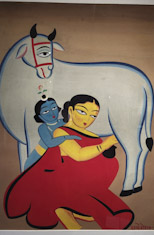
The artworks include sculptures, paintings, photographs, film posters, textiles (some created by female artists and others woven in traditional patterns by craftswomen), and prints. Almost every exhibit was a joy to behold, What was particularly interesting were examples of artworks created within the last few decades that demonstrate how Indian women artist have taken control of the way they portray women and their lives, What the viewer sees is how women see themselves, which is a contrast to what has happened in earlier times when women have often been shown in the way that men have viewed their lives.

All in all, this exciting exhibition is compelling both visually and conceptually. The curators have expressed their ideas beautifully and powerfully, but not without considerable subtlety.

The underground artist

THE BRITISH SCULPTOR Henry Moore (1898-1968) moved to London’s Hampstead district in 1929. Between that year and 1940 he lived in Parkhill Road, close to the Mall Studios, where the great sculptor Barbara Hepworth had her home and workshop. Many of Moore’s other close neighbours were in the forefront of the modern art world of the years between the two world wars. Not far away, the designer Jack Pritchard (1899-1992) and his family lived in Belsize Park Gardens, having moved there from Hampstead’s Platts Lane.

By Henry Moore, 1941

Quoting from my book “Beneath a Wide Sky: Hampstead and its Environs”:

“In 1929, he [Pritchard] and the Canadian architect Wells Coates (1895-1958) formed the company, Isokon, whose aim was to build Modernist style residential accommodation. Pritchard and his wife, a psychiatrist, Molly (1900-1985), commissioned Coates to build a block of flats in Lawn Road on a site that they owned. Its design was to be based on the then revolutionary new communal housing projects that they had visited in Germany, including at the influential Bauhaus in Dessau.”

The modernist building, now known as the Isokon, still stands on Lawn Road, which is close to Parkhill Road. It is still used as a block of flats. Completed in 1934, the building included communal areas including a restaurant and a bar called The Isobar where (to quote from my book again):

“… exhibitions were held in the Isobar and, according to an on-line article in ‘The Modern House Journal’ these were attended by artists including Adrian Stokes, Henry Moore, Barbara Hepworth, Ben Nicholson and Naum Gabo. The article also noted that this refreshment area was frequented by modernist architects such as Erich Mendelsohn, Serge Chermayeff and, Wells Coates, as well as by left-wing politicians.”

The Lawn Road Flats (the Isokon) was an early British example of a ferro-concrete building with a steel frame. This made it far more resistant to being damaged by bombs than its many brick-built neighbours. In fact, the only damage it suffered during WW2 was a few broken windowpanes. Various people, including the author Agatha Christie, moved into the Isokon to seek protection from the Blitz. Another person doing the same was Henry Moore, who moved there in 1941.

Many people, who were not lucky enough to be able to live in a relatively bomb-proof edifice, sought shelter from the bombs by spending nights on the platforms of Underground stations such as Belsize Park and Hampstead, all of which are far beneath the ground. Henry Moore created a series of dramatic drawing of the people taking shelter on Underground station platforms. It is quite possible that while living in Hampstead, he visited the stations mentioned above to find subjects for his drawings, which provide a vivid record of the terrible times when London was under attack from the air.

Recently, whilst visiting the Tate Britain art gallery, which houses a great deal of British art, I saw two of Moore’s Underground drawings, both dated 1941, and several of his sculptures. The drawings are not accurate depictions of what the artist saw, but they illustrate his reactions to what he witnessed, and as such they emphasise the atmosphere of those fearful times.  Although there is no doubt that Moore was a great artist, on the whole I prefer the works of his contemporary and sometime neighbour in Hampstead: Barbara Hepworth.

Painting in the Mall

BETWEEN HAMPSTEAD AND Belsize Park, there is a narrow footpath running north from Tasker Road. One side of it is lined with a terrace of low buildings known as Mall Studios. Built in 1872 by Thomas Battersby, they were designed as artists’ studios. Each of them contained small waiting rooms; costume rooms; and a lobby. Each studio had three skylights and large north facing windows to capture the kind of light favoured by many artists. Following the advice of the artist Walter Sickert, who had lived there, the artist John Cecil Stephenson (1889-1965) settled into number 6, Mall Studios in March 1919.  It was to remain his home until he died. In 1927, Barbara Hepworth became his neighbour in number 7, and at around that time, the influential art critic and writer Herbert Read moved into number 3. Nearby, Parkhill Road became home (for various lengths of time) to other artists including Henry Moore, Ben Nicholson, Naum Gabo, Piet Mondrian, Hans Erni, and other artists who have since become famous.

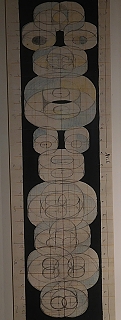
By John Cecil Stephenson

Whether it was the proximity of his artistic neighbours, who were pioneers of 20th century modernist art, or something else in his artistic evolution, Stephenson departed from his previous ‘straightforward’ portraiture and landscape painting and created works characteristic of what is now known as the ‘Modernist’ style. Although some of his works created after the late 1920s are to some extent figurative, most of his output was mainly abstract and constructivist. During WW1, Stephenson left London’s Slade School of Art temporarily to work in munition factories in Bishop Auckland (County Durham), the town where he was born. His experiences of working with industrial machinery and observing the efficiency and speed of the mechanised production processes is reflected in some of the paintings he produced later.

Stephenson, son of a grocer, was less well known than his neighbours. He produced art that bears favourable comparison to the works produced by them. Until the 18th of September 2022, there is a wonderful small exhibition of his works in a gallery within Hampstead’s charming Burgh House. The catalogue, edited by Sacha Llewellyn, Paul Liss, and George Richards, not only contains a fine collection of photographs of the exhibits but also provides a superb introduction – better than others I have seen – to the story of the pioneering role of Hampstead in the evolution of modern art in England. Burgh House, which contains several rooms comprising a museum of the history of Hampstead, also hosts excellent exhibitions such as the current survey of Stephenson’s works. Its well illuminated Peggy Jay Gallery provides a space for contemporary artists, many of them local, to display their works. Beneath the two storeys of cultural experiences, the basement of Burgh House is home to a pleasant café where anything from a cup of coffee to a wholesome meal can be obtained. And amongst the interesting range of books in the small bookshop, you can find copies of my book “Beneath a Wide Sky: Hampstead and its Environs” on sale (if they have run out, tell them to ask me for more, and then get your copy from Amazon).

Constable, Turner, and a soap maker

MY GREAT GRANDFATHER Franz Ginsberg (1862-1936) was an industrialist and a politician in South Africa. One of his main industries was soapmaking. Many of his workers would have been black Africans, mostly living in poor conditions around his factory in King Williams Town (‘KWT’). While serving on the town council of KWT, he played an active role in establishing what he hoped would be a township with improved living conditions for some of the town’s black people (including his workers). Named after him, Ginsberg township, founded at the beginning of the 20th century, still exists.

A few years before my great grandfather established the township named after him, another soap maker, William Hesketh Lever (1851-1925) who was based in England, created what he hoped would be better living conditions for his workers. Far more grandiose and much more attractive than Ginsberg Township, Lever began building Port Sunlight (south of Birkenhead) in about 1887 (a year or two after Ginsberg began making soap). Lever’s model town provided his employees with salubrious dwellings in a well landscaped environment. However, they were subject to strict rules; Lever, who believed that discouraging immorality (e.g., gambling) led to a good workforce, was a benevolent paternalist.

Turner on the left, and Constable on the right

Lever and his wife were avid collectors of artworks. These are housed in the purpose-built Lady Lever Art Gallery in the centre of Port Sunlight. This gallery, contained within an impressive French neo-classical style edifice, was designed by the Warrington based architects William Owen (1846-1910) and his son Seager Owen, and opened in 1922. It contains a fine range of artworks dating from early times (pre-Christian) to the early 20th century. It contains one of the largest and most important collections of Pre-Raphaelite artists’ works. With its spacious, airy galleries and well displayed exhibits, it is amongst my top ten British galleries and museums.

In one small gallery, which contains a sculpture of a reclining nude, two paintings hang close to each other but are separated by a neo-classical fireplace (an exhibit). One of them is by JMW Turner (1775-1851) and the other by his contemporary rival J Constable (1776-1837). It is interesting to see them almost side-by-side because it allows the viewer to compare their styles and what they try to convey  in their paintings. The Turner painting depicts “The Falls of the Clyde”, and the Constable depicts “Cottage at Bergholt”. Neither of the paintings, both created in the age before photography, achieves the accuracy of, say, a photograph; both seem impressionistic, but the effects that the artists were attempting to have on the viewer are entirely different.

Turner’s paintings are often far more impressionistic than Constable’s. Although his subject matter is always at least almost discernible, I feel that Turner’s works are created to evoke both the artist’s and the viewer’s psychological and/or emotional reaction(s) to what was being depicted. In contrast, Constable’s painting techniques seem to have been designed to emphasise aspects of the scene he was painting to give the viewer the impression that he or she is looking at the very same view as that which attracted the artist. Constable regarded painting as being a branch of science. In a lecture he gave in 1836, he said:

“Painting is a science and should be pursued as an inquiry into the laws of nature. Why, may not landscape painting be considered a branch of natural philosophy, of which pictures are but the experiments?”

Turner, in his almost abstract paintings such as the one at the Lady Lever, appeared to be wanting to stimulate the viewer’s emotions. In contrast, Constable tried to convey what he saw or felt was important in his subject matter. Without resorting to the almost photographic accuracy of, for example, both Canaletto and Vermeer, the two artist whose paintings hang almost next to each other in the Lady Lever successfully achieve their aims. For me, the avoidance of detailed accuracy of representation in both Turner’s and Constable’s paintings, enhances the impression of reality in my mind, something that photography cannot do to the same extent.

Even if you do not wish to compare Turner and Constable, I can strongly recommend a visit to the soap maker’s gallery in Port Sunlight. Finally, it is a pity that my great grandfather did not invest in great works of art!

Great expectations

I LOVE OUTDOOR sculpture exhibitions. Also, I enjoy visiting the exhibition spaces of the White Cube Gallery, which are located in Piccadilly and Bermondsey. So, it was with high expectations that we drove up to Arley Hall in Cheshire to view an exhibition of outdoor sculpture by artists with whom the White Cube represents.

The works on display until the 29th of August 2022 are by artists including amongst others Gormley, Noguchi, Tracey Emin, Mona Hatoum,and Takis. This is a formidable line up of artists.

Arley Hall and its gardens are magnificent. Unfortunately, the same cannot be said of the temporary exhibition of works by eminent modern sculptors. Unlike other outdoor sculpture shows I have seen (e.g. Frieze at Regents Park, Houghton Hall, and the Yorkshire Sculpture Park), what was on display in Arley Hall’s garden was unexciting despite the delightful setting. I felt that White Cube, whose exhibitions are, if nothing else, always dramatic, could have displayed a more impactful selection of artworks.

Exhibition aside,visiting the grounds of Arley Hall was well worthwhile as it has given us the opportunity to spend some time in Cheshire, which we do not know well.