Imitating the great: gothic in Winchester

THE CITY OF WINCHESTER has one of the longest gothic cathedrals in the continent of Europe. Built from 1091 onwards under the auspices of Bishop Walkelin, a relative of William the Conqueror, the bulk of the gothic part of the edifice was erected in the 14th century in the Perpendicular style of gothic. What was created, is exceedingly beautiful and gives a great sense of space. It is a masterpiece of gothic stone masonry. The cathedral stands not far from another large building, also built in a style of gothic inspired by what was achieved during mediaeval times.

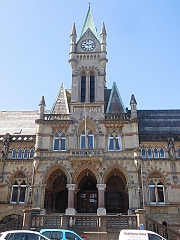
This near neighbour is far younger than the cathedral. It is the 19th century Winchester Guildhall, which was constructed between 1871 and 1873. It stands on the site of St Marys Abbey, which was taken over by Henry VIII in the late 1530s during the Dissolution of the Monasteries. The remains of the abbey, which was known as ‘Nunnaminster’, persisted until the 17th century, after which they were removed. Today, some excavated remnants can be seen behind the Guildhall.

Guildhall, Winchester

The Guildhall was built in the gothic revival style to the designs of the architects Albert William Jeffery (1840-1915) and William Skiller (1838-1901), who also submitted a design for a town hall for Hastings in Sussex. Tragically, Skiller committed suicide in 1901 (http://hastingschronicle.net/archives/architect-hangs-himself/). The Guildhall was later extended by J. B. Colson (1820-1895), who was the surveyor of Winchester Cathedral.  The original building is rich is features borrowed from mediaeval gothic, but it is topped by roofing styles that remind the viewer of French ‘chateaux’. One source summarises the Guildhall’s appearance as:

“ Gothic, symmetrical, with a middle tower and this as well as the angle pavilions provided with French pavilion roofs”; and as having a “deeply vaulted porch” at the entrance — for all this part “[t]he style is Second Pointed,” while Colson’s long extension is “much plainer”” (https://victorianweb.org/art/architecture/winchester/1.html).

Without doubt, the cathedral is a far finer building than the Guildhall, but both are impressive in their own ways. The cathedral’s integrity depends on its gothic features that have both structural and aesthetic functions, whereas in the case of the Guildhall these features have a greater decorative than structural purposes.

The Guildhall is an example of so-called ‘gothic revival, which lovers of London’s St Pancras Station and Bombay’s Victoria Terminus (Chhatrapati Shivaji Maharaj Terminus) will appreciate’. Years ago, I read “The Gothic Revival: An Essay in the History of Taste”, written by the art historian Kenneth Clark (1903-1983) in 1928. One thing that impressed me was, if I recall correctly, that the author queried whether the gothic style of architecture ever really died out in England, as it did elsewhere in Europe. Clark suggested that the gothic style continued to be used. In other words, what is described as ‘gothic revival’ is simply a continuation of the early use of this style. It is my impression that by the 19th century, when, for example, the Winchester Guildhall was built, architects were often simply borrowing features of earlier gothic buildings, as, for example Winchester Cathedral, and applying them often more mechanically than artistically. Often when the gothic style was being used structurally, as is the case in many churches built during the Victorian era, it tends to be imitative rather than creative, as is the case in the great mediaeval cathedrals and other churches. There are a few exceptions, where the 19th century architect manages to use the gothic style both structurally and artistically, as for example in the Church of St Augustine in London’s Kilburn.   Be that as it might be, The Guildhall does not lack in good aesthetic features and adds positively to the rich tapestry of the architectural scene in the historic centre of the city. I recommend visitors to Winchester not to concentrate all their time at the Cathedral but to spare some to view the Guildhall before seeing the other sights of the city.

Take me to the Tivoli

WIMBORNE IS A CHARMING small town in Dorset, a little north of Poole and Bournemouth. Famed for its Minster church with its mediaeval chained library, the place is rich in old buildings. One of these, looking less old than many of its neighbours, houses the Tivoli Theatre. It attracted my attention because of its (heavily restored) art deco features.

Housed in what was originally the 18th century Borough House, the theatre-cum-cinema was created in 1936 to the designs of Edward de Wilde-Holding, a prolific architect. The cinema was closed in 1980 and was threatened with demolition for a road scheme, which fortunately was abandoned. It was restored by a group called ‘Voluntary Friends of the Tivoli’ and reopened in 1993. In addition to showing films, the theatre is used for live events on its stage.

The Tivoli was not the only art deco cinema we spotted on our recent trip to the area around Winchester. 28 miles northeast of Wimborne, there is another one, The Plaza in Romsey, which was built in 1931 as a cinema but is now used as a theatre. Unlike the Tivoli in Wimborne, which occupies an old building, the Plaza in Romsey was purpose-built as a cinema.

Ideas and appearance

EVERY YEAR SINCE 2000 (except 2020), the Serpentine Gallery in London’s Kensington Gardens has commissioned a temporary pavilion to be constructed next to it. A website (www.inexhibit.com/case-studies/serpentine-galleries-pavilions-history/) explains:

“The pavilions, which last for three months and should be realized with a limited budget, are located in the heart of the Kensington Gardens and are intended to provide a multi-purpose social space where people gather and interact with contemporary art, music, dance and film events.”

The architects chosen to design these temporary structures have not had any of their buildings erected in London prior to their pavilions. Some of the architects involved over the years included Zaha Hadid, Smiljan Radić, Sou Fujimoto, Herzog & de Meuron and Ai Weiwei, Kazuyo Sejima and Ryue Nishizawa, Frank Gehry, Olafur Eliasson & Kjetil Thorsen, Álvaro Siza, and Eduardo Souto de Moura with Cecil Balmond, and Oscar Niemeyer.

With a very few exceptions, I have liked the pavilions and admired their often visually intriguing, original designs. My favourites were the 2007 pavilion by Olafur Eliasson & Kjetil Thorsen; 2009 by Kazuyo Sejima and Ryue Nishizawa; 2013 by Sou Fujimoto; and 2016 by Bjarke Ingels.

This year, the pavilion was designed by an architectural practice, Counterspace, based in Johannesburg (South Africa) and led by Sumayya Vally, who is the youngest architect to have become involved in the Serpentine pavilion project. According to the Serpentine’s website (www.serpentinegalleries.org/whats-on/serpentine-pavilion-2021-designed-by-counterspace/) the 2021 pavilion is:

“… based on past and present places of meeting, organising and belonging across several London neighbourhoods significant to diasporic and cross-cultural communities, including Brixton, Hoxton, Tower Hamlets, Edgware Road, Barking and Dagenham and Peckham, among others. Responding to the historical erasure and scarcity of informal community spaces across the city, the Pavilion references and pays homage to existing and erased places that have held communities over time and continue to do so today.”

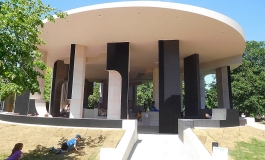
Well, maybe this was the designers’ aim, but it does not convey that concept to me. This circular, building coloured black and white, immediately conjured up in my mind images of often disused municipal structures such as bandstands and public conveniences that might have been constructed on provincial British or even South African seafronts in the 1930s to 1950s. It might have been conceived with high-minded ideas in the architects’ heads, but I felt that the structure is lacking in visual interest both in detail and in its entirety. Compared with many of the previous pavilions erected on its site, this is one of the dullest I have seen. It is a shame that the pavilion’s creators did not put more effort into its appearance than into the message(s) it is supposed to convey.   To my taste, it is a disappointment but do not let me put you off: go and see it for yourself.

A short note about a round tower

MANY CHURCHES IN NORFOLK have circular towers. Actually, there are 124 of them in the county. Here is one example, St Mary’s in tiny Titchwell, near the north Norfolk coast. The small spire that tops the round tower dates to the 14th century. The foundation of this church was much earlier.

By the way, the name ‘Titchwell’ is derived from an Old English word meaning ‘ kid (young goat)’ and an Anglian word meaning ‘spring or well’.

A historic town hall

FIRST WORLD WAR veteran William Frederick Stone died aged 108 in January 2009. He moved to Watlington in Oxfordshire in 1986 and lived the rest of his life in this small town. A popular figure in the town, he would have often passed the place’s Town Hall, which had been in existence even longer than him.

The name Watlington is probably derived from ‘tun’, meaning ‘fence’ or ‘enclosure’, and the people of ‘Wacol’ or ‘Waecol’, who also gave their name to the famous old road known as Watling Street. The town is close to another ancient cross-country route, the Icknield Way (https://en.wikipedia.org/wiki/Icknield_Way). There is evidence that there was a settlement at Watlington in the 6th century AD. The current street layout was already established by the 14th century and that there were inns in the town by the following century. During the English Civil War (1642-1651), Parliamentary troops were billeted in the town on the night before the Battle of Chalgrove Field on the 18th of June 1643, a battle in which their opponents, the Royalists, were victorious (www.britishbattles.com/english-civil-war/battle-of-chalgrove/).

Twenty-one years after the battle, in 1664, Watlington’s town hall was built by Sir Thomas Stonor (c1626-1683). He lived at Stonor Park, which is 4.7 miles south east of Watlington. The Stonor family were Roman Catholics and retained their faith throughout the Reformation and suffered for that during the 16th and 17th centuries.

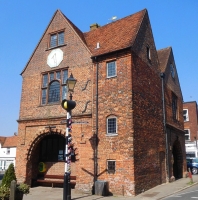
The brick town hall is unusual in that no two of its sides are equal in length and none of its corners are right angles (www.watlingtontownhall.com/history.html). Part of the ground floor is an arcade open to the outside air. This area was formerly used to hold markets. The first floor of the building served as a grammar school in the 19th century. The clock mechanism on the second floor is said to have come from the studios of the architect of St Paul’s Cathedral, Christopher Wren. This is not the only timepiece on the outside of the building. The other is a sundial, which has been gilded with 24 carat gold. The town hall was extended in the later 17th  or early 18th century (https://britishlistedbuildings.co.uk/101369012-town-hall-watlington#.YH28eehKhPY)  and was restored faithfully in the 20th century. Currently, the first-floor room, the former school, and beneath it, the under croft, are available for hire for social and other functions.

We came across the town hall quite by chance when driving home from visiting the Maharajah’s Well at Stoke Row. Today, we revisited the town on our way back from seeing several other places in Oxfordshire, about which I hope to tell you in the near future. Driving through England on roads other than motorways takes one through small towns and villages and many of these have features worth stopping to examine. Apart from the town hall, Watlington is a charming old place with several half-timbered buildings, cafés, and shops. Once again, a day trip to the countryside near London has proved rewarding.

A beautiful bank

LOVERS OF ARCHITECTURE will find much to enjoy amongst the buildings that fill the historic centre of the university city of Cambridge. Amongst the sea of old colleges, which are rich in fine architectural features, there are some attractive buildings whose existence are not solely due to the requirements of academia. One of these stands at the southern end of Sidney Street. Formerly Foster’s Bank, this picturesque edifice faced with alternating stripes of red and white and topped with a highly decorative clock tower, now houses a branch of Lloyd’s Bank.

Ebenezer Foster (1776-1851) and his brother Richard, both born in Cambridge, founded their bank in 1804. The bank was originally founded for the workers at the three mills that the Fosters owned (www.findagrave.com/memorial/181142444/ebenezer-foster). Because the university would not allow the Fosters to build railway lines to their mills, they constructed another mill close to the existing railway lines. This mill is now called Spillers Mill. The Foster family lived at Anstey Hall in Trumpington (near Cambridge) from 1838 to 1941. Ebenezer died in Trumpington. Ebenezer was Mayor of Cambridge in 1836, and later a county magistrate, then the High Sheriff in 1849. In addition to other public positions, he was a governor of Addenbrooke’s Hospital. Ebenezer’s obituary in “Cambridge Independent Pres” on Saturday the 31st of May 1851 noted:

“Mr. Foster was at the head of the first banking and mercantile establishments in the town. It is unnecessary, therefore, to say that his life was one of great activity and usefulness; and it is not too much to say that in every occupation, whether public or private, his conduct commanded universal respect.”

Before 1891, Fosters Bank was housed on Trinity Street in what was once the Turk’s Head:

“The rather attractive Tudor shop on Trinity Street now occupied by a clothes shop was once the Turk’s Head Coffee House, one of the earliest coffee houses in the country (17th century). It was much frequented by students. The upper floors later became the Turk’s Head Carvery, but it is now entirely given over to floral prints. The building was once the home of Fosters’ Bank, which later moved …” (www.cl.cam.ac.uk/~ckh11/cam.html).

Years ago, in the late 1960s, four of us, three friends and myself, ate a meal at the Turks Head. The bill for the four of us came to 14/6 (72.5pence) and we gave the waiter 15/- (15 shillings: 75 pence). My friends were horrified when I told the waiter:

“Keep the change.”

For, even in those far-off days, sixpence (2.5 pence) was a rather mean tip for a bill of 14/6.

In 1891, the bank building at the south end of Sidney Street, once Foster’s now Lloyd’s, was completed. It was designed by the architects A and P Waterhouse. Alfred Waterhouse (1830-1905) was the eldest of eight children. One of his siblings, Edwin Waterhouse (1841–1917), was one of the founders of the accountancy company Price Waterhouse (now incorporated into PWC). Alfred’s son Paul (1861-1924) joined his father’s architectural practice in 1884, becoming a partner in 1891, the year that the Foster’s Bank building was put up in Sidney Street.

Alfred Waterhouse and his practice were responsible for the design of many impressive buildings in the Victorian era. One of them, which is very well-known, is London’s Natural History Museum. Slightly less famous but equally impressive is the Prudential Assurance Building in London’s Holborn. This building is opposite numbers 337 and 338 High Holborn, which survived the Great Fire of London of 1666, and were restored by Waterhouse.   Apart from the bank in Cambridge and the Cambridge Union building, he also designed buildings associated with the following colleges: Jesus, Gonville and Caius, Pembroke, Girton, and Trinity Hall.  The bank in Cambridge is one of seven designed by Alfred Waterhouse.

I have entered the former Foster’s Bank only once. The glass-ceilinged banking hall is a riot of colour, its surfaces covered by tiles with sculpted surfaces. The octagonal clock tower is topped with a sharply pointed octagonal roof, one of the city’s many spires. The clock faces with their Roman numerals are made with tiling in several colours. Although now a branch of Lloyds, the name Foster can still be seen clearly above the main doorway.

When you next visit Cambridge, by all means admire Kings College Chapel and other architectural gems within the various colleges, but do spare some time to enjoy the former Foster’s Bank building on Sidney Street before visiting the nearby marketplace, which I always enjoy.

A small village near Cambridge

THE TINY VILLAGE of Madingley is just under 3 ½ miles west of Kings College Chapel in Cambridge, yet it feels a long way from anywhere. The settlement was recorded as ‘Matingeleia’ in about 1080, as ‘Mading(e)lei’ in the Domesday Book, and ‘Maddingelea’ in 1193. The name means ‘the leah of Mada’s people’, a ‘leah’ being a glade where mowing was done, in other words, a clearing. What became of Mada and his or her people, I have no idea. In 1086, there were 28 peasants in Madingley but by 1279, there were 90 people in the village (www.british-history.ac.uk/vch/cambs/vol9/pp165-166). The population in the 18th century reached about 150 and increased to over 200 in the 19th century. In 2011, there were 210 people living in the civil parish of Madingley (https://en.wikipedia.org/wiki/Madingley). Whenever I have visited the village, where my cousin lives, I have never seen many people out and about.

The earliest record of a church in Madingley was in 1092. Much of the present, attractive church (St Mary Magdalene), which was closed when we last visited, contains structures that date back to the 13th and 14th centuries (www.madingleychurch.org/history/). The building has a square tower topped with a tall steeple. The north side of the exterior of the nave of the church is brickwork made of irregularly shaped and equally irregularly arranged stones and mortar. The south side looks plain because the stonework is covered with plaster rendering. A church official who was passing by while I was taking photographs explained that the rendering, which protects the wall from penetration of rainfall, is probably original and that the church authorities are currently trying to decide whether to cover the north side with rendering.  

The church stands next to the entrance to the grounds of Madingley Hall. A long drive climbs sinuously up a slope to the hall, whose construction was begun by Sir John Hynde (died 1550) who acquired the Madingley estate in 1543 (https://historicengland.org.uk/listing/the-list/list-entry/1000627). Hynde, who had studied at Cambridge University, was an important judge. He was called to the Bar at Grays Inn and became Recorder of Cambridge in 1520. In 1539, as a result of the Dissolution of the Monasteries (1536-1541) ordered by King Henry VIII, he was granted the Cambridgeshire estate now known as Anglesey Abbey and in 1542-43, he came to possess lands at Madingley (https://en.wikipedia.org/wiki/John_Hynde). The construction of the Hall was continued by John’s son, Sir Francis Hynde (c1532-1596). In 1756, Sir John Hynde-Cotton, employed Lancelot (‘Capability’) Brown (1716-1783) to landscape the Hall’s grounds. I do not know how much of the landscaping seen today was that created by Brown but the lovely pond at the bottom of the lawns sweeping down from the front of the house looks like one of his typical features.  The property remained in the Hynde family until 1858. A descendant of the family, Maria Cotton, married Sir Richard King, who obtained the part of the estate that included the Hall. In 1861, Maria rented the Hall to Queen Victoria for use by the Prince of Wales, the future Edward VII, whilst he studied at Trinity College, Cambridge University. Currently, the Hall is home to the University’s Institute of Continuing Education and has sleeping accommodation both for those attending courses and also for visitors to the area.

In 1871, the Hall was sold to Mr Hurrell and then later to Colonel Walter Harding, who completely renovated the Hall. His heirs sold it to the University of Cambridge in 1948 (www.madingleyhall.co.uk/). Harding’s granddaughter Rosamund gave 30 acres of land on which the American Military Cemetery now stands beside the village of Madingley. The graves in this cemetery, mostly Christian and a few Jewish, are arranged neatly with military precision.

A half-timbered thatched lodge stands by the entrance to the drive next to the church. The former was built in about 1908 by Colonel Harding. The driveway crosses a bridge at one end of the lake or pond. This fake bridge was one of Lancelot Browns landscaping features. Sadly, when we last visited, most of the Hall was covered with scaffolding. Despite that, we were able to admire the mainly 16th century architecture of the building. One particularly interesting feature is the ogival gothic archway that leads into a courtyard behind the original Hall. Decorated with heraldic and other mouldings, this brick and limestone archway was originally part of the Old Schools in Cambridge. Sir John Hynde-Cotton brought the archway to Madingley Hall in 1758. It is worth passing beneath the archway, which bears the date ‘1758’, and entering the walled kitchen garden on the left of it. This area contains a lovely variety of well-tended plants and shrubs.

Tiny Madingley, dwarfed by the Hall and its gardens, has one pub, the Three Horseshoes. It has been in existence since 1765, if not before. Attractively thatched, as is the village hall nearby, the pub we see today was built in 1975, following destruction of an earlier building by fire. I have eaten at the pub once. My impression was that it is a place to which most of its customers drive from elsewhere. It is more of a restaurant than a typical pub. I am curious to know how many of the villagers use it to enjoy a pint or two. On our recent visit in April 2021, the establishment looked sad, being closed on account of the covid19 lockdown.

Peaceful Madingley is home to a private nursery school, housed in a building dated 1844 as well as a discreet complex of University of Cambridge animal behaviour laboratories. Apart from these attractions, there is a disused telephone box that now serves as a library where anyone can take books for free so long as they replace them with others. It is a pity that there is no village shop, often a focus of village life, but given the small population of the place, maybe its absence is not surprising.

Little Madingley is now a suburb of Cambridge yet it has not merged with the city physically. It remains at heart a picturesque and charming example of ‘village England’ – a place to take refuge from the stresses and strains of modern life.

Adam in the garden

WHEN I WAS BORN, my parents wanted to call me ‘Adam’. That was in the early 1950s. However, Mom and Dad were worried that Adam was a relatively unusual first name in those far-off days and that with such a name I might have been teased at school. As it happened, I only attended schools where the pupils were addressed by their surnames and mine, Yamey, was subject of a lot of mirth amongst my schoolmates. In view of their concerns, I was named ‘Robert Adam’, but have always been called ‘Adam’. My father, an economist, was all for calling me ‘Adam Smith Yamey’ in memory of the father of economics Adam Smith (1723-1790), but my mother was not keen giving me this name. The choice of Robert was possibly influenced by the fact that one of my mother’s brothers bore this name. It is also very vaguely possible that the name ‘Robert Adam’ was chosen in memory of another man who was alive during Adam Smith’s lifetime, the architect Robert Adam (1728-1792).

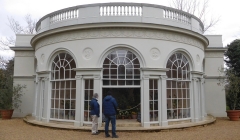
Garden House by Robert Adam at Osterley Park

Maybe because I share his name, I have grown to like and appreciate the architecture and interior decors created by the 18th century Robert Adam. However, you do not need to be called Robert Adam to enjoy Adam’s great works.

Last year, we visited Osterley Park on an extremely rainy day and were able to wander around the interior of Osterley Park House (https://adam-yamey-writes.com/2020/11/02/at-home-with-adam/). Built by the merchant and founder of London’s Royal Exchange Sir Thomas Gresham (c1519-1579) in about 1575, the house was extensively remodelled by the Child family, who owned it, during the 1760s and 1770s. The remodelling was to the detailed designs of Robert Adam.

When we visited the house on that rainy day in November 2020, we omitted walking around the house’s fine semi-formal gardens. On our recent visit, the house was not open because of covid19 prevention measures and there was no rainfall. So, we wandered around the lovely gardens. Like so many other 18th century landscaped gardens attached to stately homes, that at Osterley contains several buildings that were placed to add to the picturesqueness of the grounds.

The Doric Temple of Pan with four columns and four pilasters was built in the 18th century, probably to the design of the Scottish-Swedish architect William Chambers (1723-1796), who was born in the Swedish city of Gothenburg. Between 1740 and 1749, while in the employ of the Swedish East India Company, he made three voyages to China, where he learnt Chinese. A major rival of Robert Adam, he was an exponent of neo-classicism, of which the small Temple of Pan is a fine example. The interior of the temple, which we were unable to see because of covid19 prevention measures, contains, according to Nikolaus Pevsner and Bridget Cherry:

“… mid c18 interior plasterwork with Rococo flourishes and medallions of Colen Campbell and Sir Isaac Newton.”

The front of the temple faces across a lawn towards a structure, 175 yards away, designed by Chambers’ rival Robert Adam: The Garden House.

Adam designed the Garden House in about 1780. It has a semi-circular façade with five large windows within frames topped with semi-circular arches. Pevsner and Cherry describe these windows as “five linked Venetian windows”. A balustrade tops the façade and almost hides the conical roof. Between the windows, there are roundels containing bas-relief depictions of classical scenes with bucolic themes. The building was part of Mrs Child’s Flower Garden. The National Trust, which manages Osterley Park, notes in its website (www.nationaltrust.org.uk/osterley-park-and-house/features/the-garden-house-at-osterley-park-and-house) that the Garden House’s original purpose was:

“… a display house for the collection of rare trees and shrubs that were housed here in the 18thC. The main type of plant that we always grow and display in this building is lemon trees as we have historic evidence that 45 lemon trees were on show here in the 1780’s. We choose to have a mixed display of other interesting specimens alongside the lemons so as to give a greater display and range of interest for our visitors. All of these plants are known to have been either at Osterley in the 18thC or to have been available to grow at that time.”

Although it is not as spectacular as Adam’s interiors of Osterley Park, the Garden House is both delightful and elegant, a fine feature that enhances the appearance of the formal part of the gardens. This and other buildings designed by the same architect makes me proud to have been given, maybe accidentally, the name Robert Adam Yamey.

Gracie Fields and modernism in Hampstead

ACTRESS AND ENTERTAINER GRACIE Fields (1898-1979) commissioned a house to be built in Hampstead in 1934. This was five years before she moved to the Italian island of Capri. I cannot establish how long she retained ownership of this home. The house, with its roof covered by interlocking curved green tiles (pantiles) and centrally located gable that resembles those found in houses built by the early Dutch settlers in the Cape of Good Hope, is by no means a masterpiece of architectural design. It stands on the curved section of a private road, Frognal Way, which links Frognal to Church Row. The short Frognal Way, apart from being the location of the house that Gracie built, contains two masterpieces of twentieth century British architecture.

Number 4 Frognal Way, London NW3

Standing on raised ground above the north side of Frognal Way is number 9, Sun House. This was designed by the modernist architect Maxwell Fry (1899-1987) and built 1934-35.  Fry and his wife, the architect Jane Drew (1911-1996), worked with Le Corbusier on his 1950’s project to build Chandigarh, the new capital of the Indian state of the Punjab.  Maxwell was originally trained in the classical style, but soon began working with noted exponents of modernism including Walter Gropius, Le Corbusier, and Pierre Jeanneret. His early compositions, which were in the neo-classical style, include Margate Station (1924-26), which is a far cry stylistically from the Sun House in Hampstead. It would be difficult to believe that the same person had designed both.

The architectural historian Nikolaus Pevsner (1902-1983), himself a resident of Hampstead (at North End) and much admired by Maxwell Fry, wrote of the Sun House:

“… an object lesson in façade composition. White rendered walls, three-storeyed window bands of different heights, large first-floor balcony on thin steel supports and then a broad projection at the r. end on the first floor, and a narrow one on the l. on second floor level. The effect is surprising and shows what a design of quality can make of relatively elementary material …” (from “The Buildings of England. London 4: North”)

Regarding the other buildings in Frognal Way, Pevsner and his co-author Bridget Cherry summarise them beautifully:

“Otherwise Frognal Way has an assortment of interwar villas from Neo-Georgian to Hollywood Spanish-Colonial and South African Dutch (with pantiles) …”

The latter mentioned is the house that Gracie Fields had built. Opposite the Sun House, there is a house with two wings and a centrally located entrance, number 4, which defies stylistic categorisation. It has three windows above the front door and above these there is a curious roundel with a bas-relief depicting a man wearing a skull cap and a winged cloak. On either side of him there is a single flower. The roundel is dated 1934, the same year as the Sun House and Gracie Field’s home were built. The house with the roundel is mentioned in a blog (https://trainwalkslondon.wordpress.com/2014/02/06/walk-1-st-pancras-walk-to-west-hampstead-thameslink/), whose author, like me, cannot shed any light on the history of this building.

There is another treat for lovers of modernism in Frognal Way. It stands where this short unpaved road meets the main road, Frognal. The façade of number 66 Frognal reminds me of paintings by the Dutch artist Piet Mondrian (1872-1944). The building was constructed in 1937, the year before the artist arrived in London. It was designed by Amyas Connell (1901-1980), Basil Ward (1902-1976), and Colin Lucas (1906-1984). Their architectural practice was short-lived (1933-1939), but highly creative and productive. They

“… were among the foremost exponents of the International Style in Britain. Their architecture largely comprised cubic sculptural forms made from reinforced concrete and an emphasised horizontality.” (www.themodernhouse.com/directory-of-architects-and-designers/connell-ward-lucas/)

To quote Pevsner again, the house they designed on the corner of Frognal Way was:

“… the extreme idiom of the day, now something of a classic. The design was perhaps a little too concerned to ‘épater les bourgeois’ [i.e., ‘to shock the bourgeois’]. The design has been diluted by alterations …”

Some of these alterations were approved by the original architects, others not. Despite the alterations, the building remains a stunning and pleasing architectural statement, and is a house in which I would be happy to reside. Despite this, the architectural critic Ian Nairn (1930-1983), who both admired and criticised Pevsner’s approach to architectural writing, wrote that in his opinion it was the best house built in Britain before WW2 (www.wowhaus.co.uk/2019/02/12/1930s-connell-ward-lucas-designed-66-frognal-modernist-house-in-london-nw3/).

During the last few months, we have been making regular visits to Hampstead, each time wandering slowly along its often steep streets and alleyways.  Amongst the many historic buildings there is a good number of adventurous new buildings, many of them superb examples of late 20th and early 21st century architectural talent. It is pleasing that the pioneering work of the pre-War architects, such as can be seen in Frognal Way and other parts of Hampstead (e.g. Willow Road and Lawn Road), is continuing even today. That these visually adventurous new buildings are being constructed is a credit to the open-mindedness of local planning authorities.