The Arberesh of Sicily are a group of people descended from Albanians, who left the Balkans in the 15th century to escape from the Ottomans.
Palermo, the capital of Sicily, is separated from the rest of the island by a crescent of mountain ranges. After the occupation of Sicily by the Arabs in the 9th century, the Bishop of Palermo moved his seat to Monreale, a small hill town southwest of the city. There, he built a cathedral and then, later, after the Arabs had been expelled, the Normans built a Benedictine monastery. Monreale, which overlooks the metropolis, is now a suburb of Greater Palermo but in mediaeval times it was almost 5 miles away from the old walled city.
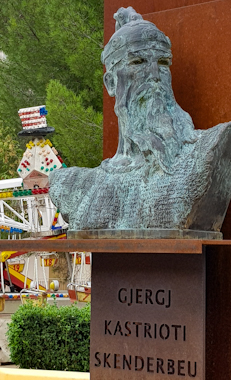
Albanian refugees landed along the coast of Sicily during the 15th century while the Ottomans were fighting in Albania, ably resisted for many years by George Kastrioti Skanderbeg (1405-68). Some Albanians landed near Palermo about twenty years after the death of Skanderbeg. In 1488, the Archbishop of Monreale granted them some vacant, disused, plague-ravished land across the mountains about 5 miles south of Monreale. They were told to make the most of it, and they did so very successfully. In exchange for this ‘gift’ of land, the Albanian settlers were required to recompense the Archbishop with taxes raised on what they were able to produce.

The settlers established a town on the south-east facing slope of Monte Pizzuta. Originally named Piana dei Greci, it is now known as Piana degli Albanese (‘Piana’). With a present population of about 7,000, most of the people speak an archaic form of Albanian known as Arberesh, as their mother tongue. They are also fluent in Italian and Sicilian.

Bilingual signs (Italian/Arberesh) in Piana
In 2014, I published a book, “From Albania to Sicily”, which describes the Arberesh communities in Piana and several other villages in western Sicily. In October this year, while staying in Palermo, we re-visited Piana for a day and a night.
The bus from Palermo to Piana winds through the mountains separating Piana from the capital. As we travelled along the sinuous road with its many hairpin bends, I looked at the slopes strewn with greyish boulders and pondered the difficulty of the terrain through which the Albanian settlers had to struggle in an era long before there were decent roads. Then, I remembered the landscape of wild, steep mountain ridges in south western Albania, south of Vlora. Travelling through the wild terrain south of Palermo must have seemed no different to what the settlers had left behind in Albania.

San Demetrio Megalomartire
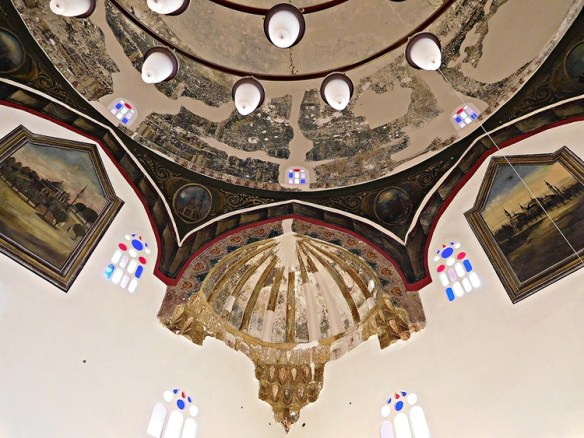
On arrival in Piana, I popped into the lovely cathedral of San Demetrio Megalomartire. This church has an iconostasis such as you would expect to find in an Eastern Orthodox church. It is home to worshippers who practise the Byzantine rites. The first inhabitants of Piana, who originated mainly in south-western Albania and the Morea (Peloponnese) were Greek Orthodox Christians. The Archbishop of Monreale allowed them to continue to worship according to the Byzantine rites, but they had to adopt the Pope in Rome, rather than the Patriarch in Constantinople, as their spiritual leader.
In 2016, we visited Himara in Albania. This beautiful seaside resort was one of the places where the Arberesh lived before escaping to Sicily. The old part of the town, high above the coastal resort, is largely abandoned, but it resembles closely the historic centre of Piana. Incidentally, Piana has a street named Via Himara, and, also, a restaurant called Valle Himara.
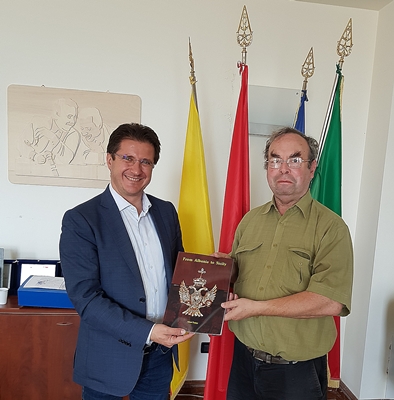
One of the reasons for our recent visit to Piana was to present a copy of my book to the town’s excellent library that occupies two storeys above Piana’s centrally located Extra Bar, which is famed for its fine canoli. We were invited to meet Ing. Rosario Petta, the town’s Mayor, who showed great interest in my volume, and even suggested that it ought to be translated into Italian.
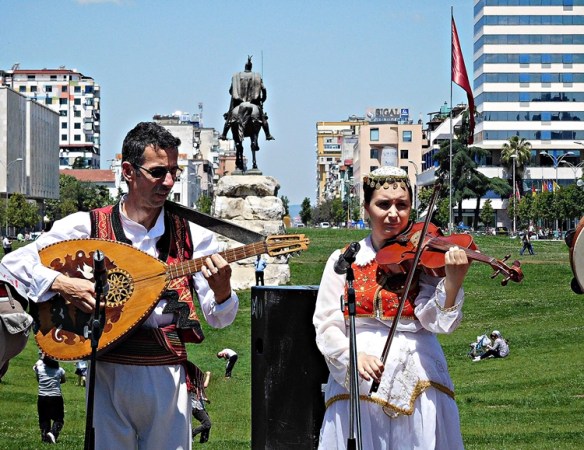
During our visit, we met many people who remembered us from our earlier stay in Piana. They greeted us like old friends, an indication that the Arberesh have not abandoned the Albanian traditions of friendship and hospitality. They have also not forgotten other traditions they brought with them from Albania. Although they dress like other Italians for daily activities, no opportunity is lost to change into colourful, decorated traditional Arberesh/Albanian costumes. This is particularly the case at Easter time, when visitors from all over Italy flock to Piana to see great numbers of people wearing this garb.
Eric Hobsbawm remarked that the people of Piana, “… had a reputation for rebelliousness …” He quotes the words of GM Trevelyan who said that Piana “… was the hearth of freedom in Western Sicily.” I wondered why of all the towns in Sicily, Piana was one of the most rebellious. GM Trevelyan puts it down to some kind of inheritance. Maybe, those Albanians, who preferred living freely rather than under the yoke of the Ottomans and also chose to leave their homes in the Balkans in the 15th century, were perhaps endowed with something, maybe even genetic, which engendered in them a love of freedom and equality. Who can say?
The Arberesh in Piana played an important role in assisting Garibaldi in his invasion of Sicily in 1860, the beginning of a series of events that led to the Unification of Italy. When GM Trevelyan visited the town sometime before 1912, he met leading citizens of the town, “… in their circolo, where a very intelligent and just pride is taken in the history of the revolution of 1860 and the highly creditable part played in it by the ‘Albanians’ of Piana.” Garibaldi, who began his campaign to liberate and unify the Italians in Sicily, proclaimed to the Sicilian Arberesh who fought with him that: “Avete combattuto come leoni” (i.e.: they had fought like lions).
During our recent visit to the library in Piana, we met a group of highly educated librarians, who showed great interest in my book. When we began discussing Garibaldi in Sicily, they, like several people we met in Palermo, displayed unfavourable sentiments about the Unifier of Italy. They all felt that the liberation of Sicily and its incorporation into Greater Italy was a bad thing for the island. What had once been a prosperous part of the Italian lands became impoverished whilst the previously impoverished north of Italy became increasingly wealthier. Many of the people we met in Piana and Palermo suggested that the liberator Garibaldi, a northern Italian, had not only liberated Sicily from the Bourbons, but had also ‘liberated’ much of Sicily’s wealth including the contents of the vaults of the island’s banks. I have yet to check the veracity of these surprising slurs on Garibaldi’s reputation.
Returning to Piana, this delightful little hillside town is an attractive, peaceful place to stay. There is accommodation in the town and in the countryside around it. You can explore the old town with its steep streets as well as the interesting Nicola Barbato Museum, the lake, and several old churches. Energetic visitors can enjoy breathing fresh mountain air on the slopes of Mount Pizzuta and other nearby peaks. If you speak Albanian (or Italian), you will have no difficulty communicating with the hospitable Arberesh. Although the Arberesh language differs from Albanian, Albanian-speakers can easily converse with the Arberesh. If, however, you are hungry for Balkan food, Piana will disappoint.

Various restaurants in Piana, including the first-rate Antica Trattoria San Giovanni, serve wonderful Sicilian fare. Signor Salemi, who established the Antica Trattoria, was a child in May 1947. He was present at a large public political gathering on the 1st of May at Portella della Ginestra (close to Piana), when members of a gang of bandits led by the bandit Salvatore Giuliano opened fire on the unarmed people, massacring about 12 folk including children as young as he was and a baby. But, that is a tragic story that I will save for another time.
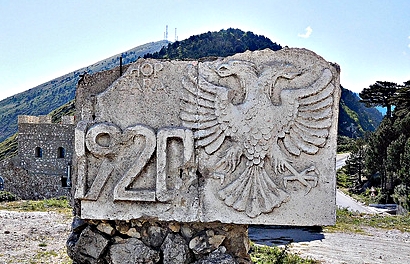
Wherever you go in Piana, you will see the Albanian double-headed eagle and Albanian flags. Road direction signs and other public notices are frequently bilingual: Arberesh and Italian. In the Cathedral, I noticed a huge poster recording the 550th anniversary of the death of the original settlers’ compatriot, Skanderbeg. The people of Piana retain their ancestral homeland, Albania, close to their hearts.
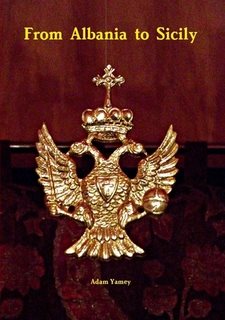
LEARN MORE ABOUT THE ARBERESH BY READING
“FROM ALBANIA TO SICILY”
by Adam Yamey.
Available on Amazon and bookdepository.com