REGULARLY ON SUNDAY mornings, you will see a group of people standing at the northern edge of Kensington Gardens’ so-called Round Pond. It is not truly round, but squarish with rounded corners. This group of men and women will be seen standing close to trolleys on which there might be large model sailing boats. Often, the boats, which are radio-controlled, will be sailing in the pond’s water. These model boat enthusiasts are members of the London Model Yacht Club, which was founded in London in 1876.
Prior to 1876, there were other model boating clubs in London. In the 1820s, a group of model boat enthusiasts used to sail their craft in a pond in Green Park. This pond exists no more. In 1834, when the pond was made inaccessible by railings, the boaters moved to the Serpentine in Hyde Park. The first formal London Model Yacht Club was founded in 1846. Following disagreements, this club was disbanded in 1871. In 1876, the Model Yacht Sailing Association was established. It and another club, the London Model Yacht Club (Est. 1884) have been sailing on the Round Pond since the late 1880s. Before that, they had been using a pond in Hackney. For those interested in the detailed history of model boat sailing in London, please visit www.lmyc.org.uk/history.
Next time you are in London at around 10.30 am on a Sunday morning, visit the Round Pond to watch the model boats ashore and on the water.
YESTERDAY (16th SEPTEMBER 2023), we met one of my cousins in Hampstead village. We ate a very satisfactory lunch at The Flask pub in Flask Walk. We chose items from the ‘brunch menu’. Each of the three dishes we ordered was tasty and generous in portion size. The dish with wild mushrooms was exceptionally good.
Long ago, there were two pubs with the word Flask in their names in Hampstead: The Upper Flask and the Lower Flask. The Upper Flask was located close to where East Heath Road meets the top (northernmost) end of Heath Street, close to Whitestone Pond. It was a meeting place for noteworthy cultural figures, but it was closed in 1750. The pub in Flask Walk, where we ate lunch, was known as The Lower Flask. Here is something about it from my book “Beneath a Wide Sky: Hampstead and its Environs”:
“Once upon a time, Hampstead had two pubs or taverns whose names contained the word ‘Flask’. This is not surprising because the word ‘flask’ used to be common in the naming of pubs. One of them, the erstwhile Upper Flask, has already been described. The other, the once named ‘Lower Flask’, now renamed, is on Flask Walk, not far from Hampstead high Street. The Upper Flask was a remarkable establishment, as already described. It figures several times in ‘Clarissa’, a lengthy novel by Samuel Richardson (1689-1761), first published in 1747. The Lower Flask pub (in Flask Walk) is also mentioned in the novel, but unflatteringly, as:
“… a place where second-rate persons are to be found often in a swinish condition …”
Unlike the Upper Flask, the Lower Flask is still in business, but much, including its name and clientele, has changed since Richardson published his novel. Located at the eastern end of the pedestrianised stretch of Flask Walk, the Lower Flask, now The Flask, was rebuilt in 1874. Formerly, it had been a thatched building and was a place where mineral water from Hampstead’s chalybeate springs was sold. Oddly, despite visiting Hampstead literally innumerable times during the last more than 65 years, it was only on Halloween 2021 that I first set foot in the Flask pub, and I am pleased that I did. The front rooms of the pub retain much of their Victorian charm and the rear rooms, one of them with a glass roof, are spacious.”
Although the Flask Pub is interesting enough, there are plenty more interesting places to see along Flask Walk and in other parts of Hampstead. You can discover these by reading my book, which is available from Amazon websites such as:
IN EARLY OCTOBER 2022. I published a book about London’s Golders Green and its neighbour Hampstead Garden Suburb. It was the part of northwest London where I spent my childhood and early adult life. I wrote about areas’ past and present, and my memories of living there. The book sells reasonably well by my modest standards, but was not reviewed until early September 2023. Then someone in Germany awarded the book 5 stars (out of 5 stars), and reviewed it on Amazon as follows:
“A very informative and often funny book! I immensely enjoyed reading it.”
Brief as it is, this reviewer encapsulated what I was aiming to do when writing my book. That was, to write something that was both elucidating and amusing.
I am always happy when someone takes the trouble to review one of my books. Naturally, I would prefer a favourable review, but a critical one is also welcome. That a reader bothers to post a review shows that he or she has read the book and reflected on its contents. I find that very gratifying.
The book about which I have been writing is called “GOLDERS GREEN & HAMPSTEAD GARDEN SUBURB: VISIONS OF ARCADIA” and is available as both a paperback and a Kindle from Amazon websites, such as:
JUST BEFORE I VISITED New York City in early 1992, I needed to buy a new coat. I entered Cordings gentleman’s clothing store on London’s Piccadilly and was greeted by a salesman. He listened carefully whilst I explained that what I was seeking had to be warm, windproof, waterproof, lightweight, and furnished with pockets both outside and inside the garment. After a moment’s consideration, he said to me:
“What you need is a Dannimac, Sir.”
I asked him whether I could see one and try it on. He replied:
“There’s only one problem, Sir.”
“What’s that?” I asked.
“They don’t make ‘em anymore.”
So, I set off for New York with an old coat that needed replacing. One day, I entered a clothing store on the lower east side of Manhattan. I explained my requirements to the very talkative salesman. When I explained my pocket requirement. He said abruptly:
“You want pockets on the inside and the outside? What are you? A private detective? A secret agent?”
That was the first, and so far, only time, someone has suggested that I did that kind of work. The man showed me some feather-filled puffy jackets made by North Face. They fulfilled all my criteria. I chose a beige one, and happily parted with over 100 US Dollars. I used that North Face for over 25 years until its appearance became too disreputable, and then, sadly, I disposed of it.
Having acquired my fine new coat, I had to get rid of the old one, which I had brought from England. I recall that there were few if any rubbish bins on the streets. As for my friend’s flat, where I was staying, there seemed to be nowhere to dispose of even the smallest bit of rubbish. On my return to the UK, my future wife, who had lived in New York City, explained that there must have been a rubbish disposal shoot in the flat or the building. I did not want to dump the old coat in the street, So, in the end, I handed it to one of the many people begging for money in the city.
AT THE END OF WW1, in 1919, there were two ways of travelling by air. Either by aeroplane or by airship (powered balloons, such as the famous Zeppelins). Airships could travel without stopping for longer distances than ‘planes, but they moved less quickly. You might be wondering how I discovered this, and why am I suddenly telling you about it. Well, yesterday, my wife bought me a copy of “The New Illustrated” in a charity shop. It was a slightly used copy of Volume 1, number 1, published on the 15th of February 1919. Edited by John Alexander Hammerton (1871-1949), it was a successor to his journal “War Illustrated”, which was disbanded in February 1919, a few days before “The New Illustrated” was launched. The first issue of the new magazine came with a “Map of the World’s Airways”, given away as a gift. It is from this map that the information in this essay is derived.
The map of the world shows routes taken both by airships and aeroplanes, and the flying times between stops. For example, from Cairo to Aden was 25 hours by airship non-stop, and about 13 ½ hours by ‘plane, not including a stop in Suakin (in northeast Sudan). By air across the Atlantic, there were two choices: airship from London to St Johns (Canada), 36 ¾ hours, then ‘plane St Johns to New York with one stop, about 12 hours flying time; or airship from London to Halifax (Canada), 46 ¾ hours, then ‘plane to New York 6 hours non-stop. The timings given on the map assumed that an airship travelled at 60 mph, and a ‘plane at 100 mph. The map only displayed what it called “All British” routes.
These days, we travel between Bangalore (not far from Madras) in India and vice vera taking about 11 hours non-stop, or about 12 hours (flying time) with a stop in the Arabian Gulf States. In 1919, the traveller from London to British India had two choices. From London to Karachi (now in Pakistan) by ‘plane took two days and 10 hours, and stopped in Gibraltar, Malta, Cyprus, Baghdad, Basra, and Bahrein Island. Alternatively, you could fly by ‘plane from London to Bombay in two days and 17 hours, stopping on the way in Gibraltar, Malta, Cairo, Suakin, Aden, and Socotra Island. From Bombay to Madras was another seven hours by ‘plane. Long as these journeys might seem to us today, we must remember that travelling by sea was far slower. For example, when my wife travelled on a P&O liner – a regular passenger service, not a cruise – from Bombay to Tilbury in 1963, the trip took at least a fortnight.
If, by chance, you had wished to circumnavigate the world, you could do it by airship in 16 days and 18 hours via India, or 18 days and 10 hours via South Africa.
While I was writing this, I remembered the father of some close friends. He worked for the Shell oil company. I remember him telling us that when he used to fly to Africa and the Far East during the 1950s, the ‘planes did not fly at night. So, each flight was made in stages. Every evening during the journey, the passengers would disembark and were put up in a hotel until the flight was resumed the following morning. Seeing the 1919 map reminded me of what he told us many years ago.
HE WAS PASSIONATE about sketching and painting. However, his father, a wealthy Quaker brewer in Hitchin (Hertfordshire), insisted that his son should dedicate himself to working in the family business and use his spare time to create his art. The artist was Samuel Lucas (1805-1870). There is a wonderful exhibition of his creations at the beautifully laid out North Hertfordshire Museum in central Hitchin until the 12th of November 2023.
After schooling and an apprenticeship in London’s Wapping, Samuel worked in the family business in London before returning to work in Hitchin in 1834. As for his artistic ability, this appears to be self-taught. However, he was a keen visitor to the Royal Academy exhibitions in London. In 1837, he married Matilda Holmes, who had been a pupil of the artist John Bernay Crome (1794-1842). She was keen on sketching, but none of her works have survived. I speculate that it is not beyond possibility that Matilda, a water colourist, might have helped Samuel develop his superb water colour techniques.
Samuel’s sketches range from extremely detailed to impressionistic, resembling the work of JMW Turner to some considerable extent. The finished oil paintings, some of which were displayed at the Royal Academy, are beautifully composed, full of detail, and of great visual interest.
Two of the exhibits interested me more than the others. One of them is a pen and ink sketch depicting Thomas Whiting of Hitchin reading Harriet Beecher Stowe’s anti-slavery novel “Uncle Tom’s Cabin” (published 1852) to a gathering of people in a hall in Hitchin. Nearby, there was one of Samuel’s oil paintings. This shows seven men seated around a small table listening to a man standing with his left hand on the table. The standing man is Bishop Samuel Wilberforce (1805-1873). He is addressing members of the Oxford Mission amongst whom is the novelist Lord Lytton of Knebworth (Hertfordshire). The bishop was a son of the anti-slavery activist William Wilberforce. Bishop of Winchester from 1870 until 1873, he was both against slavery and Darwin’s Theory of Evolution. Samuel Lucas’s painting depicts him when he was Bishop of Oxford, which he became in 1845, and remained until he was shifted to Winchester. The Oxford Mission was an Anglican missionary organisation, which became important in Bengal in the late 19th century.
The two pictures described relate to Samuel Lucas’s involvement of the anti-slavery movement. In 1840, he was Hitchin’s delegate to the Anti-Slavery Convention held in London at Exeter Hall on the 12th to 23rd June 1840. During this period, he and his wife hosted some of the delegates who had come from the USA. The convention is portrayed in a painting by Benjamin Haydon (1786-1846), which is now in the National Portrait Gallery. The gallery’s website has a photograph of this painting, which has been displayed so that the viewer can identify each of the people in it. Samuel Lucas can be found near the back of the gathering near a pillar.
Lucas was against slavery, as were many of his fellow Quakers. In addition to this activity, his artistic creations, and his involvement in the family business, he was also an active contributor to the life and development of Hitchin. One of the largest of his paintings in the gallery, but not included in the exhibition, is a depiction of Hitchin’s Market Place. Each of the many people shown in the painting is a portrait of an actual person. The museum has an interactive guide to identify the people. One of them was Isaac Newton (1785-1861). This gentleman was not the famous scientist but the owner of a family firm of painters, plumbers, and glaziers. One of the many folks in the picture has a dark complexion. This is a portrait of Samuel ‘Gypsy’ Draper (1781-1870). He was a violinist, who played for dances and fairs in the area in and around Hitchin for about 20 years. Some of the local Quakers disapproved of him, but Samuel Lucas placed him at the front of the crowd in the centre of the painting. Had we not visited the North Hertfordshire Museum out of pure curiosity, I doubt that we would have ever come across the life and works of Hitchin’s Samuel Lucas. We spent most of our time looking at the superb exhibition about him, so that we had hardly any time left to see the rest of the museum. A fleeting glimpse of the other galleries in the lovely modern building was enough to persuade us that we need to return to see more.
BURNHAM BEECHES IS an area of woodland not far from Slough and Windsor. Rich in beech trees, it was purchased by the Corporation of London in 1880. The German composer Felix Mendelssohn (1809-1847) visited Britain several times between 1829 and 1847. While staying in England, Felix enjoyed spending time in Burnham Beeches. It is said that there was one old beech tree under which the composer liked to sit. Legend has it that it was in the shade of this tree that he gained inspirations for some of his compositions including some of the well-known “Incidental music to ‘A Midsummer Night’s Dream’” (composed 1842). In January 1990, when the tree was about 500 years old, it fell over during a storm.
Part of the fallen tree was presented to the Barbican Horticultural Society. Like Burnham Beeches, the Barbican (a post WW2 development in the City of London) is managed by the Corporation of London. The remnant – part of the tree’s trunk – stands on a section of the elevated walkway not far from Barbican Underground Station. Next to it, there is a plaque detailing its history and its probable connection with the composer.
What I have described so far appears in many websites detailing the curiosities of London. However, not one of them mentions that there is yet another fragment of this tree within the barbican. This piece of the dead tree is smaller than that on the walkway, and can be found, somewhat hidden by vegetation, within the Barbican’s magnificent conservatory.
I wondered what had attracted Mendelssohn to Burnham Beeches. In an article by Helen J Read, published by the Buckingham Archaeological Society on its website (www.bucksas.org.uk), I learned that Felix was often a guest of Mr and Mrs Grote, who lived close to Burnham Beeches. They often entertained musical and literary figures. Amongst their many guests was the Swedish singer Jenny Lind, who first performed in London in 1847. The singer also had a favourite tree, which, like Mendelssohn’s, was destroyed in a storm.
Regarding Mendelssohn and his tree, Ms Read wrote:
“Mr and Mrs Grote also entertained the composer Felix Mendelssohn. His favourite part of the Beeches was a mossy slope between Grenville Walk and Victoria Drive, at that time covered with pollarded trees. Many maps mark this area as Mendelssohn’s slope, and it is thought that the music for Puck and Oberon from ‘A Midsummer Night’s Dream’ was inspired by this area. After Mendelssohn’s untimely death, Mrs Grote erected a headstone in his memory but the headstone was removed …
… There is no specific mention in the earlier maps or guides of any particular tree favoured by the composer, but a plaque was later erected on an old pollard tree. The tree blew over and the plaque was moved to one nearby until the storm of 1987, when this tree lost all its branches.”
Judging by what Ms Read wrote, it seems to me that there is a possibility that the fragments of tree, now commemorated at the Barbican as being Mendelssohn’s Tree, might not be remnants of the one beneath which he sat. Even if these bits of timber are not from his favourite tree, they make a charming memorial to a composer whose music gives pleasure to so many people.
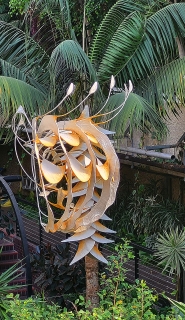
I ENJOY SEEING SCULPTURES displayed in gardens or other plant-filled locations. Until March 2024, the wonderful conservatory in London’s Barbican Centre is hosting a selection of sculptures by Ranjani Shettar. She was born in Bangalore (Bengaluru, India)) in 1977, and now lives and works in rural Karnataka. Her current exhibition in the Barbican is called “Cloud Songs on the Horizon”. The works on display were made especially for this site.
Her works are made of various materials (wood, stainless steel, muslin, and lacquer) and she employs techniques that have been adapted from traditional Indian crafts. Ms Shettar’s organic sculptures look like magnified plants or parts of plants. As she said once:
“Nature’s beauty is ever present, art helps to uncover, perceive and appreciate it.”
Seeing her exhibits in the Conservatory, certainly confirms this. However fine the artworks, putting them amongst plants helps emphasise the greater beauty of nature’s creations. The beauty of the sculptures competes with that of the plants, but the latter almost always win. So, placing one’s artworks within an area rich in plant life is a brave thing to do. I felt that Ms Shettar had done it successfully. Her creations have a harmonious relationship with the plant life surrounding them.
Whether or not you visit the exhibition, which I enjoyed, seeing the Barbican’s Conservatory – the second largest in Greater London – is always a worthwhile experience.
THERE IS A SHORT crescent lined with elegant residential houses near to the Kensington Temple church close to the centre of London’s Notting Hill Gate. A few yards west of this there is a short cul-de-sac called Horbury Mews. The crescent also bears the name Horbury. Although I have passed them often, it was only today that I wondered about ‘Horbury’.
Both the Crescent and the Mews were built on land that was leased to William Chadwick in 1848 by Felix Ladbroke, heir of the property developer and landowner James Weller Ladbroke (died 1847). William, a developer, built many houses on the Ladbroke Estate in Kensington. His heir WW Chadwick constructed the houses on Horbury Crescent between 1855 and 1857. The mews nearby bear the date 1878, which is prominently displayed on one of its buildings. The mews was constructed on a former nurseryman’s grounds. They served to house horses and servants of the nearby houses. Today, they are homes for the well-off.
The name Horbury derives from the nearby Kensington Temple, which was built in 1848-49, and was then called ‘The Horbury Chapel’. The name was chosen because the hometown one of its first deacons was Horbury in Yorkshire.
So, two street names in a little part of Kensington commemorate a small town in Yorkshire. I did not expect to discover that.








 yamey
yamey 