A murder in my family

In 1949, a year after my father, Basil Yamey married my mother, one of his cousins arrived in South Africa from Europe. Hendrik (aka: ‘Henry’, ‘Hendrik’ and ‘Heinrich’) Jami set foot on South African soil after an arduous trip. Tragically, his life ended suddenly and by foul means in South Africa.

Hendrik was a son of Moses and Dora (née Peisel) Jami. The Peisel family owned a brewery in Budapest. Moses was a brother of Basil Yamey’s father Solomon Yamey. Hendrik was born in Plunge in Lithuania in 1895, soon after his uncle Solomon had migrated from Plunge to South Africa. His brother Kurt (1901-1984) migrated to Rhode Island in the USA, and another two brothers, Isidore (1903-1946) and Max (1905-1990), followed their uncle Solomon to South Africa between the two World Wars. Records in the National Archives of South Africa suggest that Hendrik was planning to go to South Africa to join his brothers there in 1939. However, it took him 10 years to reach the country.

Hendrik, who had been living in Budapest for several years, must have perceived, as did many other Jewish people, that the Nazis in Germany were beginning to make life very uncomfortable for Jews. Even after the Second World War broke out in 1939, Hungary – an ally of Germany – was not occupied by the German troops; this only happened in 1944.

From late 1938 onwards, Hungary invaded territory beyond its eastern and south-eastern borders. This increased the length of its frontier with the Soviet Union.  Hungary declared war on the Soviet Union in June 1941. I assume that it must have been sometime before that date when Hendrik began his journey eastwards towards Shanghai. This city in China was just about the only place where there was no administrative difficulty for Jews to gain entry. According to Sally Ogle Davis writing in an article[i] published by the on-line Jewish Journal in 2002:

“It wasn’t that the Chinese deliberately set out to help the Jews of Europe, it was simply that among the warring colonial factions who ran Shanghai — the French, the British, the Japanese — no one wanted to control the passport department because no one wanted to take ultimate responsibility for the chaotic province. And in chaos lay an escape route for the Jews.”

Many of the Jews who fled to Shanghai travelled by boat via the Suez Canal. Others, including Hendrik, travelled by train across Stalin’s Soviet Union to China. Shanghai, their destination, had an established Jewish community. This was founded by wealthy Baghdadi Jews, including members of the Sassoon and Kadoorie families, in the 1870s.

Shanghai was occupied by the Japanese in 1937[ii]. It was then that the port allowed entry without passport or visa, making it a place that Jewish refugees could gain access freely if they could travel so far from Europe. By the time that Hendrik reached the city, there were already many Jewish refugees there, and conditions were becoming crowded. By 1943 there were at least 18,000 Jews sheltering in Shanghai. It was then that the Japanese forced them all to live in a small ghetto, a three-quarter square mile area of Shanghai’s Hongkou district. Conditions were cramped and difficult to say the least, but the Jews, most of whom might have already perished had they remained in Europe, were safe for the time being.

The Shanghai Ghetto was liberated in September 1945, and by 1949 most of its Jewish inhabitants had moved away from China. Hendrik Jami was amongst these. When he arrived in Cape Town in 1949, he was met by one of his brothers, Max Jami (who was to change his surname to that of his uncle Solomon: i.e. ‘Yamey’). Max took him to his home in Wolsely, which is just under 90 miles north-west of Cape Town and 10 miles south of Tulbagh where Solomon Yamey used to live. Hendrik lived with Max and his family for a few weeks while he acclimatised to his new surroundings and a new way of life.

Eventually, Hendrik moved to the town of Worcester, which is about 26 miles south-east of Wolsely. In time, he bought the Afrikaanse Koffiehuis in the centre of this small town in the High Street near where it is intersected by Porter Street; the establishment still exists. The Koffiehuis was both a café and a general store. Hendrik’s nephew, Max’s son Mervyn, remembers visiting his uncle once a week on Sundays. He recalls that Hendrik was a very friendly man who got along well with everyone. He was very generous, always plying his nephews with gifts of confectionery. Mervyn told me that his uncle’s generosity extended well beyond his family. Once, for example, he donated a huge sum of money, £1000, to the Dutch Reformed Church in Worcester. Mervyn also remembers that Hendrik did not believe or trust in banks, and kept much money in his living quarters which were situated behind the shop and separated from it by an almost enclosed yard. Another source of information, the Cape Argus newspaper, said that Hendrik was often seen around the town with his bulging wallet stuffed full of banknotes.

In early 1956, Hendrik sold his business to a Mr Athanassiou. He continued to work in the shop as its manager, and lived as before in his quarters behind the shop. Shortly before midnight on the warm summer night of the 10th of January 1957, Hendrik Jami, the manager of the Afrikaanse Koffiehuis, was seen taking a leisurely stroll along Porter Street in the small town of Worcester in the Western Cape Province of South Africa. Next morning, Mrs Rena Erasmus, who worked as an assistant at the Koffiehuis, arrived at half-past seven to find that her workplace was still closed. Usually, it was open by then. She knew that Mr Jami always opened the shop promptly at five thirty in the morning. He was always telling her so.
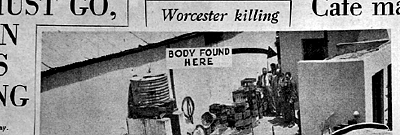
Alarmed, she telephoned the café’s owner, Mr Athanassiou, from a public ‘phone box, and told him about the unusual state of affairs. He told her to look at Mr Jami’s rooms behind the café. What she found there was very unpleasant. Mr Jami was lying fully dressed on the floor of his kitchen. His hands were tied behind his back with a handkerchief, and there were bruises on his throat. A cloud of flies hovered above him, buzzing. He was dead. His murdered body was described in gory detail in the Cape Argus. It made front page news on several consecutive days. After some days, two different rewards were publicly offered for any information that lead to the arrest and conviction of Hendrik’s murderer(s). Both Mr Athanassiou and Hendrik’s brother Max offered rewards of £100 (worth well over £1000 today).

The crime was not resolved immediately. Eventually, the murderer and his accomplice were discovered and arrested. Hendrik’s nephew Nat Yamey told me that they were both sentenced to death in the Circuit Supreme Court in Worcester.  In those days the death penalty was by hanging, and he remembers that his father told him that they were both hanged in Pretoria Central Prison.  


[i] http://www.jewishjournal.com/arts/article/europes_harms_to_chinas_arms_20021004, accessed March 2015.

[ii] A friend of mine, the late Sir Henry Norman Brain (1907–2002), was a British diplomat in Shanghai when it fell to the Japanese. He remembered that the seemingly unending fighting stopped suddenly. Soon after this, he asked a Japanese general what had made the Chinese surrender so suddenly. He was told the Chinese soldiers, who were all mercenaries, had accepted a bribe from the Japanese to do so.
Crackers and Cicero and a clinic near Camberwell

We are partial to a savoury cracker made in Finland and marketed as Finn Crisp. These thin, rectangular sourdough rye crackers used to be easily available at the Waitrose supermarkets near where we live, but of late, they have disappeared from the shelves. We have rung other branches of this chain of stores, but none of them stock Finn Crisp anymore. After a search on the Internet, we discovered a shop on Walworth Road in Walworth, a district that neighbours south London’s Camberwell. The store keeps Finn Crisp. On a rainy day, we took a bus that went south of Elephant and Castle, and disembarked near the shop. The bus stop is outside a building, which I had never seen before and it intrigued me.

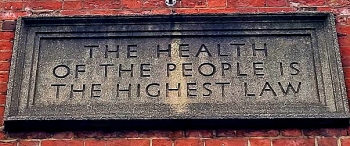
The mainly brick building houses the Walworth Clinic. Its architecture has elements typical of the Art Deco style that was in fashion in the 1920s to 1940s. Above the main entrance on Walworth Road, there is a rectangular inscribed, stone plaque on which the following was carved:

“The Health of The People is the Highest Law.”

Above this, but closer to the top of the building, I spotted a date: 1937. And above this, there is a stone sculpture depicting a buxom woman holding a staff around which a snake was intertwined – a rod of Aesculapius. At her feet, three children are depicted – two seated girls and a standing boy.

The building stands on the corner of Walworth Road and Larcom Street, from which there are two more entrances to the building.

There is much information about this building on the historicengland website ( https://historicengland.org.uk/listing/the-list/list-entry/1393674?section=official-list-entry ), from which I have quoted the following:

“The former Public Health Centre at Southwark was one of a series of pioneering health centres built at the end of the 1930s, in advance of the 1946 National Health Services Act which made their construction a duty of health authorities. Its foundation stone was laid on 11 July 1936 and the building opened on 25 September 1937.

The new building brought all the borough’s health services under one roof and included a solarium for exposing children to artificial sunlight, a TB clinic, X-ray department, maternity and child welfare centre, dentist clinic, … and the Public Analyst, the latter complete with chemical and bacterial laboratory for testing foodstuffs. There was also a special clinic ‘for women from 45 years of age who are subject to illness and disease peculiar to this age group’. With the opening of the health centre, Southwark became, ‘the first borough to have the whole of its health services in one building’, it was claimed by the Borough Medical Officer …”

The building was designed by the Borough Engineer, Percy Smart, about whom there seems to be little available information on the Internet. In contrast, the words on the front of the building are those of a well-known classical author, Marcus Tullius Cicero (106 BC – 43 BC). They are taken from his “De Legibus” (‘On the laws’). The original words which were translated and placed on the clinic were in Latin: “Salus populi suprema est lex.”

Near to this clinic, we bought the Finn Crisp crackers for which we were yearning.

As is often the case when we set out on excursions with a mundane aim, we not only achieve our aim but, as exemplified by the clinic, we discover things we had never come across before.

Why did my great grandfather leave Germany for Africa in 1880?

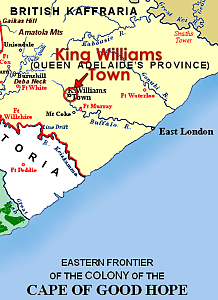
In 1880 at the age of 18, my great-grandfather, Franz Ginsberg (1862-1936) left Germany and migrated to King Williams Town (now ‘Qonce’) in the Cape Colony, which, after 1910, became incorporated into the Union of South Africa. In what is now South Africa, he became a successful industrialist as well as a politician – both at local and national levels. This essay discusses why a German Jew left Germany in 1880, and why he chose to go to a part of Southern Africa where there were few of his co-religionists – and to an area where neither gold nor diamonds were being mined, rather than to the USA, where many other Jewish people from Germany and other parts of Central Europe tended to migrate.

To begin to understand why Franz left Germany in his late teens in 1880, it is helpful to know something about his father Dr Nathan Ginsberg (1814-1890).

Nathan was born in Breslau (now ‘Wroclaw’ in Poland). At school, according to his school report which I have seen, he was recognised by his teachers as being a brilliant student. Based on this report, he was admitted to the University of Breslau. After graduating at Breslau, again with great reports from those who taught him, which I have read, he wished to apply to be awarded with a doctorate (‘PhD’). However, the University of Breslau did not permit Jewish people to be awarded with doctorates unless they converted to Christianity, which was something Nathan did not want to do.

Nathan ‘shopped around’, and applied to the University of Halle, which he discovered would award a doctorate to unconverted Jewish candidates. I have seen his letter of application and the various theses he had written in subjects including mathematics and astronomy. Halle awarded Nathan a doctorate. Next, Dr Nathan Ginsberg, being an academic, attempted to apply for teaching posts in German universities.

In those far-off days, German universities did not admit Jews as members of their academic staff unless they had first converted to Christianity. Several of Nathan’s teachers at the University of Breslau had been born Jewish, but had converted to Christianity. As the author Amos Elon pointed out in his excellent book about Jewish life in Germany, “The Pity of it All”, many of these converts working as university were non-practising Christians.

Nathan Ginsberg was unwilling to convert to Christianity, and had to forego his ambition to become a university teacher.  After working for some years in the observatory at Breslau, he moved to Beuthen (now ‘Bytom’ in Poland), where he became a founding member of a new school for Jewish children. It was a school for educating Jewish children, rather than a religious school, one of which already existed in the town. In 1870, when restrictions on the activities of Germany’s Jews eased considerably, the school was adopted by the state, and became known as the Städtisch jüdische Volksschule. It was in Beuthen that my great-grandfather was born. He was one of 12 children born to Nathan and his second wife, Rosalie (née Berg). He had a half-brother, Leo, who was born in Breslau when Nathan was married to his first wife, who died young.

During Franz’s childhood, Germany experienced economic problems that were blamed on the Jews, and this led to an increase in anti-Semitism. Before this became serious, Prussia and France went to war in 1870. Leo, who was old enough to do so, enrolled in the Prussian Army and took part in the invasion of Alsace and Lorraine, which became German territory after 1871. When he married, he and his wife were obliged, as were all newlyweds, to buy a set of chinaware from one of the Royal Prussian porcelain factories. They settled in German occupied Strasbourg (or ‘Strassburg’ as the Germans called it), where they produced four children.

Nathan, a far-sighted person, realised that the future of Jews in Germany was likely to deteriorate. That he did so as early as in the 1880s is indicative of his great wisdom. From the mid-1870s, German anti-Semites regarded the emancipated Jew as (to quote the historian Heinrich von Treitschke {1834-1896}):

“…a symbol and profiteer of modernity, of liberalism and capitalism.”

As well as stating:

“Die Juden sind unser Unglück!” [‘The Jews are our misfortune!’]

Nathan must have realised that as the Jews acquired more equality in Germany, hostility to them would grow. Many other Jews discovered this much later; some too late. Franz and some of his siblings left Germany when they were old enough to do so. The atmosphere of anti-Semitism in late nineteenth century Germany was likely to have been a potent reason for Nathan’s children to seek a better life elsewhere. Another reason might well have been the difficulties of achieving his ambitions Nathan, a Jewish man unable to give up his religion, had already encountered.

But why did Nathan Ginsberg’s children head for Southern Africa rather than the USA or elsewhere?

I cannot answer this question for certain, but can suggest the following.

Nathan Ginsberg, who was born in Breslau and lived in Beuthen, must have known the Friedlander and Goldmann families – Jewish people – living in those cities. He would have known that some of their offspring had gone to South Africa in the 1860s and before, and had done well.

And what attracted Franz to King Williams Town?

Whatever was the actual reason for leaving Germany, Franz set off for, and arrived in, South Africa in 1880, aged eighteen. His destination was not one of those most chosen by nineteenth century migrants. It was neither the diamond-rich area in the Cape Colony nor the goldfields of the Boer Transvaal Republic. Instead, he headed for King Williams Town, a small town in the eastern part of the British Cape Colony.

To understand why Franz chose to go to King rather than Kimberley or the Witwatersrand, we must turn the clock back to before his birth. Long before the arrival of Europeans in what was to become the Cape Colony, there were few inhabitants in the area. As time went by, this land was colonised from the sea by first the Dutch and then the British, and from the north by various African peoples. Where the Africans and Europeans met, there were frequently territorial conflicts. One of these trouble spots was the Eastern Cape, and in particular the part that became known as ‘British Kaffraria’, in which King Williams Town – founded in 1835 – was located.

Just before British Kaffraria became a British colony, a huge conflict was taking place far north of the Equator in and around Southern Russia. This was the Crimean War (October 1853 to February 1856). The armies of Great Britain, France, the Ottoman Empire, and Sardinia, were pitted against that of the Russian Empire. As the war dragged on, the British need additional manpower.

The British Government decided to recruit men from neutral European states to strengthen its forces in the Crimea. The German States provided a number of soldiers, who came to England, and were formed into the British German Foreign Legion (the ‘Legion’). Only a small part of the British German Legion had reached the Crimea when the war ended. The British Parliament was now faced with the problem of what to do with the men. They had all joined for the duration of the war and for one year after.

After some discussions between the Government in London and the authorities in the Cape Colony, it was decided to recruit as many as possible of the Legion to become military settlers in British Kaffraria. These settlers were offered land and help to build homes on condition that they would be available for military purposes when the need arose. Before departing for Africa, the men were encouraged to marry if they were not already espoused, because this was thought to be good for encouraging stability and also an increase in the European population of the area. Despite the prospects of good conditions in the Cape presented to the men, only 2362 officers and men out of a possible 8000 took up the offer, and of these only 361 of them were married. Many of the Germans left the Cape to fight for the British in India in 1857, when the so-called Indian Mutiny commenced.

It was believed that one of the reasons for the limited success of the settlement of British Kaffraria by the members of the Legion was the general lack of wives amongst them. Sir George Grey (1812-1898),

Sir George Grey, the Governor of the Cape Colony from 1854 to 1859, proposed re-settling the area with emigrants from the German States. He felt that those of the Legion who had decided to settle in the area would welcome them, and then help them to establish livelihoods. Using an agent, JC Godeffroy of Hamburg, Grey managed to help German families circumvent the laws that discouraged their emigration, and thus they made their way to the colony. After much hardship at first, they became good hardworking residents of British Kaffraria.

When the author Anthony Trollope arrived in King in 1877, three years before Franz Ginsberg, he found it to be:

“… a thoroughly commercial little city with a pleasant club, with a railway to East London, and with smiling German cultivation all around it …”

Some of the Germans were distributed to settlements around King Williams Town. Many of these were given German names such as Frankfort, Berlin, Braunschweig, Potsdam, and Stutterheim.

Franz Ginsberg, whose mother tongue was German, might have chosen to move to King – the town in the heart of British Kaffraria – because it was in an area full of German speakers. The Suez Canal, which had not been open when the German settlers arrived in the late 1850s, was in use by the time that Franz set sail. Whether or not he sailed through it, thus making a faster voyage than by the Atlantic route, and where he disembarked in South Africa, remain unknown. Other questions that remain unanswered are: was he travelling with a companion or alone, and did he know someone who was already there? These are not idle queries because their answers might establish how he came to know his first business partner (or maybe employer) Jakob Rindl (1853-1937).

I will end here, but in future publications, I will reveal how my great-grandfather made his fortune, and something about his political activities. I will also, eventually, discuss his attitudes towards his African, Indian, and Chinese neighbours, but this must wait for another day.

This article about Franz Ginsberg has been written with reference to my biography of Franz Ginsberg, “Soap to Senate: A German Jew at the dawn of apartheid”, which is available from Amazon.