WHEN WE ARE IN LONDON, we make regular visits to the commercial art galleries, many of which are to be found in and around Mayfair. Not only can one get to see some of the most recent works of contemporary artists, but also those that will eventually end up in private collections that are usually inaccessible to the general public. Today, the 12th of October 2023, we were walking along Cork Street, heading towards the Waddington Custot Gallery when we passed a gallery, the Stephen Friedman, which we had never entered before. Through its window, we saw works by an artist, whose oeuvre we enjoy, and entered.
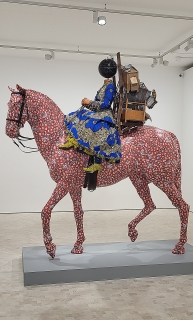
Much of the exhibition at Stephen Friedman is dedicated to creations of the British Nigerian artist Yinka Shonibare. He was born in London in 1962. His Nigerian parents took him to Lagos in Nigeria when he was 3 years old, and he lived there until he was 17. A year later, he developed transverse myelitis, which left him paralysed on one side of his body. Despite this, he went on to study fine art at the Byam Shaw art school, and then later at Goldsmith College (part of the University of London). Because of his disability, Yinka directs a team of assistants to create his artworks (sculptures, photographs, fabrics, and much more). He has become a widely exhibited and highly acclaimed artist.
Yinka’s works are visually engaging and highly imaginative. They are also full of meaning. He uses his creations to:
“… question the validity of contemporary cultural and national identities within the context of globalisation. Through examining race, class and the construction of cultural identity, his works comment on the tangled interrelationship between Africa and Europe, and their respective economic and political histories.” (see https://yinkashonibare.com/biography/)
Although one can easily enjoy the aesthetics of his creations without understanding the artist’s messages contained within them, a good knowledge of colonial and post-colonial history will enhance the viewer’s experiences of them.
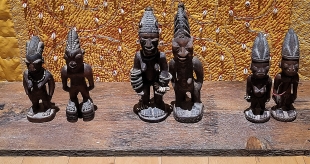
The exhibition is on until the 11th of November 2023. In addition to Yinka’s works, he has curated a small, but fascinating, collection of artworks by several artists from the African diaspora.
UNTIL I VISITED THE SOUTH LONDON GALLERY (‘SLG’) yesterday, the 11th of October 2023, I had no idea that Peckham in south London is home to one of the UK’s largest Nigerian diasporic communities. Some even call the district ‘Little Lagos’ after the capital city of Nigeria. Until the 29th of October 2023, the SLG is hosting an exhibition of artworks, called “Lagos Peckham Repeat: Pilgrimage to the Lakes”, by Nigerian and British Nigerian artists. Lagos means ‘lakes’ in Portuguese, and the Nigerian city of Lagos developed on an area with several lakes. Part of the show is housed in the same building as the Camberwell School of Art, and the other in a nearby repurposed, former fire station, which was purchased in 2010 and donated to the SLG by the artist Raqib Shaw (born in Calcutta in 1974). The two venues are a few paces from each other, and both are well worth visiting.
The exhibition consists of photographs, videos (including an excellent one showing a woman in Nigerian clothing riding through Peckham on a black horse), sculptural assemblages, and coloured drawings. Words are inadequate to describe the imaginative exhibits, but if you are unable to visit the show, there is a good verbal summary of the artworks on https://www.southlondongallery.org/exhibitions/lagos-peckham-repeat/ . To give you some idea of the ideas that link the various works on the display, I will quote from the gallery’s guide:
“This exhibition brings together thirteen contemporary Nigerian and British-Nigerian artists to explore links between Lagos, meaning ‘lakes’ in Portuguese, and Peckham as a channel through which to address wider issues of migration. It is framed around ideas of pilgrimage, meaning journeys to a sacred or special place and, in this case, migration motivated by a search for a better life. At the heart of the exhibition is an exploration of the complexities of shifting notions of home and identity as generations of Nigerians settle in London permanently, return to Lagos, or move elsewhere.”
And I feel that this summarises the show very well. All of the exhibits are visually engaging in an exciting way, and if you bother to read the guide carefully, all of them convey the artists’ concepts with great lucidity and originality.
After seeing the show, you can obtain good refreshments in the SLG’s simple but attractive South London Louie café. The SLG also has a bookshop with many intriguing titles on offer.
SOME PEOPLE MIGHT RAISE THEIR EYEBROWS in surprise when they learn of the title of my new book. Called “The Hitler Lock and Other Tales of India”, it consists of an explanatory prologue and 101 short pieces describing some of my many and varied experiences whilst visiting India frequently during the past 30 years.
My book’s name was inspired by my discovery of a company, Hitler Lock Enterprises, which manufactures padlocks in India. Despite my choice of the book’s title, only three of the vignettes contained in it are related to Germany’s former notoriously monstrous Führer. In these few pieces, I have described how I believe that Adolf Hitler is perceived by many Indians today.
The rest of the book has nothing to do with Hitler. It contains pieces with deal with topics such as: travelling in coracles; problems with monkeys; peculiarities of club life; dress code; encounters with jackals and crocodiles; teamakers and politicians; children called Lenin and Stalin; meeting maharajahs; fabulous booksellers; the City of Joy; Gandhi and his optician; and ‘love marriages’ (including my Indian wedding) – to give but a few examples. The aim of the book is to both inform and entertain, and it is written for those who are familiar with India as well as those who are not.
To be frank, I chose the name of this book to make it both eye-catching and slightly provocative. I hope that by including the word ‘Hitler’ in my title, it will not deter people from reading my text. That despicable genocidal madman is not mentioned much in the book. And I should emphasise that my text does not glorify him at all.
So, now that you know that my book is about India and its delights, rather than yet another tract about Hitler, you can obtain a copy, and enjoy it. My text is available as a paperback and a Kindle (e-book) on Amazon’s websites, including (for example):
I ALWAYS ENJOY seeing sculptures displayed in the open-air. Until the 29th of October (2023) the annual outdoor Frieze Sculpture exhibition is being held in the south-east corner of London’s Regents Park. As with all the Frieze Sculpture exhibitions I have seen, this one is no exception – it displays a ‘mixed bag’ of artworks. Although many of this year’s exhibits are colourful, creative, and often playful, few of them are exceptional.
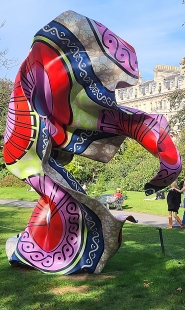
Two works struck me as standing out from the crowd. One of them, created in 2023 by Yinka Shonibare, is a folded work called “Material (SG) IV” (see photograph). This shape of this work resembles a flickering flame frozen in time. Covered in colourful patterns, the artist wanted to depict a piece of printed fabric, such as a sail, blowing in the breeze. According to the Frieze Sculpture 2023 website, this artist:
“… creates work that explores issues of race and class through the media of sculpture, painting, photography, film, pictorial quilts and public works.”
The website explained that in the work in Regents Park:
“The fabric was originally inspired by Indonesian designs, mass-produced by the Dutch and eventually sold to colonies in West Africa. In the 1960s the material became a signifier of African identity and independence and, in Shonibare’s hands, the ‘perfect metaphor for multi-layered identities’.”
Even though it is interesting to know what was in the artist’s mind when he created the sculpture, it is a visually fascinating and satisfying piece in its own right.
The other work that particularly attracted me was created in 1976 by the artist Louise Nevelson (1899-1988). Born in a city now in Ukraine, she emigrated to the USA in the early 20th century. It was in the States that she studied art, and then created most of her artworks. Painted black, and called “Model for Celebration II”, it is a tall abstract piece, which was:
Unlike the other works on display in the park, Nevelson’s work has stood the test of time. So, maybe it was unfair of the curator to include such a work amongst the works of so many newcomers to the ‘art scene’. However, I was pleased to see it, as it is one of the only exhibits that I felt had profundity rather than the immediate and often short-lasting aesthetic appeal of many of the other exhibits.
BY THE END OF the last Ice Age (which occurred 1800 to 8000 years ago approximately), there was a huge landslip on the south coast of the Isle of Wight (‘IOW’). This resulted in the formation of an almost level strip of land about 5 miles long and between ¼ and a ½ mile in width. South of it is the sea, and to the north it is flanked by a steep hillside. Known as the ‘Undercliff’, the town of Ventnor stands upon it. At the eastern end of the Undercliff, the small village of Bonchurch stands. Where this village is located the Undercliff is not exactly flat but slopes considerably, which means that many of the buildings in the place are at different levels. This part of the Undercliff is perched on a high, constantly crumbling cliff overlooking the sea.
The village of Bonchurch is mentioned in the Domesday book. The name is probably derived from the Anglo-Saxon words meaning ‘Boniface’ and ‘church’. The oldest existing building in the village is the small St Boniface Church, now known as ‘The Old Church’. A notice outside it states that it was rebuilt in 1070. In good condition, this simple building is hardly used in comparison with the newer village church built in 1848. A steep path with some steps leads from the old church to the sea front, where the crumbling cliffs can be studied. The path crosses a babbling brook, which carries water from a spring next to the Old Church. Some believe that it was the existence of this spring that encouraged the first humans to settle in this district.
Later settlers and visitors to Bonchurch included some literary figures, who have become well-known. In 1819, whilst staying in Shanklin, the poet John Keats wrote to his sister Fanny Keats:
“Bonchurch too is a very delightful Place—as I can see by the Cottages, all romantic—covered with creepers and honeysuckles, with roses and eglantines peeping in at the windows. Fit abodes for the People I guess live in them, romantic old maids fond of novels, or soldiers’ widows with a pretty jointure—or any body’s widows or aunts or anythings given to Poetry and a Piano-forte—as far as in ’em lies—as people say. If I could play upon the Guitar I might make my fortune with an old song—and get two blessings at once—a Lady’s heart and the Rheumatism. But I am almost afraid to peep at those little windows—for a pretty window should show a pretty face, and as the world goes chances are against me.”
However, the poet did not stay in Bonchurch. Amongst the celebrated literati who spent time in the village, were the historian Canon Venables (1819-1895); the novelist Elizabeth Missing Sewell (1816-1906); the author Henry de Vere Stacpoole (1863-1951); the poet Algernon Charles Swinburne (1837-1909), and, most famous of all, Charles Dickens (1812-1870).
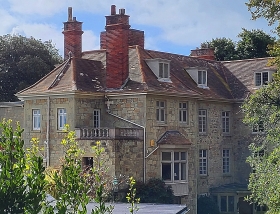
According to a booklet I purchased in the Old Church, between July and October 1849, Dickens stayed in a large house called Winterbourne (see photograph), which he had rented from his friend the writer and vicar, Reverend James White. It was here that Dickens wrote six chapters of his novel “David Copperfield”. Each of these chapters were initially published month by month, as was the case for many of the author’s other stories. In addition to writing, Dickens enjoyed rambling in and around Bonchurch and playing rounders on the seashore. Also, he spent much time socialising with James White and his wife Rosa, who lived elsewhere in the village. A website (www.bonchurchvillage.co.uk/post/a-christmas-story-the-grandfather-s-story) recorded:
“Dickens and his wife Catherine with their children became very close friends of Rev. White and Rosa White (nee Hill) and their children during their holiday at Winterbourne in 1849.”
It also noted:
“James White had already had success with plays performed in London and stories contributed to ‘Blackwells Magazine’ in Edinburgh.”
A visit to Bonchurch is a delightful experience. Climbing its steep roads and paths makes a picturesque substitute for a ‘work out’ in a gym.
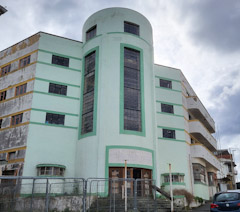
WE PARKED OUR CAR in Ryde on the Isle of Wight. I noticed that we had stopped outside a building that looked as if it had been transported from Marine Drive in Bombay to the Isle of Wight. Like many of the buildings that line Marine Drive, this one in Ryde is a beautiful example of the Art Deco architectural style, which became popular in the 1930s.
The former Royal York Hotel
The building in Ryde was constructed as the former Royal York Hotel. Completed in 1938, it was designed by JB Harrison and HP Gilkes.
When the hotel was opened, Ryde had become a popular destination for ’high society‘ holidaymakers. The then state-of-the-art hotel would have been in high demand. Partly because of the increasing ease of foreign travel, the hotel’s customers gradually decreased in number. So, in 2006, the hotel closed forever, and remained disused and looking dejected.
When we saw it in October 2023, there was scaffolding on the edifice and evidence that work was being carried out. I have read that there are plans to work on the building to create residential flats as well as a new hotel within it. Let us hope that this splendid example of Art Deco architecture will be preserved.
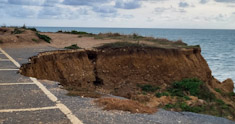
THE CAR PARK at Compton Bay on the south coast of the Isle of Wight is falling into the sea far below. The waves are undermining the cliff upon which the car park is situated. In conjunction with this, wind and rain are literally eating away the cliff. Where there had been a row of marked parking spaces, this has become unusable because the cliff has broken away. The markings are still visible, but they end abruptly at the fractured cliff edge. The local National Trust warden told us that next year, this disappearing car park will be closed and grassed over. A new one will have to be created further away from the clif edge. Seeing the damage being caused brought home how powerful are the forces of nature.
YESTERDAY (THE 4th OF OCTOBER 2023), I gave a short talk to introduce my book about the pioneering Victorian photographer Julia Margaret Cameron (1815-1879). Born in Calcutta (Kolkata), she died in Ceylon (Sri Lanka). Between 1860 and 1875, Julia and her family lived at Freshwater Bay (on the Isle of Wight) in a house called Dimbola. It was named after one of Mr Cameron’s coffee plantations (Dimbula) in Ceylon. The house at Freshwater Bay is now a well-curated museum dedicated to Julia and her photographic works. It was in its large tearoom, once the Cameron’s dining room, that I gave my brief talk.
When the Cameron’s bought Dimbola (at Freshwater), which is close to the house where the poet Alfred Lord Tennyson lived, it was a group of two separate cottages. Builders were employed to join the two buildings to create one large residence. A crenelated tower was constructed to join the two formerly separated edifices. From the outside Dimbola appears to be a typical Victorian construction. However, inside a treat awaits the visitor.
Apart from the interesting exhibits in the museum, some of the house’s internal decorative features deserve attention. There is much timberwork that reminds one of India. The Cameron’s designed parts of their house in what is often known as the ‘Indo-Saracenic’ style. This is an often-successful marriage of gothic and Islamic architectural details. Wikipedia expands on this as follows:
“Indo-Saracenic architecture (also known as Indo-Gothic, Mughal-Gothic, Neo-Mughal, in the 19th century often Hindoo style) was a revivalist architectural style mostly used by British architects in India in the later 19th century, especially in public and government buildings in the British Raj, and the palaces of rulers of the princely states. It drew stylistic and decorative elements from native Indo-Islamic architecture, especially Mughal architecture, which the British regarded as the classic Indian style, and, less often, from Hindu temple architecture.”
Apart from the magnificent example of this decorative style in the Durbar Room at Osborne House (on the Isle of Wight), there are few if any examples of its usage in houses in England that can rival that which can be seen at Dimbola. Fortunately, Dimbola was saved from demolition late in the last century. Had it been demolished to make room for holiday flats, this superb example of the use of Indo-Saracenic style, which harmonises well with some of Dimbola’s Arts and Craft style details, would have been lost. During recent restoration of the house, the walls have been covered with reproductions of the Arts and Craft Style wall papers that used to decorate the place back in the 19th century. Some fragments of the original William Morris wallpapers were discovered during the restoration works. In addition, a wall with Victorian paintwork was found, and has been preserved, albeit a little faded, in its original state.
A visit to Freshwater’s Dimbola is worthwhile, not only to imbibe the atmosphere of the home of the charismatic Victorian photographer but also to enjoy excellent coffee and home-made cakes in its delightful café. And while you are there, you can buy a copy of my book “BETWEEN TWO ISLANDS: JULIA MARGARET CAMERON AND HER CIRCLE” in the museum’s small shop. If you are unable to reach Dimbola, you can get a copy from Amazon sites such as:https://www.amazon.co.uk/dp/B0BZFCVLX9/
A DISTINCTIVE BUILDING stands opposite the Art Deco Winter Garden (built by 1936) high above the seashore of Ventnor on the south side of the Isle of Wight. With a tower overlooking the sea, the edifice facing the Art Deco structure was which was built in 1846 by the Reverend Richard John Shutte (1800-1860), who had once been a canon at St Paul’s Cathedral. It was named St Augustine Villa (see photograph below), and now houses a hotel and restaurant.
Several Russians opposed to the Imperial Romanov regime, including the writer Ivan Turgenev(1818-1883) visited Ventnor during the 19th century. Amongst these was Alexander Herzen (1812-1870), who was the ‘father’ of Russian Socialism’. In 1852, he and his family began living in England for several years. During this sojourn, he made some visits to the Isle of Wight. In September 1855, Herzen stayed in Augustine Villa, which he had rented. However, he was not alone as the commemorative plaque on the Villa notes. He stayed there with Malwida von Meysenbug (1816-1903).
Now, I had already heard of Herzen. I became familiar with his name when watching a trilogy of plays by Tom Stoppard about 19th century Russian Socialism. However, I had never come across Malwida von Meysenbug until I saw that plaque in Ventnor. A writer, she was born in Kassel (Germany) and was a friend of both Friedrich Nietzsche and Richard Wagner. By the time that Herzen and Malwida had their holiday in Augustine Villa, she was living with Herzen’s family and helping to look after his children. Alexander’s wife Natalia had died in 1852, and he had hired Malwida to educate his children.
Malwida was much more than a mere governess as the UCL academic Sarah J Young explained in her excellent, highly informative article (http://sarahjyoung.com/site/2011/11/10/in-herzens-footsteps-a-visit-to-ventnor/). In this essay, Dr Young gives excerpts from Malwida’s published “Memoirs”. The following is particularly interesting:
“We spent happy days in beautiful Ventnor. In the evenings we were usually with the Pulszkys, who were spending the summer there. Therese’s mother, an educated and intelligent Viennese lady, had come to visit them, and this made for many a pleasant hour with her keen humor and wit. The Kossuths were also there, and he was much more pleasant in a more intimate setting than he had been at the formal gatherings in London. At the time, our thoughts were preoccupied by the war Russia had started with Turkey. Herzen, more so than the others, was very excited. He prophesied the Russian defeat and wished for it, since he believed it would lead to the downfall of autocracy.”
The Kossuths, were members of the family of the Hungarian revolutionary Louis Kossuth, whom Herzen was extremely excited to have met during his stay in Ventnor. Another exiled Hungarian revolutionary, Ferenc Pulszky (1814-1897) was also staying with his family in Ventnor at the same time as the Herzens and the Kossuths. Pulsky’s wife, Theresa, and Malwida spent time drawing together in Ventnor, and made several competent sketches of Ventnor and its surroundings,
Dr Young also quoted Herzen, who noted in his diaries that Malwida:
“… spent all her time in the water …”
From what Dr Young and others have discovered during their research, Malwida was out of the sea long enough to create works of art depicting the seaside resort.
Herzen liked Ventnor but had some reservations as he wrote in a letter (quoted from Dr Young’s article):
“For three days the weather has been like June – and I’m bathing recklessly in the sea. But before that there were four days of storms, rain and bitter cold … If it were not so boring, I would live here, but there are no resources at all. And getting to Ryde is expensive … “
Many years have passed since Herzen and Von Meysenbug holidayed in Ventnor. Slightly less time has elapsed since the future Mahatma Gandhi visited Ventnor in 1890 and 1891. According to one source (www.bonchurchvillage.co.uk/post/bonchurch-gandhi), Gandhi:
“… had wanted to study medicine but his father had objected, and his studies were in law. He was a prominent member of the London Vegetarian Society, and that may have led to his staying at Shelton’s Vegetarian Hotel at 25 Madeira Road in Ventnor, in January 1890 and again in May 1891, on the second occasion addressing a Vegetarian meeting in Ventnor.”
In his autobiography, Gandhi wrote of the following experience in Ventnor:
“My cowardice was on a par with my reserve. It was customary in families like the one in which I was staying at Ventnor for the daughter of the landlady to take out guests for a walk. My landlady’s daughter took me one day to the lovely hills round Ventnor. I was no slow walker, but my companion walked even faster, dragging me after her and chattering away all the while. I responded to her chatter sometimes with a whispered ‘yes’ or ‘no’, or at the most ‘yes, how beautiful!’ She was flying like a bird whilst I was wondering when I should get back home. We thus reached the top of a hill. How to get down again was the question. In spite of her high-heeled boots this sprightly young lady of twenty-five darted down the hill like an arrow. I was shamefacedly struggling to get down. She stood at the foot smiling and cheering me and offering to come and drag me. How could I be so chicken hearted? With the greatest difficulty, and crawling at intervals, I somehow managed to scramble to the bottom. She loudly laughed ‘bravo’ and shamed me all the more, as well she might.”
I do not think that Gandhi made any other visits to Ventnor or elsewhere on the Isle of Wight.
Today, Ventnor is still delightful and although much has been modernised since the Victorian era, it still retains an almost unspoilt old-world charm. I fancy that were it possible for Herzen and Malwida and their revolutionary friends to return today, they would find much in Ventnor that they would easily recognise.
Seeing the plaque on Augustine Villa made me curious about Herzen’s stay in Ventnor and the identity of Malwida von Meysenbug. By reading up about it, I learned of other noteworthy visitors to the town, and as I did so my interest in Ventnor has increased considerably.





 yamey
yamey 