
Eyes glued to screens
On tablets and phones:
Absorbed, alone with their egos

Eyes glued to screens
On tablets and phones:
Absorbed, alone with their egos

Vienna and Wiesbaden can
No more be reach’d
From this here station
My late mother-in-law, an Indian living in Bangalore, made the best cucumber sandwiches that I have ever eaten. She used fresh slices of thin white bread with crusts removed. Each slice was spread with a small amount of butter mixed with freshly mixed English-style mustard. Then, finely sliced, peeled and de-seeded cucumber was inserted as the sandwich’s filling. The result was both delicate and refreshingly delicious. Having eaten these superb snacks on numerous occasions, I formed the idea in my head that India is THE place for cucumber sandwiches. This led to an amusing incident.

Photo by Pixabay on Pexels.com
Some friends of ours from England were spending a few days in Mysore, which is not far from Bangalore, where we were based. So, we decided to drive to Mysore to spend a day with them.
Our friends were staying in an old palace that had been tastefully converted into a hotel. After we had roamed around Mysore with them, they invited us to have afternoon tea in the lovely garden of the hotel. When we had sat down at a table, I said:
“This is the ideal place to eat cucumber sandwiches. The best cucumber sandwiches in the world are made in India.”
Everyone was happy to order a plate of these. When we asked the waiter for the sandwiches, he asked:
“You want vegetable sandwiches, with capsicum and all?”
“No, just cucumber sandwiches, no capsicums,” we replied.
Some minutes later, the waiter returned with A plate of sandwiches oozing with a bright red paste filling.
“What’s that?”, we asked him.
“Miner’s sauce”, came the reply.
“Miner’s sauce? What on earth is that?” asked one of our friends.
The waiter simply repeated the words “miner’s sauce”.
After a minute or two, the penny dropped, and I said:
“He means mayonnaise.”
Now, many non-English people pronounce this word as ‘my-on-nays’, which is closer to ‘miner’s sauce’ than the English pronunciation.
“We don’t want that sauce,” one of our friends protested, “Only cucumber.”
The waiter looked confused.
“What, no bread?” he asked.
“Let me show you what I mean,” said one of our friends, standing up and accompanying the waiter to the kitchen.
The waiter returned after a while with a very sub-standard collection of cucumber sandwiches.
Later my wife pointed out that just because her mother made excellent cucumber sandwiches, this was not necessarily the case all over India, as I had foolishly assumed.

Like ants they crawl
Across a sea of glass
High above the River Thames

On the 24th of December 1940 Mohandas Gandhi (the ‘Mahatma’) wrote to the Chancellor of Germany, Adolf Hitler. Amongst other things that he wrote in his letter, the following extracts suffice to give the gist of it:
“I hope you will have the time and desire to know how a good portion of humanity who have view living under the influence of that doctrine of universal friendship view your action. We have no doubt about your bravery or devotion to your fatherland, nor do we believe that you are the monster described by your opponents. But your own writings and pronouncements and those of your friends and admirers leave no room for doubt that many of your acts are monstrous and unbecoming of human dignity, especially in the estimation of men like me who believe in universal friendliness. Such are your humiliation of Czechoslovakia, the rape of Poland and the swallowing of Denmark. I am aware that your view of life regards such spoliations as virtuous acts. But we have been taught from childhood to regard them as acts degrading humanity. Hence we cannot possibly wish success to your arms.
But ours is a unique position. We resist British Imperialism no less than Nazism. If there is a difference, it is in degree. One-fifth of the human race has been brought under the British heel by means that will not bear scrutiny. Our resistance to it does not mean harm to the British people. We seek to convert them, not to defeat them on the battle-field. Ours is an unarmed revolt against the British rule. But whether we convert them or not, we are determined to make their rule impossible by non-violent non-co-operation…
…During this season when the hearts of the peoples of Europe yearn for peace, we have suspended even our own peaceful struggle. Is it too much to ask you to make an effort for peace during a time which may mean nothing to you personally but which must mean much to the millions of Europeans whose dumb cry for peace I hear, for my ears are attended to hearing the dumb millions? I had intended to address a joint appeal to you and Signor Mussolini, whom I had the privilege of meeting when I was in Rome during my visit to England as a delegate to the Round Table Conference. I hope that he will take this as addressed to him also with the necessary changes.” (see: https://www.mkgandhi.org/letters/hitler_ltr1.htm).
I do not think that this unbelievable letter ever reached the Führer. However, it formed the basis for a film, which was on general release in India briefly.

[Source: MensXP.com]
In 2011, an Indian film, “Gandhi to Hitler”, was put out on general release in India. One newspaper accorded it a rating of half a star out of five. We were staying in Bangalore when it was showing, and I was dying to see a film whose name juxtaposed the peace-loving Gandhi with the war-mongering Adolf Hitler.
Only one cinema was showing the film in Bangalore. It was a long way from where we were staying. We arrived for the 10 am performance and joined a long queue of school-aged children waiting at the box office of the cinema multiplex. When we reached the ticket office, I said to the ticket seller:
“Two for the Gandhi/Hitler film.”
“Not possible, sir,” came the reply.
“Why not?”
“I must sell three tickets before we can screen a film, and you are only two.”
“But,” I protested, “we have come all the way from London to see this film.”
I thought for a moment, and then said:
“Sell me three tickets, and then you can screen the film.”
The seller was happy with this. We walked over to the lift that would take us up to the cinema. While we were waiting, the ticket man came rushing up to us, waving one of the notes with which we had paid for our tickets. He had managed to find a third taker for the film and refunded our third ticket.
Apart from an usher, there were only three of us in the large auditorium. The film was so dreadful that it was quite amusing. The plot had three main strands that ran in parallel. The first was Gandhi and his followers walking endlessly around a lovely garden. One of the followers was the wife of a man, who appears in the second strand. This aspect of the plot revolved around a group of Indian soldiers who had joined the German Army but were trying to desert from it. For those who are unaware of it, some Indian soldiers did actually join the Wehrmacht during WW2, hoping that a German defeat of the British might hasten the independence of India. Throughout the film, this forlorn band of soldiers trudged through a snowy mountainous landscape that was supposed to be the Alps but looked more like the Himalayas. Somehow, quite inexplicably, the woman in India was able to correspond by letters with the soldier tramping through the ‘Alps’.
The third strand of the film, which had no obvious connection with the other two strands, was set in Hitler’s bunker in Berlin during the last days of the Third Reich. Anyone who has watched the excellent film “Downfall” (2004) would be able to see that the bunker in the Indian film is a very crude copy of that in the German film. Unlike Adolf Hitler, the man portraying him in the Indian film is a true Aryan, an Indian. Goebbels is played by a character who looks like an elegant Italian. The Indian Hitler kept forgetting which of his arms was supposed to be lame.
There was an interval half way through the film. We left the auditorium to stretch our legs. When we returned for the second half of the film, my wife and I were the only people left in the auditorium.
The step well of Gujarat are fascinating…

The step well at VIRPUR in Saurashtra is typical of the subterranean wells found all over the State of Gujarat. A series of staircases lead underground to a deeeply located well head. The staircases are connected with galleries through which light filters down to the depths. These wells often doubled up as meeting places for women and underground Hindu shrines. This well at Virpur is prized by women seeking enhanced fertility.
Learn much more about step wells in Adam Yamey’s book:
“TRAVELS THROUGH GUJARAT, DAMAN, AND DIU“
Available: https://www.bookdepository.com/Travels-Through-Gujarat-Daman-Diu-Adam-YAMEY/9780244407988
And on Amazon as well as Kindle

Let us spray
That the water will help
Nourish the vegetati-on
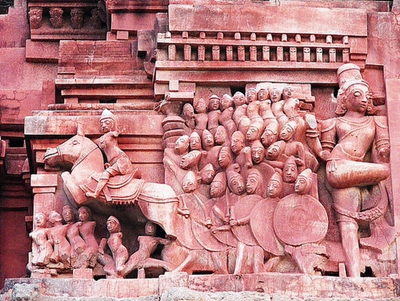
The state-run Mayura Hotel at Hampi is conveniently located in the midst of the extensive, picturesque ruins of the once very prosperous city of Vijayanagara. The former city was once the world’s second largest metropolis, but it was destroyed in 1565. I have stayed at the hotel on at least three occasions despite its shortcomings, some of which I will describe below. It is only fair to point out that the last time I stayed at this hotel was at least nine years ago. Things might well have improved by then.
On one occasion, we were driving to Hampi from Bangalore, and were running late. We rang the hotel to tell them that we would be likely to turn up by 6 pm. They replied that it would not be a problem: our room was waiting. And, so it should have been because check-out time was 12 noon. Whoever had occupied the room on the previous day should have vacated their room by noon.
When we turned up at the hotel, we were told that the room we had booked was still occupied. We were not pleased. The receptionist explained that the occupants of our room, who should have vacated it by noon, were still using it. We remonstrated and asked for an explanation. We were told that the family that was overstaying in our promised room had also arrived late the day before, and the hotel was kindly letting them extend their stay at our expense. We were tired and not amused.
The receptionist and another member of staff settled us temporarily in a small bedroom while we waited for our room to become vacant and cleaned up. After a couple of hours, we were shifted to our allotted family room. There were several workmen in the bathroom. They were trying to turn off a jet of water, like a geyser, that was shooting up from the floor. They managed after about an hour.
There were no towels in our accommodation. By now it was well after dark. We asked for towels and were told that we could not have them because the person with the (presumably only) key to the linen cupboard had gone home.
At the end of one of our stays at the Mayura, we asked to have breakfast at 7 am, when the dining area was supposed to open. When we arrived promptly at 7 am, there was no staff too be seen. Apart from us, the dining area was empty. After a few minutes, I walked into the kitchen: it was empty. All of the kitchen and serving staff were standing in a crowd in a nearby room, their eyes glued to a television screen. We learned the reason when, eventually, someone came to look after us. The television was showing the funeral of the much-loved Kannada film star Vishnuvardhan, who died on the 30th December 2009. Vishnuvardhan’s family were dismayed because his loss was not so greatly mourned as that of another star Rajkumar, who had died three years earlier. People had committed suicide on hearing of Rajkumar’s demise. Nevertheless, our driver thought it would be safer if we drove with a photo of Vishnuvardhan attached to the window as a mark of respect. Without it, we might have been attacked!
During one of our stays, we were curious to taste what appears on many South Indian restaurant menus. It is something called ‘Chicken 65’. What appeared resembled breaded chicken nuggets. They were bland and tasteless – very disappointing.
Some days later, we had dinner with an elderly Dutch couple, who were back-packing around India. It was clear to us that they had had enough of spicy food. We suggested that they ordered French fries (finger chips in Indian English), which, like omelettes and tomato soup, are almost always available wherever you are in India. Their eyes lit up at this suggestion. Also, we recommended that they order Chicken 65, which we assured them was not at all spicy.
After a while, the chips were served along with a plate of chicken pieces that did not resemble the Chicken 65, which we had ordered a couple of days earlier. Our new friends tasted this dish, and their eyes nearly popped out of their sockets. What had been served to them as Chicken 65 was far from bland; it was fiery hot. It seemed to us that the chefs in the kitchen paid little attention to what was ordered by the customers. We later learned that Chicken 65 is supposed to be hot and spicy. What we had been served before we met the Dutch people, was definitely not that dish.
The spicy dish was originally created at Buhari’s Hotel in Madras in 1965, hence the 65 in the name (see: https://www.thehindu.com/news/cities/chennai/the-hows-whys-of-our-chicken-65/article5042658.ece).
While we were staying in the hotel one visit, a tour group of Italians had dinner one evening. One man, who had had enough of spicy food, shouted out in a hysterical voice: “I want chicken, plain chicken with salt, nothing else, just chicken and salt, no spices, just chicken and salt.” He kept repeatng this, and we thought: “He should be so lucky in this eatery”.
Despite its elements of “Fawlty Towers” hospitality, the Mayura is a lovely place to base a few days of exploration of the substantial ruins of a once great city.

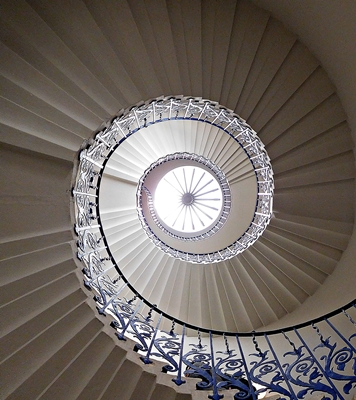
Your eye is enticed
towards a celestial light,
relentlessly
By the 16th century AD, Vijayanagara in the south of India, located in what is now the State of Karnataka, was one of the world’s largest and most prosperous cities. It was destroyed by a coalition of Muslim rulers in 1565, and since then has laid in ruin. These picturesque ruins, now much visited by tourists, lie scattered around the village of Hampi, which is close to the city of Hospet.

We first visited Hampi with our seven-month-old baby in late 1995. We stayed in a hotel in the fairly non-descript town of Hospet and made daily excursions to explore the picturesque ruins of Vijayanagara, which are scattered over a large expanse of rock-strewn, almost lunar, landscape. One day, we stopped for lunch at a state-run hotel, the Mayura, in the midst of the archaeological area. The pleasant restaurant was outdoors but sheltered from the sun by a large canopy. I will write more about this hotel in a future blog.
During the meal, I paid a visit to the toilet. On my way, I passed some of the hotel’s bedroom doors. Each was locked with a padlock. I do not know what made me look at the padlocks closely, but I did. And, what I saw surprised me. Some of the locks were made by a company called ‘Hitler’.

Adolf Hitler is far from unknown in India. Copies of his best-known work of literature, Mein Kampf, are to be found in practically every bookshop, often rubbing shoulders with works by less illustrious politicians such as Narendra Modi, Barack Obama and Nelson Mandela. There is at least one Bollywood film that I know of which has Hitler in its title. It is not a great film, and the Hitler in the film is neither German nor a Nazi. He is a police officer in a jail, if I remember rightly.
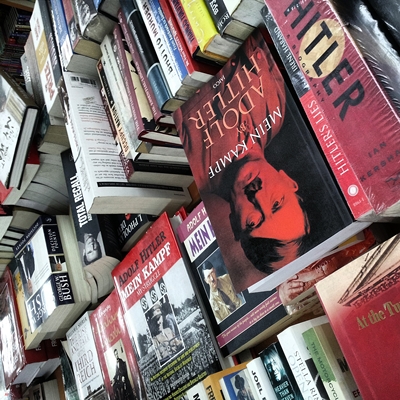
I have scoured markets in India trying to find a lock seller with Hitler locks, but in vain. The Hitler Lock Company was set up in 1989. It is based in Aligarh (United Provinces).

 yamey
yamey 