
Playing the piano
At the lake side,
Awaiting the setting sun

Playing the piano
At the lake side,
Awaiting the setting sun

In the early 1960s, my parents installed a Permutit water softening unit in our family home. I have no idea why they did this. Maybe it was to save soap and the furring up of pipework. I am not sure that they would have done it had they known of the research that shows that heart disease is reduced as the hardness of drinking water increases.
The apparatus consisted of two cream coloured cylinders, each about five feet high, which stood next to each other in our garage by the side of the house. One of the cylinders was sealed shut and surmounted by a circular metal control wheel. Its neighbour could be opened by lifting a lid. Once a week, my father had to refresh the ion-exchange resin in the sealed container. This was done by adding salt in large quantities to the other cylinder, having removed its lid. By turning the control wheel at intervals dictated by an instruction manual, the refreshing cycle was completed over a period of about two hours. When the procedure was completed, my father used to test the softness of the water in our taps by mixing it with a soap solution supplied by Permutit. If a stable foam was produced, this indicated that the refreshment cycle had been completed successfully.
A special salt, called dendritic salt, was required for the weekly process described already. There was only one store that would both supply sacks of dendritic salt and, also, deliver it to our home. That store was the world-renowned Harrods in Knightsbridge, which brought us the salt in their silent electrically-powered delivery vehicles. In order to get these regular deliveries, my parents had to open a Harrod’s account.
Harrods has never been a store that one would enter hoping to find a bargain. In the sixties, they provided their customers with very attractive carrier bags. My late mother liked these, but she was not particularly interested in buying anything from the store in Knightsbridge. So, she used to enter Harrods and buy a packet of Polo mints, one of the least costly things on sale, and have the payment of them put on the family account. This low-cost purchase allowed her to get what she really wanted: a Harrods’ carrier bag.
In May 2016, my wife and I landed in Albania at Tirana’s airport. There was a line of taxis whose drivers were all eager to drive us into the city centre and to accept either local currency or Euros. At other times during our trip, getting a taxi was never a problem. However, thirty-two years earlier, when Albania was a strictly controlled Stalinist dictatorship (at least as as repressive as North Korea is today) , getting to hire a taxi was impossible as this excerpt from my book “Albania on my Mind” will demonstrate.

A ‘busy’ street in Tirana in 1984
“After we had eaten lunch at the hotel, a group of us went into the square outside it. We saw a long line of taxis, which were waiting vacantly by a booking booth. We wondered how often these were hired and by whom; there was not a soul in sight taking the slightest interest in them. One of us walked up to the booth and asked the man sitting inside whether we could hire a taxi to take us up to Mount Dajti, some way outside Tirana. Just when it seemed that we had succeeded in hiring a cab, another person inside the booth lifted a telephone receiver, listened for a moment, and then whispered something to the man with whom we had just negotiated. He beckoned to us, and pointed at the hotel. Somehow, he made it clear to us that we needed to book the taxi not from him, but from the hotel reception desk.
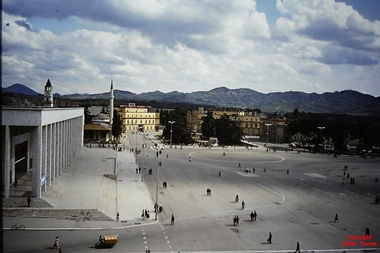
Tirana 1984. Typically empty main square (Skanderbeg Square)
We trouped back into the hotel’s lobby and made a beeline for the reception desk. Two suited men, sitting on a sofa nearby, looked at us over the tops of their newspapers. As we reached the desk, I noticed that the doors of one of the hotel’s two lifts were opening. Our Albanian guide Eduart hurried through them and towards the receptionist, who was beginning to attend to us.
“What do you need?” Eduart asked us, out of breath.
“We want to hire a taxi.”
“Why?”
“We want to visit Mount Dajti?”
“Why should you do that?”
“We need some fresh country air. We’ve been in the city for too long.”
“That’s ridiculous,” Eduart protested. “You have already spent many days in the countryside.”
“But, that’s what we want, and we believe that the views from Mount Dajti are magnificent.”
“You cannot go.”
“Why ever not?” we asked.
“There is a lot of traffic. The roads are crowded.” We looked at Eduart disbelievingly. Traffic congestion was certainly not a problem in Albania in 1984.
“You know that there’s a big national cycle race on at the moment.”
“That was over long ago,” one of us objected. “We saw the posters announcing it along the roads.”
“You can visit Mother Albania, but no further.”
We had already visited the Mother Albania monument, which was located in the outskirts of the town. However, as we were determined to not to give in to our obstreperous guide, we agreed to his compromise.
“Alright,” we said.
Then, Eduart said menacingly:
“You may take the taxi to Mother Albania, but remember that if anything happens to you, we cannot take any responsibility for your safety. You will not be protected by your group visa.” “We’ll risk it,” one of us said.
I did not like the threatening sound of Eduart’s voice, but followed the rest of our small group back to the taxi rank. When we arrived there no more that ten minutes after we had left it, we found that all of the taxis had disappeared, and also there was an extremely long line of people waiting in a queue outside the booth. Accepting defeat, we made our way on foot to …”

Traffic in Tirana, 2016
DISCOVER WHAT IT WAS LIKE VISITING COMMUNIST ALBANIA IN 1984 IN “ALBANIA ON MY MIND” by ADAM YAMEY
It is available from Amazon, Bookdepository.com, lulu.com, and on Kindle
My parents were against supporting dictatorial regimes. For example, during the 1960s and ‘70s, they would only buy pickled gherkins that had been made in Western Europe, in places like West Germany or Holland. They would not have bought Hungarian or Polish, or even Bulgarian gherkins because by doing so they believed that some of the money they spent might well end up being used build weapons that could be used against the ‘free’ West. They were against visiting countries behind the “Iron Curtain” or General Franco’s Spain.

My father had several Greek colleagues. At a dinner held by one of them, they met a Greek millionaire, one of Greece’s wealthiest men. My mother noticed that he was fiddling with worry beads and did not know what they were. She asked him, and he threw the beads across the table to her. They were coral beads on a gold chain. She looked at them, and then began to hand them back, when he said:
“Keep them.”
“Don’t be silly, I can’t keep these,” my mother replied, realising their worth.
“No, please let me give them to you.”
My mother and the millionaire struck up an amicable relationship, and near the end of the evening, he said:
“You must bring your family to Greece as my guests.”
My mother thought he was joking, but after that occasion my parents kept getting invitations from him.
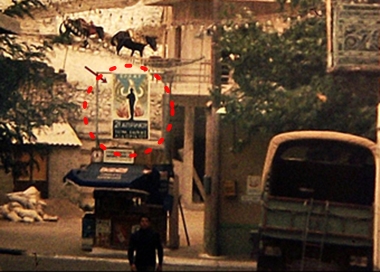
The symbol of the Junta is circled in this picture taken in rural Greece during the late 1960s
This dinner party happened soon after the 21st of April 1967, when a group of colonels, the Junta, took control of the Government of Greece replacing a democracy with a dictatorship. How could they possibly accept their new friend’s kind invitation to a country with a dictatorship? Much as they would have liked to accept, going to Greece was even worse than buying gherkins from a Communist country.
The invitation kept being repeated. After about two years, I came up with a suggestion. I said to my parents that if we were to become guests of the millionaire, we would contribute little or nothing to the economy of the Greek Junta. Miraculously, my parents saw my point and decided to accept the invitation.
On arrival in Greece, we found it very difficult to spend any of our own money. We were looked after by one of the millionaire’s former employees. If he saw us so much as looking at something, he would try to buy it for us. We learned to look at things discretely!
We saw little of our host, a busy man. One evening, we were invited to a party at his large estate on the edge of Athens. It was a lovely place with numerous outhouses including an open-air eating area with its own large kitchen building. Our host met and introduced us to various guests. After a while he introduced us to a gentleman, saying:
“Please meet Colonel Pattakos.”
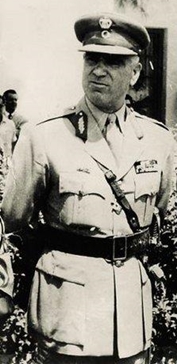
Colonel Stylianos Pattakos. [Source; Wikipedia]
My parents were polite, but doubtless horrified after shaking hands with Pattakos. Stylianos Pattakos (1912-2016), a Greek military officer, was one of the principal leaders of the Greek military dictatorship. Pattakos is best known outside Greece for his decision to strip the singer Melina Mercouri of her Greek citizenship. She is reported to have said of Pattakos, who was the Minister of the Interior:
“I was born a Greek and I will die a Greek. Mr Pattakos was born a fascist and he will die a fascist.”
Unloved by most Greeks, Pattakos is said to have told a reporter that when, he returned to his native Crete, a few months after seizing power, his mother had demanded to know who had put him up to “this evil” (see: https://www.telegraph.co.uk/obituaries/2016/10/09/stylianos-pattakos-last-survivor-of-the-1967-greek-military-junt/).
I feel sure that if they had been able to do so, they would have washed their hands thoroughly after contact with Pattakos.
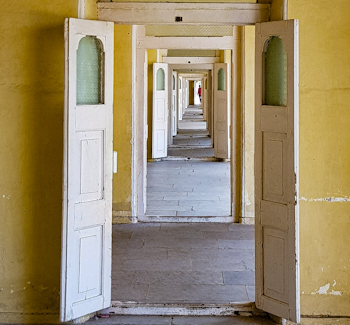
Seize the opportunity
One door leads to another:
Paths of life
Picture taken in Hyderabad, India
The Bangalore United Services Club was established in its present pleasant premises in 1868 by members of the British military, the United Services. It was an officers’ club. With a very few exceptions (some members of Indian royal families), the Club only admitted Europeans (i.e. white people). One of its best-known members was Winston Churchill, who did not like Bangalore and left the city leaving an unpaid bill at the Club. After WW1, some Indian military officers were admitted as members, but other Indians were excluded. After 1946, the Club was renamed “The Bangalore Club”, and civilians, both ‘white’ and Indian could become members. My late father-in-law became one of the first Indian members in the early 1950s.

Today, the Bangalore Club is regarded as being one of the top (elite) social clubs in India. To become a member, applications must be made, and a hefty amount of money must be deposited with the Club. Then, the prospective member is put on a waiting list. The average waiting time is currently about a quarter of a century. This slow method of entry can be bypassed if you are the child or the spouse of an existing member. It so happens that I married a member of the Club. I was eligible to become a ‘spouse member’.
Simply being married to a member is not enough to get you into the Club. The spouse candidate needs first to apply, and then to find six sponsors, who are already members of the Club, and then to attend an interview. The interviews are only held a few times a year. Missing the interview might wreck the candidate’s chances of ever becoming a member. So, the candidate, who might be living anywhere in the world, must drop everything and attend when he or she is summoned.
I was lucky. My father-in-law (‘Daddy’), a well-respected and much-loved member of the Club, arranged that I would be called for interview on a date, when he was certain that I would be in India. However, he did not tell us about the interview before we left London. Had I known, I would have packed my only smart suit, but I did not. As soon as we arrived in Bangalore, Daddy told us about the interview, and we told him that we had not brought my suit. Undismayed, he rang around his friends in the neighbourhood, and he and I drove from house to house, trying to find a suit for me to borrow. Eventually, some kind person lent me his incredibly smart double-breasted jacket suit, which fitted me well. Unfortunately, I had to return it after the interview.
For a few days before my interview, Daddy and I visited several venerable members of the Club to get their signatures for my sponsorship. At each of their homes, I was received kindly, offered drinks and snacks while my potential sponsors became acquainted with me. At last, I was ready for the interview.
On the day of the interview, I woke up with an attack of influenza. My temperature was high, but the interview could not be missed. I was dosed up with paracetamol. Just before we left the flat, with me in my smart suit, Daddy sprayed me with some Eau de Cologne, saying it was best that I should smell pleasant when I met the interviewing committee.
I arrived with Daddy at the Club, where we joined about ten other candidates. Each candidate was chaperoned by a member, who would introduce him or her to the interviewers. Daddy was my chaperone. The interview procedure involved introducing me to each of several Club Committee members. Each Committee member asked me questions. Daddy was clearly worried about what I might say in response. So, as soon as I was about to answer any of the questioners, Daddy would interrupt me, saying something like:
“You remember me. I have been a member since 1954. How is your father? He joined at the same time as me, you know.”
I do not recall having answered any of the questions. Being Daddy’s son-in-law was enough to persuade them that I would be an acceptable member of the Club.
As we walked away from the interviewing room, Daddy congratulated me for becoming a member of the esteemed club. He led me to the Men’s Bar (for men only), where we downed draught Kingfisher beer. Oddly, my influenza symptoms were beginning to subside by then.
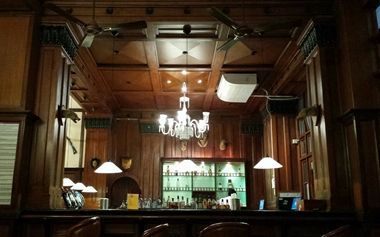
Sadly, Daddy is no longer around. Today, the Men’s Bar is no longer for men alone. Its name changed in about 2017, by which time both men and women were permitted to use its facilities. Daddy would, I believe, have approved of the liberation of the former Men’s Bar.
Finally, let me emphasise that I do not agree with Groucho Marx, who said:
“Please accept my resignation. I don’t want to belong to any club that will accept people like me as a member”
Caring for pigeons in Hyderabad and other cities in Indis
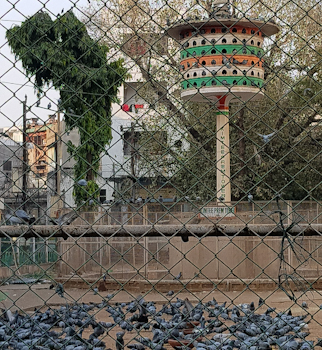
In London pigeons are regarded as a nuisance, as pests. A previous Lord Mayor of the city once described them as “flying rats”. Now, feeding them is frowned upon. Gone are the days when you could buy corn to feed the pigeons in Trafalgar Square.
During our long journey through Gujarat in western India, we saw many places dedicated to feeding pigeons. In Bhavnagar, for example, I saw a man scattering seeds, which were being avidly consumed by a large crowd of grey pigeons. The grain was strewn over a large area in which there were several large bowls of water to quench the birds’ thirst.
In Ahmedabad, we saw a fenced off area supplied with drinking bowls as already described. This special feeding area was well supplied with grain scattered on the ground. In that same city, we saw a huge pigeon ‘hostel’. This consisted of a matrix of…
View original post 243 more words

After we married in 1994, we used to visit my in-laws in Bangalore (India) regularly. During the first few visits, we stayed in their home in Koramangala, a suburb to the south of the city’s diffuse central area. Although they lived close to shops, some within easy walking distance, their street was visited by itinerant sellers. For example, there were (and still are) people wheeling barrows from which they sell fruit and vegetables. These sellers announce their arrival with shouts in the Kannada language, which I cannot understand. Other vendors come to the door selling bags of nuts and deep-fried and other snacks. Every street or street corner has a stall that is visited daily by the dhobi, who collects washed clothes to be ironed from your front door. All of this occurred in 1994 and continues today.
When I was a child during the 1950s and ‘60s, I lived with my family in Hampstead Garden Suburb (‘HGS’) near to Golders Green in north-west London. The HGS is a housing project, which was conceived by the social reformer and general ‘do-gooder’ Henrietta Barnett (1851-1936). The Suburb, whose construction began around 1904, is a mixture of residences of varying sizes built in different styles of architecture. Her idea was to provide homes for all classes of society, so that people from all these social classes could live harmoniously side-by-side. As with all the best-laid plans, this social mixing was never achieved. The very pleasant green suburb became a haven for the middle classes, the bourgeoisie. In his autobiography “A Little Learning”, Evelyn Waugh wrote of HGS (in its early years) that it was inhabited:
“… not exactly by cranks, nor by Bohemians, but mainly by a community of unconventional bourgeois of artistic interests.”
Today, this kind of people cannot afford to live there; it is now a highly desired residential area for the sector of middle class with plenty of money at hand.
Henrietta Barnett included three churches, a community hall (the so-called ‘Tea Room’), a school, an Institute, and two areas of woodland in her utopian suburb, but rejected the idea of including anything so ungodly as shops. So, HGS had, and still has, no shops within its boundaries. The nearest shopping centres are Golders Green, Temple Fortune, and the Market Place that is located on an arterial road that divides HGS into two separate parts. Unless one lived near to any of these shopping areas, the nearest shops could be up to a mile away from your front door. Because of this, HGS used to be visited by various roving services in my day.
The milkman made deliveries of dairy products every day. These were loaded on small electrically powered vehicles (‘milk floats’) that moved almost silently along the streets. The only sound they made was the tinkling of glass milk bottles as they rattled in the wagon. The milkman collected his stock from the Express Dairy Depot at Hoop Lane on the edge of the boundary of HGS. It was at this depot that the electric vehicle’s batteries were charged overnight. Newspapers were delivered to the door by a delivery boy employed by a local newsagent. A man with a French accent wearing a beret used to cycle around HGS selling strings of onions. For some reason unknown to me my mother never bought onions from him, but her sister, who lived close by, always did. Several times a week a tatty lorry used to cruise slowly along our streets. His vehicle contained a vegetable shop.
In summer, vans selling ice-cream would occasionally cruise along our street. When they stopped, they played a pre-recorded musical (well, not very musical) jingle to attract customers’ attention.
Every now and then, a knife grinder would arrive on his bicycle. He had a pedal-operated grinding wheel that spat out a shower of sparks when a knife was being sharpened. My mother never employed the grinder, claiming that he would ruin her kitchen knives. Being a sculptress, she was used to sharpening her chisels on a stone, and probably sharpened her own knives as well. Cries of what sounded to me like “old iron and echo” heralded the arrival of the scrap metal collector. When I was very young, he arrived with a horse-drawn wagon. This was later replaced by a battered motor driven lorry.
Twice a week, a mobile public library visited HGS. I never used it, preferring to walk to the better stocked library in Golders Green. The only commercial establishment, the nearest approximation to a shop, within HGS was Mendels Garage, which sold petrol and repaired cars. This has long since disappeared as did some of the other services mentioned above.

A dhobi ironing in Bangalore
Moving fast forward to today’s world, there is little need to leave your home if you do not feel like doing so. With the advent of the Internet, everything can be brought to your front door: from cooked meals to rare books, clothes, and almost anything you might want to buy. Even fast-food joints like McDonald’s will deliver your favourite snacks. Recently, a friend in Bombay needed a new rubber stamp costing a very few rupees. He rang the manufacturer to order it and was told that it would be delivered to his home within a very short time.
The convenience of home delivery is obvious, but this may jeopardise the future of shops that rely on people entering their stores to buy things. Such is life, as so many people say, rather irritatingly I feel!
Many years ago, in the 1970s, I accompanied ‘M’ on a trip, my first, to Scotland. We spent a few hours in St Andrews, which is famed for its golf course and its university, at which Prince William first met his future wife Kate. Both M and I were keen on second-hand book buying.
On arrival at St Andrews, we made enquiries about second-hand bookshops. Both of us felt the urge to visit one. We told that there was probably one somewhere in the suburbs of the small town. We drove along a tree-lined road and nearly missed the small sign outside what looked like a normal residence. The doors of its attached garage were open, and it could be seen that its walls were lined with bookshelves filled with books. We got out of the car and approached the garage. As we entered, and just before beginning to browse, a late middle-aged man approached us, saying:
“Do come indoors, I’ll be serving coffee soon.”
We followed him into the house and sat in the large living room with several his other customers. After we had been served with coffee and biscuits, the man, who owned the building and the business, told us that we were free to wander around the house, his home, selecting the books that we wished to buy. He told us that we could select volumes from any room except his office, which was on the first floor at the top of the stairs. Every room in the house was filled with books, even the bedrooms. We were told that he lent rooms to students from the university providing that they did not mind his customers wandering through them when his bookshop was open.

Photo by Mikes Photos on Pexels.com
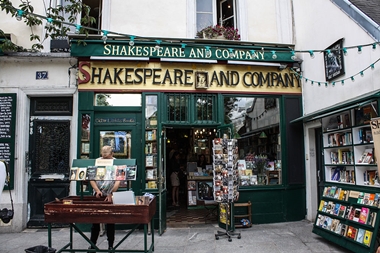
A few years later, I visited some friends of a friend in Paris. They were from the USA. One of them, Duncan, was a dealer in oriental carpets. It was a Sunday, and they served me lunch in their flat, which was on the edge of central Paris. After we had eaten, they invited me to join them for tea in the heart of the city. We headed for one of the quais that faced the Ile de La Cité, and entered a second-hand bookshop called ‘Shakespeare & Co.’ I believe that I had come across this shop before, but this time when we entered it, it was not to purchase books.
Shakespeare & Co. occupied larger premises than the shop in St Andrews and was spread over more floors. Both of the two shops (or maybe the correct term should be ‘establishments’) allowed, or maybe encouraged, young people to take residence amongst the books. Duncan had been one of these when he first arrived in Paris from America. As we climbed the stairs to the top of the building, he told me that we would be attending one of the owner’s famed Sunday tea parties at which anyone who had lived in the shop was always made to feel welcome.
When we reached the crowded apartment at the top of the house, I was introduced to the elderly-looking owner of the shop. Many years later, I discovered that his name was George Whitman. I cannot remember much about him except that a tiny child, who must have been less than 2 years old, was crawling around his feet. Her mother was close by. She was far younger than Mr Whitman and, if I recall correctly, looked as if she was of Far Eastern extraction. I remember being impressed that someone who looked as venerable as Mr Whitman had been capable of producing a child. He was, I have recently discovered, only 68 years old. Recently, one of my cousins, who was then aged 69, produced a daughter. So, maybe I should not have been so surprised, but in the early 1980s, when I met Mr Whitman, I was less well experienced in the ways of the world! After tea, we left the shop and went our own ways. However, the memory of attending that tea party sticks in my mind.
After M and I had spent nearly two hours exploring the stock in the shop in St Andrews, we heard the owner summoning everyone to the living room. He told us to make ourselves comfortable as he was about to serve tea and cakes. Both M and I staggered into the living room bearing huge piles of books that we had chosen. Tea and cakes were served, and whilst we were enjoying these, we chatted with the book seller. It turned out that he was a graduate of University College London (‘UCL’), where he had studied either English or English Literature, M had studied chemistry, and I had completed my PhD. I do not remember when he was at UCL. He and M did not know anyone in common from the college. I have recently discovered that the present owner of Shakespeare & Co., Sylvia Beach Whitman – that small child who I saw at that Parisian tea party back in the early 1980s – was also an alumnus of UCL, but long after my time there!
When tea was over, we thanked the owner and asked if we could pay for the books we had selected. He added the prices in our books and announced the total. However, before we could pay, he discounted the totals considerably; he would accept no more than the ridiculously low amounts that he mentioned. We loaded the books in the car and set off for our next destination, Aberdeen.
Years later in the early part of this century while I was investigating the ramifications of my mother’s family tree, I discovered that I had many French cousins. I keep in touch with some of them. One of them, who is related to the famous Captain Dreyfus of the Dreyfus Affair, speaks and writes excellent English. On one occasion not too long ago, we met him in Paris outside Shakespeare & Co, where he is well-known. It turns out that he attends a creative writing class organised by the bookshop. It is a small world, as so many people say!

The wonder of water:
It reflects the truth
And sometimes distorts it
Chowmollah Palace in Hyderabad

 yamey
yamey 