Comparing kebab rolls in London’s Soho with those in Kolkata

ACCORDING TO ITS website, the small restaurant in Soho’s Poland Street called The Kati Roll Company (‘KRC’):

“… serves authentic street Kati Rolls just like the ones in Kolkata, India.”

The restaurant is attractively decorated, with its wall covered with fragments of Hindi film posters and a corrugated iron ceiling. It has several tables and chairs. Food is ordered from a counter at the far end of the rectangular dining area, and is delivered a few minutes later. I could not see the kebabs being prepared, but if they are truly kati kebabs, they should have been grilled on bamboo skewers. The roll, wrapped in paper consists of a spicy meat or vegetarian filling enclosed in a rolled-up roti, which the restaurant described as a ‘paratha’.

Kati Roll Company, London

KRC was, according to its website, started:

“… by Payal Saha shortly after she moved from her hometown of Kolkata to New York City. Without any experience running a restaurant, she let her desire for authentic kati rolls drive her passion.”

Well, it was with great interest that today, 3 September 2025, I visited and ate at KRC in Poland Street. I was curious to see how their rolls compared with those at Nizams in central Kolkata. I have written quite a lot about this restaurant in my latest book “88 Days in India: A Journey of Memory and Discovery”. Here is a short excerpt from my description of the rolls at Nizams:

“The kathi roll consists of a kebab (usually chicken or mutton, or potato for vegetarians) wrapped, with or without a cooked egg (like an omelette), in a rolled up flaky paratha. Onions and chillies can also be included in the roll. The paratha is heated in a large amount of oil on a tava (a circular, concave metal hotplate). It is the same one that was installed when the restaurant first opened. According to an article in The Telegraph Online (dated August 2024), the tava weighed 185 Kg in 1932, but through constant use it has lost weight. By 2024, it weighed 80 Kg. Until 1964, the kebabs were grilled on iron skewers. After that, the metal skewers were replaced by cheaper bamboo sticks, known in Bengali as ‘kathi’. The rolls have always been served, wrapped up in paper so that the customers (often in the early days, British men out on the town with Indian ladies) did not get grease on their fingers whilst consuming them. Interesting as the history is, it pales into insignificance when you bite into one of Nizam’s kathi rolls. I do not know how they achieve it, but the taste of Nizam’s kebab filled rolls surpasses that of every other kebab roll I have eaten. Year after year, Nizam’s manages to maintain the high quality and magical flavour of their products.”

After having eaten at Nizams many times, I waited with great interest for the 4 kathi rolls we had ordered in Poland Street to be served.

The fillings in the KRC rolls were tasty enough, and if you have never eaten at Nizams, you would think that they taste pretty good. The so-called parathas in which KRC’s rolls are wrapped seemed more like rotis than what I was expecting. In contrast, the parathas that enclose the fillings at Nizams are, as mentioned above, flaky, almost as much as Malabar or Kerala parathas, but oilier.  Although I enjoyed the rolls at KRC, and will happily eat there again, they are not nearly as satisfying and tasty as those at Nizams. However, it is much easier and quicker for us to reach KRC in Soho than it is for us to get to Nizams in Kolkata.

PS: My book, which contains a chapter about eating in Kolkata, is available from Amazon:

Down in Hampshire at The Vyne with the Sandys and the Chutes

THREE MILES NORTH of Basingstoke, there is a magnificent stately home, The Vyne, which is now owned by the National Trust. Set in fine grounds alongside a long, thin lake, this edifice is a wonderful mixture of architectural styles and features.

The present house began its life as a Tudor mansion built between 1500 and 1510 for William Sandys, 1st Baron Sandys, Lord Chamberlain to King Henry VIII. It remained a possession of the Sandys family for most of the time from when it was constructed until 1653, when it was sold to Chaloner Chute (died 1659), who was a lawyer and the Speaker of the House of Commons during the Commonwealth. Because he felt that the Vyne was too big for his requirements, he had much, but not all, of the Tudor mansion demolished. Fortunately, several of the beautiful rooms with elaborate wood panelling were saved, along with the Tudor chapel.

The rest of what remained of the original building was converted to a version of the Palladian Style. This included adding a neo-classical portico to the north side of the hose, facing the lake. In the eighteenth century, one of Chaloner’s descendants, John Chute, influenced by his friend Horace Walpole, redesigned the interior of the chapel, adding trompe l’oeil features and also installed a very spectacular staircase in the house. The staircase is in the neo-classical style. It must have impressed those who visited the Chutes, and it still dazzles the visitor today. Although there are many fine artefacts to be seen in the house, this staircase was, for me, the ‘star of the show’.

When John Chute died childless, The Vyne was inherited by his cousin Thomas Lobb, who then changed his surname to Chute. After that, few changes were made to the house. The house remained in the Chute family until 1958 when Charles Chute bequeathed the estate to the National Trust.  

In the pie, or the core of the matter

RECENTLY WHEN WALKING in an an orchard in Hampshire, we found that the trees were literally groaning beneath the weight of apples growing upon them. Seeing all of these ripe fruits brought back memories of visiting family friends, who lived in Kent, during my early childhood.

Whenever we went to their home, we were given a lavish lunch. The dessert was always apple pie. The apples were covered with a topping of pastry. What fascinated me was that the centre of this topping was always raised above the rest of it. Beneath this centrally located curved mound, – and this is what used to fascinate me – there would be a ceramic cup buried amongst the cooked apples. Discovering a cup buried in an apple pie tickled my imagination, and always puzzled me. I believe that it is normal practice to insert something to support the pastry topping, but when I was less than 10 years old, I did not know this. Our friend who used to cook this apple pie for us is, sadly, no more,

Incidentally, in recent years, some of the best apple pie I have tasted is that served at The Only Place in Museum Road, Bangalore (south India). Its recipe was introduced to the restaurant by the American wife of Haroon, who founded the restaurant many years ago.

A village in Hampshire that lives up to its name

THERE IS NOT much to see at Little London, a village in Hampshire, located between Basingstoke and Reading. It is a part of the civil parish of nearby Pamber. The place is spread out along its single main road. There are several attractive houses, and new ones are being constructed in the neighbourhood. This upsets the long-established locals who point out that apart from a single pub, there are no other amenities, not even a village shop.  The one pub, The Plough Inn, an old-fashioned looking building, was closed when we passed, but it is highly recommended judging by the reviews it receives.

Although Little London has an appropriately small village hall, I could not find any church in the place. On an old map surveyed in 1894, there is a Methodist chapel shown in the village. Today, the building, constructed in 1867, has been repurposed, and now provides bed and breakfast accommodation. 

If you are a church enthusiast, it is worth driving 1.8 miles northwest of Little London to the much larger village of Tadley. Using your navigating equipment, find Malthouse Lane, and drive carefully along this narrow road. Soon you will arrive at a building that could easily be mistaken for country cottage except that it is set amid a small cemetery. It is Tadley United Reform Church (‘URC’). A notice board near its entrance reads: “‘Old Meeting’ United Reform Church (1662)”. According to the establishment’s website, the reason that this church was designed to look like a house from the outside was it was built during the period when non-conformist worship was a punishable offence. It was best to disguise the purpose of the building. The website related:

“The original worship area consisted of an open space with a gallery on three sides which was accessed by an external staircase. It is recorded as being able to seat 450 people, although this must have been very cosy! It is understood that during the times of persecution there was a hidden door below the pulpit to allow the presiding minister to escape if there was a raid. The worship area was extended in … 1828 to accommodate an additional 100 worshipers and the ‘School Room’ added to the side maybe around 1848.”

It appears that although it is not a ‘mainstream’ church, it is one of the closest to Little London.  

By now, you might be wondering about Little London’s name. Apart from the village described above, there are 17 more Little Londons in England and Wales. Several of these, including that near Tadley, are within about 50 miles of London. One explanation of the name is that it was a place to which Londoners came when fleeing the Great Plague of 1665. Another possibility is that it was a place where people from London came to assist with the harvest. Another suggestion is that Little London is a corruption of Little Loddon, the Loddon being a stream that runs close to the village.

Hampshire’s own Little London is near to the site of the Roman town of Calleva Atrebatum, which is close to the town of Silchester. Until the mid-nineteenth century, Little London was a centre for brickmaking, and it was from places such as this that the Romans built their nearby town. The brickfields at Little London were close to The Plough Inn.

Pleasant as it is, Little London lives up to the first part of its name. It is truly little.

Works of art flating on a canal near London’s Paddington

EVERY FEW WEEKS, we walk along the towpath of the Grand Union Canal (Paddington Arm) between the Meanwhile Garden in North Kensington and Little Venice near Paddington station. About 1/3 of the way along this route, we stop at the pleasant Grand Junction Café. Many canal narrow boats are moored alongside the towpath. Most of them are floating residences. Today, 31 August 2025, we spotted a narrow boat that we had not seen before. Moored between the Meanwhile Garden and the café, it is a floating, mobile art gallery.

Below the words “Canal Boat Contemporary” attached to the starboard side of the boat, there was a large glass-covered frame facing the towpath. This contained about 15 paintings. Next to the frame, there were notices giving information about the gallery’s concept and the works of the artist being displayed. There was also a whiteboard on which viewers could add their reactions to the art, using the marker pen attached to it. Between 27 August and 2 September, works by the artist Henrietta Roeder are on display.

Also attached to the boat and visible to passersby was the ‘manifesto’ of Canal Boat Contemporary, which can be read on a website (www.canalboatcontemporary.com). It refers to the ‘box’, by which they mean the display containing the art. Here are some excerpts from the manifesto to illustrate what the organisation is trying to achieve:

“Opera sings to chandeliers. If art wants to matter, it has to leave the palace … We moor up. We don’t ask for permission.We resist fixed power structures and take art to different places and contexts … We’re all speaking, nodding, showing – but always to each other. The Box is a window turned outward – away from the art world – for new eyes. It’s for someone walking their dog … The Box is modest, but powerful. A single painting on the towpath can shake you to the core … We don’t want your submissions. We want doppelgängers. Copy us. This idea wants to spread like moss. All you need is a frame no one’s using. A window everyone passes.”

Seeing the boat with its artworks, appearing as if from ‘out of the blue’ was a lovely experience. I think it is a wonderful idea to bring contemporary art outside of great institutions and commercial art galleries to make it available for anyone to stumble across unexpectedly.

At rest for ever in a gallery of art

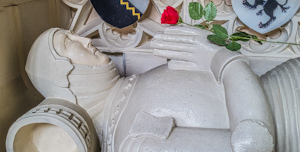
ALTHOUGH THE MAIN attraction of Dulwich Picture Gallery is the collection of works of art by famous painters, there is a small but fascinating feature that should not be missed. And that is the mausoleum. This small chamber houses the sarcophagi containing the remains of the gallery’s founders, Sir Peter Francis Bourgeois, Noel Desenfans, and his wife Margaret.

Like the rest of the gallery, the mausoleum was designed by Sir John Soane (1753-1837). Working in an age before electric lighting was available, he was a master of maximising the use of natural illumination to get light into his buildings. The galleries at Dulwich are provided with clear glass ceilings that are sufficient to provide adequate lighting of the artworks. However, this is now supplemented with electric lighting. Light enters the mausoleum through glass windows at the top of it. Instead of plain glass, he used amber coloured glass. The light passing through this gives the mausoleum a warm glow, making it feel a spiritual place.

The mausoleum was badly damaged during an air raid in WW2. However, it was restored and is said to look exactly as it did before the war. Although it was designed as a final resting place, it is occasionally used to house art installations and films about temporary exhibitions being held in the galleries.  

Never come to Holland again with this passport

DURING THE 1980s, I used to drive from my home in Kent through Europe to Hungary and Yugoslavia. I used to take the car across the sea on the Olau Line that ran between Sheerness in Kent and Vlissingen in Holland. In those days, I held an old-style UK passport. With hard covers, it was dark blueish black. On the front cover, there was a coat of arms embossed in gold and words in gold lettering mentioning it was a British passport. There were two horizontal slots in the front cover. These were lined with white paper. On one of them, the passport holder’s name was written by hand, and on the other, the passport number.

I used to carry my passport in my trouser pocket. So with time, it gradually got a bit bent as it pressed against my leg. Another thing that happened was that the gold coat of arms and the gold lettering wore so thin that they were barely visible. Likewise, my name on the cover also began to become less distinct.

At various demanding frontiers, such as the borders to Communist countries such as Albania, Bulgaria, and Hungary, the tatty appearance of my passport was of no concern to the often-over-zealous border officials. However, it did cause trouble in a place where I least expected it.

On one occasion, after disembarking at Vlissingen, I handed my passport to the Dutch immigration official. He looked at it, and then wandered away with it. About 10 minutes later, he returned with it, holding it gingerly by one of its corners. As he handed it to me, he said:

“Next time you are coming in Holland, you must have a new passport.”

Clearly my passport’s appearance was not in harmony with the Dutch sense of tidiness and orderliness.

The mouth as landscape in Dulwich, south London

RACHEL JONES IS an artist who was born in London in 1991. She trained at Glasgow School of Art, then at the Royal Academy Schools. There is an exhibition of her paintings, “Gated Canyons”, at Dulwich Picture Gallery until 19 October 2025. I must admit I had never heard of her before visiting the show in August 2025. So, I went to see it without knowing what to expect.

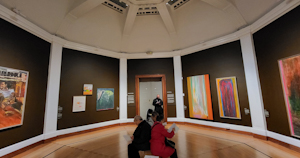
Rachel’s colourful paintings on display vary in size and shape. All of them are more abstract than figurative, but not completely abstract. The artist uses colours well, producing appealing images. Many of them interested me as a retired dentist because most of what was on display included somewhat abstract depictions of jawbones, teeth, lips, and tongues. The artist regards the mouth as being important as it is a portal through which we interact with the outside world, express our feelings, and explore psychological landscapes. If I understand it correctly, Rachel regards the mouth as a gateway to both our inner selves and the outside world. Having read the informative labels that tell viewers about her work, I began seeing, or even imagining, elements of her paintings that might be interpreted as features of oral anatomy.

The exhibition occupies three rooms, one of which I felt was too small to properly view the three large pictures within it. Otherwise, the paintings were nicely displayed and well-lit. I am glad I saw the show, but I would be reluctant to recommend it to most people I know.

Two barristers from South Africa stand together in central London

A FEW MONTHS AFTER Mahatma Gandhi was born in India in October 1869, Jan Smuts was born in South Africa’s Transvaal Republic (in May 1870).

In 1893, the young barrister Mohandas K Gandhi, the future ‘Mahatma’, arrived in Durban, South Africa, from Bombay. This was the year before Smuts graduated in law at Christ’s College in Cambridge, England. After passing the Bar examinations in late 1894, he returned to South Africa, where he became involved in politics.

Gandhi remained in South Africa from 1893 until 1915. During his time there, he practised law as a qualified barrister, fought for the rights of Indians in the country, and gradually developed his non-violent approach to protest, which he later practised during the struggle to free India from British domination. During the Second Anglo-Boer war (1899-1902), Gandhi assisted the British with caring for casualties. Meanwhile, Smuts fought with his fellow Boers.

After that war, Smuts was involved with negotiations that led eventually to the union of the four territories, which then became unified as the South Africa we know today. In 1914, the First world War broke out. Smuts fought for the British, most notably in what was then German Southwest Africa, now Namibia. Meanwhile, in 1915 Gandhi returned to India, and the rest is history.

Both Gandhi and Smuts are commemorated by statues in London’s Parliament Square. They stand near each other, but not next to each other. Jan Smuts stands on the north side of the square, and is depicted as striding towards Westminster Abbey. Mahatma Gandhi stands on the east side of the square quite close to the statue of another South African, Nelson Mandela. Gandhi appears to be gazing at the Houses of Parliament.

Seeing those statues standing in the same square today made me wonder how, if at all, Gandhi and Smuts felt about each other. I found an article in a website called “The Observation Post”, which helps understand their relationship. Here are some quotes from it:

“It’s a common misconception that Jan Smuts and Mahatma Gandhi’s relationship was one of animosity. It is a little known fact that both men actually respected each other, remaining life long admirers of one another … Gandhi tried, at all times, to look for the positive in Smuts and said of him that he had a ‘high place among the politicians of the British Empire and even of the world’.”

When Gandhi was about to leave South Africa in 1915, he sent Smuts a pair of sandals that he had made at Tolstoy Farm, a cooperative colony he set up near Johannesburg, from which he ran his campaign of satyagraha (non-violence). Smuts wore these every day when at his farm, and is recorded as having said on Gandhi’s seventieth birthday:

“I have worn these sandals for many a summer, even though I may feel that I am not worthy to stand in the shoes of so great a man.”