From Madras to Kensington

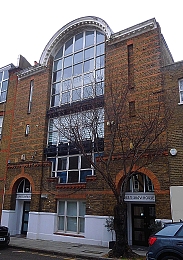
CAMPDEN STREET IN Kensington is a short thoroughfare running between Kensington Church Street and Campden Hill Road. On it, there is a distinctive building called Byam Shaw House. Until 1990, this edifice with its large centrally placed, north facing window was the Byam Shaw School of Art, which opened in 1910. Named at first as ‘Byam Shaw and Vicat Cole School of Art’, after its founders, Rex Vicat Cole (1870-1940) and John Liston Byam Shaw (1872-1919), it soon became known as the Byam Shaw school.
John Liston Byam Shaw is also known as ‘Byam Shaw’. He was born in British India, in Madras (now ‘Chennai’), where his father was registrar of the High Court at Madras. In 1878, the Shaws moved back to England, where they lived in Kensington. At an early age, he showed artistic promise and at the advice of the artist John Everett Millais (1829-1896), he entered an art school in London’s St Johns Wood. As he grew older, Byam’s works attracted less interest and he turned to teaching to earn a living. In 1910, he and Cole founded the art school in Campden Street. Sadly, Byam Shaw died during the great influenza epidemic that followed WW1.

The school in Campden Street has produced several significant artists including Winifred Nicholson (first wife of Ben Nicholson), Bernard Dunstan, Yinka Shonibare, Mona Hatoum, as well as stage designers, stained-glass makers, and actors. The inventor James Dyson also studied there. In 1990, the school moved to larger premises in Archway, and in 2003, the school was absorbed into the Central Saint Martins College of Arts and Design. Byam Shaw would have been pleased to know that his school produced such fine alumni.  Guy Burch, who studied at the school between 1981 and 1984, wrote:

“The innovative independent Art School founded in the early 1900s, Byam Shaw had an open studio policy that suited my inability to fit into categories marked ‘painter’ or ‘sculptor’. Most art schools at the time made you choose one or other with cross-media working tending to be discouraged. Their studios allowed you to move between them. I was in the ‘Image Studio’, and worked on collage, painting and mixed media installations.” (http://www.guyburch.co.uk/?p=4358)

I feel it is a shame that the building in Campden Street, which has now become a block of flats, is without any notice commemorating its former use.

Guardian dragons

CAST-IRON STATUES of dragons mark the City of London’s boundaries on main roads leading into it., The City includes the oldest part of the metropolis.

Standing on their hind legs, the dragons stick out their red-painted tongues and rest their left forepaws on a shield with the coat-of-arms of the City of London. The creatures were designed by James Bunstone Bunning (1802-1863), who was architect to the City of London from 1843 until his death.

Thirteen of these dragons can be found in London. Some of them were placed at entrances to the City as late as the 1960s. The dragons are part of the City’s coat-of-arms, which was in use by 1381. In this emblem, a pair of them supports a crest.

I consider that these creatures look far from welcoming.

Burgers on the Strand

THE BYRON RESTAURANT chain, which specialises in serving burgers, has a branch next to the Adelphi Theatre on London’s Strand. I have not eaten there but I did peer through its street door. What I saw is quite amazing. The ground floor dining room’s walls have giant mirrors separated by marble pilasters. The ceiling beams look like marble , although it is unlikely that they are made of that material. The grand dining room has a decadent fin-de-siècle appearance, providing your eyes are averted from the banquettes upholstered with red leather, or perhaps plastic, which are quite appropriate for a burger joint.

The large façade of the restaurant has pink granite pillars on both sides. On one of these, there is a commemorative plaque that reads:

“Site of the Adelphi Theatre Restaurant owned by the Swiss-Italian Gatti family, restaurateurs, music hall, theatre and electricity supply entrepreneurs. Sir John Gatti served as Lord Mayor of Westminster, 1911-12.”

The Adelphi Theatre is still in business, but its neighbour, the Adelphi Theatre Restaurant, is now the Byron outlet.  Carlo Agostino Gatti (1841-1897) and his brother Stefano Gatti (1844-1906), father of Sir John, ran the Adelphi Theatre, the Adelphi Theatre Restaurant and the Vaudeville Theatre all in the Strand (www.londonremembers.com/subjects/gatti-family). Carlo and Stefano came from Ticino Canton in Switzerland. Another Gatti, Gaspare Antonio Pietro Gatti, known as ‘Luigi’, came to London from Montalto Pavese in Italy, where he was born in 1875. He is supposed to have managed the restaurant at The Ritz Hotel, as well its concessions on two ships, one of which was the ill-fated Titanic. Whether Luigi was related to the brothers is uncertain.

What is also uncertain in my mind is whether the dining room that now serves as home to Byron and its burgers is the original that existed when the Gatti family owned the restaurant or whether it is from a later era. The upper storeys of the building were recently converted into luxury flats, whose interiors can be viewed on websites such as https://www.businessinsider.com/pictures-london-gatti-house-millionaire-flats-on-the-strand-with-pizza-lift-2015-10?r=US&IR=T .

So, next time you are wandering along the Strand, take a peek into Byron’s and, maybe, if you are feeling peckish …

Art on the roof

TEMPLE STATION IS on the Circle and District lines of London’s Underground. It was opened in 1870 and named after the nearby ancient Temple Church, which stars in Dan Brown’s 2003 novel “The Da Vinci Code”. The station’s ticket office is housed in a single storey building with a flat roof surrounded by a balustrade. The flat roof, with a few benches, occupies about half an acre and until recently served simply as a place to sit in the fresh air. Now, this has changed.

The flat roof has become employed as an open-air exhibition space for young artists. Today (December 2021), we climbed the stairs to reach the roof and were amazed to see that it has been covered with multi-coloured painting and plastic floor tiles, a dramatic sight. There is also a colourful hut, “The Artist’s Hut”, a modern take on the traditional cabman’s shelter. With the title “Back in the Air: A Meditation on Higher Ground”, the art installation was created by London-based artist Lakwena Maciver (born 1986). Also on this coloured space, there are a couple of ceramic works by another artist, Camilla Bliss. It is a wonderful surprise to see this field of bright colours, especially beneath a cloudy, grey sky. It would be fun to see the space from the air. But I do not know whether the pigeons would agree with me.

In the future, it is hoped that other artworks will b e displayed above Temple Station.

Putting Hampstead on paper

I HAVE TOLD SEVERAL friends that I am busy writing a book about Hampstead in North London. Hearing this, each one of them has said something like “Aren’t there already so many books about the place?” Well, those words are hardly encouraging. Had I been writing a love story or a book about WW2, they would not have expressed any sentiments about the untold number of already published love stories and books about WW2.

I wondered how many books there are about Hampstead, non-fiction rather than fiction. I searched for “Hampstead” in the book section on Amazon’s UK website and found that there are not more than about 40 different non-fiction titles relating to Hampstead rather than only Hampstead Heath or Hampstead Garden Suburb. Of these titles, 11 were published since 2000, and most of these before 2015. The rest were published before 2000, and of these at least 16 were published before 1980. Since 2015, only 3 books, which deal mostly with Hampstead, have been published. Therefore, although there are many books about Hampstead, few of them have been published in the last six years. So, maybe it is time that another one should appear in print.

While researching the book I am writing, I have consulted many of the books still available on Amazon and many others which have chapters about Hampstead, as well as a wealth of information that can be found on the Internet. I am making much use of what I have discovered from these sources and from my own observations, and I believe that when it is completed my book will contain a distinctive combination of facts and observations, which differs from presentations in other books about the locality.  

The greater part of the book’s subject matter will be about Hampstead and its ‘satellites’, North End, Swiss Cottage, Belsize Park, and West Hampstead. I am also including shorter, detailed sections on Highgate and Golders Green. I am still at an early stage in the book’s production, but I do not feel deterred by observations that my friends have made that imply that I am simply ‘sending coals to Newcastle’, by writing yet another book about Hampstead. Time will tell.

A foreign wind

THERE IS A HOUSE in Hampstead’s Downshire Hill, where John Heartfield (1891-1968) lived between 1938 and 1943. Born in Germany as Helmut Herzfeld, he was an artist who employed art, and in particular photomontage, as a political weapon. He was anti-Nazi and fled Germany in 1933, arriving in England in 1938, having spent some time in Czechoslovakia. Nearby, are houses where three other artistic creators lived: Roland Penrose and his wife Lee Miller; and the creator of The Muppets, Jim Henson.

Heartfield’s home on Downshire Hill has a peculiar feature, which might have been added long after he lived there. It is a weathervane. That is not a particularly unusual embellishment, but on closer examination, it is not a run-of-the-mill British weathervane. Weathervanes in England often have the four points of the compass abbreviated as NSEW, that is, north, south, east, and west. The one on Heartfield’s former home has the letters NSOE. At first, I thought that the O was an abbreviation for the German for east, ‘Ost’. If the weathervane was German, it should have had the letters NSOW. Then, I thought that the O is probably an abbreviation for the Italian for west, ‘ovest’ or for ‘oeste’ the Portuguese and Spanish words for west. This makes sense because the other points of the compass in those languages are abbreviated as: N, S, and E. Short of ringing the doorbell to ask, the linguistic identity of the weathervane will have to remain a mystery to me for the present.

Lift your eyes

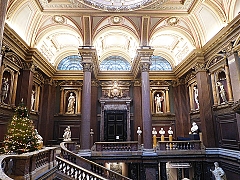
IT IS TEMPTING to concentrate on the wonderful collection of exhibits in Cambridge’s Fitzwilliam Museum, but you should spare some of your attention for the magnificent decoration of some of its galleries. Look up from the paintings and display cases to see superb ceiling decorations above you, and also around you when using the grand staircase. You are sure to be amazed.

The museum is housed in a neo-classical edifice initially designed by George Basevi (1794-1845), architect of London’s Grosvenor Square. After Basevi’s death, the planning of the structure was completed by Charles Robert Cockerell (1788–1863). Built to house the collection bequeathed to the University of Cambridge by Richard FitzWilliam, 7th Viscount FitzWilliam (1745-1816), the present museum was opened to the public in 1848. Over the years since then, the museum has been enlarged by adding newer buildings and now it is home to about 500,000 artefacts.

Years ago, I remember reading (I cannot remember where) a comparison of a museum in the USA designed by Ludwig Mies van der Rohe (1886-1969) with another one, the Guggenheim in Manhattan, designed by Frank Lloyd Wright (1867-1959). Both buildings are elegant but that by Mies Van der Rohe modestly allows the exhibits to grab the viewer’s attention more than the architecture, whereas the unusual design of Wright’s building competes with the artworks for the viewer’s attention. The internal decoration of the older galleries of the Fitzwilliam are sufficiently eye-catching to be able to compete with the exhibits housed in them, but somehow, they hardly do this. That is why I am asking you to take your eyes off the exhibits if only to glance briefly at the décor of the galleries,

Golden guesswork: the Scythians in Cambridge

THE SCYTHIANS ROAMED around the steppes of Central Asia from about 800 BC to about 300 BC. I write “about” because very little is known for certain about this group of people, also known as the Saka-Scythians or Saka. My interest in the Scythians, who were dependant on horse riding for their not inconsiderable exploits including ruling most of Central Asia, was aroused by discovering that they used the double-headed eagle, a symbol that fascinates me, in their handiwork. So, it was with great excitement that I visited the special exhibition of Scythian gold at the Fitzwilliam Museum in Cambridge. The show, “Gold of the Great Steppe”, is on until the 30th of January 2022.

The exhibition is well worth seeing. The gold and other items found in Scythian grave mounds in Kazakhstan are superb examples of sophisticated technology and fine craftsmanship and they are displayed beautifully. The labelling is clear and easy to read. However, what is very clear from what is written on these labels is that almost nothing concrete is known about the people who created the exhibits. The curators make numerous reasonable-sounding suggestions about the possible ways of life that the items suggest, but these seem to me to be mainly intelligent guesswork. The Scythians left no written records. What we know about them depends mainly on metallurgical and genetic findings, as well as a few linguistic studies. Various Ancient Greek writers have written about them, but their opinions were often biased against them. So, it is not surprising that visitors to the exhibition are left little wiser about the people who created the magnificent artefacts on display. Interspersed amongst the items found in the graves in Kazakhstan there are modern recreations of how the Scythians and their horses might have looked in life. I felt that these mock-ups were rather too speculative for my taste. That said, I was pleased to have seen the show.

Catching the wind

Cambridge, UK

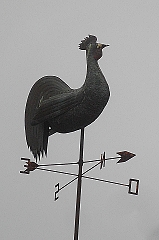
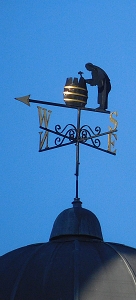
LOOK UP AND if your eyesight is reasonably up to scratch, you might well be lucky enough to see a weathervane on top of a church steeple or some other high point on a building. The ‘vane’ in weathervane is derived from an Old English word, ‘fana’, meaning flag (in German the word ‘Fahn’ means flag). Weathervanes are simple gadgets that indicate the direction of the wind. They usually consist of an arrow attached by a horizontal straight rod to a flat surface that catches the wind. The rod is mounted on a vertical support in such away that it can rotate as the wind catches the flat surface. The horizontal rod with the arrow rotates so that it offers the least resistance to the prevailing wind. Beneath the rotating arrow are often indicators that are labelled with letters denoting the four points of the compass. If, for example, the wind begins to blow from east to west, the horizontal rod will rotate so that the arrow is above the ‘E’ denoting east. Some weathervanes substitute the horizontal rod with a single flat asymmetric object that can catch the wind and rotate. Often the object seen above churches is a cock or other bird, whose beak will indicate the direction of the wind. I suppose that for birds wind direction is quite important.

The weathervane is not a recent invention. It was invented in the 2nd century BC both by the Greeks and the Chinese but separately. Some of the oldest Chinese weathervanes were shaped as birds and later, at least by the end of the 9th century AD, bird shaped vanes became used in Europe. Although avian weathervanes are still very common, a wide variety of other shapes have been used. Sundials, weathervanes, now archaic, only give an approximate indication of time and wind direction respectively. However, unlike sundials, which do not work when the sun is not shining, weathervanes work in all weather conditions and in day and night, although they are somewhat difficult to see at night-time. Despite their relative inaccuracy compared with modern instruments for measurements of  wind, weathervanes are attractive adornments to buildings both old and new.