Ten instead of twelve

HAPPY NEW YEAR!

AT FIRST SIGHT, this clock, on the esplanade overlooking the seashore at Folkestone in Kent, looks unexceptional. But look again, and you will see that it is missing the figures ’11’ and ’12’. It is a decimal clock forming part of an artwork.

There are as you know 24 hours in a day and of these twelve are usually displayed on a clock face. For a few years during the French Revolution, it was decided to divide the day into ten hours instead of the usual 24. This was not all: the decimal hour was divided into 100 decimal minutes, each of which consisted of 100 decimal seconds. Midnight became 0 in decimal time, and 1 in decimal time was 2.24 am in the 24 hour system, 2 occurred at 4.48 am, 3 at 7.12 am, and so on. This attempt at revolutrionising time did not last for long in France. It was abandoned in 1805.

The French were not pioneers in using decimal time. They were preceded by the Chinese, who ceased using it in favour of the 24 hour system in 1645.

The decimal clock in Folkestone is one of ten in the town, which were created by Ruth Ewan as part of an artwork named “We could have been anything that we wanted to be”. The Tate Gallery website noted: “The commission comprised ten decimal clocks of different designs installed around the seaside town of Folkestone in Kent. All the clocks were displayed publicly, some in very prominent positions such as the town hall, and others that had to be either assiduously sought out or happened upon by chance, such as those found in a pub or a local taxi. With each clock, Ewan replaced the dials and mechanism to achieve the decimal regulation of time.”

The example, which we saw near a Victorian bandstand on the Esplanade has a decimal clock on one side and a regular one on the other side.

Cleansing the sole

BOOT SCRAPERS ARE metal objects found near the front doors of houses or on the steps leading up to them. Their purpose is to provide a sharpish metal surface on which people can rub the soles of their footwear to detach mud and other dirt from them before entering the house. An article published on the 21st of August 2011 in “The Independent” related that boot scrapers became popular in cities in the late 18th, and throughout the 19th, centuries.

Boot scrapers in Warwick

According to the article: “Though the ancient Romans built footpaths, only the poor walked Europe’s cities until the late 18th century when the bling classes of the time hopped off their carriages to amble the streets…The sudden popularity of walking the streets helped shape today’s cities, with footpaths, tree-lined boulevards, public parks and covered arcades built during the 19th century… The new taste for strolling also saw shoes morph from heavy high-heeled designs for indoors to softer, low-heeled, foot-fitting gear, as scientists engrossed themselves in the study of motor skills and local authorities turned to public hygiene, improving sewerage and offering public toilets. …In the first decades of the century, footpaths were lined with scrapers to wipe off the mud and excrement before going indoors. As more and more people adopted the walking habit, it became vital to clear a special space for the new pedestrian class, safe from the flying mud and bolting horses.”

Despite its humble and basic function, boot scrapers, like other items of street furniture, the coal hole covers and manhole covers, attracted the creative side of their manufacturer’s minds. The result is that boot scrapers can be found with an amazing variety of decorative features. The four examples illustrated were found outside four neighbouring houses in a street in Warwick (Warwickshire). The basic design of each of these is the same, but their appearances differ considerably,

People, less privileged than those who were accustomed to riding in carriages, walked the streets in Europe long before the end of the 18th century and before the advent of boot scrapers. Some of them wore pattens, which were wooden platforms held to footwear by straps, thereby raising the wearer’s soles above the mud and other disagreeable matter on the street.

Today, it is still worth glancing down when you are out walking even though many dog owners now retrieve their pets’ solid waste matter as soon as it appears. Other users of the pavement are less considerate, but, sadly, boot scrapers seem to be going out of fashion.

HAPPY NEW YEAR!

Almost hidden from view

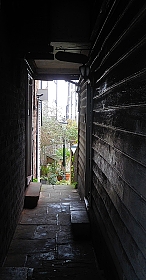
A GAP BETWEEN the houses almost opposite the long-established La Gaffe restaurant (opened in 1962) on Hampstead’s Heath Street leads into an alley lined on one side of a wall covered with overlapping planks of timber, i.e., clapboard. Steps lead down from the alleyway to a small sunken paved square surrounded by houses, some of which are 18th century.  This almost hidden nook is called Stamford Close. The name derives from the now-demolished Stamford Lodge, where John Constable and his family were briefly lodgers in 1823 after they had left their rented accommodation on Hampstead’s Lower Terrace, where they lived between 1821 and 1823.

According to Christopher Wade, in the 1930s, six old cottages were condemned and the close was considered to have been:

“…a miserable dark square – a black spot.”

Today, the square is far from miserable, and many would kill to own a house there. I am not sure how practical this would be as far as shifting heavy shopping and luggage is concerned. Also, parking cars is not possible close to the houses. Despite these disadvantages, this square would be a lovely place to live.

Marching on

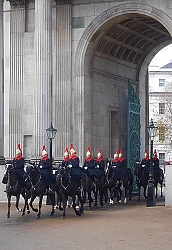
As we approach the end of the year, the pandemic rages on, the weather is appalling, and prospects for post-Brexit UK are not yet looking too bright. But all is not doom and gloom. On Christmas Eve, we went for a walk from Knightsbridge to St James Park. As we reached Hyde Park Corner and the Wellington Arch, an ever present reminder of the days when ‘England ruled the waves’ and a great deal more, we heard the sound of horse’s hooves behind us. We turned to look back at the arch and saw a line of mounted soldiers with shining helmets adorned with red tassels emerging from beneath the arch.as they have been doing several days a week for very many years, if not for several centuries. Seeing this age-old tradition being enacted in front of us reminded me that although much has been disrupted since the covid19 virus began ruling the waves, life goes on.

Mahatma Gandhi in Hampstead

WHEN I USED TO visit Hampstead with my parents in the early 1960s, we always walked past a place that intrigued me when I was a youngster. It was the still standing Hampstead Quaker Meeting House, which has a lovely front garden. The latter is overlooked by its neighbour, the late 18th centuryMansfield Cottage, which in the 1960s housed a tearoom or restaurant. The Meeting House with art nouveau (Arts and Crafts) features was built in about 1907 to the designs of Fred Rowntree (1860-1927). According to James D Hunt in his detailed book “Gandhi in London”, Mohandas K Gandhi (1869-1948), the future Mahatma, spoke in this meeting house on the 13th of October 1909:

“… perhaps travelling there by the recently opened underground line … The Society of Friends (Quakers) were not at this time much interested in Indian affairs … The 1909 meeting was sponsored by the Hampstead Peace and Arbitration Society”

The speech, as recorded by Robert Payne in his “The Life and Death of Mahatma Gandhi”, was entitled “East and West” and outlined the evils of the British occupation of India and the sufferings of Indians in South Africa. I knew nothing of this or about the house when we used to stroll down Heath Street.

Blood on the Page

HAPPY CHRISTMAS !

I WAS THE EDITOR of the newsletter of the Anglo Albanian Association (‘AAA’), when a writer, Thomas Harding, sent the following email in late 2016:

“… I am researching the life of Allan Chappelow, a former member of Albanian Society and Anglo-Albanian Association. My former books include ‘Hanns and Rudolf’ and ‘The House By The Lake’. I would welcome hearing from anyone who remembers or has stories about Allan Chappelow…”

I had already heard of the two books and seen a little bit of correspondence about Chappelow, which suggested to me that he was a mysterious fellow. He interested me because he had been a member of one of the earliest groups to visit Communist Albania soon after the end of WW2 and he was a participant in the first student tour of the USSR made after Stalin had died.

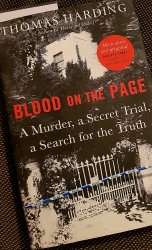
Thomas Harding published his book, “Blood on the Page” in 2018. The secretary of the AAA and I attended a launch of this publication in Daunt’s bookshop in Hampstead’s South End Green. The book is about Chappelow, and I have only just finished reading it, having purchased a copy only recently.

Chappelow (1919-2006) lived and died at number 9 Downshire Hill, a lovely Georgian house in Hampstead. Sometime in May or June 2006, he was brutally murdered in his home. His rotting body was only discovered many days later after a bank had been investigating some irregularities in his account and had been unable to contact him. Wang Yam, a man of Chinese origin was accused of, and found guilty of, his murder and stealing his identity to carry out fraudulent financial transactions. All of this is detailed in Harding’s un-put-down-able book, which reads like a good thriller. In addition, Harding describes the trial of the man accused of having been the murderer.

The trial of the accused, who now languishes behind bars, was unusual for a murder case. Some of it was held ‘in camera’ for reasons that have never been disclosed and cannot be, without risking contempt of court. Trials are usually held ‘in camera’ either to protect national security interests and/or to protect the identity of witnesses. Chappelow’s was the first ever murder case to have been held ‘in camera’ in the UK. Why this was the case was not revealed in Harding’s wonderful book. It is clear from his text that he was not privy to the reason for the secrecy. As I read the book, I kept wondering what it is that the government wants to keep secret. From the detailed account of the murder and what Harding was able to find out about it and the 86-year-old victim, by then a recluse, I could not detect anything that could have been a threat to national security

One possible reason for the secrecy during the trial is mentioned in an article in “The Observer”, published on the 25th of January 2018 (https://www.theguardian.com/news/2018/jan/25/murder-in-hampstead-did-secret-trial-put-wrong-man-in-jail-allan-chappelow). Here is a relevant extract:

“Before, during and after the trial, the government went to extraordinary lengths to ensure that details of Wang’s links with MI6 would remain secret. Two cabinet ministers told the trial judge that Wang’s entire defence must be heard behind closed doors. A contempt order issued by the judge prevents the media from speculating about the reasons for the secrecy.”

Elsewhere, the article mentioned:

“Between his arrest and the start of the trial, it emerged that Wang had acted as an informant for MI6 in London for a number of years. Wang was well placed to be an informant for Britain’s foreign intelligence agency. He had family links with China’s first communist leaders, he was opposed to repressive measures taken by Beijing, and he was something of a computer expert.”

Chappelow had visited both the USSR and Albania during the height of the so-called Cold War. I first visited Albania in 1984, when the Cold War was still ongoing, and the Stalinist dictator Enver Hoxha still held the country in his repressive grip. Our group included people who, after the trip, revealed that they were not what they had claimed to be while we were in Albania. For example, a lady who told me during our visit to Albania she was an archaeologist revealed to me later that she was really a journalist. At that time, journalists were forbidden from visiting Albania unless invited by the regime. Chappelow revisited Albania in 1993 after the ending of Communist rule. In his book, Harding quotes a member of the AAA, who was on the trip with him. She remembered that he had said he was a teacher, but she never “got to the bottom of his background”. Most biographical notes about Chappelow refer to him as a photographer and an author, not a teacher. That got me thinking, as did recalling an incident from my 1984 trip.

At least one of my fellow travellers told me that after the trip that he had been approached in Tirana discreetly by one of our Albanian tour guides and some of her colleagues. They invited him to become an agent to provide Albania with information about his country, Australia. Remembering this incident, I wondered whether Chappelow’s murder trial was held behind closed doors because his trips behind the Iron Curtain had either not been purely for reasons of tourism, or possibly while he was there, he had been approached by the local authorities as was the case of my Australian travelling companion.

Returning to Chappelow’s visits behind the Iron Curtain, here is something else I noticed in the Guardian’s article:

“Chappelow was the product of an educated, socialist family, whose liberal-leaning father, a successful decorator and upholsterer, had moved to Denmark rather than be conscripted into military service during the first world war. At the end of hostilities, the family returned to London and bought 9 Downshire Hill. Allan grew up in a politically progressive home; his parents were active members of the Fabian Society. At the onset of the second world war, the bookish Chappelow was faced with the same dilemma as his father, as well as his schoolboy hero, George Bernard Shaw, who had refused to fight in the first world war and was strongly opposed to the second.”

Interesting as speculations about whether Chappelow could have been involved with intelligence work might be, we will probably not find out the real reason for the secrecy for many years to come. In any case, this mysterious episode, centred in and around Hampstead, is a good reason to read Harding’s exciting and intriguing book … and possibly you might come up with your own hypothesis about why Wang’s trial was held ‘in camera’.

Winter solstice in the park

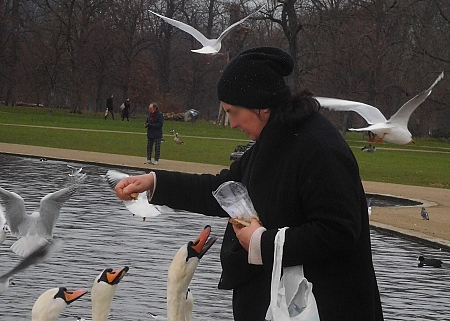
THE TEMPERATURE HAS dropped. Fear of the Omicron variant of the covid19 virus has meant that less people are out and about in London. This was the case in Kensington Gardens today, the winter solstice. The wildfowl that gather around its not so round Round Pond wait eagerly for visitors to distribute tasty morsels. Today, I saw a lady feeding the birds. So many were attracted to her that sometimes her head seemed lost in a cloud of noisy gulls. In front of her, swans extended their necks, attempting to reach her hands. Undaunted, this animal lover continued carrying out her kind gesture.