THE SERPENTINE NORTH art gallery is housed in what was once a gunpowder store, built in 1805. Next to it, there is an elegantly curvaceous café created by the Iraqi-British architect Zaha Hadid (1950-2016). Until the 3rd of September 2023, there is an interesting exhibit behind the north side of the café. It is an abstract mural of brightly coloured, differently sized rectangles and squares. When I showed a photograph of this to our daughter, she said it reminded her of African printed textiles. Maybe, this should not be surprising suggestions because the mural was painted by a Ghanaian artist, Atta Kwami (1956-2021), who was born in Accra.
The mural, painted on wood, is titled “Dzidzɔ kple amenuveve”, which means ‘Joy and Grace’.
The Serpentine’s website noted: “Its title is in Ewe, a West African language spoken by Kwami, and its composition characteristically plays with the colour and form improvisations distinctive to Ghanaian architecture and strip-woven textiles found across the African continent, especially kente cloth from the Ewe and Asante people of Ghana.”
Sadly, the mural is the last public work that Atta Kwami created. He died in the UK shortly after he completed it.
THIS MARCH (2023), we have seen several exhibitions of works of art and craft involving the use of braiding, knotting, weaving, and other methods of employing threads. We saw the exhibition of Kimohimi braiding at the Japan House in Kensington. At the Tate Modern, we saw the quipus created by Chilean Cecilia Vicuña and the wonderful exhibition of imaginative fabric sculptures made by the Polish Magdalena Abakanowicz. Today, the 26th of March, we visited the Serpentine North (formerly ‘Sackler Serpentine’) Gallery in Kensington Gardens. We visit this place often because it usually has exhibitions which are always of interest and frequently pleasing aesthetically. Until the 10th of April 2023, the Serpentine North has a display of sculptures by the African American artist Barbara Chase-Riboud (born 1939 in Philadelphia, USA). We had never heard of her, but that did not surprise us as the gallery often shows works by artists, who are new to us.
A talented child, she entered the Fleischer Art Memorial School in Philadelphia. This establishment, which was opened in 1898, offered free art classes to children. After a successful school career at the Philadelphia High School for Girls between 1948 and 1952, she was awarded Bachelor of Fine Arts from the Tyler School at Temple University in 1956. By 1960, she had moved to Paris (France). Just before that, her eyes were opened-up to non-European art when she made a trip to Egypt.
The beautifully produced exhibition hand-out related that in Paris, she: “… found herself among a diverse community of socio-politically engaged writers, artists and thinkers including James Baldwin, Alexander Calder, Max Ernst, Dorothea Tanning, Lee Miller,and Man Ray. Moreover, through extensive travelsto Egypt, Turkey and Sudan, she deepened herknowledge and appreciation of global art and architecture, which continued to shape her artistic production from this point onwards.”
The Serpentine exhibition is called “Infinite Folds”. This is a good name because many of Barbara’s works involve the use of folded materials, be they sheets of fabric or of cast metal. In many cases folded sheets of metal are combined with bundles of silk or wool threads, often knotted in places. Some of the metal sculptures appear to have skirts of fabric threads. The artist makes these works seem as if the metal is being supported by the threads – giving, as she said, the impression that the wool has become the stronger material and the folded metal sheets the weaker of the two.
Some of the works are the artist’s interpretations of ancient cultures and traditions of places she has visited such as India and China. Other artworks celebrate famous figures from the past including Josephine Baker, Malcolm X, Nelson Mandela, the Queen of Sheba, and others.
The works in the exhibition are intriguing, well-crafted, and beautiful. They have been placed attractively and well-spaced in the within the old armoury, now the Serpentine North Gallery. When we headed for the exhibition, we had no idea what to expect. What we found was breath-takingly wonderful. Although there is no entry charge, I would have been happy to pay to see this artist’s works.
LONG AGO PEOPLE in the Andes did not write. Instead, as Chilean artist Cecilia Vicuña (born 1948) explained in a note on the Tate Gallery website:
“… they wove meaning into textiles and knotted cords. Five thousand years ago they created the quipu (knot), a poem in space, a way to remember…”
After the Europeans conquered South America, they abolished and burnt the quipus. However, as the artist explained:
“… the quipu did not die, its symbolic dimension and vision of interconnectivity endures in Andean culture today.”
Cecilia has created two large sculptures which are hanging from the tall ceiling of the Tate Modern’s Turbine Hall until the 16th of April 2023. Each of these artworks consist of knotted strands of different materials, each of which is 27 metres long. They hang from circular metal structures looking to me rather like shredded laundry. Though they are undoubtedly deeply meaningful and attract the attention of many viewers, I felt the history underlying them was more interesting than their aesthetic qualities.
Abakanowicz
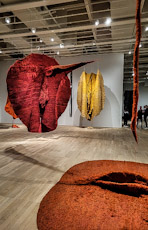
Elsewhere in the Tate Modern, we viewed an exhibition of the works of an artist, who knew how to write, but was creating during a time when the use of words had to chosen carefully to avoid being punished by the government. That artist Magdalena Abakanowicz (1930-2017), was born in Poland, where she created most of her art. After WW2, she studied painting and weaving the Academy of Plastic Arts in Warsaw. Her early works were created during a period when the Soviet-supported Stalinist regime in Poland imposed great restrictions on creative endeavours. During that harsh period, artists had to express any criticisms of the regime in a coded way in order to evade censorship. To some extent, this was necessary until Communist rule ended in Poland. In the mid-1950s, restrictions on art eased up a bit and experimentation became possible.
Magdalena moved from creating flattish conventional woven pieces to innovative three-dimensional artworks – woven sculptures of great originality. Photographs cannot do justice to these amazing creations. Videos can help the viewer appreciate the amazing way that these tapestries both fill and engulf space. However, the best way to see these works is to see them with your own eyes, which you can do at the Tate Modern until the 21st of May 2023. Included in the exhibitions are photographs of the lovely sculptures the artist created in later life and some videos of the artist talking about her work. There is also a film made in 1970 in which her tapestries are displayed on the sandy dunes of Poland’s Baltic coast. The artworks are suspended from poles and move gently in the sea breeze. It is clear from this film, which included scenes showing the fabric sculptures in galleries, that the artist seemed keen to have viewers explore them by touch as well as by vision. Sadly, and probably sensibly, the Tate forbids visitors from touching the lovely artworks.
Both the Vicuña and the Abakanowicz artworks use knotting and weaving to communicate ideas with the viewer. A window in one of the Abakanowicz exhibition rooms overlooks one of the quipu artworks. It intrigued me to see the juxtaposition of the works of the two fabric artists. Seeing these two exhibitions, one immediately after the other, made for a fascinating visit to the Tate Modern.
I WAS FOURTEEN IN 1966. That year, Selfridges in London’s Oxford Street opened the Brass Rail restaurant on the ground floor, with windows facing Orchard Street. Its speciality was then, and still is, salt beef. I recall visiting the place once or twice with my mother back in the 1960s. In those days, I did not particularly care for the taste of salt beef. For some reason, maybe the cost of the place, we did not frequent the Brass Rail.
Winding the clock forwards several decades, I now enjoy eating salt beef occasionally. Today, the 22nd of March 2023, we needed to go to Selfridges for something, and as we were there, I suggested that we ate at the Brass Rail. Unsurprisingly, the eatery has changed its appearance considerably since the 1960s, but it is still located in the same part of Selfridges as it was originally. Its tables are enclosed in an area lined banquettes upholstered with red fitted cushions. The service was brisk and attentive. We ordered Reuben sandwiches in rye bread. These are generously filled with warm salt beef, sauerkraut, Swiss cheese, gherkin, and Russian dressing.
The Reuben was enjoyable, filling, and quite tasty. However, I felt that the taste of the salt beef was overpowered by that of the dressing and the other ingredients. Good though it is at the Brass Rail, I prefer eating the bagels crammed full of salt beef, which are served at the 24 hour Beigel Bake in Brick Lane. At half the price of the Brass Rail, but without the great service, they are more than twice as enjoyable.
MY MOTHER SETTLED in London in about 1951, a year before I was born. The UK was still recovering from WW2, and life was not too easy. There were shortages of food. I remember my mother telling me that during the early 1950s, relatives in South Africa used to send parcels of food, including, as I can still recall, tinned guavas. The postman used to lug these heavy packages to our home in Hampstead Garden Suburb. My mother used to feel guilty that she was lucky enough to be receiving food that few others could not obtain, and used to open the parcels and give the postman a couple of tins from them. Soon after I was born, my mother, already a painter, began making sculptures. Somehow or other, she managed to get permission to work in the sculpture studios at the St Martin School of Art, which was then located on Tottenham Court Road. She was not enrolled as a student, but worked alongside, and received help from, several sculptors who have now become famous. Amongst these were Antony Caro, Phillip King, William Turnbull, and Elisabeth Frink, who became a family friend.
Most of my mother’s sculpting was done during the 1950s and 1960s. This was a period when many people, including British sculptors, were simultaneously recovering from the horrors of war; fearful of the Cold War and the possibility that it might develop into a war with atomic weapons; and looking towards the future. Sculptors reacted to this situation in various ways as can be seen at an exhibition being held in the Marlborough Gallery in London’s Mayfair until the 22nd of April 2023. Called “Towards a New World: Sculpture in Post-War Britain”, this show to quote the gallery’s press release:
“… emphasises the international impact of a group of young sculptors and artists who merged past trauma, present anxieties, and future hopes into a new visual language.”
Lyn Chadwick
The artists whose works are on display include, amongst others, Elisabeth Frink, William Turnbull, Reg Butler, Bernard Meadows, Kenneth Armitage, Lyn Chadwick, Graham Sutherland, and Francis Bacon.
Apart from some of the works by Reg Butler and Bernard Meadows, the artworks on display exhibit what the art historian Herbert Read described as: “…the iconography of despair, or of defiance; and the more innocent the artist, the more effectively he transmits the collective guilt. Here are images of flight, or ragged claws ‘scuttling across the floors of silent seas’, of excoriated flesh, frustrated sex, the geometry of fear.”
The Geometry of Fear was the name of a group of British artists who exhibited at the 1952 Venice Biennale.
Bernard Meadows (1915-2005) was a name that was new to me. He was Henry Moore’s first assistant. Later, he taught Elisabeth Frink at the Royal College of Art. He was a member of the The Geometry of Fear group but as the press release explained he differed from most of its members: “While the distorted human figure became a prominent motif for many of the artists associated with the ‘geometry of fear’ group, for others, like Bernard Meadows, it was animal imagery that resonated most with the collective societal trauma of the war. Visceral depictions of birds and crabs acted as vehicles to express human emotion.”
I enjoyed seeing this exhibition. The works are well-displayed in the spacious, well-lit rooms of the Marlborough. After viewing the exhibition, I wondered about my mother’s sculptures, most of which now only exist in photographs. Her first sculpture, a terracotta mother and child, was figurative but veering towards the abstract. As time passed, her work became increasingly abstract, and tended to be closer to being brutalist rather than naturalist. Although I never heard her mention The Geometry of Fear, I wonder whether her artistic sympathies lay with them rather than with any other ‘school’ of artistic activity.
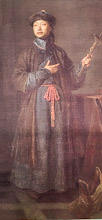
I BET YOU DID NOT KNOW that Michael Alphonsus Shen Fuzong (c1658-1691) was the first documented person from China to visit England. I did not know that he met King James II in 1687. Furthermore, did you know that the Chinese sculptor Tan-Che-Qua (c1728-1796) from Canton, who visited London between 1769 and 1772, not only exhibited at London’s Royal Academy but also met King George III before returning to his native land. Maybe, I might have stumbled across these two notable men from China by accident had I not visited the British Library today (the 20th of March 2023), but this is highly unlikely. Until the 23rd of April 2023, there is a fascinating, well-displayed exhibition called “Chinese and British” at London’s British Library.
Beginning with the earliest Chinese visitors to Britain, this splendid exhibition charts the growth and considerable achievements of Chinese people who chose to live in Britain. John Hochee (1789-1869) was one of the first people from China to have settled permanently in England. He arrived from Canton in 1819, worked as a property manager with John Fuller Elphinstone (1778-1854; son of William Elphinstone a Director of the EIC: see https://www.rh7.org/factshts/hochee.pdf), whom he probably met whilst working for the East India Company in China. Hochee married an English lady, Charlotte Mole, and James (1832-1897), one of their seven children, became a surgeon. John was naturalized in Brighton in November 1854.
Since Hochee (Ho Chee) settled in Britain, many more people from China have followed in his footsteps. The exhibition at the British Library illustrates this well. Early settlers included many who had worked on ships and had landed in Liverpool or London. Chinese communities became established in the 1880s, notably in London’s East End. The Chinese in Britain established businesses to serve their community and their British neighbours. Chinese restaurants and laundries figured largely amongst the early enterprises. With the advent of laundrettes in the 1950s and 1960s, the Chinese laundry business faded away, but still today the Chinese are very important in Britain’s catering industry. It was after WW2 that restaurants and take-aways really took off in Britain. These outlets supplied both British and Chinese food. Many of their workers and owners were from Canton and Hong Kong.
During WW1, nearly 100,000 Chinese men provided support for The British Army in Europe – digging trenches, burying the dead, and other tasks. Some of these men had signed 3-year contracts, which obliged them to return to China after the war, which most of them did. The exhibition devotes some space to the activities of these men.
Apart from what I have already described, the exhibition has displays illustrating the many other achievements of the Chinese British. One exhibit that particularly amused me was a selection of books in English by Chinese British authors. They were displayed on a ‘lazy Susan’, a revolving serving platform often found in the centre of round tables in Chinese restaurants.
All in all, I am very pleased that a post on Instagram alerted me to this interesting exhibition, and I encourage everyone to visit it.
ANYONE FAMILIAR WITH London will know that except for some parkland, the city is a built-up urban environment all the way west from Marble Arch to Acton and further beyond. This is also the case from Hyde Park Corner to Heathrow Airport. However, this has not always been the situation.
When John Rocque (1709-1762) drew his detailed, accurate maps of London in the 1740s, Paddington was a small village separated by open countryside from what was then London. In those days, Kensington was a village reached from London by a country road flanked on its northern edge by Hyde Park. And from Kensington to Hammersmith would have been a ride along a road running between a series of agricultural fields and orchards. And to the north of Hammesrsmith, Shepherds Bush was an open space around which there were only a few well-separated houses. And as for Notting Hill Gate, Rocque did not even bother to name this road junction in the middle of the countryside.
By 1826/27, when C & J Greenwood published their detailed map of London, Earls Court was still a country hamlet; Kensington a small town; and there was barely any development around what is now Notting Hill Gate. However, by 1826 Paddington was beginning to grow and was no longer separated from Marylebone by open countryside. Additionally, the northern edge of the eastern end of Bayswater Road was losing its rural nature and being built upon.
In brief, as the 19th century progressed, London spread west. As it did so, urban development covered what had been open countryside and places that had been separated from London began to become part of it. Places like Kensington, Earls Court, Shepherds Bush, Hammersmith, and places further west were no longer separated by open countryside. Instead, they became engulfed by the expanding metropolis.
My book “BEYOND MARYLEBONE AND MAYFAIR: EXPLORING WEST LONDON” describes in detail how the villages and towns to the west of Park Lane and what is known as ‘The West End’ became engulfed by London’s westward growth. It reveals the history of these places; what they are like today; and what remains of their existence before they became joined to London, as it spread from Mayfair and Marylebone to Heathrow and beyond.
BEYOND MARYLEBONE AND MAYFAIR: EXPLORING WEST LONDON
By Adam Yamey
is available as an illustrated paperback and Kindle from Amazon:
THE RIO CINEMA in London’s Kingsland Road district (in Dalston) is a fine example of a film theatre constructed in the Art Deco style. It was designed by Frank E Bromige, who specialised in designing cinemas in that style, and constructed in 1937 on the site of an earlier Edwardian-style film theatre, which first opened in 1909. The Rio has been showing films ever since then. Since 1976, the Rio has been run successfully, and independently of any cinema chain, as a not-for-profit charity. The cinema’s Art Deco exterior has been faithfully maintained and the interior’s original design has been reconstructed. There are two screens. The largest one, the main auditorium, looks much as it might have done when it was built in the late 1930s. There is a smaller auditorium in the basement. This has a large screen and comfortable raked seating.
Today, the 18th of March 2023, we watched a film in the smaller auditorium. Called “Lunana: A Yak in the Classroom”, this film was shot mainly in the tiny Himalayan Kingdom of Bhutan. It is a beautiful film, beautifully made. Without giving the story away, it is about the experience of a young Bhutanese teacher sent from the capital to teach in a remote village called Lunana. The tiny elementary school in that high altitude settlement surrounded by breathtakingly attractive mountain scenery is the remotest school in the world. The film shows how Lunana impacted on the young teacher and vice-versa.
Apart from having a good story, some humour, and much emotion, the film provides a fascinating view of Bhutan. “Lunana” allows the viewer to realise the spectacular nature of the country’s landscape and rural traditions. What particularly interested me was the depiction of a lifestyle so remote and different from what we are used to here in the west and in many parts of India, even also in the urban areas of Bhutan’s neighbour Sikkim. The subject of global warming is introduced, but in a quite subtle way. The villagers in Lunana are portrayed as being simultaneously innocent, playful, spiritual, and philosophical. Although “Lunana” is a highly enjoyable film and Bhutan is portrayed in an affectionate and appealing way, I felt that the country, which is undoubtedly spectacularly attractive, is not one that I am in a hurry to visit. It is an unusual and unique film, and it was appropriate to have watched it in one of London’s unique individual cinemas.