Inspired by a novel by James Joyce

THE ARTIST ANSELM Kiefer was born in Germany a few weeks before the end of WW2 in Europe. He was brought up in a country devastated by warfare and with a shameful recent past. It is said quite reasonably that much of his artistic output has been influenced by the guilt-ridden environment in which he grew up.

Today, the 21st of June 2023, we visited the White Cube Gallery on Bermondsey High Street in south London. Until the 20th of August 2023, it is hosting a spectacular show of works created by Kiefer. To call it an exhibition is a bit of a misnomer – it is really an ‘immersive experience’. It occupies the gallery’s entire exhibition space as well as the long central corridor that links the various large display rooms.
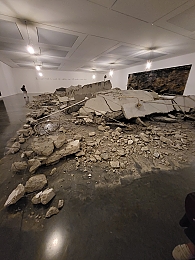
The long central corridor is lined with a large variety of ‘objets trouvés’, which some might well describe as ‘junk’. Together, they form a large-scale cabinet of curiosities like those which wealthy people used to create in the past, but few of the objects would have appealed to such collectors. Three large rooms can be entered from the corridor. The walls of each of these are lined with what at first sight look like enormous paintings. They are made of metal, often quite three-dimensional, and coloured with paint. Each one is both visually exciting and satisfying. In the middle of each room, there is an installation that suggests that it has formed after some apocalyptic event – maybe, an atomic bomb explosion or some similarly catastrophic event. In one room, the centre is filled with a pile of sand in which discarded supermarket trolleys have been abandoned. Another room is filled with what look like huge books damaged by flood waters. In the third and largest room, there are the concrete and rusted iron remains of what might once have been a modern building – it is a scene of horrendous devastation.

Throughout the ‘exhibition’, there are handwritten words, phrases, and sentences. These can be found on the walls, on the painting-like panels, and near objects stored in the corridor. A gallery attendant told us that each of them had been handwritten by Kiefer when he came to inspect the installation of his show. The words were not his but are all taken from “Finnegan’s Wake”, published in 1939 and written by James Joyce (1882-1941). Hence, the exhibition at the White Cube has been given the name of this novel.

Superb as this exhibition surely is, I found it oddly claustrophobic. Although it is a visual feast and a great feat of imagination and creativity, I found it slightly disturbing – that might have been the artist’s intention. But please do not let me put you off visiting this unusual and wonderful show.

A cafe of uncertainty

MANY READERS – ESPECIALLY those with some knowledge of physics – will have heard of the German Werner Heisenberg (1901-1976), who is well known for his famous Uncertainty Principle that relates to quantum physics. Because of my uncertainty about what exactly this principle expresses, I will let you look it up on Google or elsewhere.

One thing I was not uncertain about was seeing a café called Heisenberg in Chiswick’s Turnham Green area. As it was nearly 11 am, I was certain that I needed a cup of coffee, and what better place to have it than a place named after a person who ‘discovered’ uncertainty. The café is small but quirkily decorated and the coffee it served was very good. We drank from disposable cups, which bear the motto:

“Perfection cannot be measured as explained by the Heisenberg theory. However, this is the closest you’ll get to the perfect cup of coffee.”

Although I am uncertain whether the second part of this is true, I am certain that when I am next in the area, I will try another cup of Heisenberg’s coffee.

No, not the former Prime Minister

AT THE WESTERN END of Chiswick’s Turnham Green, there is a striking church, which was designed in the Arts and Crafts style by the architect Richard Norman Shaw (1831-1912) and consecrated in 1880. It served the community that was beginning to settle in the recently established Bedford Park, which I described as follows in my book “Beyond Marylebone and Mayfair: Exploring West London”:

“Bedford Park near Turnham Green is probably the first example of what has become known as a ‘Garden Suburb’ development, although originally it was not known as such. Pevsner noted:

‘Its reputation as the earliest garden suburb needs some qualification. Trees and green spaces … are found in many earlier suburbs; the novelty of Bedford Park is their combination with ‘artistically designed’ houses … inspired not by classical or Gothic pattern books but by the red brick and tiled idiom derived chiefly from the home counties vernacular of the c17 and c18…’

He added that the idea was to recreate the:

‘… relaxed informal mood of a market town or village…’, in ‘… a completely speculatively built suburb.’

And, in the case of Bedford Park this ideal has been almost but not quite fully achieved, because the suburb, attractive though it is, has a somewhat staid, bourgeois feel about it. Created by Jonathan Thomas Carr (1845-1915), its development began in 1875 …”

If you want to know more, you can find it in my book.

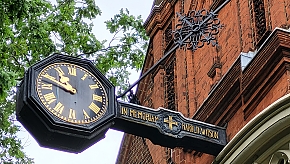
Returning to the church, which we re-visited today (20th of June 2023), I showed my wife the interesting clock on one of its exterior walls. It is held away from the building by a sturdy beam on which there are some words. On one side, you can read: “Spion Kop Africa 1900”, and on the other, you will see: “In memoriam Harold Wilson”.

In case you are wondering, the clock has nothing to do with the former Prime Minister Harold Wilson (1916-1995). Instead, it commemorates 2nd Lieutenant Harold AC Wilson, who fell at the battle of  Spion Kop in January 1900 during the 2nd Anglo-Boer War (1899-1902).

[My book is available from Amazon: https://www.amazon.co.uk/BEYOND-MARYLEBONE-MAYFAIR-EXPLORING-LONDON/dp/B0B7CR679W/ ]

Playing the music of Thomas Tallis without much feeling

JUST AS A PHOTOGRAPHER should try to capture what he or she feels about a subject, rather than attempting to copy it slavishly, I feel that good musicians should not only reproduce what is in the composer’s score but also express what they feel about it and what it means to them as they play.

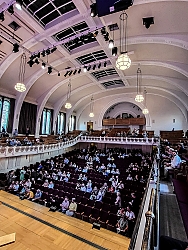
Last night, the 19th of June 2023, we attended a concert of music by Thomas Tallis (c1505 – 1585) performed by the Tallis Scholars at Cadogan Hall (see photograph) in Sloane Square. As far as I could tell, the choir sung well. But I felt for most of the concert they were concentrating on accuracy more than anything else – the result seemed sterile to me. It was only during the final piece “Spem in allium” that the performer’s music sprung to life magnificently – it was an uplifting performance of this piece.

Come with me in my Ferrari

Fort Kochi (Fort Cochin) is the picturesque, historic part of Kochi – a port on the coast of Kerala in southwest India. Occupied at various different times by the Portuguese, Dutch, and British, this small urban area at the northern tip of an island contains many buildings that recall the town’s former foreign occupiers.

Essentially, the historic town centre consists of a few short streets and some open spaces. Fort Kochi is built on flat terrain, and is a paradise for walkers even in the hot, humid weather that prevails most of the year. As a consequence, the large number of autorickshaw (‘auto’) drivers often seems to outstrip customer demand.

From dawn to after dusk, auto drivers cruise around the town in their empty vehicles, looking for customers. We usually spend at least a week in Fort Kochi every year, especially when the excellent Kochi-Muziris international art biennale is in progress. So, individual auto drivers get to know us as we stroll around. They stop and ask us if we need a ride. We tell them that we are walking. So, when they next see us, optimistically they invite us to take a ride. When we turn them down, they say to us in an understanding way:

“Walking, walking! – always walking.”

Other auto drivers, who either do not recognise us or are trying to tempt other tourists into their cabs, say:

“See my Ferrari. Come and take a ride in my Ferrari.”

This always amuses me because to describe an auto as a Ferrari is rather like describing a pigeon as an eagle.

On the subject of Ferraris, there are some in India. One of them, an eye-catchingly bright yellow, belongs to, or is driven by, a young man who is the late teenaged son of a wealthy family in Bangalore. Because this is not a type of vehicle that could be safely parked in most parts of the city, he can only use it to drive to and from the exclusive Bangalore Club, where he can park it in an area well policed by security guards. At his home, he parks it in the safe compound containing his residence. Given the density of traffic and the daring driving in Bangalore, it is amazing that he feels safe enough to flaunt his precious car on the roads between his home and the Club.

Keeping watch in the Kyoto Garden

LONDON’S HOLLAND PARK contains a lovely area – the Kyoto Garden. It is a well-maintained Japanese-style garden. I visit it frequently. Each time, I see something different there.

The garden is planted around a small pond in which there are several rocks, which look like miniature islands. Today, I saw a heron perched on the summit of one of these rocks. It stood still, moving its head slowly every now and then. It showed little interest in the many fish that swim in the pond. My wife noticed that there was a nest containing eggs just below the bird’s feet. The creature stood like a sentinel, guarding its future offspring.

I could see four eggs in the nest – there might have been more. In general, so I learned from Wikipedia, the various species of heron are monogamous and lay between three and five eggs. I have no idea what species I saw in the Kyoto Garden, but it is the first time I have seen a heron’s nest with eggs anywhere in Holland Park.

Trees at sunset in Kensington Gardens

YESTERDAY EVENING, WE took a stroll in Kensington Gardens when the temperature was beginning to drop. The sun was low in the sky. This caused some parts of trees to be shadowed by neighbouring trees so that lovely patterns of light appeared on them. One any particular tree, part of its foliage was brightly coloured because the rays of the sun could reach it, and other parts appeared dark green because the sun could not reach them. All this is obvious when you see it described in words, but wonderful when you see it in life.

PS: It is light effects such as these that make it difficult for artists to paint trees

An out of date passport and a different world

OFTEN WHEN ONE IS SEARCHING for something, something, which you were not looking for, comes to light. A day or so ago, one of my old passports was discovered. It is an old-fashioned, blue-covered book with barely a trace of the wording and crest that used to be on the cover. I used to carry my passport in a trouser pocket, which rubbed against it and gradually denuded the cover. The ten-year document expired on the 19th of March 1990. This was a couple of months before I made my last trip to what was still known as ‘Yugoslavia’. Soon after that, civil wars erupted, and the country became divided into smaller independent units.

The passport gives my height but not my eye colour, which used to be recorded in earlier passports. It contains eight Hungarian visa stamps (one is illustrated above), all issued in London except for one which was affixed in Belgrade. There is also a Bulgarian visa stamp, which was issued in March 1983. In addition to these visa stamps, for which I was charged roughly $10 each, there are many border stamps – entry and exit. Most of these are for Hungary and Yugoslavia, which I visited frequently throughout the 1980s. In those days, Brits did not need a visa to enter Yugoslavia.

One of the border stamps is of special interest. It was issued when I entered Yugoslavia at Bozaj on the 5th of June 1984. Bozaj, now in the Republic of Montenegro, was a Yugoslav border post on the shore of Lake Shkodra. The stamp was placed in my passport a few minutes after leaving the Albanian border post, also beside the lake, at Han-i-Hotit. It was here that an Albanian entry stamp was put in my passport two weeks earlier when I visited the country, which was then even far more mysterious than North Korea is to us today. In 1984, the Stalinist regime headed by Enver Hoxha was still in place. The two weeks spent in Albania were both fascinating and unusual to say the least. I have described that holiday in my book “Albania on My Mind.”

In addition to the visas and stamps issued by socialist countries, there is one Greek entry and one exit stamp, both issued at Athens airport in August 1981. It seems that I was in Greece from the 11th to the 17th. Another stamp issued on the 13th by the Piraeus branch of the National Bank of Greece takes up most of one page and has something to do with money and traveller’s cheques, but my Greek is not up to translating it.

The accidental finding of this old passport brings back many happy memories of travelling in parts of Europe that have now changed beyond recognition – for better or for worse.                                                                                                 

The Poles in London’s Marylebone

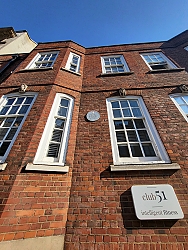
IT ALMOST GOES WITHOUT saying that wherever you are in central London, you are never more than a few footsteps away from a spot that has played a role in significant historical events. Most of these historical spots have been recorded, and therefore are not unknown to at least a few people. However, when walking around London, I often come across a memorial which I had not noticed before despite having passed it several times. Such is the case with number 51 New Cavendish Street – a brick building in Marylebone, which we have walked past several times recently.

Number 51 bears a commemorative plaque which has the following information:

“This building housed the headquarters of the Polish navy during 1939-1945”.

Underneath this, but in much smaller letters, are sixteen Polish names. From an informative website (https://wartimelondon.wordpress.com/2018/12/12/new-cavendish-street-and-the-free-polish-navy/), I learned that these are the names of Polish naval vessels -ships and submarines.

Poland became an independent country at the end of WW1. By 1920, then with only 90 miles of coastline, Poland began to construct a navy. This was based in Gdynia, near to the ‘free port’ of Gdansk (Danzig), which was not under Polish control. In 1939, with little chance of withstanding attack by the Germans, Polish naval vessels began leaving the Baltic, and heading for British waters. In late 1939, Polish Naval Headquarters were established at 51 New Cavendish Street. Although the Poles had administrative control over their vessels, operational control was dictated by British military requirements. Between 1939 and 1945, the number of men working in the exiled Polish Navy increased from 1000 to 4000.

After the end of WW2, in September 1946, the Polish Naval Detachment in the UK was disbanded. One of its warships was handed back to the new Communist government of Poland. Only a few of the naval personnel felt able to return to their native land now that it was under Communist rule.

Well, I knew a little about the exiled Polish Air Force and have visited Audley End House, where Polish Special Operations Executive personnel trained before being dropped behind the lines in German-occupied Poland. I have even eaten dinner at a Polish Airman’s Club in South Kensington, but this place’s restaurant might well have closed since then. However, until my most recent visit to New Cavendish, I did not know anything about Poland’s navy and its role in WW2.