EVERY NOW AND then, when touring around England, we have spotted village lock-ups. These were small places with barred doors where prisoners could be held briefly in a cell until more suitable accommodation could be found for them. These miniature jails were:
“… used in the eighteenth and nineteenth centuries to house criminals who were apprehended on suspicion of committing petty crime … Lock-ups were only temporary forms of imprisonment, usually for one or two people, before the local authorities of the day decided how to deal with the offender. Criminals could be released or sent to the closest large town for trial.” (www.essexlive.news/news/essex-news/historic-jails-essex-you-can-3227277).
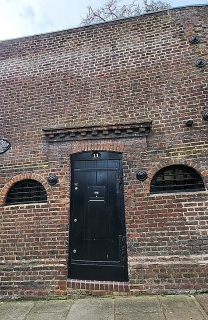
There were probably quite a few parish lock-ups in London, but now most of them have disappeared. However, if you walk along Cannon Lane in Hampstead, you will find one that has been preserved to some extent. It is within the garden wall of the grounds of Cannon Hall, which is where local magistrates held court, A plaque next to its entrance informs that the lock-up was established about 1730. Soon after the creation of the police force in 1829, the lock-house became disused, and prisoners were locked up in the Watch House that stands in Hampstead’s Holly Walk. Today, it seems as if the entrance to the former lock-house, flanked by two barred windows, is now the front door of some kind of residential accommodation.
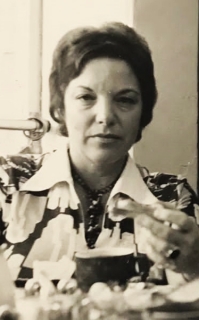
In 1962, my parents took me and my sibling to Denmark. We travelled by car, and wherever we stayed, the beds had duvets (feather filled quilts), rather than sheets and blankets. My mother was very impressed by the duvets, which we had never seen before. Here is an excerpt abot duvets from my book about my mother “Remembering Helen: My Mother the Artist”:
“In Denmark, my mother purchased four duvets filled with Eider duck feathers, and cotton covers for them. The Danish word for duvet is ‘dyne’, which is pronounced ‘doo-ne’. Two of the duvets were folded and placed on the rear seat of the car. My sister and I sat on these all the way from Denmark back to London. The other two were stuffed in the boot. After returning from Denmark, my mother decreed that from then on, duvets would be used instead of sheets and blankets. At home, we referred to them by their Danish name. Although a few British people had known about duvets since long before the 18th century (the English traveller Tom Coryate had described them in the 17th century), and Harrods stocked them in the 1950s, they did not become commonly used until Terence Conran began selling them in his Habitat shop in 1964. Once again, my mother was ahead of the times. Not only had she installed car seatbelts and child locks long before they became common in Britain, but also her use of duvets was way ahead of the crowd.“
You can read more about my mother, a sculptor who worked and exhibited alongside Elizabeth Frink, Antony Caro, Philip King, Barbara Hepworth, and Henry Moore in my book that is available from Amazon (click on the picture below):
THE ARAL SEA which is a lake on the border between Uzbekistan and Kazakhstan was once the world’s third largest lake. From the 1960s onwards, it began to shrink because the rivers that fed it were diverted to be used for Soviet irrigation projects. Now it has shrunk to less than 10% of its original area. From the 1960s onwards, the decline of the sea’s size has been monitored by satellite imagery.
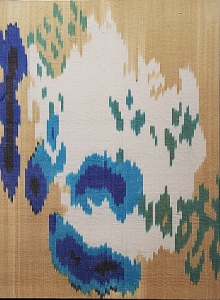
During March 2026, Vadehra art gallery has put on a temporary exhibition (at London’s Cork Street) of works by the Indian artist Himali Singh Soin and the British artist David Soin Tappeser, an artistic duo called ‘Hylozoic/Desires’. The show includes a series of images based on what can be seen of the Aral Sea in the satellite pictures that chart its decline. Their images are made of cloth woven using the traditional ikat method. Simplifying the technique, it involves weaving with threads that have been dyed in several colours in varying patterns along their length. We first saw this extremely complicated method of fabric production at Patan in Gujarat (India: see https://gujarat-travels.com/2019/02/05/weaving-in-patan/ for more about the technique). The ikat pictures at the exhibition were woven in Uzbekistan. By using this technique to capture the essence of the satellite images, the artists have produced a beautiful artistic representation of an environmental disaster that has take place over almost seven decades.
Although the ikat fabrics chart a tragic history, there is some good news. The Kazakhstan government has been able to increase the depth of the sea significantly, and as a result its salinity has dropped.
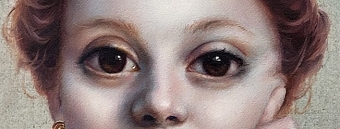
GINNY ON FREDERICK is a tiny art gallery at 99 Charterhouse Street, next to Smithfield meat market. We had never heard of it before, and after seeing it mentioned in the Financial Times newspaper, we went there today (11 March 2026) to view a collection of portrait paintings by British-born Hanna Murray (b. 1994). She received her MFA from New York Academy of Art in 2021, and now lives and works in Brooklyn, New York (USA). Like the gallery, the artist was new to us.
The six paintings on display were all portraits, beautifully executed. What makes each of them special is the artist’s depictions of her subjects’ eyes. They are literally eye-catching, and especially alluring. Along with her choice of colouring, the eves give the portraits an almost dreamlike quality, slightly weird but in a positive way. The gallery’s excellently written handout mentions the eyes, suggesting (quite correctly) that the subjects depicted:
“ … appear to observe themselves being observed.”
Difficult to find because it is so small and without a noticeable sign outside it, Ginny on Frederick was well worth the visit, and seeing the works by Hannah Murray was a delightful experience.
NOT FAR FROM the Bhadra Fort in Ahmedabad (India), on Bhadra Road, there are two shops that sell tasty, crystallised fruits (my favourites are orange slices with their rinds and pineapple) and a large selection of imported: sweets, biscuits, dates, nuts, and other mainly edible items suitable for gifts. In one of the shops, I noticed that there was a wide range of spice mixes made by a company called Shan. As we have used this excellent brand often at home, I looked at them.
Now, Shan is a Pakistani company (founded in Karachi in 1981), and at present Pakistan and India are not on the best of terms. So, I was interested to note that a Pakistani brand was on sale in a shop in India. When I looked at the packaging, I noticed that they were not labelled ‘Product of Pakistan’, but instead ‘Product of the UAE’. After looking at several boxes, I notice that one or two of the many that were on the shelf had the words ‘Product of Pakistan’. I wondered whether the shop owners had noticed this.
PS: The company has factories in UK, Pakistan, Saudi Arabia, and UAE
EALING ROAD RUNS south from near Wembley Central station to Alperton station. At the north end of the road is the vegetarian Gujju Dhaba Express, which offers a range of Gujarati and other Indian dishes including Indo-Chinese food. Nearby, there are other restaurants (mostly South Indian and Sri Lankan) and several jewellery shops with signs and notices both in English and Tamil. A little south of these there is the Wembley Central Masjid, which is housed in an old church. Next door to this mosque is a Hindu Shiva temple. And a little further south, there is a branch of ICICI, an Indian bank. Further along the road there is a modern building covered with colourful paintings from top to bottom. This is Brent Indian Association, which looks from its website to be primarily concerned with Gujarati and Gujaratis. The lampposts along the northern part of the road are decorated with large notices discouraging the use of paan, and spitting this substance onto the road.
After walking along a section of the road without shops, one reaches a long stretch of shops and eateries. Almost all of them cater to the Gujarati population. Almost without exception, the shop assistants and the managers speak Gujarati. During the few months before I first went to India, Lopa, who is now my wife, took me to this Gujarati area of London a few times, maybe to familiarise me with Indian things. Often, we used to eat at Sakonis, where South Indian vegetarian dishes were served, along with some items commonly eaten by Gujaratis who hailed from East Africa.
Inide Popat store
Yesterday, 7 March 2026, we revisited Ealing Road after not having been there for several years. Sakonis is still in business but looks fancier than it did more than 30 years ago. And to our great delight, Popat, a wonderful hardware and household goods shop, is still going strong. So strong that it has opened a new branch a few yards away. While wandering around Popat, I found a collection of framed images of Hindu deities. Rummaging through them, I hoped to find an image of Shrinathji, a form of Krishna that is favoured by my wife’s mother’s family. When we have visited various members of this family, all devoted to Shrinathji, we have always seen images of this deity hanging in several rooms of their homes.
I could not find an image amongst all the pictures on offer. So, we asked one of the friendly assistants in Popat. She searched through the stock, and found one. She was delighted that we should want to obtain an image of Shrinathji, as she is devoted to him. She told us that she had visited his shrine, a temple at Nathdwara, which is not far from Udaipur in Rajasthan. Full of enthusiasm, this lady related that she had spent more than two days at the shrine, and had attended many pujas and darshans each day. She said it was the most wonderful experience, and that we should also visit Nathdwara because Shrinathji would enrich our lives and change them for the best. After she had extolled the virtues of the deity and the benefits that would surely follow a visit to his shrine at Nathdwara, we purchased the image. As we did so, I thought that it is not every day one enters a shop and receives a lesson in theology.
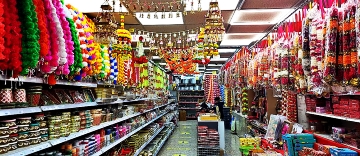
Apart from Popat, there are shops selling clothes for everyday use and weddings, jewellery shops, vast fruit and vegetable stores, other shops selling ingredients for south Asian cooking, and shops selling freshly made snacks, which most Gujaratis love. This part of Ealing Road is an ‘outpost’ of Gujarat that is frequently beneath a dismal grey sky. Despite the bad weather, the crowd of shoppers, mostly speaking Gujarati, is good humoured, as are those who serve in the shops. Visiting Ealing Road provides a taste of India without needing to purchase an air ticket. Having said that and having visited Gujarat many times, I felt that the Gujarati section of Ealing Road was even livelier than many places in Gujarat itself.
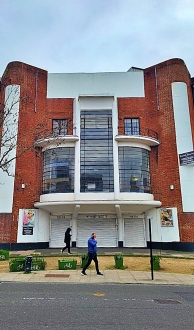
THERE ARE MANY places in the world that I have never visited. Until today (7 March 2026), one of them was Kilburn Park Underground station. I have passed it many times, but never entered it. Served by trains on the Bakerloo Line, it was opened in January 1915.
The station’s exterior, the building on the surface, is covered with terracotta tiles, the colour of dried blood. It was designed by Stanley A. Heaps (1880–1962), an English architect who designed several other Underground stations. In 1908, he became the architect for the Underground Electric Railways Company of London. The station was one of the first in London designed for escalators rather than lifts.
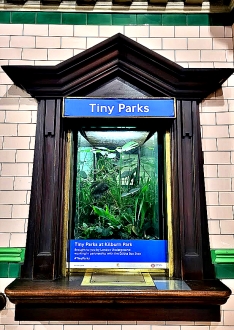
The platforms are within the kind cylindrical space which gave rise to the use of the word ‘Tube’ when referring to the Underground railway system. There is a pair of escalators linking the subterranean station with the ticket hall on the surface. Above the middle of the escalator shaft, an oval skylight admits daylight. Within the ticket hall, a surprise awaits the traveller. What used to be the ticket windows have been covered with glass. Behind the glass of each window, plants are growing, and above each of the three ticket windows, there is a sign that reads “Tiny Parks”. And below each window, there is a notice that reads:
“Tiny Parks at Kilburn Park. Brought to you by London Underground working in partnership with the Edible Bus Stop. #TinyParks”
The Edible Bus Stop’s website explained:
“The Edible Bus Stop® is an award-winning spatial design studio specialising in creating accessible and interactive green spaces and multi-sensory experiences.”
The Edible Bus Stop was asked to transform disused Underground ticket offices into “green and engaging spaces”. The project began in 2016, and to date they have planted within the ticket offices not only of Kilburn Park, but also St James Park, Belsize Park, and Wood Green. Interestingly, but possibly coincidentally, each of these stations has a name that suggests greenery.
Emerging from Kilburn Park’s ticket hall is less exciting than being within it. The area around the station is hardly likely to become a destination for tourists in the foreseeable future.
WORKS BY COLOMBIAN artist Beatriz Gonzalez (1932-2026) are being exhibited at London’s Barbican art gallery until 10 May 2026. She began studying architecture in the 1950s, but dropped out. Later, she studied fine arts at the University of Los Andes in Bogota, graduating in 1962.
Over the years, Gonzalez produced a wide variety of works, and throughout her life she believed that (to quote her): “Art says things that history cannot”, and what one can see in the exhibition confirms this. She lived through troubled times in Colombia, and this is reflected in many of her artworks. She has been described as a ‘pop artist’ possibly because many of her works were inspired by things she saw in magazines, newspapers, posters, and other media aimed at the public. However, she discounted this description, as can be seen by this answer to the question “Did you ever consider yourself (now or in the past) a pop artist?” during an interview she gave at the Tate Gallery in 2015:
“No, I considered my work a provincial type of painting. I’ve always considered myself more of a painter and within this remit I painted the joy of the underdeveloped. For me the type of art that I was doing could only circulate internationally as a curiosity. Mine was a provincial type of art without horizons, confronting the everyday: art is international.”
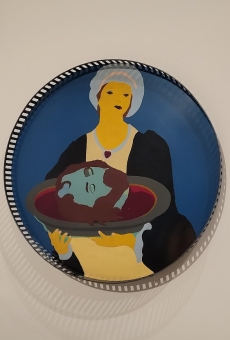
I will not attempt to discuss all the works on display at the Barbican, but will confine myself to her paintings on items of furniture, which she commenced in the 1970s. These beautifully executed creations are often quite witty. “The Last Supper” was one of the first of these pieces of furniture repurposed as a work of art. It consists of a fine table on the top of which the artist has painted a simplified version of a renaissance depiction of the Last Supper. And on a wooden coat stand, the mirror has been painted over with Gonzalez’s simplified version of the famous Mona Lisa painting. Another example is a straw basket with a ribbon on its handle. On the inside of the base of this everyday object she has painted a picture of three puppies resting on a floor. There is also a metal cot whose base is painted with a picture of a sleeping child. In the show, there are some televisions with paintings of people covering their screens. By now, you must be getting the idea of this aspect of Gonzalez’s art. My favourite example of this re-use of household items as places to paint pictures is a circular tray on which the artist has depicted Salome carrying the severed head of St John the Baptist on a circular tray.
Apart from the painted furniture and domestic items, the exhibition has a series of sections that show examples of Gonzalez’s art at the various stages in her artistic career. As is often the case at the Barbican art gallery, the artworks are beautifully displayed and well labelled.



 yamey
yamey 