Bringing India to Queen Victoria in England

OSBORNE HOUSE ON the Isle of Wight was one of Queen Victoria’s favourite residences. Apart from one room within it, I was not overly impressed by the place. That room, which alone is a very good reason to visit Osborne, is the ornate Durbar Room. Entering this vast hall is like stepping inside an exuberantly decorated Maharajah’s palace somewhere in India. It is a superb example of the Indo-Saracenic style, which is according to one definition (on Wikipedia) was:

“… a revivalist architectural style mostly used by British architects in India in the later 19th century, especially in public and government buildings in the British Raj, and the palaces of rulers of the princely states. It drew stylistic and decorative elements from native Indo-Islamic architecture, especially Mughal architecture, which the British regarded as the classic Indian style, and, less often, from Hindu temple architecture.”
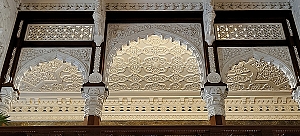
The Durbar Room was built not in India but in the country that ruled it at the time. It was designed not by a British architect but by a man from British India – Ram Singh (1858-1916), who was born in Rasulpur in the Punjab (now a village in Pakistan). His skills were recognised at a young age when he was seen working in a woodcarver’s shop in Amritsar. The man who spotted his talent was Rudyard Kipling’s father, the art teacher Lockwood Kipling (1837-1911). At the time, Lockwood was the first principal of the Mayo School of Industrial Arts, Lahore (established in 1875). He enrolled Ram as a student. Ram Singh was a successful student and soon became assistant drawing master at the school and Lockwood’s protégé. The two men collaborated in many important projects including designing Aitchison College in Lahore, the Mayo School in Lahore, and both the Indian Passage and ballroom at Bagshot Park (near Windsor). The work he had done in England led to him and Lockwood Kipling being given the commission to design the Durbar Room at Osborne.

The Durbar Room was designed to accommodate large ceremonial occasions and to reflect Queen Victoria’s exalted position as Empress of India, a role created by the British Parliament in 1876. This room, completed in 1891 as an extension of Osborne House, with its riotous array of mainly Mughal-style plasterwork decorations might have served yet another purpose. By the time it was completed, Victoria had never visited India, and at the age of over 70 years was unlikely to do so (and never did). In a way, the Durbar Room brought India to Victoria, and judging by its appearance, did so very well.
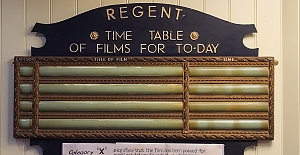
Regent: a cinema regenerated in a small town in Dorset

OVER THE YEARS, many cinemas that were opened in the first half of the 20th century have either been closed or converted to be used for other purposes. A substantial number of them were built in the Art Deco style, which flourished in the 1920s and ‘30s. Some cinemas, such as the Ionic and the ABC in Golders Green and the Odeon in Temple Fortune, have been demolished. Others became bingo halls or meeting places for religious groups. The Coronet in Notting Hill Gate began life as a theatre, then became a cinema, and is now a theatre again. During a recent visit to Christchurch in Dorset, I saw a cinema, designed in the Art Deco style, which is still in business.

The Regent Cinema stands on Christchurch’s High Street. It is in pristine condition – a fine example of Art Deco architecture and internal design – it looks as if it has been built recently. Opened on Boxing Day 1931, it continued showing films until it closed in July 1973. After that, like so many other cinemas, it was operated by the Mecca company as a bingo hall and social club. This functioned until it closed in 1982. Late that year, the building was purchased by Christchurch Borough Council.

The local authority together with over 100 volunteers restored the Regent to its original Art Deco glory. In June 1983, the Regent Centre with its cinema were opened for use. Since then, the restoration of the cinema has continued and technological improvements have been made (e.g., digital cinema has been introduced). Very recently (in 2021) further work has been done to recreate the original cinema (e.g., the cinema’s seats, carpet and colour schemes, have been restored to their original appearance, and 35 mm projection has returned). Given all this loving care the cinema has received, it is no wonder that it looks like new. Now, it is mainly run by keen volunteers.  It is very heartening to discover a cinema that has survived closure and repurposing and lived to return to being used for the purpose it was originally designed. On the Sunday morning that we visited it, we were unable to enter the auditorium because it was filled with children enjoying the screening of a film. However, the ticket office contains a good set of photographs of the restored cinema’s interior.

Shelley died abroad and is remembered in Dorset

THE PRIORY CHURCH in Christchurch (Dorset) is all that remains intact of the Priory of the Holy Trinity, one of many monastic institutions dissolved by King Henry VIII. The king allowed the cathedral-like priory church to be preserved and used as Christchurch’s parish church. The rest of the priory was demolished. The church’s construction began in the Norman era, the nave being completed by about 1150. The church contains many fine Norman architectural and decorative features. On the north wall at the west end of the building, at the bottom of the square bell tower, there is a 19th century monument that commemorates one of England’s great poets and his equally famous wife, a novelist.

In 1816, the poet Percy Bysshe Shelley (1792-1822) married the novelist, author of “Frankenstein”, Mary Wollstonecraft Shelley (1797-1851). Six years later, Percy was in Italy, where he met Leigh Hunt and Lord Byron to discuss establishing a new journal to be called ‘The Liberal’. During this trip, Shelley died at sea (on the 1st of July 1822). His body was washed up near Viareggio ten day later. It was cremated on the beach. However, his heart resisted burning (possibly because it was highly calcified due to a tubercular infection). His ashes were buried in the Protestant Cemetery in Rome, and his heart was eventually buried either at St Peters Church in Bournemouth or at the Priory Church in Christchurch, Mary, Percy’s wife, died in her home in London’s Chester Square, but was buried at St Peter’s Church in Bournemouth, which was near her seaside home at Boscombe (now part of Bournemouth).

The monument to Percy and Mary in the Priory Church was sculpted in white marble by Henry Weekes (1807-1877) in 1853-54. It was erected by Percy and Mary’s son, who lived at Boscombe. The memorial:

“… shows Mary Wollstenecraft Shelley mourning over the body of her husband who drowned off the coast of Italy in 1822.” (https://victorianweb.org/sculpture/weekes/8.html).

After attending Sung Eucharist one Sunday morning in October (2022), we asked the cleric why the monument was in the Priory Church. He was not entirely sure of the reason, but suggested that at the time when the memorial was put up, Bournemouth was far smaller than its older neighbour Christchurch. He explained that before the arrival of the railway in 1870, Bournemouth was a smallish place, a village, and that Christchurch was a far larger and more important place, a town, in the area. Whatever the explanation, it was interesting to discover this monument to Shelley during our visit to the beautiful, venerable Priory Church.

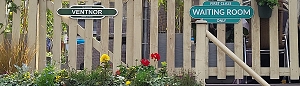
Vanished from Ventnor

THERE WAS A TIME when one could take a train from London to Portsmouth, cross the Solent by ferry to Ryde on the Isle of Wight, and then take another train from Ryde to Ventnor. This was before 1966 when the station at Ventnor was closed forever. A century earlier, in 1866, this station opened to rail traffic. The closure was part of an extensive plan (devised by Dr Richard Beeching [1913-1985]) to reduce Britain’s railway mileage.

The station, the southern terminus of the isle of Wight Railway, with its associated sidings was located on the site of an old quarry. It was almost completely surrounded by high cliffs. Trains reached it from Shanklin by emerging from a 1312-yard-long tunnel running beneath St Boniface Down. It must have been dramatic emerging from the tunnel to find oneself in the space surrounded by vertiginous rocky walls.

Today, the entrance to the tunnel, through which water pipes now run, is hidden by dense foliage. Nothing remains of the tracks, and only a small part of the former station building (ticket office etc.) remains. The space once occupied by the platforms and railway lines is now occupied by an assortment of buildings, comprising an industrial estate.  Trains still run between Ryde and Shanklin, but Ventnor station has all but vanished.

A gnomon on the esplanade

FOR THOSE WHO DO NOT know, a gnomon is the part of a sundial that casts a shadow.

The gnomon on the Esplanade at Ventnor

In 1851, Sir Thomas Brisbane (1773-1860), who gave his name to a city in Australia, donated a tall gnomon to the town of Ventnor on the Isle of Wight. In sunny conditions, this object casts a shadow on a line marked on the pavement at noon GMT (1 pm BST). Sir Thomas had spent some time in Ventnor during the mid-19th century, and sadly his daughter Eleanor Australia MakDougall Brisbane died in Ventnor in 1852 at the young age of 29.

As we are discovering during our visit to the Isle of Wight, the sun does not always shine in Ventnor (or anywhere else on the island). Recognising this problem that renders the gnomon useless when the sun is not shining, the town erected a short clock tower near to the gnomon in 1870. This clock was rebuilt in 2001. It bears a plaque commemorating Fred Blake (1924-2001), who, along with his father (Adolphus) and grandfather (James), were: “… proud to maintain this barometer for over 120 years”.

We did not see the gnomon working because of cloudy weather conditions, and the two faces of the clocks displayed different times and neither of them appeared to be working. The barometer seemed to be working. It is curious features such as the gnomon that help make towns on the English coast endlessly fascinating.

Transported back to childhood on the Isle of Wight

IN THE EARLY 1970s, I used to travel on the London Underground’s line from Golders Green to Euston or Warren Street, both stations being near University College London, where I was a student. Back in those days, smoking was permitted on the Underground. Each Northern line tube train had two carriages for smokers. I have never smoked, but I used to travel in the smokers’ carriages because they were usually emptier than the other ones in which smoking was forbidden. Thinking back on this, I suppose that I must have been passively smoking on the Underground. On the other hand, because there were fewer people in the smoking carriages, my chances of catching other people’s airborne germs must have been reduced.

From an early age, before I became a daily commuter, I liked travelling in the rear carriages of the Northern Line tubes. These carriages contained control panels, which the train’s guards operated to open and close the doors and to inform the driver when the train was ready to leave. As a child, I was fascinated by watching the guard at work. Actually, there was little else to watch after the tube entered the tunnel after leaving Golders Green. Incidentally, what was the rear carriage, was also the front carriage when the train changed direction on reaching the end of a line.

The Northern Line trains I have been describing were built by Metro-Cammell in 1938. By the end of the 1980s, the trains were taken out of service and newer units began operating on the Northern Line. The 1938 trains were shipped out to the Isle of Wight, where they carried passengers on the Island Line. After many years of service on the island, the sea air caused these venerable trains to corrode and deteriorate. In the early years of the 21st century, they were taken out of service.

In late October 2022, we visited the train museum at Havenstreet on the Isle of Wight. One of the exhibits is a collection of old train carriages and engines in a large shed. Amongst these exhibits is one of the former Northern Line carriages built in 1938. Visitors are permitted to enter it. I was delighted to find that the example on display was one of the rear carriages containing the guard’s control panels. Seeing these again after so many years was a curiously moving experience. I felt for a moment that I had been transported back to my childhood days, when travelling in these trains used to fill me with wonder.

A marriage recorded on stained glass

THE GREAT HALL of Lytes Cary Manor House in Somerset has some stained glass windows decorated with crests relating to the Lyte family, who owned the property between the 15th and 18th centuries. One of the crests caught my eye because the crest contains a double-headed eagle. This is a symbol that began to interest me in my teens when I first became fascinated by the Balkans. The double-headed eagle figures on the flags of Albania and some of its neighbours. The earliest known use of this peculiar creature is on seals used to secure goods in Babylon during the 3rd century BC.

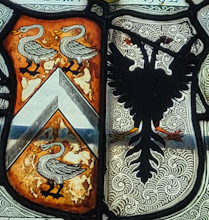
The crest at Lytes Cary Manor is a combination of the Lyte family crest and that of the Worth family, which incorporates the two headed bird.

In 1592, Thomas Lyte (c1568-1638) married Frances Worth (1580-1615) who was born in Charlton Mackrell in Somerset. Thus, the double-headed eagle of the Worth family became joined with the three swans of the Lyte family crest. This marriage which was celebrated so long ago, is recorded in glass on a window of the Great Hall at Lytes Cary.

Why the Worths employed the double-headed eagle on their crest is something I would like to know, and will investigate. The double-headed eagle appears on British crests less frequently than other heraldic creatures. Possibly, andI am only guessing, it relates to the fact that a son of King John, Richard, Duke of Cornwall (1209-1272) was appointed King of The Germans, that was a senior position in the Holy Roman Empire. The symbol of that empire was the double-headed eagle.

A polo player in India and Somerset

LYTES CARY is a mediaeval manor in the English county of Somerset. This beautiful building, maintained by the National Trust, was owned by the Lyte family since the 15th century, if not earlier. The Great Hall of the manor house was built in the 1460s. The manor remained in the Lyte family until 1755, when the indebted Thomas Lyte IV surrendered all rights to their family home. Between then and 1907, the property fell into decay.

In 1907, the dilapidated Lytes Cary was purchased by Sir Walter Jenner (1860-1948) and his wife Flora, who died in 1920. They lived with their daughter Esme (1898-1932), a keen horse rider, who died of pneumonia after having been drenched in a rainstorm. Sir Walter was the son of Queen Victoria’s physician, Sir William Jenner (1815-1898), who studied at my alma mater University College in London. At his death, he left a great fortune.

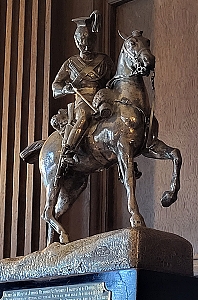
Polo trophy

Sir Walter had the house repaired and filled it with furniture and objets d’art appropriate to the age of the house. The result was a comfortable home with fascinating contents. One of the many objects that caught my eye is a trophy depicting a military man on a horse. This item bears an engraved plate:

“Major Sir Walter Jenner Bt, from Lt Colonel Forrester Colvin 1915 to commemorate joining the Ninth Lancers together December 1880. The many happy years spent therein and the following polo tournaments won by the regiment…”

Below this, there is a long list of tournaments played in India, England, Wales, and Ireland. In India, he was in the winning teams in Umballa (Ambala) in 1883 and 1884, and in Meerut in 1885. The latest tournament listed on the trophy was in Dublin in 1893.

Educated at Charterhouse School, Sir Walter became a magistrate in Somerset after retiring from the Ninth Lancers. He served in his regiment during WW1 and was awarded the DSO for his services in that conflict.

I enjoy visiting old houses like Lytes Cary and always find it interesting when I discover links between them and the history of India. Sir Walter’s polo trophy is not one of the most attractive pieces on display at Lytes Cary, but for me it was most fascinating.

Coloured cliffs and the Needles rocks

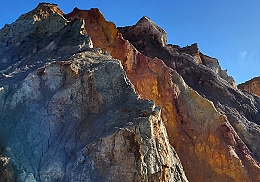
NEAR THE WESTERNMOST point on the Isle of Wight, lies Alum Bay. From its pebble beach, the Needles rock formation with their light house can easily be seen. Turn your back on the Needles and you will see that the bay and its beach have a backdrop of folded cliffs. These are not any old cliffs. They are multi-coloured.

The colouration of the cliffs is caused by the presence of oxidised iron compounds formed under different conditions.

The beach from which the coloured cliffs can be seen can be reached two ways. Either by foot, using a series of staircases, or by travelling on a spectacular set of chairs suspended from cables: a sort of funicular. I recommend descending by foot to enjoy the views at leisure and returning using the chair lift. However, descending on the latter is also said to be an exciting experience.

A quaint market shelter

Inside the Buttercross

THERE IS AN OLD octagonal building in the market place of Somerton in Somerset. According to a website about the town, this building is:

“… the octagonal shaped market cross; also known as the Buttercross. This was built by the Stawell family in 1673 and given the parish council in 1916 … The market place was a busy and noisy area during market day, and in extremely hot weather the dairy products such as cheese, butter and milk would soon go off. These goods would also be ruined in wet weather, and so a shelter was required that would shade and cover the products from the weather conditions. The Buttercross was the ideal solution, as it was both cool and dry. It is now listed as a Grade II ancient monument, and has been repaired on a couple of occasions during the last century.” (from: http://www.somerton.co.uk/virtual-tour/market-cross/)

It is not the only octagonal structure in Somerton. The tower of the mediaeval parish church is also octagonal.