
THE GERMAN AUTHOR Rudolf Ditzen (1893-1947) is better known by his nom-de-plume Hans Fallada. Readers of English translations of his novels are most familiar with his book “Alone in Berlin” (known as “Every Man Dies Alone” in the USA). This excellent story has been made into a film.
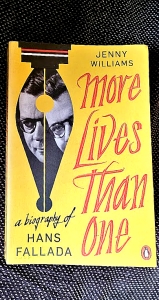
In most of his novels, Ditzen’s characters portray the trials and tribulations of the ‘little man’ as he tries to struggle within the often-challenging conditions that prevailed in Germany before WW1 and between that war and the end of WW2. How Ditzen achieved the portrayal of ordinary people’s lives in the first half of the twentieth century is brilliantly described in “More Lives than One” by Jenny Williams (published in 1998). Her well-documented, highly researched biography of Ditzen reads like a good novel.
Ditzen’s frequently difficult life was itself the stuff of novels, and he made much use of his own experiences and those of others in the many stories he wrote. Jenny Williams describes in engaging detail the author’s struggles with women, drugs, alcohol, imprisonment, psychiatric disorders, publishers, and the Nazi regime. Not political animal, Ditzen was keen to promote common decency in Germany. This became an increasingly difficult aim after the end of WW1, and especially during the years when Germany was under the dictatorial rule of Adolf Hitler.
Unlike many fellow authors in Germany, Ditzen decided not to emigrate as conditions became increasingly difficult in Hitler’s Germany. He continued writing prolifically after Hitler came to power, but as the years rolled on, finding publishers became difficult, and for a while Ditzen had to moderate what he wrote to keep out of trouble, In describing the author’s life during the awful times many experienced in Germany between 1932 and 1945, Jenny Williams gives the reader a fascinating view of what it was like living during that period.
At the end of WW2, Ditzen was found to be ‘acceptable’ as a cultural figure in Germany. Without having collaborated with the Nazis (apart from reluctantly editing some of his writing to please censors), he was considered reliable in the Soviet occupied part of Germany, and was for a short while chosen to be the mayor of a small town, a job he hated. The Soveiet controlled German authorities provided Ditzen with a Gestapo file, and encouraged him to write a nove based on what it contained. The result was his final novel, “Alone in Berlin”.
Even if you have never read anything by Ditzen/Fallada, “More Lives than One” makes for fascinating reading. Primarily a biography of Rudolf Ditzen, it is also an intriguing view of conditions in Germany.

